Jack and Noah Melton were hospitalized for weeks at Texas Children’s Hospital.

News 3 talked to the boys’ parents Friday about a very frightening experience that turned out for the better.

But Jack and 2-year-old Noah Melton haven’t fully recovered from what happened last April 16th when the family went for a meal at Coco Loco Mexican Restaurant on George Bush Drive in College Station.

After an investigation the Brazos County Health Department determined the boys and their parents had eaten ground beef contaminated with E. coli from the restaurant.

10 people were believed to be infected.

Not sure who Kirstie Foster is, but they should make her CEO of General Mills IMHO.  Here is what she said:

As has been widely reported, General Mills recently posted a revised set of Legal Terms on our websites. Those terms – and our intentions – were widely misread, causing concern among consumers.

So we’ve listened – and we’re changing them back to what they were before.

We rarely have disputes with consumers – and arbitration would have simply streamlined how complaints are handled. Many companies do the same, and we felt it would be helpful.

But consumers didn’t like it.

So we’ve reverted back to our prior terms. There’s no mention of arbitration, and the arbitration provisions we had posted were never enforced. Nor will they be. We stipulate for all purposes that our recent Legal Terms have been terminated, that the arbitration provisions are void, and that they are not, and never have been, of any legal effect.

That last bit is from our lawyers.

We’ll just add that we never imagined this reaction. Similar terms are common in all sorts of consumer contracts, and arbitration clauses don’t cause anyone to waive a valid legal claim. They only specify a cost-effective means of resolving such matters. At no time was anyone ever precluded from suing us by purchasing one of our products at a store or liking one of our Facebook pages. That was either a mischaracterization – or just very misunderstood.

Not that any of that matters now.

On behalf of our company and our brands, we would also like to apologize. We’re sorry we even started down this path. And we do hope you’ll accept our apology. We also hope that you’ll continue to download product coupons, talk to us on social media, or look for recipes on our websites.

Our legal terms? You’ll find them right on our website. You’ll also find they’re back to what they always were.

General Mills – “good on ya.”

When Stephanie Strom of The New York Times wrote “When ‘Liking’ a Brand Online Voids the Right to Sue,”it caught my attention. At first I thought General Mills could not be serious about trying to deny its customers the right to their day in court if wronged by a General Mills product. I mean, why would a company focus on saving itself from a potentially bad outcome when it should be focused on making foods that are healthful, safe and honestly labeled?

And, it seemed at first blush the so-called “Arbitration Clause” had the limited application to using the General Mills website. The policy reads:

These terms are a binding legal agreement (“Agreement”) between you and General Mills. In exchange for the benefits, discounts, content, features, services, or other offerings that you receive or have access to by using our websites, joining our sites as a member, joining our online community, subscribing to our email newsletters, downloading or printing a digital coupon, entering a sweepstakes or contest, redeeming a promotional offer, or otherwise participating in any other General Mills offering, you are agreeing to these terms.

I thought the arbitration clause certainly would not also involve a situation where a General Mills product sickened or killed a consumer with a foodborne pathogen. But, a bit further down the policy, the desire of General Mills becomes much clearer – it wants to deny its consumers the rights of a civil jury trial even in situations resulting in personal injury or death. The policy continues:

3.  Dispute resolution; binding arbitration

This Section 3 is intended to be interpreted broadly to encompass all disputes or claims arising out of this Agreement or your purchase or use of any General Mills product or service for personal or household use. As noted above, “General Mills” includes any and all of General Mills’ affiliated companies or brands. These affiliated brands include, but are not limited to, Betty Crocker, Pillsbury, Green Giant, Yoplait, Nature Valley, Old El Paso, Progresso, Hamburger Helper, Toaster Strudel, Gold Medal, Bisquick, Totino’s, Cheerios, Cinnamon Toast Crunch, Lucky Charms, Kix, Trix, Cocoa Puffs, Total, Wheaties, Fiber One, Chex, other General Mills Big G cereals, Box Tops For Education, and all other brands listed here: http://generalmills.com/Legal_Notice_Brands.aspx

ANY DISPUTE OR CLAIM MADE BY YOU AGAINST GENERAL MILLS ARISING OUT OF OR RELATING TO THIS AGREEMENT OR YOUR PURCHASE OR USE OF ANY GENERAL MILLS SERVICE OR PRODUCT (INCLUDING GENERAL MILLS PRODUCTS PURCHASED AT ONLINE OR PHYSICAL STORES FOR PERSONAL OR HOUSEHOLD USE) REGARDLESS OF WHETHER SUCH DISPUTE OR CLAIM IS BASED IN CONTRACT, TORT, STATUTE, FRAUD, MISREPRESENTATION, OR ANY OTHER LEGAL THEORY (TOGETHER, A “DISPUTE”) WILL BE RESOLVED BY INFORMAL NEGOTIATIONS OR THROUGH BINDING ARBITRATION, AS DESCRIBED BELOW.

Well, it seems pretty clear that General Mills is intent on having consumers – even those who may have suffered a serious injury – seek redress only in a forum of General Mills’ choosing. Do not think for a second that this in any way benefits a sickened consumer. By adopting this policy, General Mills has clearly decided to focus on saving itself from litigation and not focus on what keeps it out of a courtroom, namely focusing on making foods that are healthful, safe and honestly labeled. If General Mills would focus on those three things, the likelihood of spending time in a courtroom would be of far less concern to it and much better for its consumers.

MMWR reported the 2013 FoodNet data today and it was a bit depressing.

FoodNet conducts active, population-based surveillance for laboratory-confirmed infections caused by Campylobacter, Cryptosporidium, Cyclospora, Listeria, Salmonella, Shiga toxin–producing Escherichia coli (STEC) O157 and non-O157, Shigella, Vibrio, and Yersinia in 10 sites covering approximately 15% of the U.S. population.  For information on those bugs, see www.foodborneillness.com.

In 2013, FoodNet identified 19,056 cases of infection, 4,200 hospitalizations, and 80 deaths.  The number and incidence per 100,000 population were Salmonella (7,277 [15.19]), Campylobacter (6,621 [13.82]), Shigella (2,309 [4.82]), Cryptosporidium (1,186 [2.48]), STEC non-O157 (561 [1.17]), STEC O157 (552 [1.15]), Vibrio (242 [0.51]), Yersinia (171 [0.36]), Listeria (123 [0.26]), and Cyclospora (14 [0.03]). Incidence was highest among persons aged ≥65 years for Cyclospora, Listeria, and Vibrio and among children aged <5 years for all the other pathogens.

Compared with 2010–2012, the 2013 incidence was significantly lower for Salmonella (9% decrease; CI = 3%–15%), higher for Vibrio (32% increase; CI = 8%–61%) and not significantly changed for other pathogens.  Compared with 2006–2008, the 2013 incidence was significantly higher for Campylobacter and Vibrio.  The overall incidence of infection with six key foodborne pathogens was not significantly different in 2013 compared with 2010–2012 or 2006–2008.

The incidence of laboratory-confirmed Salmonella infections was lower in 2013 than 2010–2012, whereas the incidence of Vibrio infections increased. No changes were observed for infection with Campylobacter, Listeria, STEC O157, or Yersinia.

The email in my inbox this morning enclosing a questionnaire asking about the possible link between foodborne illnesses and last weeks Food Safety Summit was tempting enough.  The dozens of emails from attendees from around the world that followed made the irony complete – a potential foodborne illness outbreak at the Food Safety Summit – too bad to let alone.  I posted the email in full and questionnaire link without thinking about the negative impact on the investigation by perhaps having people log into the survey who had not been attendees of the Food Safety Summit and thereby compromising the investigation.

For that I am truly sorry.

This just landed in my inbox:

Dear Food Safety Summit Attendee,

The Baltimore City Health Department and the Maryland Department of Health and Mental Hygiene, Division of Outbreak Investigation are investigating illnesses among people who were at the Baltimore Convention Center from April 8-10, 2014.  We have not yet determined how people became ill, and we want your help to do so, even if you did not get sick.

Please assist us by answering some questions regarding your time at the convention, whether or not you became ill.   We anticipate that this may take about 15 minutes to complete, but your full participation is critical to determining how people have become ill.

The on-line survey is available at the following link: https://www.surveymonkey.com/s/conventionoutbreak

Again, PLEASE COMPLETE THE SURVEY EVEN IF YOU DID NOT HAVE ANY SYMPTOMS, as we also need to hear from those who are not ill to investigate this situation. If you have any questions about the survey or would like to answer the questions by phone interview, please contact the Division of Outbreak Investigation at 410-767-6700.

Thank you,

Division of Outbreak Investigation
Office of Infectious Disease Epidemiology and Outbreak Response
Maryland Department of Health and Mental Hygiene

201 W. Preston Street
Baltimore, Maryland 21201
Emily Luckman, MPH, BSN
Epidemiologist
Division of Outbreak Investigation
Maryland Department of Health & Mental Hygiene
201 West Preston Street, 3rd Floor
Baltimore, MD 21201

email: Emily.Luckman@maryland.gov
fax:  410-669-4215

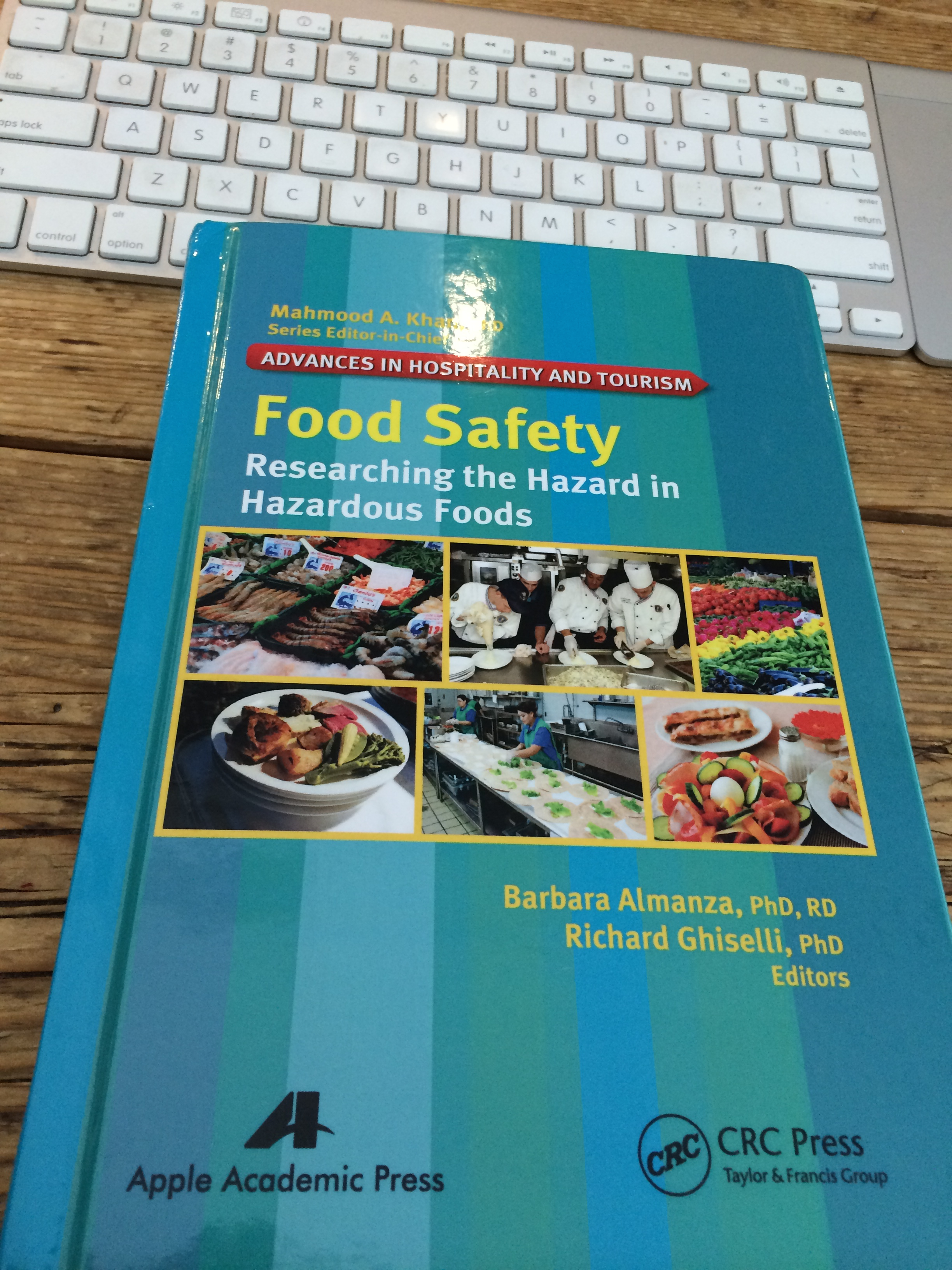
The book I was asked to do a Preface for arrived while I was in Baltimore at this year’s Food Safety Summit.  You can buy the hardcover on Amazon.

The book provides a thorough review of current food safety and sanitation information with practical applications of current research findings included. The book surveys and examines the prevailing research and applications and reviews specific operational issues such as power or water emergencies. It also covers food safety and sanitation in various environments, such as restaurants, schools, and fairs and festivals. It is multidisciplinary in that it comprises culinary, hospitality, microbiology, and operations analysis.

Topics include:

  • Importance of food safety in restaurants
  • History of food safety regulation in restaurants
  • Microbiological issues
  • What happens during a restaurant food safety inspection
  • Legislative process, regulatory trends, and associations
  • Legal issues for food safety
  • Differences in the food safety perception of consumers, regulatory officials, and employees
  • What restaurants should do during power or water emergencies
  • Front of the house sanitation and consumers’ perceptions of food safety
  • Social media and food safety risk communication
  • Food safety in farmers’ markets
  • Food safety at fairs and festivals
You could also stop by the office and borrow mine after I finish reading it.

The Pueblo Chieftain reported Saturday that state Senator Larry Crowder, R-Alamosa, had entered the “juicy fruit argument” at the State Capitol.

Apparently, Colorado lawmakers are pushing a bill that would name the Palisade peach as Colorado’s official state fruit, but Crowder said that he would attempt to add Rocky Ford cantaloupe into HB1304, which was introduced in the House by Rep. Angela Williams, R-Denver.

Clearly a well-read person, Crowder told the Chieftain that in researching the Rocky Ford cantaloupe and Palisade peach, he has found that they have a very comparable history in the state.  Hmm, I must have missed where the Colorado Department of Health and the Centers for Disease Control and Prevention had linked peaches to 147 ill with 33 dead from Listeria, but perhaps I missed something?

Crowder also told the Chieftain:  “Where is it written where you can’t have two state fruits?”  My guess is that it is written in the same place that Crowder looked when he ignored Colorado cantaloupe’s recent history of killing people.

I did notice that Colorado does not have a state nut.  I nominate state Senator Larry Crowder.


Barry Estabrook wrote for OnEarth and Reader’s Digest Magazines: The Dangers in Our Food Supply Are Worse Than You Think

As Barry correctly points out – Foodborne illnesses are escalating in the United States, and it’s not because of a few unwashed spinach leaves. Foul conditions, lax regulations, and too few inspectors are threatening our safety.

But, what got my 86-year-old mom’s attention was this:

If there is an enforcement arm for food safety in the United States, it’s trial lawyers like Marler, an intense workaholic who estimates that his firm, Marler Clark, has won more than $600 million for clients since he filed his first lawsuits in the early 1990s. As he sees it, the FDA is being slowly starved of the resources and manpower required to fulfill its mandate. In the 1970s, the agency conducted 35,000 inspections of food-processing plants each year. Today, it inspects fewer than 8,000, although the number of facilities under its jurisdiction has skyrocketed.

Well, it is Sunday – off to work.

A confirmed case of acute Hepatitis A has been identified in a food handler at the La Fontana restaurant in Nyack. Patrons and other employees may have been exposed to Hepatitis A virus between March 19 and April 1, 2014.

The Health Department will offer free Hepatitis A vaccine to restaurant patrons and employees starting Saturday, April 12 from 11 am – 5 pm, Sunday, April 13 from 11 am to 3 pm and Monday, April 14 from 9 am to 12 pm at the Rockland County Fire Training Center, 35 Firemen’s Memorial Dr. in Pomona.

The Rockland County Department of Health is recommending that all people who ate at the restaurant on March 29, March 30 and April 1, 2014 receive Hepatitis A vaccine. Patrons who ate at the restaurant between March 19 and March 28 will not benefit from vaccination. In order for the vaccine to be most effective, people who have been exposed to Hepatitis A should be vaccinated within 14 days. The earlier the vaccine is given, the more effective it is in preventing the disease. In general, the vaccine is 80% to 90% effective.

Restaurant patrons may also receive vaccine at their medical provider’s office. People who were exposed but have already received two doses of Hepatitis A vaccine sometime in their life do not need another shot; all others should be vaccinated.

Hepatitis A is a liver disease caused by a virus. It is spread from person to person by putting something in the mouth (even though it might look clean) that has been contaminated with traces of fecal matter from an infected person. Most people recover within a few weeks with bed rest and by avoiding alcoholic beverages.