

Clover Hill Dairy Requesón / Soft Ricotta — What the Outbreak Numbers Are Really Telling Us
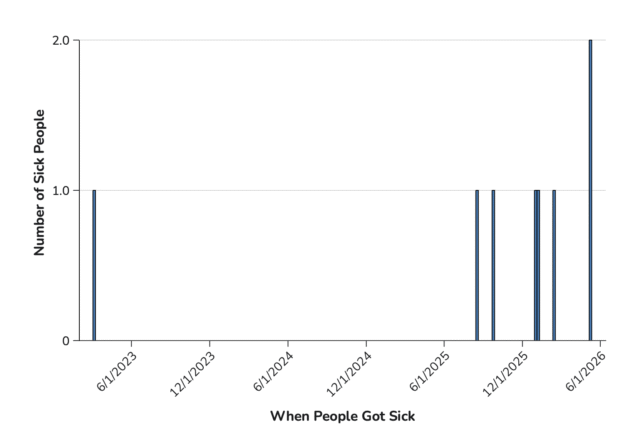
One death, seven hospitalizations out of eight known illnesses, and a contaminated strain that genetic fingerprinting ties back to 2023.
Let me say that again, because it deserves to be said plainly. Nearly nine in ten of the people we know about ended up in a hospital bed. One of them did not survive. And the bacteria that did this has apparently been circulating, undetected and unaddressed, for the better part of three years.
One Death and a 7-in-8 Hospitalization Rate
As of June 4, 2026, the CDC and FDA report 8 people infected with the outbreak strain across 3 states — Maryland, New York, and Virginia — with 7 hospitalizations and 1 death. Do the math on that. An 87.5 percent hospitalization rate is not a statistic you shrug at. Most foodborne pathogens put a fraction of the people they sicken in the hospital. Listeria monocytogenes is different, and it has always been different. It is one of the deadliest bugs we deal with in this work, and these numbers show exactly why.
And remember what the CDC itself says about counts like these: the true number of sick people is almost certainly higher. It takes three to four weeks to confirm that someone is part of an outbreak, and people who recover at home are never tested at all. So, eight is the floor, not the ceiling. Behind that single reported death is a family that got the worst possible news, and behind those seven hospitalizations are people who, if they were pregnant, elderly, or immunocompromised, were fighting for their lives over a container of soft cheese.
A Strain That Whole Genome Sequencing Ties Back to 2023
Here is the part that should make everyone — regulators and the dairy alike — deeply uncomfortable. According to the FDA, the patient samples in this outbreak were collected on dates ranging from March 6, 2023 to May 9, 2026. This is being investigated as a multi-year outbreak, and that is not a casual description. Whole genome sequencing — the genetic fingerprinting that lets public health scientists say with confidence that illnesses years apart were caused by the same bacterial strain — is what links these cases together.
In plain English: the same Listeria has very likely been making people sick since the spring of 2023. When a strain persists for three years, it usually means it has found a home — a harborage point on equipment, in drains, in the production environment — and has been seeding product the whole time. That is the textbook signature of a sanitation problem that was never found or never fixed. People do not get sick for three years from a one-time slip.
How Investigators Connected the Cheese to the Cases
The break in this case came out of New York. On May 13, 2026, the Suffolk County Health Department flagged two related Listeria illnesses in the same family, who had bought food from a retailer in Brentwood, New York. State investigators confirmed both had eaten requesón cheese from that store, pulled five cheese samples, and one repacked requesón sample tested positive. Whole genome sequencing then confirmed that the Listeria in the cheese matched the strain that had sickened the two New York patients.
From there the trace-back led to the source. On May 27, 2026, New York investigators inspected the retailer’s distributor and identified Clover Hill Dairy, LLC of Mechanicsville, Maryland as the manufacturer. A sample taken from an unopened, sealed 18-pound bucket of Clover Hill requesón also tested positive for Listeria monocytogenes. On June 3, 2026, Clover Hill issued a voluntary recall of its requesón and soft ricotta products, and the Maryland Department of Health suspended the company’s operating license and issued a consumer advisory.
I want to be fair about where the investigation stands. The FDA is candid that this is early, that additional products may be involved, and that — in its words — there is not yet enough evidence to determine whether the recalled cheese explains the entire outbreak. Of seven people interviewed, five reported eating cheese and two specifically named Clover Hill requesón. That is an investigation still being built. But a sealed bucket of this company’s product testing positive for the pathogen is about as direct a piece of physical evidence as you will find this early in a case.
What the Recall Covers
The recall covers all requesón cheese manufactured by Clover Hill Dairy, and people should know a few things about how to spot it:
- Some varieties carry jalapeño or other flavors.
- The product may be relabeled under a different brand when it is distributed, so the manufacturer information on the package is what matters.
- The label should show the Clover Hill Dairy manufacturer permit (plant) number “24-128.”
- It was sold from Clover Hill’s own retail market in Maryland, at farmers markets, and through third-party distributors, including in New York and Virginia.
If you have this cheese, do not eat it — throw it out or return it. And because Listeria survives and even grows at refrigerator temperatures, clean and sanitize anything it touched: shelves, drawers, containers, surfaces. This is one of the few pathogens that treats your refrigerator as a comfortable place to live.
Why This One Matters
Soft, fresh, Hispanic-style cheeses — queso fresco, requesón, and their cousins — have a long and tragic history with Listeria. They sit at the dangerous intersection of high moisture, minimal processing, and a customer base that often includes pregnant women and their families. For a pregnant woman, Listeria can mean miscarriage, stillbirth, premature delivery, or a life-threatening infection in a newborn. For someone over 65 or with a weakened immune system, it routinely means hospitalization and sometimes death. The CDC’s own guidance is blunt: if you are in one of those groups, soft cheeses like these — even pasteurized ones — are a riskier choice.
None of this had to happen. That is the line I have repeated for three decades, and I will repeat it again here, because it is still true. Listeria outbreaks are preventable. The tools to find this organism in a plant — environmental monitoring, whole genome sequencing, aggressive sanitation when you get a positive — exist and are well understood. When a strain is allowed to persist for three years and it takes a death and seven hospitalizations to bring it to light, that is not bad luck. That is a failure of food safety, and the people who paid for it were the customers who trusted a label.
Sources