Thursday, February 5, 07:00 pm on KCTS 9 HD
Seattle/Yakima

Duration: 0:26:46

Description: Last summer’s Carlton Complex Fire burned 250,000 acres. EarthFix correspondent Courtney Flatt shows how ecologists are working to prevent another devastating fire. Producer Terry Murphy profiles local attorney Bill Marler’s 20-year crusade to make food safer. And producer Michael Werner takes us inside a crow’s brain to find out if these intelligent birds have feelings too.

[HD][CC]

View Additional Airings

Broadcast In: English

The Obama Administration is proposing a radical overhaul of the country’s food safety operations. Instead of having several bodies like the FDA, USDA, and FSIS, President Obama is proposing a single government agency that would oversee all food safety and inspection operations.

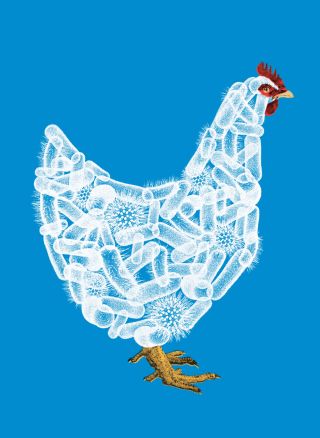
Wil S. Hylton is the author of a terrifying New Yorker article about lax food safety titled, “A Bug in the System: Why Last Night’s Chicken Made you Sick.” Food safety lawyer Bill Marler is the man leading the charge against unsafe food in Hylton’s story.

Together they weigh in on the president’s proposal and the state of food safety in America.

Published today in Fresh Fruit Portal:

Nearly 20 years ago, a growing, all organic, all raw juice company saw its sales and profits ever rising. Looking for new markets to sell its “Superfood,” it reached out to the U.S. Army to sell the juice to healthy young men and women. The Army sent a food safety group to visit the plant. In a letter to Odwalla after the plant inspection and product-testing, the Army stated that it had determined that “your plant sanitation program does not adequately assure product wholesomeness for military consumers. This lack of assurance prevents approval of your establishment as a source of supply for the Armed Forces at this time.” Hmm, if you cannot sell your juice to the Army, why would you continue to sell it to the general public, including pregnant women and children?

Just a few months after receiving the above notice from the Army, an E. coli O157:H7 outbreak linked to the company’s organic, raw apple juice sickened dozens. The outbreak caused several people to have acute kidney failure, and killed one child. The company pleaded ignorance that its product could be the cause. Eventually, the company paid out US$15,000,000 to my clients in settlements and was fined by the FDA for US$1,400,000. A tough lesson for the company on the realities of bacteriology and pasteurization; however, a deadly lesson for at least one young customer.

In early December 2014 came the announcement of a Listeria outbreak linked to caramel apples that had sickened over two dozen, sending all to the hospital. Eventually the number of outbreak victims would rise to at least thirty-two in ten states, with several dead. Given the long incubation period (up to 70 days), the illness and death toll will surely rise.

After an extensive traceback and traceforward, the grower and processor of two types of apples were implicated, which prompted an apple recall. A strain of Listeria matching that which had sickened and killed so many was found in the plant. Moreover, the recall that had initially been limited to the U.S. now spans the globe. Warnings have been issued from Malaysia and Vietnam to refrain from eating U.S. apples. There is no lack of irony in this warning, given that over the years I have watched U.S. food producers attempt to scare domestic consumers away from “foreign grown food.” The eventual cost of the worldwide recall and the consumer litigation from the apple outbreak will be in the tens of millions of dollars.

Of course the inevitable refrain has arisen, “how could we have known, this is the first Listeria outbreak linked to caramel apples. It has never happened before.” We heard the same whine following the Listeria outbreak that left 147 sick with 33 dead in 2011 linked to cantaloupe grown in Eastern Colorado. That outbreak was not only one of the deadliest in U.S. history, but I am making sure that it will also be one of the most expensive.

When I am not suing companies for poisoning and killing their customers, I am telling them a few simple concepts gleaned from the tatters of companies that cannot seem to learn from the past or pay attention to warning signs from the future. They are three simple ideas:

1. Arm yourself with good, current information – including paying attention to the past.
2. Since you have a choice between doing nothing and being proactive, be proactive.
3. Make food safety a part of everything you do.

Chances are good that if you follow the above simple principles, reading this editorial will be the very last you hear of me.

President Barack Obama’s 2015 budget wants to create a new government agency dedicated to keeping the nation’s food safe.  Now, who could disagree with that?

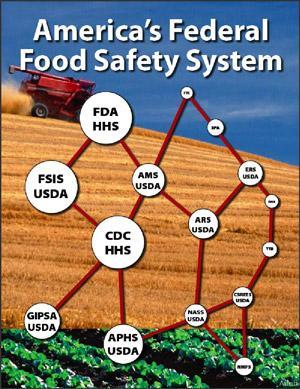
Presently, The Department of Agriculture oversees the safety and inspections of meat and processed eggs and the Food and Drug Administration oversees safety of most other foods. The split oversight is often complicated — the FDA would be responsible for the safety of a frozen cheese pizza, for example, but USDA takes over part of the duties if the pizza has meat on it.  USDA inspects meat daily as it is processed, while the FDA generally conducts inspections every few years. And, the two agencies share inspection duties at the border.

The 2015 budget proposes consolidating the Agriculture Department’s Food Safety and Inspection Service and all of FDA’s food safety oversight (plus about a dozen other agencies) into one new agency within the Department of Health and Human Services. The new agency also would coordinate with state and local health departments, a job that is now mostly handled by the Centers for Disease Control and Prevention.  The administration said the agency would be based at HHS because food safety and foodborne outbreaks are public health concerns, which are consistent with the larger mission of the department.

The budget proposes an additional $301 million for the FDA to implement that law, though part of the money would come from user fees imposed on the food industry.

Where do I apply?

I made the Daily Meal’s: America’s 50 Most Powerful People in Food for 2015

#43 Bill Marler, Foodborne Illness Lawyer and Attorney

An accomplished personal injury and products liability attorney, Marler has been litigating foodborne illness cases since 1993, when he represented Brianne Kiner, the most seriously sickened survivor of the Jack in the Box E. coli outbreak, creating a Washington State record for an individual personal injury action ($15.6 million). More than a lawyer, Marler has become an advocate for a safer food supply, petitioning the USDA to better regulate pathogenic E. coli, working with nonprofit food safety and foodborne illness victims’ organizations, and helping spur the passage of the 2010-2011 FDA Food Safety Modernization Act. He also helps keep us in the loop with his blog, which he updates on a near-daily basis.

I’m up from 47th in 2014, And, wedged between some interesting people this year:

#50 Adam Rapoport, Editor in Chief, Bon Appétit

#49 Ingrid Newkirk, President and Co-Founder, People for the Ethical Treatment of Animals

#48 José Andrés, Chef-Restaurateur

#47 Julie Packard, Executive Director and Vice-Chairman, Monterey Bay Aquarium

#46 Steve Spinner, CEO, President, and Director, United Natural Foods, Inc.

#45 Alice Waters, Chef-Restaurateur and Founder and Director, The Edible Schoolyard Project

#44 David Murdock, CEO, Dole Food Company

#43 Bill Marler, Foodborne Illness Lawyer and Attorney

#42 Bill Shore, Founder and CEO, Share Our Strength#41 Jimmy Fallon, Host, The Tonight Show

#40 Paul Grimwood, CEO and Chairman, Nestlé USA

#39 Pete Wells, Restaurant Critic, The New York Times

#38 Michel Landel, CEO, Sodexo

#37 Craig Jelinek, CEO, Costco

#36 Mario Batali and Joe Bastianich, Chef/Restaurateurs

#35 Dan Bane, Chairman and CEO, Trader Joe’s

#34 Danny Meyer, Restaurateur

#33 Steve Ells, Founder/ Co-CEO, Chairman, Chipotle Mexican Grill

#32 Mehmet Oz, Doctor, Author, and TV Host

#31 Eric J. Foss, CEO, Aramark

#30 Fred DeLuca, Co-Founder and President, Subway

#29 Ben Silbermann, Founder and CEO, Pinterest

#28 Dawn Sweeney, President and CEO, National Restaurant Association

#27 Jim McGovern, Co-Chair, House Hunger Caucus

#26 David C. Novak, Executive Chairman, Yum! Brands

#25 Yancey Strickler, Founder & CEO, Kickstarter

#24 Paul Polman, CEO, Univeler

#23 Bob Tuschman, General Manager and Senior Vice President, Food Network

#22 Rodney McMullen, Chairman and CEO, The Kroger Co.

#21 Irene Rosenfeld, CEO, Mondelez International

#20 Patricia Woertz, Chairman, President, and CEO, Archer Daniels Midland

#19 Donnie Smith, President and CEO, Tyson Foods

#18 Steve Easterbrook, CEO, McDonalds

#17 Pamela Bailey, President and CEO, Grocery Manufacturers Association

#16 John T. Cahill, CEO, Kraft Foods

#15 David MacLennan, President and CEO, Cargill

#14 John Mackey, Founder and Co-CEO, Whole Foods Market

#13 Barack and Michelle Obama, President and First Lady

#12 Rachael Ray, Television personality

#11 William J. Delaney III, CEO, Sysco

#10 Jeremy Stoppelman, Co-Founder and CEO, Yelp

#9 Jack Menzel and Dan Entin, Google

#8 James P. Hoffa, General President, International Brotherhood of Teamsters

#7 Indra Nooyi, Chairman and CEO, PepsiCo

#6 Howard Schultz, CEO, Starbucks

#5 Michael R. Taylor, Deputy Commissioner for Food, Federal Drug Administration

#4 Susan Neely, President & CEO, American Beverage Association

#3 Hugh Grant, Chairman, President, and CEO, The Monsanto Company

#2 Jack Sinclair, Executive Vice President, Grocery Division, Walmart

#1 Thomas Vilsack, Secretary, USDA

I listened in on the press conference today held by U.S. Senator Richard Durbin (D-IL) and U.S. Congresswoman Rosa DeLauro (D-CT) who today introduced the Safe Food Act of 2015, which would create a single, independent food safety agency.

Currently food safety oversight is split up among 15 different agencies, resulting in a patchwork where no single voice guides industry, retailers and consumers. Durbin and DeLauro introduced similar legislation in 1999, 2004, 2005 and 2007.

“The fragmented nature of our food safety system has left us more vulnerable to the risk of foodborne illness. It has too often forced citizens to go it alone in the case of outbreak,” said Durbin. “The Safe Food Act that Congresswoman DeLauro and I are introducing today would transfer and consolidate food safety authorities for inspections, enforcement, labeling, and research into a single food safety agency. That would allow us to prioritize system-wide food safety goals and targets. It would also help families navigate the differing federal, state, and local food safety agencies to get the answers they deserve.”

“Government has a moral responsibility to keep our families safe from foodborne illness,” said DeLauro. “One reason we have not been able to do so is that our food safety system is hopelessly fragmented and outdated. Consequently, lives are unnecessarily put at risk and the need for reform becomes more urgent. I am proud to join Senator Durbin in introducing this bill to ensure that we have a single person being held accountable for food safety, research, prevention, inspections, investigations and labeling. We need a commonsense, 21st century way of ensuring food safety and a single food safety agency is it.”

The Safe Food Act would:

· Transfer and consolidate food safety authorities for inspections, enforcement and labeling into a single food safety agency

· Provide authority to require the recall of unsafe food

· Require risk assessments and preventive control plans to reduce adulteration

· Authorize enforcement actions to strengthen contaminant performance standards

· Improve foreign food import inspections

· Require full food traceability to better identify sources of outbreaks

Perhaps I should apply for the first head of this new agency?

Washington Beef, LLC, a Toppenish, Wash., establishment, is recalling 1,620 pounds of boneless  beef trim product that may be contaminated with  E. coli O157:H7, the U.S. Department of Agriculture’s Food Safety and Inspection Service (FSIS) announced today.

The following boneless beef product produced on Nov. 28, 2012, is subject to recall:  60 lb. bulk packs of “TRIM 65/35 (FZN)”

The product subject to recall bears the establishment number “EST. 235” inside the USDA mark of inspection.

The problem was discovered during an internal records audit by the company, which notified FSIS. Product was shipped for further processing to a single grinding facility, then on for use in hotels, restaurants and institutions in Oregon and Washington.

E. coli O157:H7 is a potentially deadly bacterium that can cause dehydration, bloody diarrhea and abdominal cramps 2–8 days (3–4 days, on average) after exposure the organism. While most people recover within a week, some develop a type of kidney failure called hemolytic uremic syndrome (HUS). This condition can occur among persons of any age but is most common in children under 5-years old and older adults. It is marked by easy bruising, pallor, and decreased urine output. Persons who experience these symptoms should seek emergency medical care immediately.

I have received quite a few comments (mostly positive) on Wil S. Hylton’s article in The New Yorker – A Bug in the System – Why last night’s chicken made you sick.

Although, I just figured out I might well be the bug!

Although the opening tagline makes my mom happy, my kids embarrassed and me blush – “A lawyer is leading the fight to keep contaminated food off the supermarket shelf” – there are a lot of people in industry, academia, government (regulatory and public health), and public advocacy that really do the heavy lifting to make our food supply as safe as it presently is.  However, we all can do much better – and we all know it.  Here are a few quotes about the use of a well placed lawsuit:

… During the past twenty years, Marler has become the most prominent and powerful food-safety attorney in the country….

… Given the struggles of his clients—victims of organ failure, sepsis, and paralysis—Marler says it can be tempting to dismiss him as a “bloodsucking ambulance chaser who exploits other people’s personal tragedies.” But many people who work in food safety believe that Marler is one of the few functioning pieces in a broken system….

… When regulation fails, private litigation can be the most powerful force for change. As Marler puts it, “If you want them to respond, you have to make them.” Robert Brackett, who directed food safety at the F.D.A. during the George W. Bush Administration, told me that Marler has almost single-handedly transformed the role that lawsuits play in food policy: “Where people typically thought of food safety as this three-legged stool—the consumer groups, the government, and the industry—Bill sort of came in as a fourth leg and actually was able to effect changes in a way that none of the others really had.” Hagen said the cost that Marler extracts from food makers “can be a stronger incentive or disincentive than the passing of any particular regulation.” Mike Taylor called litigation such as Marler’s “a central element of accountability.” …

… At least twice a month, he flies across the country to speak with advocacy groups and at food-industry events. He will not accept payment from any food company, and has turned down thousands of dollars to deliver a short lecture, only to pay his own way to the venue and present the speech for free. Sometimes, when Marler takes the stage, members of the audience walk out. At a meeting of the Produce Manufacturers Association, in the summer of 2013, he approached the lectern as loudspeakers blared the Rolling Stones song “Sympathy for the Devil.” …

… Sometimes, when Marler encounters critics who charge him with having predatory motives, he challenges them to “put me out of business.” David Acheson, a former Associate Commissioner for Foods at the F.D.A., told me, “That’s just become a bit of a trademark. He doesn’t want that.” Still, Acheson told me that he has seen an evolution in Marler. “In the early days, Bill was just on a mission to sue large food companies—he was on a mission to make money,” Acheson said. “But I think during the course of that he realized that there are problems with the food-safety system, and I think progressively, philosophically, he changed from just being a plaintiff attorney to being somebody who believes that changing food safety for the betterment of public health is a laudable goal.” Acheson added, with no small measure of distaste, “He still sues food companies.” …

I think Dr. David needs a hug.