Yesterday, the Salt Lake County Board of Health amended Health Regulation #5: Food Sanitation to require hepatitis A vaccination for all food workers in an establishment when anyone working in that establishment has been in contact with someone infected with hepatitis A. This amendment is in response to Salt Lake County’s ongoing hepatitis A outbreak and takes effect immediately, on February 1, 2018.

At least 181 people have been sickened in the Salt Lake area.

“Throughout this outbreak, we’ve identified that some people infected with hepatitis A share a household or are otherwise in contact with someone who works at a food service establishment,” explained Gary Edwards, SLCoHD executive director. “When we’ve learned this, we’ve immediately acted to vaccinate all food workers in that same establishment for the protection of the public. This amendment formalizes and codifies that health department response as it relates to food workers.”

The temporary amendment requires food service establishments to vaccinate all employees who handle food if any worker in the establishment is identified as a contact of someone confirmed to have hepatitis A. Establishments have 14 days to comply with the vaccine requirement; workers who do not comply within 14 days will be excluded from work assignments that involve handling food or food-contact surfaces.

Under the temporary amendment, food establishments are responsible for maintaining official record of their employees’ vaccination status. Each occurrence of an unvaccinated employee handling food or a food-contact surface will be recorded as a critical violation on the establishment’s inspection history, and repeated failure to comply may result in suspension or revocation of the affected food establishment’s permit to operate.

The temporary amendment also authorizes SLCoHD to reduce the cost of the first dose of the hepatitis A vaccine by up to 50 percent for anyone seeking vaccination at a health department immunization clinic who can document that they are a food-service employee in Salt Lake County.

Temporary amendments may be enacted by the Board of Health without the normal public hearing process in response to an imminent public health concern. Temporary amendments are limited to 120 days, during which the Board may, if they choose, engage in the full public notification and hearing process to permanently amend a regulation. The Board has not yet determined if it will be necessary to permanently amend Health Regulation #5.

The Michigan jail system is fighting the spread of hepatitis A in the state’s three largest counties.

The Detroit News reports that thousands of jail inmates in Wayne, Oakland and Macomb counties have opted to receive the hepatitis A vaccine for free in recent months.

A spokeswoman for the Michigan Department of Health and Human Services says the vaccine costs the state $25 per dose.

Health officials say those in jail are particularly vulnerable to hepatitis A because of the close quarters inmates share.

The Health Department says southeast Michigan has had 715 cases of hepatitis A and more than 20 deaths since August 2016. Health officials say the majority of cases are among drug users, homeless people, and current and former inmates.

As I said in a previous post, I have been advocating this fo a very, very long time.  For Goodness Sake, Vaccinate – Against Hepatitis A.

The Detroit Health Department recommends all food establishments get their employees vaccinated.

To support this effort, the Detroit Health Department is launching a mobile vaccination clinic program to provide easy and convenient access for Detroit food establishments to vaccinate their employees.

The Department will set up clinics throughout the City of Detroit, where clusters of restaurants are located.

Restaurants can call the Detroit Health Department at 313-876-0135 to arrange for vaccination.

Southeast Michigan has seen 692 hepatitis A cases, with 564 hospitalizations resulting in 22 deaths in the last year.

Hepatitis A is a contagious liver disease that results from infection with the Hepatitis A virus. It can range in severity from a mild illness lasting a few weeks to a severe illness lasting several months. Hepatitis A is usually spread when a person ingests fecal matter — even in microscopic amounts — from contact with objects, food, or drinks contaminated by the feces, or stool, of an infected person.

At least 37 babies in France are known to have fallen ill with Salmonella Agona.  There is reported another illness in Spain, while Greece has also seen one unconfirmed case.

Of the babies taken ill in France, 18 were hospitalized. All are now recovering, according to the public health agency.

Hundreds of lawsuits have already been filed against Lactalis by families who say their children got Salmonella poisoning after drinking powdered milk made by the company.

The French government has laid the blame for the widening crisis squarely on both Lactalis, one of the world’s largest dairy groups, and on retailers who sold the tainted products despite a recall.

Anger has been growing since it emerged that Lactalis’s own tests had discovered salmonella at the Craon site in August and November, but did not report the findings because it had no legal obligation to do so.

Lactalis has recalled more than 12 million packages of Picot, Milumel, Celia and other brands of powdered baby milk from 83 countries.

According to the National Institute for Communicable Diseases, at present, the source of the outbreak is not known.  Although, according to press reports cooked chicken and other deli meats such as ham and ‘polony’ are high on the list of suspects for causing the world’s worst ever recorded listeriosis outbreak.

As of 23 January 2018, a total of 820 laboratory-confirmed listeriosis cases have been reported to NICD since 01 January 2017 (Figure 1). Most cases have been reported from Gauteng Province (59%, 486/820) followed by Western Cape (13%, 105/820) and KwaZulu- Natal (7%, 59/820) provinces. Cases have been diagnosed in both public (66%, 542/820) and private (34%, 278/820) healthcare sectors. Diagnosis was based most commonly on the isolation of Listeria monocytogenes in blood culture (71%, 579/820), followed by CSF (23%, 188/820).

Where age was reported (n=784), ages range from birth to 93 years (median 18 years) and 42% (329/784) are neonates aged ≤28 days (Figure 2). Of neonatal cases, 96% (317/329) had early-onset disease (birth to ≤6 days). Females account for 55% (431/783) of cases where gender is reported. Final outcome data is available for 29% (238/820) of cases, of which 34% (82/238) died.

Municipal Environmental Health Practitioners in all provinces have embarked on systematic inspection and sampling of meat & poultry production, processing, and packaging facilities. Cases of listeriosis will continue to be investigated, with trace back and further investigation of any positive food/environmental samples.

Today interviewed me earlier in the week on the food I tend to avoid and why:

The alarming food recalls keep coming: Romaine lettucepackaged vegetableschickenfrozen fruitcheesespotato chips and many more products in just the last couple of years. All were feared to be contaminated by harmful bacteria.

Bill Marler knows all too well what kind of damage tainted food can do. The Seattle attorney has represented victims of foodborne illness for 25 years — people who came close to death just by eating a hamburger. Marler’s work hasn’t put him off from eating in restaurants, but he’s more wary when he eats out.

“If I had a rule that I follow, it’s that I eat things that are well-cooked or that are cold, because bacteria tend to not do well at hot temperatures and tend to not grow at cold temperatures,” Marler told TODAY.

“There’s just some good common sense when you’re not controlling the food you consume.”

Each year, 48 million Americans get sick from foodborne diseases and 3,000 die, the CDC estimates. It names norovirus, salmonella and clostridium perfringens as the top three illness-causing germs. Bugs that are more likely to lead to hospital stays include botulism, listeria and E. coli. E. coli cases linked to red meat are down, but Marler has been alarmed by an increase in cases of listeria, which — unlike most bacteria — can grow at refrigerator temperatures.

Based on the cases he’s been involved in, Marler has come up with a list of seven foods he never eats:

1. Raw sprouts

All types of raw sprouts, including alfalfa, mung bean, clover and radish sprouts, are at the top of Marler’s list.

“Sprouts are just a really difficult product to make safe,” he said. “Seeds get contaminated and then when you sprout things in warm water, it’s a perfect bath for the bacteria to grow.”

The Barf Blog, a website run by a former professor of food safety, has documented at least 55 sprout-associated outbreaks — or “sprout-breaks,” as Marler calls them — worldwide since 1988. Most have been caused by salmonella and E. coli.

The latest suspected outbreak has sickened eight people with salmonella in Illinois, Wisconsin and Minnesota since December, with raw sprouts served at Jimmy John’s restaurants “a likely source,” the CDC reports. The Illinois Department of Public Health asked the restaurant chain to remove sprouts from their menus until the investigation is complete.

Sprouts should be cooked thoroughly to reduce your risk of illness, the government advises. Children, the elderly, pregnant women, and people with weakened immune systems should avoid eating any raw sprouts, it notes.

2. “Raw” milk and juices

Whatever possible benefit you think you might get from unpasteurized milk or “raw” packaged juice, it’s not worth the risk, said Marler, who helped create a website listing some of the consequences of people drinking contaminated raw milk, including kidney failure and paralysis.

Raw milk and products made from it can contain bacteria, viruses, and parasites that pose “severe health risks, including death,” the CDC warns. Possible germs include campylobacter, E. coli, salmonella and listeria, with 81 outbreaks in 26 states linked to raw milk from 2007-2012, the agency notes.

As for raw juice, if you’re making it at home in a clean environment, washing the exterior of the fruit, and then drinking the juice right away, the risks are very low, Marler said. Just skip any packaged “raw” juice.

Marler would also stay away from “raw” water: “It’s sometimes amazing to me how we humans forget our history,” he said. “You just sort of scratch your head and wonder what people are thinking.”

3. Raw flour

Raw flour has been linked to E. coli outbreaks, so resist the temptation to eat cookie dough or taste raw cake batter.

“It’s something I think the public is pretty unaware of and we need to educate people that when handling flour you buy in the bags in the grocery store, you have to consider it a raw agricultural product that could be the source of a pathogen,” Marler said.

People often dust their kitchen counter top with flour when rolling out dough. Think about it this way: it’s not dissimilar to putting raw chicken on your counter, so wipe things down and consider using wax paper instead, he advised.

4. Pre-cut fruits and vegetables

The more you control food in your own kitchen, the less likely it is to be a problem, Marler believes. He finds it much safer to take your own apple, wash it, cut it and put it in a plastic bag for lunch than to go to the grocery store and buy an apple that was sliced a few days ago in facility 500 miles away.

“It’s certainly convenient, but sometimes I think the convenience isn’t worth the risk,” he said. “I don’t buy pre-washed, pre-bagged products, but if I did, I would wash it again myself. It’s all about decreasing the bacterial load.”

5. Ground meat that’s not well done

Any ground meat has to be cooked thoroughly, Marler said. That’s because bacteria on the surface of the meat can get mixed throughout the product when it’s ground. Be sure to cook ground beef, veal, pork and lamb to an internal temperature of 160°F, the CDC notes.

When it comes to a whole piece of beef steak, like filet mignon, Marler would consider eating it medium or medium-well done. But chicken, turkey and other poultry has to be cooked thoroughly, he noted. The CDC recommends cooking it to an internal temperature of 165°F.

In case you’re wondering, Marler isn’t that concerned about raw fish, but he still doesn’t eat a lot of sushi.

6. Raw oysters

Marler has seen a spike in bacterial and viral illnesses linked to raw oysters in the last several years, perhaps because the water is warmer for longer periods of time, he said. Eating raw oysters is not worth the risk, he added.

7. Raw eggs

They’re still on Marler’s list, although government oversight and industry intervention have made eggs a lot safer today than they were a decade ago, he said.

But even though the likelihood of salmonella has “decreased a lot,” he still wouldn’t eat eggs raw (even from the chickens he raises at home), sunny-side-up or soft-boiled, especially in a restaurant. He always opts for scrambled eggs.

I have been advocating this fo a very, very long time.  For Goodness Sake, Vaccinate – Against Hepatitis A.
The Detroit Health Department recommends all food establishments get their employees vaccinated.

To support this effort, the Detroit Health Department is launching a mobile vaccination clinic program to provide easy and convenient access for Detroit food establishments to vaccinate their employees.

The Department will set up clinics throughout the City of Detroit, where clusters of restaurants are located.

Restaurants can call the Detroit Health Department at 313-876-0135 to arrange for vaccination.

Southeast Michigan has seen 692 hepatitis A cases, with 564 hospitalizations resulting in 22 deaths in the last year.

Hepatitis A is a contagious liver disease that results from infection with the Hepatitis A virus. It can range in severity from a mild illness lasting a few weeks to a severe illness lasting several months. Hepatitis A is usually spread when a person ingests fecal matter — even in microscopic amounts — from contact with objects, food, or drinks contaminated by the feces, or stool, of an infected person.

The 11th Circuit spoke today:

“With respect to both Stewart and Michael, the evidence of guilt was overwhelming.”  The former PCA chief executive, Stewart Parnell will continue his sentence of 28 years for selling misbranded food, introducing adulterated food into interstate commerce, fraud, conspiracy and other charges related to knowingly allowing peanut butter contaminated with Salmonella to enter the stream of commerce.  His brother Michael will continue serving 20 years for the same offenses.

The Court also found that “the evidence that Wilkerson did know of positive Salmonella results in 2008 was overwhelming. And while the obstruction of justice charge against Wilkerson was based on a single question and answer to Agent Gray during the investigation, the evidence is very clear that defendant Wilkerson lied to Agent Gray about not having knowledge of positive test results.” She will continue serving a five-year prison term for obstruction of justice.

Here is the full decision

I have thought a lot over the last 25 years about what lessons can be drawn from the tragedy that was the 1993 Jack in the Box E. coli O157:H7 outbreak. Knowing the children—many who are now nearing 35—who still bear the scars of eating a hamburger, and knowing the parents of those who died, makes it difficult for me to see the benefit of those losses.

My first reaction is, “Why does it always seem to take a tragedy before we seem to be able to act?” Whether it was reinforcing the cockpit doors after the horror of 9/11, or now finally having a dialogue about automatic weapons post-Newtown, we have seemed nearly incapable of preventing a tragedy before it has happened multiple times, or with such force that ignoring it any longer is impossible. Frankly, not being able to look ahead to prevent disasters seems so ingrained in human DNA that I am not sure of a ready fix.

Human evolution aside, I think there are lessons that can be learned from Jack in the Box that have meaning in the food safety world both in the past and in the future. First, like all food safety failures, and the outbreaks that stem from them, the Jack in the Box outbreak was completely preventable—in other words, Jack in the Box had warnings enough to have prevented the outbreak. And second, after the outbreak there will always be facts—and documents—that prove it.

In March of 1992 the Washington State Board of Health mandated that the internal cook temperature for ground beef should be 155 degrees, not the 140 degrees that all other of the 49 states used based on the Federal Food Code. Washington was ahead of the curve because health officials had investigated an earlier outbreak linked to undercooked ground beef. Officials reached out to all restaurants in the State with the new standards. Although Jack in the Box leaders initially claimed that they knew nothing of the changes—and perhaps they did not directly—but the new standards were found in files in corporate headquarters in San Diego.

Finding the Washington State Food Code in the bottom drawer of a cabinet was certainly not the best “find” in the litigation. Far from it; a bit of context might be in order.

Although the outbreak was announced in mid-January 1993, aggressive litigation and discovery did not really commence until late 1993. It lasted through the end of 1994. During that time, I received nearly 50 boxes of paper from the lawyers representing Jack in the Box and its meat suppliers. From those documents and the dozens of depositions taken, it became clear that Jack in the Box had more than just the new cook temperatures in its desk drawer. Scattered (on purpose) within the boxes were documents that showed that Jack in the Box knew of the new cook-temperature guidelines and simply chose to ignore them.

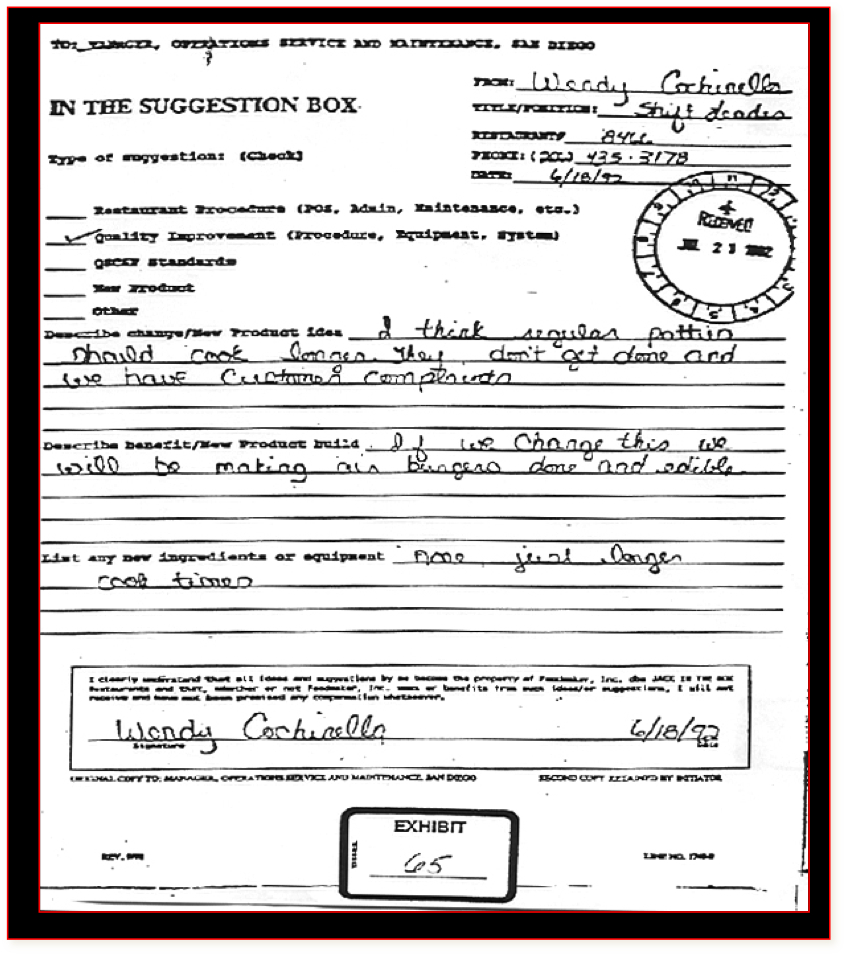
On June 18, 1992—five months before the Jack in the Box E. coli outbreak struck its hometown of San Diego and seven months before it would hit the Pacific Northwest—Wendy Cochinella, the shift leader at the Arlington, Washington restaurant faxed the below “IN THE SUGGESTION BOX” to Jack in the Box corporate headquarters in San Diego:

She wrote:

“I think regular patties should cook longer. They don’t get done and we have customer complaints.”

“If we change this we will be making our burgers done and edible.”

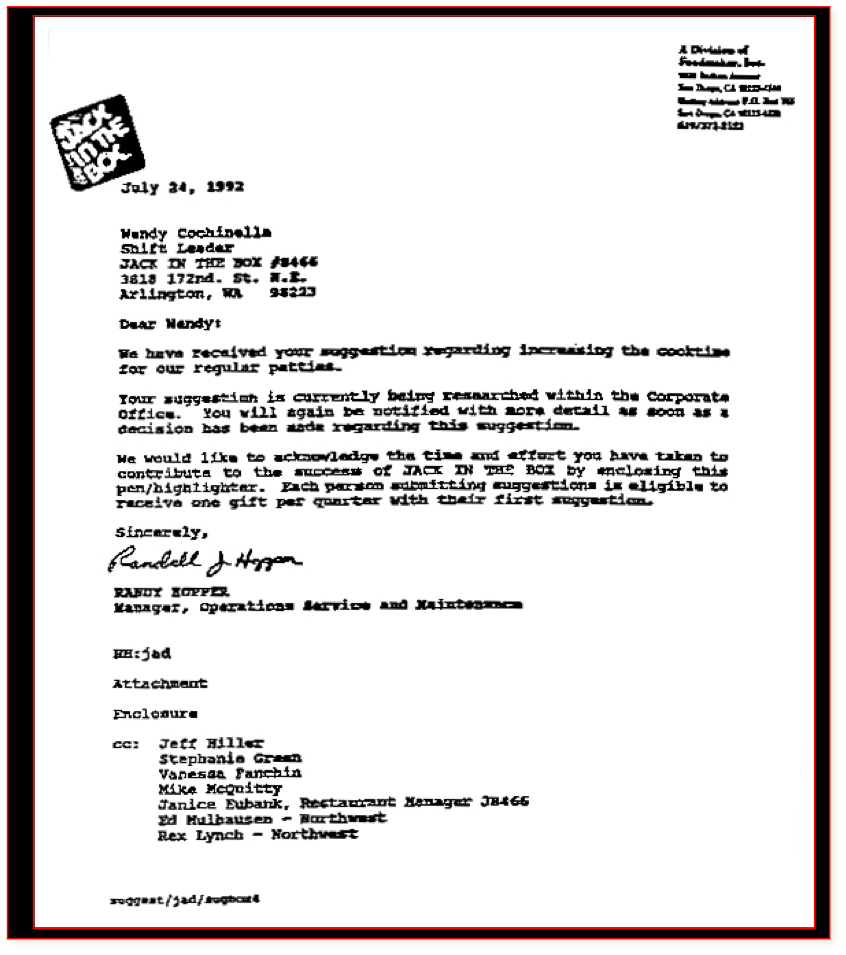
After just over a month, Wendy (and most of the Jack in the Box food safety team) received the below response from corporate headquarters. Wendy also received a pen highlighter (I always thought they should have made her at least Vice-President):

It reads:

We have received your suggestion regarding increasing the cook time for our regular patties.

Your suggestion is currently being researched within the corporate offices. You will again be notified with more detail as soon as a decision has been made regarding this suggestion.

We would like to acknowledge the time and effort you have taken to contribute to the success of JACK IN THE BOX by enclosing this pen/highlighter. Each person submitting suggestions is eligible to receive one gift per quarter with their first suggestion.

But it did not end there. No, Jack in the Box wanted to see if they could make “[their] burgers done and edible.” What they found in their corporate kitchen was that sometimes they could reach internal temperatures of 155 degrees and above on new grills with the two-minute cook time, but often—too often—internal temperatures of 140 degrees or below were reached on older grills with the two-minute cook time. E. coli O157:H7 bacteria can survive at 140 degrees for two minutes, but not at 155.

So, what was the response?

Yes, you guessed it, the two-minute cook time was more important than having “burgers done and edible.” Wendy’s next communication from corporate headquarters indicated that a cook time longer than two minutes made burgers “tough.”

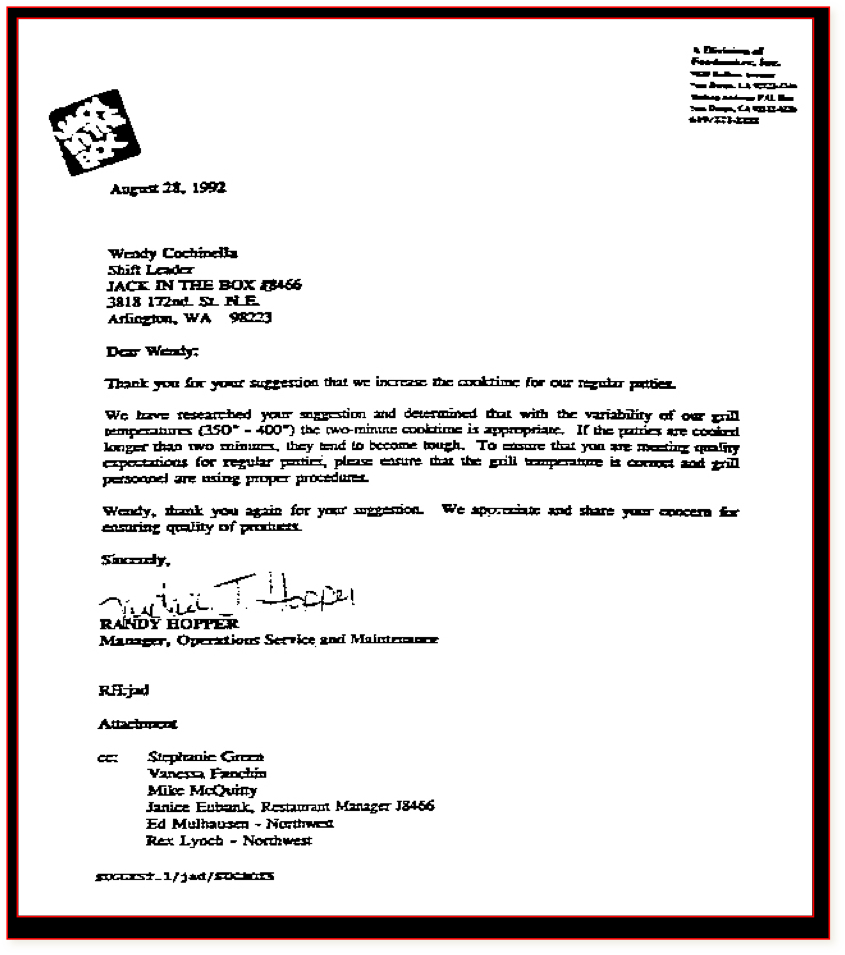
Wendy and the Jack in the Box food safety team received the following communication from superiors:

We have researched your suggestion and determined that with the variability of our grill temperatures (350° – 400°) the two-minute cook time is appropriate. If the patties are cooked longer than two minutes, they tend to become tough. To ensure that you are meeting quality expectations for regular patties, please ensure that the grill temperature is correct and grill personnel are using proper procedures.”

And, as they say, the rest is history—a tragic history.  Weeks after the outbreak was announced Jack in the Box changed the cook time from two minutes to two minutes and fifteen seconds – yes, fifteen seconds.

  • Multistate Salmonella Outbreak, Jimmy John’s Restaurants Sprouts 2018

As of January 18, 2018, eight people infected with the outbreak strain of Salmonella Montevideo have been reported from Illinois, Wisconsin and Minnesota. Illnesses started on dates ranging from December 20, 2017 to January 3, 2018. Ill people range in age from 26 to 50, with a median age of 34. All 8 (100%) are female. No hospitalizations and no deaths have been reported.  Evidence indicates that raw sprouts served at Jimmy John’s restaurants are a likely source of this multistate outbreak.

Federal, state, and local health and regulatory officials are conducting traceback investigations from the six Jimmy John’s locations where ill people ate raw sprouts. These investigations are ongoing to determine where the sprouts were distributed, and to learn more about the potential route of contamination. 

  • Multistate E. coli O121 Outbreak, Jimmy John’s Restaurants Alfalfa Sprouts 2014

19 Sickened – Public health officials in California, Idaho, Michigan, Montana, Utah and Washington collaborated with their federal partners at the Centers for Disease Control and Prevention (CDC) and the Food and Drug Administration (FDA) to investigate an outbreak of E. coli O121 that occurred in May 2014.  A total of 19 persons with the outbreak strain, identified by PulseNet PFGE Pattern Identification Numbers EXKX01.0011/EXKA26.0001, were reported.  Among persons for whom information was available, dates of illness onset ranged from May 1, 2014 to May 20, 2014.  Ill persons ranged from 11 years to 52 years.  Seven of 16 persons for whom information was available were hospitalized.  No ill person developed hemolytic uremic syndrome and no deaths were reported.

Epidemiologic and traceback investigations conducted by public health officials implicated raw clover sprouts produced by Evergreen Fresh Sprouts, LLC of Hayden, Idaho as the likely source of this outbreak.  Thirteen (81%) of 16 ill persons reported eating raw clover sprouts in the week before becoming ill.  Ill persons in Washington and Idaho reported eating sprouts in sandwiches at several local food establishments including several Jimmy John’s Gourmet Sandwiches locations, the Pita Pit, and Daanen’s Deli.

As part of the investigation the FDA performed a traceback analysis and determined that Evergreen Fresh Sprouts supplied sprouts to seven restaurants with outbreak associated cases.  This analysis used documents collected directly from the distributors and the grower, Evergreen Fresh Sprouts, as well as documents collected by the states from the points of service.

The FDA conducted several inspections at the Evergreen Fresh Sprouts facility in May and June.  During the inspections FDA investigators observed a number of unsanitary conditions, including condensate and irrigation water dripping from rusty valves, a rusty and corroded watering system in the mung bean room, tennis rackets (used to scoop mung bean sprouts) that had scratches, chips and frayed plastic; a pitchfork (used to transfer mung bean sprouts) that had corroded metal, and a squeegee (used to agitate mung bean sprouts inside a soak vat) that had visible corroded metal and non-treated wood.

On June 26, 2014 the FDA and CDC held a meeting with the owner of Evergreen Fresh Sprouts to advise the firm of FDA’s concerns that the seed lot used to row clover sprouts linked to this outbreak might be contaminated and to encourage Evergreen Fresh Sprouts to discontinue using that seed lot.  The owner of Evergreen Fresh Sprouts agreed to stop using the suspected lot of seeds.

  • Multistate E. coli O26 Outbreak, Jimmy John’s Restaurants Alfalfa Sprouts 2012

29 Sickened – A total of 29 individuals infected with the outbreak strain of E. coli O26 were reported from 11 states, including:  Alabama (1), Arkansas (1), Iowa (5), Kansas (2), Michigan (10), Missouri (3), Ohio (3), Pennsylvania (1), Washington (1), Wisconsin (1), and West Virginia (1).

Of the 27 ill persons with available information, 23 (85%) reported consuming sprouts at Jimmy John’s restaurants in the 7 days preceding illness.  Among 29 ill persons, illness onset dates ranged from December 25, 2011 to March 3, 2012.  Ill persons range in age from 9 years to 57 years old, with a median age of 26 years.  89% of ill persons are female.  Among the 29 ill persons, 7 (24%) were hospitalized. None developed HUS, and no deaths were reported.

Preliminary traceback information identified a common lot of clover seeds used to grow clover sprouts served at Jimmy John’s restaurant locations where ill persons ate.  FDA and states conducted a traceback that identified two separate sprouting facilities; both used the same lot of seed to grow clover sprouts served at these Jimmy John’s restaurant locations.  On February 10, 2012, the seed supplier-initiated notification of sprouting facilities that received this lot of clover seed to stop using it.

Results of the epidemiologic and traceback investigations indicated eating raw clover sprouts at Jimmy John’s restaurants was the likely cause of this outbreak.

  • Sprouters Northwest, Jimmy John’s Restaurants Clover Salmonella Sprouts Outbreak 2010

7 Sickened – Sprouters Northwest of Kent, Washington, issued a product recall after the company’s clover sprouts had been implicated in an outbreak of Salmonella Newport in Oregon and Washington. At least some of the cases had consumed clover sprouts while at a Jimmy John’s restaurant. Jimmy John’s Restaurants are a restaurant chain that sells sandwiches. Concurrent with this outbreak, a separate Salmonella outbreak (Salmonella, serotype I 4,5,12,i- ; see Multistate Outbreak, Tiny Greens Organic Farm, Jimmy John’s Restaurants), involving alfalfa sprouts served at Jimmy John’s restaurants was under investigation. The recall of Northwest Sprouters products included: clover; clover & onion; spicy sprouts; and deli sprouts. The Sprouters Northwest products had been sold to grocery stores and wholesale operations in Washington, Oregon, Idaho, Alaska, British Columbia, Saskatchewan, and Alberta. The FDA inspection found serious sanitary violations.

  • Multistate Salmonella Outbreak, Tiny Greens Organic Farm, Jimmy John’s Restaurants Alfalfa Sprouts 2010

140 Sickened – On December 17, the Illinois Department of Health announced that an investigation was underway into an outbreak of Salmonella, serotype I4,[5],12:i:-. Many of the Illinois cases had eaten alfalfa sprouts at various Jimmy John’s restaurants in the Illinois counties of: Adams, Champaign, Cook, DuPage, Kankakee, Macon, McHenry, McLean, Peoria, and Will counties. The sprouts were suspected to be the cause of the illnesses. On December 21, Jimmy John Liautaud, the owner of the franchised restaurant chain, requested that all franchisees remove sprouts from the menu as a “precautionary” measure. On December 23, the Centers for Disease Control revealed that outbreak cases had been detected in other states and that the outbreak was linked with eating alfalfa sprouts while at a nationwide sandwich chain. On December 26, preliminary results of the investigation indicated a link to eating Tiny Greens’ Alfalfa Sprouts at Jimmy John’s restaurant outlets. The FDA subsequently advised consumers and restaurants to avoid Tiny Greens Brand Alfalfa Sprouts and Spicy Sprouts produced by Tiny Greens Organic Farm of Urbana, Illinois. The Spicy Sprouts contained alfalfa, radish and clover sprouts. On January 14, 2011, it was revealed that the FDA had isolated Salmonella serotype I4,[5],12:i:- from a water runoff sample collected from Tiny Greens Organic Farm; the Salmonella isolated was indistinguishable from the outbreak strain. The several FDA inspections of the sprout growing facility revealed factors that likely led to contamination of the sprouts.

  • CW Sprouts, Inc., SunSprout Sprouts, “restaurant chain (Chain A),” a.k.a. Jimmy John’s Salmonella Outbreak 2009

256 Sickened – In February, Nebraska Department of Health and Human Services officials identified six isolates of Salmonella Saintpaul. Although this is a common strain of Salmonella, during 2008, only three cases had been detected in Nebraska and only four subtypes of this outbreak strain had been identified in 2008 in the entire USA. As additional reports were made, a case control study was conducted; alfalfa sprout consumption was found to be significantly related to illness. The initial tracebacks of the sprouts indicated that although the sprouts had been distributed by various companies, the sprouts from the first cases originated from the same sprouting facility in Omaha, Nebraska. Forty-two of the illnesses beginning on March 15 were attributed to sprout growing facilities in other states; these facilities had obtained seed from the same seed producer, Caudill Seed Company of Kentucky. The implicated seeds had been sold in many states. On April 26, the FDA and CDC recommended that consumers not eat raw alfalfa sprouts, including sprout blends containing alfalfa sprouts. In May, FDA alerted sprout growers and retailers that a seed supplier, Caudill Seed Company of Kentucky, was withdrawing all alfalfa seeds with a specific three-digit prefix.  Many of the illnesses occurred at “restaurant chain (Chain A).”

  • Jimmy John’s Restaurant Alfalfa Sprouts and Iceberg Lettuce E. coli Outbreak 2008

28 Sickened – Several University of Colorado students from one sorority became ill with symptoms of bloody diarrhea and cramping. Additional illnesses were reported. E. coli O157:NM(H-) was determined to be the cause. Consumption of alfalfa sprouts at the Jimmy John’s Restaurants in Boulder County and Adams County were risk factors for illness. In addition, the environmental investigation identified Boulder Jimmy John’s food handlers who were infected with E. coli and who had worked while ill. The health department investigation found a number of critical food handling violations, including inadequate handwashing. The fourteen isolates from confirmed cases were a genetic match to one another.