

The Chicago Tribune reported today that the Illinois Department of Public Health is looking into whether a recent E. coli outbreak is linked to a Portillo’s in Glendale Heights, authorities said Friday.
Four cases of a toxin producing the bacteria and one case of a resultant blood syndrome stemmed from customers eating at the Portillo’s at 235 E. North Ave. in Glendale Heights on July 16 and 17, IDPH wrote in a health alert.
The “possible issue” came from four customers during that time period, Portillo’s spokeswoman Sara Wirth wrote in a Saturday statement. She said the company reexamined its food safety protocols after learning of the outbreak.
“Across Portillo’s, we have extensive sanitary and food handling guidelines in place, including daily deep cleanings of all restaurants,” Wirth said. “Once notified, we moved quickly and began assisting with the investigation and revisiting our food safety best practices with our team members to mitigate potential future risk.”
The health department is urging doctors to consider an E. coli diagnosis in symptomatic patients who have recently eaten at the location.
With an average incubation period of one to 10 days, the condition can include cramps and diarrhea and, in children and older adults, kidney failure and red blood cell destruction, IDPH said.
E. coli Outbreak
The Mississippi State Department of Health (MSDH) has identified several cases of E. coli O157 infection associated with use of the swimming pool and/or splashpad at the Jellystone Park Camp Resort-Yogi on the Lake in Pelahatchie, Miss.
The cases identified so far have exposure dates on the weekend of July 30th through August 1st, but additional exposures may have occurred through August 9, 2021. The pool and splashpad were closed on August 9, 2021.
Individuals who were swimming in the pool or splashpad at Yogi on the Lake in Pelahatchie between July 30 and August 9 should monitor for symptoms of stomach cramps, diarrhea, vomiting and fever. Consult a healthcare provider immediately if you do have symptoms and tell your provider about your exposure.
Salmonella Outbreak
As of July 22, 2021, 11 people infected with the outbreak strain of Salmonella Typhimurium have been reported from three states. Illnesses started on dates ranging from June 10, 2021, to July 1, 2021.
Sick people range in age from 19 to 61 years, with a median age of 47, and 64% are female. Two people have been hospitalized. No deaths have been reported.
Interview data and shopper card records show that seven people ate or bought a variety of BrightFarms packaged salad greens before they got sick, including Sunny Crunch, 50/50 Spring & Spinach, Harvest Crunch, and Butter Crisp. FDA conducted a traceback investigation and identified BrightFarms greenhouse farm in Rochelle, IL, as the likely source of packaged salad greens bought by sick people.
Salmonella Outbreak
As of June 2, 2021, a total of 17 people infected with the outbreak strain of Salmonella Enteritidis have been reported from 6 states. Illnesses started on dates ranging from February 21, 2021, to May 7, 2021.
Sick people range in age from 3 to 83 years, with a median age of 52 years, and 60% are female. Of 13 people with information available, 8 (62%) have been hospitalized; no deaths have been reported.
The Minnesota Department of Agriculture collected for testing five raw frozen breaded stuffed chicken products from a grocery store where an ill person purchased these products. The outbreak strain was identified in two samples of Kirkwood’s Chicken Cordon Bleu.
I spoke to a mom in Louisiana whose daughter is sick with E. coli O157:H7 after attending Jellystone Park Camp Resort-Yogi on the Lake on a family vacation the week before she became ill. So, expect the illness numbers to expand.
 The Mississippi State Department of Health (MSDH) has identified several cases of E. coli O157 infection associated with use of the swimming pool and/or splashpad at the Jellystone Park Camp Resort-Yogi on the Lake in Pelahatchie, Miss.
The cases identified so far have exposure dates on the weekend of July 30th through August 1st, but additional exposures may have occurred through August 9, 2021. The pool and splashpad were closed on August 9, 2021.
This is an evolving situation and MSDH is conducting an ongoing investigation to identify any additional cases. The management of the Jellystone Park Camp Resort-Yogi on the Lake are cooperating with the investigation and response.
E. coli O157 infection can be a serious illness, especially in very young children and the elderly, and is associated with severe stomach cramps, diarrhea (sometimes bloody), vomiting and fever. Some individuals develop a severe and potentially life-threatening condition called hemolytic uremic syndrome (HUS). HUS occurs about a week after symptoms first appear, as they are improving. It can lead to kidney failure in some cases. Early symptoms of HUS can be associated with decreased urination and fatigue.
Symptoms of E. coli infection usually develop three to four days after exposure, with a range between one and 10 days. Outbreaks with recreational waters such as pools and splashpads can occur when waters become contaminated by an infected person through diarrhea or fecal contamination, and other swimmers then swallow the water, becoming exposed and infected. Person to person transmission can also occur.
Individuals who were swimming in the pool or splashpad at Yogi on the Lake in Pelahatchie between July 30 and August 9 should monitor for symptoms of stomach cramps, diarrhea, vomiting and fever. Consult a healthcare provider immediately if you do have symptoms and tell your provider about your exposure.
Is there another outbreak brewing?
It was about three weeks from now, sixteen years ago, that I was teaching my daughters to surf on the Oregon coast when I got a tip that an E. coli outbreak was brewing. It eventually blew up to the 2006 Dole baby spinach E. coli outbreak that sickened 205 – killing 5. The industry called it their Jack-in-the-Box and their 911. 2006 seems a long time ago, but when I got a tip today that an outbreak – hopefully smaller in size – is coming to a salad bar near you, it seemed like yesterday.
So, assuming my tipster is correct, what does that say about the leafy green industry and its Jack-in-the-Box and their 911 moments? Cleary, the growers, through the California and Arizona LGMAs have made modest progress. Clearly, the FDA now recognizes that leafy greens grown in proximity to cattle is at best problematic. However, we still do not have real, enforceable land use (keep cow shit away from ready to eat greens) programs, water use and testing regimes, and enforceable product test regulations. We will continue to have these outbreaks until we all come to grips with the need for a comprehensive view of a complex problem.
E. coli outbreaks associated with lettuce, specifically the “pre-washed” and “ready-to-eat” varieties, are by no means a new phenomenon. In fact, the frequency with which this country’s fresh produce consuming public has been hit by outbreaks of pathogenic bacteria is astonishing. Here are just a sample of E. coli outbreaks based on information gathered by the Center for Science in the Public Interest, Kansas State University, Barfblog, North Carolina State University and the Centers for Disease Control and Prevention:
| Date | Vehicle | Etiology | Confirmed Cases |
States/Provinces |
| July 1995 | Lettuce (leafy green; red; romaine) | E. coli O157:H7 | 74 | 1:MT |
| Sept. 1995 | Lettuce (romaine) | E. coli O157:H7 | 20 | 1:ID |
| Sept. 1995 | Lettuce (iceberg) | E. coli O157:H7 | 30 | 1:ME |
| Oct. 1995 | Lettuce (iceberg; unconfirmed) | E. coli O157:H7 | 11 | 1:OH |
| May-June 1996 | Lettuce (mesclun; red leaf) | E. coli O157:H7 | 61 | 3:CT, IL, NY |
| May 1998 | Salad | E. coli O157:H7 | 2 | 1:CA |
| Feb.-Mar. 1999 | Lettuce (iceberg) | E. coli O157:H7 | 72 | 1:NE |
| Oct. 1999 | Salad | E. coli O157:H7 | 92 | 3:OR, PA, OH |
| Oct. 2000 | Lettuce | E. coli O157:H7 | 6 | 1:IN |
| Nov. 2001 | Lettuce | E. coli O157:H7 | 20 | 1:TX |
| July-Aug. 2002 | Lettuce (romaine) | E. coli O157:H7 | 29 | 2:WA, ID |
| Nov. 2002 | Lettuce | E. coli O157:H7 | 13 | 1:Il |
| Dec. 2002 | Lettuce | E. coli O157:H7 | 3 | 1:MN |
| Oct. 2003-May 2004 | Lettuce (mixed salad) | E. coli O157:H7 | 57 | 1:CA |
| Apr. 2004 | Spinach | E. coli O157:H7 | 16 | 1:CA |
| Nov. 2004 | Lettuce | E. coli O157:H7 | 6 | 1:NJ |
| Sept. 2005 | Lettuce (romaine) | E. coli O157:H7 | 32 | 3:MN, WI, OR |
| Aug. 2006 | Spinach (baby) | E. coli O157:H7 and other serotypes | 205 | Multistate and Canada |
| Nov./Dec. 2006 | Lettuce | E. coli O157:H7 | 71 | 4:NY, NJ, PA, DE |
| Nov./Dec. 2006 | Lettuce | E. coli O157:H7 | 81 | 3:IA, MN, WI |
| July 2007 | Lettuce | E. coli O157:H7 | 26 | 1:AL |
| May 2008 | Romaine | E. coli O157:H7 | 9 | 1:WA |
| Oct. 2008 | Lettuce | E. coli O157:H7 | 59 | Multistate and Canada |
| Nov. 2008 | Lettuce | E. coli O157:H7 | 130 | Canada |
| Sept. 2009 | Lettuce: Romaine or Iceberg | E. coli O157:H7 | 29 | Multistate |
| Sept. 2009 | Lettuce | E. coli O157:H7 | 10 | Multistate |
| April 2010 | Romaine | E. coli O145 | 33 | 5:MI, NY, OH, PA, TN |
| Oct. 2011 | Romaine | E. coli O157:H7 | 60 | Multistate |
| April 2012 | Romaine | E. coli O157:H7 | 28 |
1:CA Canada |
| June 2012 | Romaine | E. coli O157:H7 | 52 | Multistate |
| Sept. 2012 | Romaine | E. coli O157:H7 | 9 | 1:PA |
| Oct. 2012 | Spinach and Spring Mix Blend | E. coli O157:H7 | 33 | Multistate |
| Apr. 2013 | Leafy Greens | E. coli O157:H7 | 14 | Multistate |
| Aug. 2013 | Leafy Greens | E. coli O157:H7 | 15 | 1:PA |
| Oct. 2013 | Ready-To-Eat Salads | E. coli O157:H7 | 33 | Multistate |
| Apr. 2014 | Romaine | E. coli O126 | 4 | 1:MN |
| Apr. 2015 | Leafy Greens | E. coli O145 | 7 | 3:MD, SC, VA |
| June 2016 | Mesclun Mix | E. coli O157:H7 | 11 | 3:IL, MI, WI |
| Nov. 2017 | Leafy Greens | E. coli O157:H7 | 67 | Multistate and Canada |
| Mar. 2018 | Romaine | E. coli O157:H7 | 240 | Multistate and Canada |
| Oct. 2018 | Romaine | E. coli O157:H7 | 62 | Multistate and Canada |
| Dec. 2019 | Romaine | E. coli O157:H7 | 167 | Multistate and Canada |
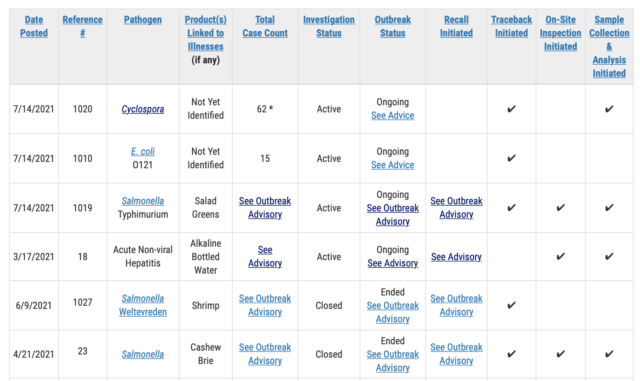
Over the last several weeks I have been monitoring the FDA and CDC as both of our premier public health entities tried to track down the likely vector sickening people across several states with E. coli O121. Earlier today, they both announce the vector – cake mix from a yet unknown manufacturer – as the cause of the outbreak. Despite the announcement as of several hours, not one national, or for that matter, more local, media outlet has publicized the outbreak and warned consumers about the risk of consuming unbaked flour and/or cake mix.
Media, you have to do better.
Fast Facts:
Source of cake mix: Unknown
States with illnesses: Illinois 2, Indiana 1, Iowa 2, Massachusetts 1, Michigan 1, Nebraska 2, Ohio 2, Oregon 1, South Carolina 1, Utah 1, Virginia 1, Washington 1.
Condition of victims: 7 hospitalized with 1 developing hemolytic uremic syndrome (HUS).
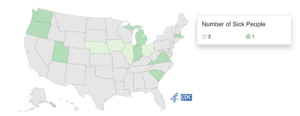 As of July 27, 2021, 16 people infected with the outbreak strain of E. coli O121 have been reported from 12 states. Illnesses started on dates ranging from February 26, 2021 to June 21, 2021.
Sick people range in age from 2 to 73 years, with a median age of 13, and 100% are female. Of 16 people with information available, 7 have been hospitalized. One person has developed a type of kidney failure called hemolytic uremic syndrome (HUS), and no deaths have been reported.
State and local public health officials are interviewing people about the foods they ate in the week before they got sick. Of the eight people interviewed, six (75%) reported tasting or eating raw batter made with a cake mix. People reported buying different varieties and brands of cake mix.
FDA is conducting a traceback investigation using purchase records from locations where sick people bought cake mix to try to determine a common cake mix brand or production facility.
CDC advises people not to eat raw cake batter, whether made from a mix or homemade. Eating raw cake batter can make you sick. Raw cake batter can contain harmful bacteria. Bacteria are killed only when raw batter is baked or cooked.
 According to South African press reports, Tiger Brands, South Africa’s biggest food manufacturer, announced yesterday that it is immediately recalling about 20 million Koo and Hugo’s canned vegetable products that were produced from May 1, 2019, to May 5, 2021, over safety concerns due to potentially defective cans.
The issue with the cans, which is a deficient side seam weld that could cause the cans to leak, was initially discovered in May this year with 18 cans at one of Tiger Brand’s facilities. The cans came from a supplier. While that batch and several others weren’t released for trade, a probe determined that some cans from a defective batch did. It did a test and out of 287 040 cans inspected after a transport and handling test, a side seam leak had developed in two cans. This prompted the recall.
No illnesses have been reported to date. Although, it is unknown if botulism is a reportable disease in South Africa.
Although not mentioned in the Tiger press release below, defective cans have the potential to be contaminated with Clostridium botulinum, a bacterium which can cause life-threatening illness or death. Consumers are therefore warned not to use the product even if it does not look or smell spoiled.
Botulism, a potentially fatal form of food poisoning, can cause the following symptoms: general weakness, dizziness, double-vision and trouble with speaking or swallowing. Difficulty in breathing, weakness of other muscles, abdominal distension and constipation may also be common symptoms. People experiencing these problems should seek immediate medical attention.
According to financial reports, Tiger Brands wiped more than R1bn off its market value after recalling millions of canned vegetable products on Monday in the latest food safety concern for a company that is still reeling from the discovery of the deadly Listeria strain at its meat processing factory.
The National Consumer Commission on Monday said it would only rest once all Tiger Brands’ defective canned vegetable products were removed from the market and consumers got their refunds.
Full Tiger Brands press release:
TIGER BRANDS LIMITED – Withdrawal of canned vegetable products
Withdrawal of canned vegetable products
TIGER BRANDS LIMITED
(“Tiger Brands” or “the Company”)
(Incorporated in the Republic of South Africa)
(Registration number 1944/017881/06)
Share code: TBS
ISIN: ZAE000071080
WITHDRAWAL OF CANNED VEGETABLE PRODUCTS
Shareholders are referred to the interim results announcement of 20 May 2021, which included disclosure in respect of defective packaging materials identified at one of the Company’s sites. This related specifically to a small number (18) of leaking food cans which had been identified by Tiger Brands’ Groceries division during May 2021, as part of its internal quality assurance processes.
These defective cans were identified prior to the final labelling of the finished products and were traced back to three different batches of cans which had been purchased from one of the division’s key packaging suppliers. This incident was immediately reported to the packaging supplier.
Shortly after reporting this incident to the packaging supplier, we were notified by the supplier that a further three batches of cans could have presented the same defect, which was a deficient side seam weld that could cause the cans to leak.
The six defective batches referred to above were the subject of the disclosure made by the Company on 20 May 2021. It is important to note that all the affected finished products manufactured, using these six defective batches of cans, were never released to the trade, and were placed in quarantine for further investigation, with the knowledge and agreement of the packaging supplier.
After the initial identification of the six batches containing defective cans, a full investigation of all cans sourced from this supplier was initiated. In the early part of June 2021, the investigation identified a further small quantity of leaking cans in the finished goods warehouse. These were unlabeled finished product and, as a result, had not yet passed through the Company’s final quality control and inspection procedures. These defective cans were traced back to a seventh batch of cans purchased from the packaging supplier and, therefore, was not part of the defective batches of packaging material identified in May.
Unlike the defective cans identified in May (which had been isolated), it was established that a portion of the cans from this seventh defective batch had been released to the trade in the form of finished product. This release to the trade was after following the normal quality assurance processes which did not yield evidence of leaking cans.
Despite the Company having found no evidence of any leaking cans in the trade or with consumers, and with the agreement of the packaging supplier, it immediately initiated a rigorous transport and handling test. This entailed transporting both labelled and unlabeled product from our warehouses in Johannesburg to our facilities in the Western Cape.
The purpose of this test was to assess whether the leaks could manifest after the finished product had passed through Tiger Brands’ quality assurance processes and left Tiger Brands’ custody. Out of 287,040 cans inspected after the transport and handling test, a side seam leak had developed in two cans. These two defective cans formed part of the first six defective batches received from the packaging supplier.
A leak in a can presents a risk of secondary microbial contamination after the canned products are dispatched into the marketplace. Where such contamination occurs, it will present a low probability of illness and injury if the contaminated product is consumed.
Notwithstanding that only two side seam leaks had been detected because of the transport test, with consumer safety as an absolute priority, Tiger Brands considers it appropriate that it institutes an immediate recall of all products that could potentially be affected. This involves the withdrawal of specific canned vegetable products manufactured under the KOO and Hugo’s brands between 1 May 2019 and 5 May 2021 (both dates inclusive), amounting to approximately 20 million cans, which is ~9% of annual production. A full list of the potentially affected products can be found on the Company’s website at www.tigerbrands.com.
KOO canned fruit, which is produced using a different can from a different can manufacturing plant, is not impacted by this defect and does not form part of the recall. In addition, KOO canned pilchards are also not impacted as the cans are supplied by a different supplier.
Tiger Brands has engaged with the National Consumer Commission on this matter and will, with immediate effect, roll out an appropriate consumer and customer communication plan in respect of the recall. The recall is expected to be concluded in approximately 120 days.
The financial impact of the recall, including the cost of the potentially affected stock that may be written off, transport and storage costs, as well as the loss of margin on the returned stock, is estimated at between R500 million and R650 million. Tiger Brands has product recall insurance for the logistics of recalling the products. The Company’s claim under the contract with the third-party supplier is yet to be assessed.
Shareholders will be updated as appropriate.
The financial information contained in this announcement has not been reviewed or reported on by Tiger Brands’ auditors.
And, you thought Tiger Brands’ only had a Listeria problem.
Over 1,000 sickened with over 200 dead from Listeria tainted polony. I have the honor to be working with counsel in South Africa – See Listeria Class Action.
Following the declaration of the Listeria outbreak in December 2017, a multi-sectoral outbreak response was initiated. Findings were shared by the Minister of Health, Dr. Aaron Motsoaledi at a public media briefing on 4 March 2018 (statement available at www.nicd.ac.za), and are summarized below. In addition, the National Department of Health requested a full recall of implicated processed meat products. According to Dr. Aaron Motsoaledi:
In our constant search for the source of the outbreak and the treatment of people who are affected, a team from the NICD has interviewed 109 ill people to obtain details about foods they had eaten in the month before falling ill. Ninety-three (85%) people reported eating ready-to-eat (RTE) processed meat products, of which polony was the most common followed by viennas/sausages and then other ‘cold meats’.
On Friday 12th January, nine children under the age of 5 years presented to Chris Hani Baragwanath Hospital with febrile gastro-enteritis. The paediatrician suspected foodborne disease, including listeriosis, as a possible cause. The environmental health practitioners (EHPs) were informed and on the same day visited the crèche, and obtained samples from two unrelated polony brands (manufactured by Enterprise and Rainbow Chicken Limited (RCL) respectively) and submitted these to the laboratory for testing.
Listeria monocytogenes was isolated from stool collected from one of the ill children, and from both of the polony specimens collected from the crèche. These isolates were sent to the NICD Centre for Enteric Diseases, and underwent whole genome sequencing and genomic analysis. The ST6 sequence type was confirmed on all three isolates on Saturday 27th January. Remember that in the last press conference I informed you that from clinical isolates obtained from patients (patient blood), 9 sequence types of Listeria monocytogenes were isolated and 91% were of sequence type 6 (ST6). We had then concluded that time that this outbreak is driven by ST6.
Following the lead from the tests performed on these children from Soweto and the food they had ingested, the EHPs (Environmental Health Practitioners), together with the NICD and DAFF representatives, accompanied by 3 technical advisors from the World Health Organisation in Geneva, visited a food- production site in Polokwane and conducted an extensive food product and environmental sampling.
Listeria monocytogenes was isolated from over 30% of the environmental samples collected from this site, which happens to be the Enterprise factory in Polokwane.
To conclude the investigation, whole genome sequencing analysis was performed from this Enterprise factory and the results became available midnight or last night. The outbreak strain, ST6, was confirmed in at least 16 environmental samples collected from this Enterprise facility.
THE CONCLUSION FROM THIS IS THAT THE SOURCE OF THE PRESENT OUTBREAK CAN BE CONFIRMED TO BE THE ENTERPRISE FOOD-PRODUCTION FACILITY IN POLOKWANE
According to the Centre for Enteric Diseases (CED) and Division of Public Health Surveillance and Response, Outbreak Response Unit (ORU), National Institute for Communicable Diseases (NICD)/ National Health Laboratory Service (NHLS) the current number of ill and deceased are as follows:
As of 26 July 2018, 1060 laboratory-confirmed listeriosis cases have been reported to NICD from all provinces since 01 January 2017.

To date, 749 cases were reported in 2017, and 311 cases in 2018. Females account for 56% (549/979) cases where gender is reported. Neonates ≤28 days of age are the most affected age group, followed by adults aged 15 – 49 years of age. Most cases have been reported from Gauteng Province (58%, 614/1060) followed by Western Cape (13%, 136/1060) and KwaZulu-Natal (8%, 83/1060) provinces. Final outcome data is available for 76% (806/1060) of cases, of which 27% (216/806) died.

Hilliard, Lori – complaint FINAL
As of July 22, 2021, 11 people infected with the outbreak strain of Salmonella Typhimurium have been reported from three states. Illnesses started on dates ranging from June 10, 2021, to July 1, 2021.
Sick people range in age from 19 to 61 years, with a median age of 47, and 64% are female. Two people have been hospitalized. No deaths have been reported.
The true number of sick people in an outbreak is likely much higher than the number reported, and the outbreak may not be limited to the states with known illnesses. This is because many people recover without medical care and are not tested for Salmonella. In addition, recent illnesses may not yet be reported as it usually takes 3 to 4 weeks to determine if a sick person is part of an outbreak.
Officials from Illinois, Michigan, and Wisconsin interviewed people about the foods they ate in the week before they got sick and collected shopper card records to determine what products they bought.
All 11 people reported eating leafy greens, and nine (82%) people reported eating prepackaged salads.
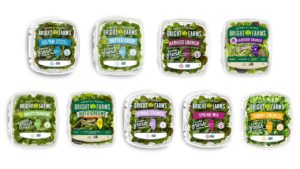 Interview data and shopper card records show that seven people ate or bought a variety of BrightFarms packaged salad greens before they got sick, including Sunny Crunch, 50/50 Spring & Spinach, Harvest Crunch, and Butter Crisp. FDA conducted a traceback investigation and identified BrightFarms greenhouse farm in Rochelle, IL, as the likely source of packaged salad greens bought by sick people.
Illinois: Mariano’s Fresh Markets, Walmart (select stores), Strack Van Till, Sullivan’s Foods, Caputo’s, Jewel-Osco
Wisconsin: Pick ‘n Save, Metro Market, Copps, Tadych’s, Walmart (select stores)
Iowa: Walmart (select stores)
Indiana: Strack Van Till
Michigan: Tadych’s
BrightFarms salad greens produced in Rochelle, IL that have been recalled:
At least seven people ate or bought BrightFarms packaged salad greens before getting sick.
Investigators are working to determine if additional products with later “best buy” dates may be affected.
We will be filing a lawsuit in Illinois in the morning.
What products have been recalled?
The BrightFarms products come in clear, plastic clamshells and have “best by” dates through 7/29/2021:

The recall was issued after eleven people fell ill with Salmonella after eating packaged salad greens. BrightFarms products grown outside of Illinois have not been affected, so this recall should only affect shoppers in the Midwest.
What States have the recalled product?
BrightFarms issued this recall in Illinois, Wisconsin, Michigan, Iowa and Indiana, all states that sell packaged salad greens grown on the company’s Rochelle, Illinois farm. Retailers selling the potentially contaminated products include:
Where were the products sold?
Illinois: Mariano’s Fresh Markets, Walmart (select stores), Strack Van Till, Sullivan’s Foods, Caputo’s, Jewel-Osco
Wisconsin: Pick ‘n Save, Metro Market, Copps, Tadych’s, Walmart (select stores)
Iowa: Walmart (select stores)
Indiana: Strack Van Till
Michigan: Tadych’s
With both the FDA and CDC being more transparent on the status of outbreak investigation, it is easy to keep track of the outbreaks even is we do not yet know the causes.