Perry Stein of the Washington City Paper wrote yesterday that “Washington Post Cafeteria Shut Down After ‘Evidence of Some Mice Activity.’” Apparently, Jeffrey Cox, the paper’s director of administration and operating services, alerted the staff in a company-wide email this morning, writing the “cafeteria will be temporarily closed due to deficiencies found during a routine inspection by the DC Department of Health that occurred yesterday.”

Sound familiar?

In 2010 Stephanie Gaskell of the New York Daily News reported that the “New York Times cafeteria food may be past its deadline.” According to the Daily News, “[t]he Health Dept. is investigating cases of possible food poisoning at the New York Times cafeteria. …The dining room at the paper’s headquarters on Eighth Ave. and 40th St. was shut down Thursday after several employees fell ill with digestive problems. …The kitchen and dining areas are being sanitized and all prepared foods have been tossed. …Health inspectors are on the case but said Thursday night they still haven’t found the cause.”

Interesting that the respective papers did not report on the problems in their own cafeterias?

It is good to see a leader in public health taking a stand for public health. 

Robert V. Tauxe, MD, MPH, Deputy Director, Division of Foodborne, Waterborne, and Environmental Diseases, National Center for Emerging and Zoonotic Infectious Diseases, Centers for Disease Control and Prevention wrote the following letter to State and Territorial Epidemiologists and to State Public Health Veterinarians today.  I was pleased to get an advanced copy.

The role of raw milk and other unpasteurized dairy products in the transmission of infectious diseases is well documented.  Pasteurization is the process of heating milk to a high enough temperature for a long enough time to kill disease-causing bacteria.  Raw milk was recognized as a source of severe infections over 100 years ago, and pasteurization of milk to prevent these infections is one of the public health triumphs of the 20th century.  Pathogens such as Escherichia coli O157, Campylobacter jejuni, and Salmonella can contaminate milk during the milking process because they are shed in the feces of healthy-looking dairy animals, including cows and goats.  Infection with these pathogens can cause severe, long-term consequences, such as hemolytic uremic syndrome, which can result in kidney failure, and Guillan-Barré syndrome, which can result in paralysis.  These infections are particularly serious in those who are very young, very old, or who have impaired immune systems.  They can be fatal.

Adherence to good hygienic practices during milking can reduce, but not eliminate, the risk of milk contamination.  Pasteurization is the only way to ensure that fluid milk products do not contain harmful bacteria.  Routine pasteurization of milk from healthy cows in a hygienic setting began in the 1920s and became widespread in the United States by 1950 as a means to reduce contamination and resulting illness.  This led to dramatic reductions in many diseases previously associated with milk.  Pasteurization is recommended for all animal milk consumed by humans by the Centers for Disease Control and Prevention (CDC), the Food and Drug Administration (FDA), the American Academy of Pediatrics, the American Academy of Family Practitioners, the American Veterinary Medical Association, the National Association of Public Health Veterinarians, and many other medical and scientific organizations.

In 1987, the FDA prohibited the distribution of raw milk across state lines for direct sale to consumers.  Despite the federal ban on interstate sale of raw milk and broad use of pasteurization by the dairy industry, human illness and outbreaks associated with consumption of unpasteurized products continue to occur.  Raw milk is still available for sale in many states, and CDC data shows that the rate of raw milk-associated outbreaks is 2.2 times higher in states in which the sale of raw milk is legal compared with states where sale of raw milk is illegal.

From 2007 to 2012, the CDC National Outbreak Reporting System received reports indicating:

  • 81 outbreaks of infections due to consumption of raw milk resulting in 979 illnesses, 73 hospitalizations, and no deaths.
  • Most infections were caused by Campylobacter, Shiga toxin-producing Escherichia coli, or Salmonella bacteria, pathogens that are carried by cattle that appear healthy.
  • The number of outbreaks increased during this time, from 30 in the three year span 2007–2009 to 51 in 2010–2012.
  • Eighty-one percent of outbreaks were reported from states where the sale of raw milk was legal in some form; only 19% occurred in states where the sale of raw milk was illegal.
  • The reported outbreaks represent only the tip of the iceberg.  For every outbreak and illness that is reported, many others occur that are not reported; the actual number of illnesses associated with raw milk and raw milk products is likely much greater.
  • It is important to note that a substantial proportion of the raw milk-associated disease burden falls on children; 59 % of outbreaks involved at least one person aged <5 years.

To protect the health of the public, state regulators should continue to support pasteurization and consider further restricting or prohibiting the sale and distribution of raw milk and other unpasteurized dairy products in their states.

CDC has a recently updated raw milk website that contains useful information and materials, including a list of relevant publications and other scientific resources on illnesses associated with raw milk consumption reproduced in the attachment.  The website is: http://www.cdc.gov/foodsafety/rawmilk/raw-milk-index.html   This information can be shared with persons involved in foodborne disease outbreak investigations and the regulation of unpasteurized dairy products.

A few months ago I received this email:

Dear Mr. Marler,

After speaking with __________, _________ would much prefer to invite you to be a speaker at our next annual meeting of the _________, to be held on _________, 2015 rather than inviting you to one of our smaller roundtable meetings. The _________ annual meeting & suppliers expo generally attracts in excess of 200 participants, a great majority of whom are CEOs of small food processing facilities or affiliated service providers.

I think that our audience would LOVE to hear you give a presentation such as “Food Safety Challenges for Small Businesses – How NOT to have Bill Marler representing your sickened/injured customers”. I often talk to this audience about food safety and the regulations regarding food safety, but it would have a much greater impact, for them to hear about some of the possible repercussions of failing to adhere to food safety preventive measures from YOU.

Thanks for your time and consideration.

I was therefore a bit surprised when I received this email on the way home from giving another speech on “Why it is a bad idea to poison your customers”:

This is really embarrassing, but several members of the __________ Board were strongly opposed to having Mr. Marler speak at the 2015 Annual Conference.

I would have loved to have him here, personally, because from the academic perspective I think there is great value in learning more about both sides of any situation. Unfortunately, most of the Board members are company owners or CEOs of food production facilities who are very enthusiastic for me to bring-in speakers who might can help them with improving food safety in their processing plants, but do not feel it is appropriate for me to bring-in someone who might one day be coming after them for something that they were not even aware was taking place.

I hope that Mr. Marler can understand this situation, and why I have to retract the invitation.

Over that last two decades I have done hundreds of talks in front of every group imaginable – from colleges, to public health entities, to industry groups – small and large – all for free.  I have done these talks in Australia, China, New Zealand, Canada, England, South Africa, Dubai and more than 30 US states.  Some have been keynote speeches in front of thousands and some were sitting across the table with Boards of Directors.

I have tried to do more than sue companies to take responsibility for the customers they sickened or killed.  I have tried to convince them that avoiding problems in the first place is a much better course.

(I removed identifiers to not embarrass the individuals who invited me)

The Pocono Record reports that the Pennsylvania Department of Health is investigating a situation involving a Red Robin restaurant employee who was diagnosed with Hepatitis A.

“The Disease Prevention and Control Law prohibits us from providing further details as the investigation is ongoing at this time,” said Aimee Tysarczyk, press secretary/director of communications for the state Health Department.  “As the investigation continues and if any public health risks evolve, the department will provide additional information to ensure the safety and well-being of the public, as needed,” Tysarczyk said.

In a statement to the Pocono Record, Red Robin said:

“On May 5, 2014, Lehigh Valley Restaurant Group was informed by the Pennsylvania Department of Health that an employee at the Red Robin restaurant in Stroudsburg, Pa., had contracted Hepatitis A.  The employee has not been in the restaurant since April 27, 2014, and will not return to work until he has been granted medical clearance.”

At this time, the Pennsylvania Department of Health does not believe there is a risk to the general public; however, guests who visited the Stroudsburg Red Robin restaurant between April 16 – May 5 can contact the department at 1-877-PA-HEALTH with any questions or concerns.

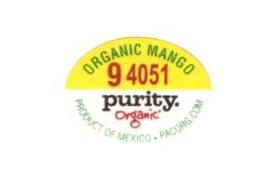
Pacific Organic Produce, San Francisco, CA is voluntarily recalling a limited number of cases of organic Tommy Atkins mangos (PLU numbers 94051 & 94959) that were sold under the Purity Organic brand between the dates of April 14, 2014 and May 2, 2014 due to a possible health risk from Listeria monocytogenes. No illnesses have been reported in association with the recall and no other mangos or products under the Purity Organic brand are being recalled.

The PLU number is printed in the middle of the PLU sticker on the fruit. The mangos were shipped to retailers and distributors in limited quantities within five (5) U.S. states (Arizona, California, Colorado, New Jersey and Texas).

No illnesses have been reported to date. However, the recall was issued as a precaution because a single sample in a FDA sample yielded a positive result for Listeria monocytogenes. Pacific Organic Produce is coordinating closely with regulatory officials and has contacted its customers to ensure that any remaining recalled products are removed. Listeria monocytogenes is an organism that can cause foodborne illness in a person who consumes a food item contaminated with it. Symptoms of infection may include fever, muscle aches and gastrointestinal symptoms such as nausea or diarrhea. The illness primarily impacts pregnant women and adults with weakened immune systems. Most healthy adults and children rarely become seriously ill.

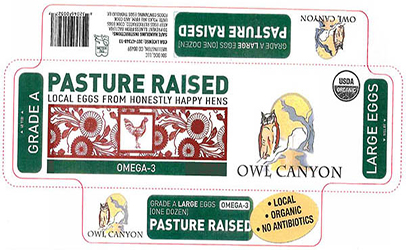
Sixdog Investments LLC of Wellington, CO, is voluntarily recalling some cases of their certified organic eggs sold under the Owl Canyon brand because of potential contamination with Salmonella.

The company’s voluntary field action was initiated because of routine testing results and not because of any illnesses to date from consumption.

Some of the eggs were distributed in Colorado and some may have gone to Idaho, Kansas, New Mexico and Utah. These were distributed through retail outlets.

The eggs are packed in dozen and half-dozen packages. The products in question will have a packing date of 93, 94, 97, or 98; an expiration date of “051814,” “051914,” “052214,” or “052314”; they will also include a location code of 1 or 3. All this information is on the package, located on a white sticker on the end of each carton.

The company is confident that any and all products sent out with any other packing codes or expiration dates are fully safe for consumption. No associated illnesses have been reported to date.

Routine testing, initiated by the firm, revealed that the finished products from certain barns could potentially contain the Salmonella bacteria. The company immediately ceased production in these areas and began taking action to rectify the situation.

Anhing Corporation of Los Angeles, CA is conducting a Nationwide recall of Caravelle Brand Chili Powder in 8 ounce plastic tubs lot code 560916, because it has the potential to be contaminated with Salmonella, an organism which can cause serious and sometimes fatal infections in young children, frail or elderly people, and others with weakened immune systems. Healthy persons infected with Salmonella often experience fever, diarrhea (which may be bloody), nausea, vomiting and abdominal pain.

The product was distributed through retail stores.

This Chili Powder is contained in a clear plastic tub with a red lid. It has an orange paper label which reads in part “Caravelle CHILI POWDER HOT Net Weight 8 oz. (227G) Packed For ANHING CORP. Los Angeles, CA 90031 PRODUCT OF THAILAND”. It also contains Thai and Chinese wording. The Bar Code is: 080736115551. There are two codes involved 560916 or 570115. These codes ore located on a white label adhering to the bottom of the plastic tub.

There are no illnesses reported to date.

This recall was the result of a routine sampling program by the State of Maryland.

Schnucks Kitchen, an O’Fallon, Mo., establishment, is recalling approximately 130 pounds of Curry White Meat Chicken Salad product due to possible contamination with Listeria monocytogenes, the U.S. Department of Agriculture’s Food Safety and Inspection Service (FSIS) announced today.

The Chicken salad product, in three-pound bags, was produced on April 24, 2014, and shipped to Schnucks retail grocery locations for deli distribution in Illinois, Indiana, Iowa, Missouri and Wisconsin. The following product is subject to recall:

3-lb. sealed plastic bags containing “CURRY WHITE MEAT CHICKEN SALAD WITH WALNUTS.”

Because the products were sold at deli counters, consumer packaging may vary. Plastic containers in various sizes may bear a purchase date between April 24, 2014 and May 2, 2014. Bulk case labels or packaging may bear the case code 0989674 or 0963124 as well as establishment number “EST. P-13562” inside the USDA mark of inspection.

The problem was discovered when routine product sampling by FSIS personnel tested positive for Listeria monocytogenes on April 28, 2014. This product was held by the firm and did not enter commerce. Further investigative sampling by the company later determined bulk walnuts from an outside supplier, an ingredient used in the product, may have been contaminated with the pathogen. FSIS and the company have received no reports of illnesses associated with consumption of these products. FSIS is working in partnership with the Food and Drug Administration to further investigate the source of the contamination.

Consumption of food contaminated with L. monocytogenes can cause listeriosis, a serious infection that primarily affects older adults, persons with weakened immune systems, and pregnant women and their newborns. Less commonly, persons outside these risk groups are affected.

Listeriosis can cause fever, muscle aches, headache, stiff neck, confusion, loss of balance and convulsions sometimes preceded by diarrhea or other gastrointestinal symptoms. An invasive infection spreads beyond the gastrointestinal tract. In pregnant women, the infection can cause miscarriages, stillbirths, premature delivery or life-threatening infection of the newborn. In addition, serious and sometimes fatal infections in older adults and persons with weakened immune systems. Listeriosis is treated with antibiotics. Persons in the higher-risk categories who experience flu-like symptoms within two months after eating contaminated food should seek medical care and tell the health care provider about eating the contaminated food.

FSIS and the company are concerned that some product may be frozen and in consumers’ freezers.