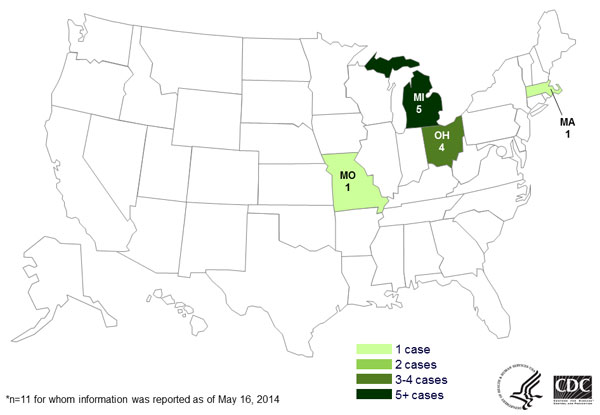
As of May 16, 2014, a total of 11 persons infected with the outbreak strains of Shiga toxin-producing Escherichia coli O157:H7 (STEC O157:H7) have been reported from 4 states.The number of ill persons identified in each state is as follows: Massachusetts (1), Michigan (5), Missouri (1), and Ohio (4).60% of ill persons have been hospitalized. No ill persons have developed hemolytic uremic syndrome (HUS), and no deaths have been reported.Epidemiologic and traceback investigations conducted by local, state, and federal officials indicate that contaminated ground beef produced by Wolverine Packing Company is the likely source of this outbreak of STEC O157:H7 infections.On May 19, 2014, Wolverine Packing Company voluntarily recalled approximately 1.8 million pounds of ground beef products that may be contaminated with STEC O157:H7.

The products subject to recall bear the establishment number “2574B.”

The recalled ground beef was shipped to distributors for retail and restaurant use nationwide.

FSIS announced late last night that Wolverine Packing Company recalled approximately 1.8 million pounds of ground beef products that may be contaminated with E. coli O157:H7.  These products were shipped to distributors for restaurant use in Massachusetts, Michigan, Missouri, and Ohio.  FSIS was notified of E. coli O157:H7 illnesses on May 12, 2014. Working in conjunction with public health partners from the Centers for Disease Control and Prevention (CDC), FSIS determined that there is a link between the ground beef products from Wolverine Packing Company and this illness cluster. Based on epidemiological and traceback investigations, 11 case-patients have been identified in 4 states with illness onset dates ranging from April 22, 2014 to May 2, 2014.

It has been six years since there has been a ground beef recall of this size or greater associated with illnesses.  Here is a bit(e) of history:

In late June of 2008, public health officials in Michigan and Ohio began investigating several cases of E. coli O157:H7.  An epidemiological investigation by officials at the Michigan and Ohio departments of agriculture determined that the source of the E. coli outbreak was ground beef purchased at Kroger stores.  Kroger stores recalled an undetermined amount of ground beef, which was ultimately linked to 42 illnesses of E. coli O157:H7— 21 in Michigan and 20 in Ohio. In its recall announcement, Kroger identified stores that had sold the contaminated meat, including Fred Meyer, QFC, Kroger, Fry’s, Ralph’s, Smith’s, Baker’s, King Soopers, City Market, Hilander, Owen’s, Pay Less, Scott’s, Dillons, and Gerbes.  Nebraska Beef also issued a massive recall of ground beef, which was eventually expanded to include a total of 5.3 million pounds of meat intended for use in ground beef production.  On July 18, 2008 the CDC announced that 49 confirmed E. coli O157:H7 cases had been linked both epidemiologically and by molecular fingerprinting to the consumption of ground beef products produced with Nebraska Beef meat.  States with confirmed cases included Georgia, Indiana, Kentucky, Michigan, New York, Ohio, and Utah. Twenty-seven people were hospitalized, and one patient was known to have developed a type of kidney failure called hemolytic-uremic syndrome (HUS). No deaths were reported. Later that year, in August of 2008, Nebraska Beef recalled an additional 1.2 million pounds of meat for potential E. coli contamination after a cluster of Boston illnesses was traced to Whole Foods, whose processor, Coleman Natural Meats, purchased the meat from Nebraska Beef.  As many as 30 E. coli cases were reported in California, Colorado, Connecticut, Idaho, Illinois, Massachusetts, New Jersey, New Mexico, Pennsylvania, Virginia, and Canada in association with the August recall. On August 14, Nebraska Beef expanded its recall to include 160,000 pounds of meat, bringing the total meat recalled in August to 1.36 million pounds.

On October 6, 2007, Cargill Meat Solutions Corporation announced that it was recalling approximately 845,000 pounds of frozen ground beef patties for possible E. coli O157:H7 contamination. The recall was initiated after three people in Minnesota tested positive for E. coli and a joint investigation by the Minnesota Department of Health and Minnesota Department of Agriculture identified the Cargill hamburger patties as the source of the illnesses.   The Cargill products were sold at retail establishments and to restaurants and other institutions. Sam’s Club announced that it was pulling the potentially E. coli-contaminated ground beef patties produced by Cargill from its store shelves nationwide on October 5th.  The most grievously sickened victim was Stephanie Smith, who developed HUS and spent months in a medically-induced coma.  The former dance instructor was paralyzed from the waist down, and both her kidney function and cognitive abilities were impaired.  Michael Moss of the New York Times won a Pulitzer Prize for the article he wrote about Stephanie Smith and the background of the beef that went into the burger that made her sick.

In September 2007 Topps Meat Company expanded a recall of frozen hamburgers to 21.7 million pounds of patties because it was contaminated with a deadly type of E. coli, making it the second-largest ground beef recall in U.S. history. The largest ground beef recall in U.S. history was the 1997 Hudson Foods Company recall of 25 million pounds of ground beef. The third largest was the ConAgra Foods recall of 2002, which covered 19.7 million pounds of ground beef. The Centers for Disease Control and Prevention had identified 40 cases of E. coli in eight states. While this is the first recall in Topps’ 65-year history, it is not the first time the company has had problems with E. coli. In 2005, a 9-year-old girl in Glenmont, N.Y., went into kidney failure after being infected with bacteria linked to a Topps beef patty. Ill persons reside in 8 states – Connecticut (2), Florida (1), Indiana (1), Maine (1), New Jersey (9), New York (13), Ohio (1), and Pennsylvania (12).

In June 2007 United Food Group, LLC, expanded its June 3 and 6 recalls to include a total of approximately 5.7 million pounds of both fresh and frozen ground beef products produced between April 6 and April 20 (the largest recall since 2002) because it was contaminated with E. coli. An investigation carried out by the California Department of Health Services and the Colorado Department of Health, in coordination with the Centers for Disease Control and Prevention, preceded the recall of June 3. Illnesses occurred in Arizona (6), California (3), Colorado (2), Idaho (1), Utah (1) and Wyoming (1). Illness onset dates ranged between April 25 and May 18.

Prior to the 2007 – 2008 bump, it was five years since another large one:

On June 30, 2002, the USDA Food Safety and Inspection Service (FSIS) announced the recall of 354,200 pounds of ground beef manufactured at the ConAgra Beef Company plant in Greeley, Colorado.  The contaminated ground beef had been produced at the plant on May 31, thirty days prior to the recall, and was distributed nationally to retailers and institutions.  On July 12, the Colorado Department of Public Health and Environment (CDPHE) disclosed that 17 Colorado residents had been infected with E. coli O157:H7.  Several other cases were subsequently reported in neighboring states.  Three days later, on July 15, the Centers for Disease Control and Prevention (CDC) announced that the strain of E. coli O157:H7 that had infected the 17 sickened individuals was genetically indistinguishable from the strain isolated from the recalled ConAgra beef.  On July 19, 2002, FSIS expanded the ConAgra ground beef recall to 18.6 million pounds of ground beef.  In the weeks that followed the nationwide recall, more than 45 people in 23 states reported illnesses linked to the contaminated ground beef.

On December 4, 2000, the USDA Food Safety and Inspection Service (FSIS) announced that American Foods Group (AFG) was recalling 1.1 million pounds of ground beef for potential E. coli contamination. The recalled meat was manufactured at AFG’s Wisconsin meat plants, and supplied to stores throughout the Midwest and Southeast United States. The recall was initiated after a preliminary investigation by both MDOH and FSIS indicated that ground beef produced at the plant in early November 2000 was likely contaminated with E. coli O157:H7. The Wisconsin Department of Public Health linked three reports of Wisconsin E. coli O157:H7 cases to those reported in Minnesota.

Wolverine Packing Company, a Detroit, Mich. establishment, is recalling approximately 1.8 million pounds of ground beef products that may be contaminated with E. coli O157:H7, the U.S. Department of Agriculture’s Food Safety and Inspection Service (FSIS) announced today.

The ground beef products were produced between March 31, 2014 and April 18, 2014. For a full list of products that were recalled please see the attached document.

The products subject to recall bear the establishment number “EST. 2574B” and will have a production date code in the format “Packing Nos: MM DD 14” between “03 31 14” and “04 18 14”. These products were shipped to distributors for restaurant use in Massachusetts, Michigan, Missouri, and Ohio. There was no distribution of the products to the Department of Defense, the National School Lunch Program, or catalog/internet sales.

Factors that can contribute to the size of the recall include potential contamination of additional products due to a lack of microbiological independence between lot production, as well as a deficiency in supportive record-keeping by distributors.

FSIS was notified of E. coli O157:H7 illnesses on May 12, 2014. Working in conjunction with public health partners from the Centers for Disease Control and Prevention (CDC), FSIS determined that there is a link between the ground beef products from Wolverine Packing Company and this illness cluster. Based on epidemiological and traceback investigations, 11 case-patients have been identified in 4 states with illness onset dates ranging from April 22, 2014 to May 2, 2014. FSIS continues to work with our state and federal public health partners on this investigation and provide updated information as it becomes available.

According to Nathan Vickers of KCTV, recently there have been three cases of Hemolytic uremic syndrome, or HUS, diagnosed and treated in Wichita, Kansas, and now one in Kansas City.  The likely cause E. coli O157:H7.   Post-diarrheal Hemolytic Uremic Syndrome is a severe, life-threatening complication that occurs in about 10% of those infected with Escherichia coli (E. coli) O157:H7 or other Shiga toxin-producing E. coli. That means that there is a bit of a statistical oddity or there are some 40 others ill out there. KCTV5

Food Safety News reports that an E. coli O157 outbreak in Michigan has been genetically matched to one in Ohio, where local, state and federal health officials are currently investigating at least four similar cases.

The case count in Ohio includes three in Lucas County and one in Portage County and involve adults ranging in age from 19 to 42 years.

The five Michigan cases of E. coli infection include adults aged 20 to 41 from the following five counties: Oakland, Washtenaw, Ken, Livingston and Ottawa. According to the Michigan Department of Community Health, three of the five people sickened were hospitalized.  According to the Record-Eagle,a Grand Traverse region resident likely is the sixth Michigander diagnosed with E. coli poisoning in recent weeks.  The woman lives in an area covered by the Benzie-Leelanau District Health Department. She recently traveled to Grand Rapids where she ate ground beef.

Those sickened in Michigan indicated to health officials that they had consumed undercooked hamburger prior to developing symptoms. Michigan health officials have reportedly been trying to track down the source of the meat.

Two cases of E. coli 0157:H7 in West Michigan have been traced back to consumption of raw milk products from an Ottawa County cow share program. In March, a 31 year old Muskegon County woman became ill after drinking raw milk, and in April, a 6 year old child from Kent County became ill after possible consumption of the raw milk product.

Organisms that make people sick are found in the intestines of animals. Contamination of milk occurs when fecal matter is present on the udder of an animal or in the equipment used to process the milk. Enough bacteria to cause illness can be present and not be visibly dirty upon inspection. Pasteurizing is the process of heating the milk to high temperatures to kill the harmful bacteria that make you sick. Raw or unpasteurized milk (sometimes called fresh milk or fresh unprocessed milk) is milk that comes directly from a cow, goat, sheep or other animal’s udder and is not heat treated (pasteurized) to kill bacteria. Raw milk carries a much higher risk of causing serious illness than pasteurized milk, and you cannot see or smell the germs in raw milk that make you sick.

Some believe drinking raw milk products is more nutritious and provides the body with “good bacteria”. The pasteurizing process does not significantly change the nutritional value of milk, and due to the risk of serious illness, there are far safer sources of good bacteria than raw milk. Pasteurized probiotic yogurts, kefir, and other products are a great source of probiotics.

The CDC reports that unpasteurized milk is 150 times more likely to cause foodborne illness, and results in 13 times more hospitalizations than illnesses involving pasteurized dairy products. Due to poorly developed immune systems, infants and children are at greater risk for becoming sick and are more likely to suffer from long term damage from diseases linked to drinking raw milk.

Due to the health risk of consuming raw milk, it is not legal to sell raw milk or raw milk products in the State of Michigan. Because of this, raw milk is obtained through herd share programs. In a herd share program, consumers purchase a share of a cow and, as the owner of the cow, are provided raw milk from the farmer.

These herd share dairy programs are not licensed or inspected by state or local agencies.

If you or someone you know has become ill in the days following consumption of a raw milk product, seek medical attention. Symptoms of illness include vomiting, diarrhea, and abdominal pain along with fever, headache, and body ache. Pregnant women, infants, small children, the elderly, and people with chronic illnesses should never consume raw milk products.

KCPQ reports that Attorney Bill Marler represents clients who have gotten sick after eating at restaurants they thought were safe.

“We rely on restaurants to follow the rules because we want to go out and have a good time,” Marler said.  “We don’t want to be worried that our kids or ourselves are going to get sick.”

Josh Mitchell of the Missourian wrote today:  “More Than 300 Get Food Poisoning from Gravy, County Health Officials Estimate.

Franklin County health officials estimate that more than 300 people got food poisoning from gravy that was served at a recent wedding event.  Tests of food and stool samples came back positive for Clostridium perfringens, said Tony Buel, epidemiology specialist with the Franklin County Health Department.  Apparently, several hundred people attended.  Not a wedding to remember fondly.

However, here is the most shocking part.  According to Mr. Mitchell, Mr. Buel said he did not want to release the name of the caterer because it could harm the business. He said he would have to check with the county attorney to see if the name of the caterer could be released.

Releasing the name would harm business?  Really?  What about poisoning a few hundred people?  First, that is bad enough for business and Second, do you really think the attendees of the wedding will keep this a secret?

The Michigan Departments of Community Health (MDCH) and Agriculture and Rural Development (MDARD) along with local health departments in Kent, Livingston, Oakland, Ottawa, and Washtenaw counties are investigating a cluster of recent illnesses due to the bacteria E. coli O157:H7.

Five confirmed Shiga-toxin producing E. coli O157 illnesses have been reported in adults between 20-41 years of age with symptom onset dates from April 22 – May 1. Three individuals have been hospitalized. None of the ill individuals have developed hemolytic uremic syndrome (HUS), a severe complication of E. coli O157 infection, and no deaths have been reported.

Laboratory results suggest these illnesses are linked to a common source. The investigation is ongoing, and preliminary information collected from ill persons indicates that ground beef is most likely the source. Ill individuals ate undercooked ground beef at several different restaurants in multiple locations. MDARD is working with local health departments and the United States Department of Agriculture (USDA) to determine the source of the ground beef and how widely it was distributed.

Eric Gorski of the Denver Post this morning writes: “Food inspections flag health threats in edible marijuana products.”  Gorski reports that food safety inspections of businesses that manufacture and sell marijuana edibles in Denver have found products that should be refrigerated sitting out on shelves and preparation methods insufficient to kill bacteria that can cause serious food-borne illness.  The unannounced visits by the Denver Department of Environmental Health have led to three product recalls and the destruction of tens of thousands of dollars’ worth of products.  Most infused baked goods are fine on shelves if the marijuana extraction or concentrate has been continuously refrigerated before being added, according to a department memo last month.

  • Edibles manufacturer At Home Baked, operating under a license held by Advanced Medical Alternatives, was instructed to stop selling and destroy its marijuana-infused baking mixes and oil pouches.  The company used a cold-water hash extraction in oil stored in reduced oxygen packaging at room temperature, which is conducive to spore germination and toxin formation, a report says.