
HAR Maspeth Corp. of Maspeth, NY, is recalling its 2 ounce and 4 ounce packages of Jinga “Pan Fried Anchovies” due to contamination with Listeria monocytogenes, an organism which can cause serious and sometimes fatal infections in young children, frail or elderly people and others with weakened immune systems. Although healthy persons may suffer only short-term symptoms such as high fever, severe headache, stiffness, nausea, abdominal pain and diarrhea, Listeria infection can cause miscarriages and stillbirths among pregnant women.

The recalled Jinga “Pan Fried Anchovies” were distributed nationwide in retail stores and through mail orders. The product comes in a 2 ounce and 4 ounce, clear plastic packages marked with an expiration date of “9/28/2014” stamped on the top.

An alleged illness has been reported to date in connection with this problem.

The recall was initiated after routine sampling by The Virginia Department of Agriculture and Consumer Services Food Inspectors and subsequent analysis of the product by Food Laboratory personnel revealed the presence of Listeria monocytogenes.

Buddy’s Kitchen, a Burnsville, Minn. establishment, is recalling approximately 62,488 pounds of meat and poultry products due to possible contamination with Listeria monocytogenes, the U.S. Department of Agriculture’s Food Safety and Inspection Service (FSIS) announced today.

The meat and poultry breakfast products were produced on various dates from July 16, 2014 through Sept. 25, 2014, and then shipped to distributors, retail locations, and airlines nationwide. The following products are subject to recall:

“Swiss Cheese and Mushroom Omelet with Seasonal Tid-Bit Potatoes & Turkey Buffet Sausage Link” trays with the production codes “07/16/14 9”, “08/08/14 9” and “08/27/14 9”.
“Savory Scrambled Eggs with Seasoned Red Skin Potatoes and Turkey Buffet Links” with the production codes “09/19/14 9” and “09/22/14 9”.
“Garden Omelet w/ Parslied Potatoes & Chicken Sausage Links” with the production codes “07/16/14 9”, “07/17/14 9”, “07/18/14 9”, “07/22/14 9”, “07/25/14 9”, “08/22/14 9”, “08/25/14 9”, “09/02/14 9”, “09/09/14 9” and “09/16/14 9”.
“Fiesta Scramble Bowl with Sausage Links” with the production code “10I14 9”.
“Breakfast Skillet Burrito with eggs, sausage and cheese” with the production codes “18G14 2”, “06I14 4”, “16G14 4”, “17G14 2”, “07H14 4”, “20H14 2”, “21H14 4”, “22H14 4” and “25H14 4”.

Case labels or packaging may bear the establishment number “EST. 4226” or “P-4226” inside the USDA mark of inspection.

Nancy Luna yesterday reported that Zov’s restaurant in Irvine was forced to shut down briefly Wednesday in the wake of a foodborne illness probe tied to four sick customers, health department officials said Thursday.

The sickened guests ate at Zov’s on Portola on three different dates between Sept. 16-22, said Deanne Thompson, a spokeswoman for the county’s Health Care Agency. All four people tested positive for shigella, an intestinal disease that triggers severe diarrhea.

Health investigators cleared Zov’s to reopen the same day after the restaurant’s owners took quick action to sanitize the restaurant and discard all ready-to-eat foods including fresh produce.

Employees, who cannot return to work until they are medically cleared by the health agency, were also given training on proper hand-washing, Thompson said.

Here is a little online history:

REASON FOR PERMIT SUSPENSION/CLOSURE ONGOING FOODBORNE ILLNESS INVESTIGATION 10/01/2014

HEALTH PERMIT REINSTATEMENT 10/01/2014

ROUTINE INSPECTION 09/30/2014

Eating/Drinking/Smoking in Food Storage/Prep Areas

  • Lack of/Improper Handwashing
  • Unsanitary Equipment/Utensil/Linen/Plumbing
  • Lack of/Unsanitary/Condition Walls/Floors/Ceilings
  • Improper Food Storage/Receiving
  • Water Temp (100F-119F)/Wash Temp <100F/Cross Con
  • Inoperable/Lack of Food Thermometer
  • Lack of/Improper Handwashing/Handwashing Sup.

ROUTINE INSPECTION 04/29/2014

  • Water Temp (100F-119F)/Wash Temp <100F/Cross Con
  • Unsanitary Equipment/Utensil/Linen/Plumbing
  • Inappropriate Sanitizer Level/ Lack of Test Strips
  • Lack of/Unsanitary/Condition Walls/Floors/Ceilings
  • Improper Food Storage/Receiving

ROUTINE INSPECTION 10/21/2013

  • Improper Holding Temp of PHF (60F-120F), (50F-59F)
  • Improper Food Storage/Receiving
  • Improper Thawing
  • Change Room Improper Use/Lack of Inadequate Hygiene (Hair/Clothing/Eating/Drinking)
  • Lack of/Improper Handwashing/Handwashing Sup.
  • Inappropriate Sanitizer Level/ Lack of Test Strips
  • Unapproved Pesticides/Chemicals/Labeling
  • Unsanitary Equipment/Utensil/Linen/Plumbing
  • Water Temp (100F-119F)/Wash Temp <100F/Cross Con

ROUTINE INSPECTION 04/22/2013

  • Improper Holding Temp of PHF (60F-120F), (50F-59F)
  • Improper Food Storage/Receiving
  • Inappropriate Sanitizer Level/ Lack of Test Strips
  • Lack of/Unsanitary/Condition Walls/Floors/Ceilings

ROUTINE INSPECTION 12/21/2012

  • Improper Warewashing/Inoperable Dishmachine
  • Unapproved Pesticides/Chemicals/Labeling
  • Water Temp (100F-119F)/Wash Temp <100F/Cross Con
  • Unsanitary Equipment/Utensil/Linen/PlumbingChange Room Improper Use/Lack of
  • Lack of/Unsanitary/Condition Walls/Floors/Ceilings
  • Lack of/Improper Handwashing/Handwashing Sup.
  • Improper Food Storage/Receiving
  • Lack of Food Protection Manager Certificate

Major Violations pose the highest risk of causing food poisoning (or foodborne illness. Major violations are sometimes resolved during the inspection or a reinspection may be scheduled to verify compliance.

Minor Violations pose less risk of causing food poisoning (or foodborne illness), and do not warrant immediate verification of compliance.

The Center for Science in the Public Interest today asked the U.S. Department of Agriculture to declare four antibiotic-resistant strains of Salmonella as adulterants under federal law. In a petition filed with the agency CSPI says antibiotic-resistant strains on meat and poultry were linked to at least 2,358 illnesses, 424 hospitalizations, and eight deaths—facts that CSPI says obligates USDA to keep those strains out of the food supply.

I think this is a very good idea.

NBC News:

The meat industry fought the E. coli ban, too, recalled Bill Marler, a Seattle food safety lawyer who represented families of children sickened by that outbreak. It won’t be easy to eradicate Salmonella from meat and poultry, and it will be expensive, he said.  But Salmonella is already banned from ready-to-eat produce, he noted. And it doesn’t have any place in other foods.

“Why do chicken manufacturers and why do beef manufacturers get a free ride on Salmonella when carrot and lettuce producers don’t?” Marler said. “Salmonella is an adulterant.”

Washington Post:

Bill Marler, a food poisoning attorney who filed a successful petition on most of the now-banned E. coli strains, said the Salmonella petition has a good shot of being acted on by the USDA this time around. CSPI filed a similar petition that was rejected in 2011.

“It is long past due to give salmonella the same legal standing that pathogenic E. coli has. The beef industry has thrived with E. coli as an adulterant,” Marler said. “The meat industry as a whole will benefit ridding its product of Salmonella. What’s good for its consumers and public health will be good for the industry.”

Sindhu Sundar of Law360 reported today “Cargill Wins $9M From Beef Supplier In Tainted Meat Suit.”  According to the article, Cargill Inc., on Monday was awarded a $9 million verdict by a Nebraska federal jury in its dispute with an Omaha, Nebraska-based Greater Omaha Packing Co., that it accused of selling it beef products tainted with E. coli O157:H7 that put Cargill on the hook for $26 million in costs, including victim settlements.  PDF of verdict and judgment.

The E. coli O157:H7 outbreak began in August 2007 and led to the eventual recall of 845,000 pounds of Cargill ground beef. In early October, Minnesota health department officials noticed a cluster of three E. coli O157:H7 cases with the same pulse-field gel electrophoresis (PFGE) genetic pattern. Interviews with the case-patients found a common exposure of Cargill hamburger. Wisconsin, North Carolina, and Tennessee also had victims with matching PFGE patterns and exposure to Cargill hamburger. Sam’s Club stores were a major purchaser of the Cargill frozen hamburgers.  The outbreak sickened as many as 54, including Stephanie Smith, who was profiled in the Pulitzer Prize winning article by Michael Moss in the New York Times.

Cargill had settled claims with victims and then proceeded against Greater Omaha.

We are pleased with the jury verdict,” Cargill spokesman Michael Martin said Tuesday. “The jury agreed that Greater Omaha must be responsible for the safety of its beef products. Cargill holds its suppliers accountable to the same standards we apply to beef produced at our plants.”

Cargill did it right – It took responsibility for its product, took care of its customers, and forced accountability up the supply chain

Hillsdale Daily News reports that the Salmonella outbreak which struck the Reading Summer Festival Days the weekend of July 31 was part of an eight-state outbreak from contaminated berries or melons, according to health officer Steve Todd of the Branch-Hillsdale-St. Joseph Counties Community Health Agency (CHA).

Todd said the outbreak now has 12 lab-confirmed cases of the foodborne intestinal disease including “several additional secondary cases that appear to be either family members or otherwise related to a person that was ill.”

Interviews with those who have had contact with people infected during the event continues “to prevent an outbreak from getting into food service establishments, daycares, or healthcare settings,” Todd said.

The Center for Disease Control (CDC) said the Reading outbreak was a sub-cluster of the larger outbreak. The particular strain of Salmonella “is normally associated with poultry.”

The CDC has not been able to locate the exact source of the contaminated food.

Jessica Bringe of WEAU reports that more than 100 total Durand High School students were reported absent last week with Durand’s football team being hardest hit by the illness.  There are 19 confirmed cases of Campylobacter; all are members of the football team.

Now, Pepin County Health officials are trying to figure out how the spread started and where.  The investigation into what caused the outbreak of campylobacter within the district is still ongoing.

Heidi Stewart, with the Pepin County Health Department says all 19 confirmed cases of Campylobacter have been members of the football team.

“Over 50 interviews have been completed of members of the football team, people around the football team, coaches staff and other people,” says Stewart.

The Pepin County Health Department continues to work with the DHS and the Durand School District in efforts to prevent and control infections and to investigate the source of the outbreak.

The Department of Health Services and the Wisconsin State Laboratory of Hygiene continue to coordinate testing for any ill students and staff to identify the source of their illness. The Durand School District will continue to provide updates.

The Durand School District continues to follow the cleaning and disinfection guidelines recommended by the DHS to ensure all school buildings, buses, and grounds are safe for all parties involved.

Campylobacter is a bacteria and a common cause of gastrointestinal illness in Wisconsin. Symptoms include diarrhea, which may be bloody, abdominal cramping and fever.

Zach Murdock reports that the S.C. Department of Health and Environmental Control is investigating about nine cases of Salmonella poisoning in Beaufort County, including one illness matched to a national cluster of salmonella, according to a state spokeswoman.

The department has received reports of eight people with gastrointestinal symptoms, and laboratory testing has confirmed several are salmonella infections, spokeswoman Cassandra Harris said Friday.

Health officials have not determined if there is a common source that might have caused the illnesses, but the investigation is ongoing, she said.

The Centers for Disease Control and Prevention also has asked for the department’s help investigating a separate, single case of salmonella poisoning that matches a national cluster of salmonella, Harris said.

Further details about when and where the illnesses occurred in Beaufort County were not immediately available Friday afternoon.

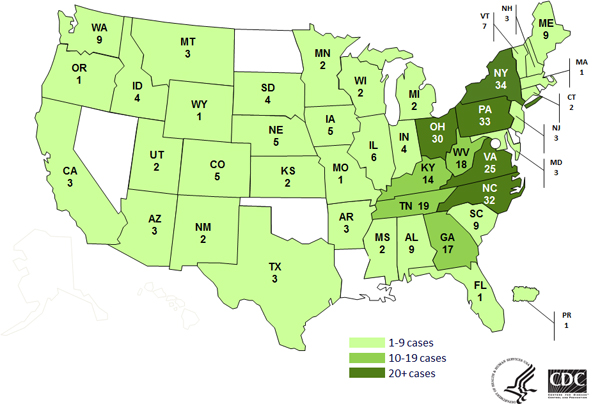
A total of 344 person infected with the outbreak strains of Salmonella Infantis, Salmonella Newport, or Salmonella Hadar have been reported from 42 states and Puerto Rico. The number of ill persons identified in each state is as follows: Alabama (9), Arizona (3), Arkansas (3), California (3), Colorado (5), Connecticut (2), Florida (1), Georgia (17), Idaho (4), Illinois (6), Indiana (4), Iowa (5), Kansas (2), Kentucky (14), Maine (9), Maryland (3), Massachusetts (1), Michigan (2), Minnesota (2), Mississippi (2), Missouri (1), Montana (3), Nebraska (5), New Hampshire (3), New Jersey (3), New Mexico (2), New York (34), North Carolina (32), Ohio (30), Oregon (1), Pennsylvania (33), Puerto Rico (1), South Carolina (9), South Dakota (4), Tennessee (19), Texas (3), Utah (2), Vermont (7), Virginia (25), Washington (9), West Virginia (18), Wisconsin (2), and Wyoming (1).

31% of ill persons have been hospitalized, and no deaths have been reported.

Epidemiologic, laboratory, and traceback findings have linked this outbreak of human Salmonella infections to contact with chicks, ducklings, and other live poultry from Mt. Healthy Hatcheries in Ohio.  Findings of multiple traceback investigations of live baby poultry from homes of ill persons have identified Mt. Healthy Hatcheries in Ohio as the source of chicks and ducklings. This is the same mail-order hatchery that has been associated with multiple outbreaks of Salmonella infections linked to live poultry in past years, including in 2012 and 2013.