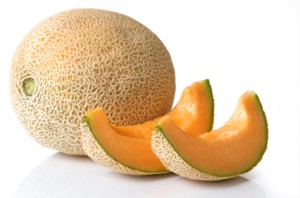
The Centers for Disease Control and Prevention (CDC) is reporting 60 cases from five states – Illinois, Indiana, Michigan, Missouri, and Ohio. The CDC investigation indicates pre-cut melons, including fruit salads, are a likely source of this multistate outbreak.  SpartanNash appears to be the supplier and processor, but may be named under Renaissance or Caito Foods.

“The Illinois Department of Public Health is urging people not to eat pre-cut melon purchased from any Walmart store in Illinois, or any of the other affected states, at this time,” said IDPH Director Nirav D. Shah, M.D., J.D. “If you have recently purchased pre-cut melon from Walmart, throw it out. If you have recently eaten pre-cut melon from a Walmart store and experience diarrhea, fever, and cramps, contact your health care provider.”

Illinois cases range in age from 23 to 87 years and have been reported in all regions of the state. Therefore, it is recommended that people not eat pre-cut melon from Walmart stores anywhere in Illinois. As the investigation continues, additional grocery stores may be added.

Most people affected by Salmonella develop diarrhea, fever, and abdominal cramps 12 to 72 hours after eating food contaminated by the bacteria. The illness usually lasts 4 to 7 days, and most people recover without treatment. However, diarrhea for some people may be so severe that they need to be hospitalized. The CDC has indicated there have been more hospitalizations with this outbreak than what is typically seen. The elderly, infants, and those with compromised immune systems are more likely to have a severe illness.

The U.S. Food and Drug Administration is working to identify the source of Salmonella and there may be recalls as more information is learned. Walmart stores in Illinois have removed pre-cut melons linked to this outbreak from their shelves.

Time to dust off www.fair-safety.com and www.realrawmilkfacts.com

The Knox County Health Department (KCHD) is investigating a cluster of Escherichia coli (E. coli) O157 cases in children likely associated with consumption of raw milk and contact with farm animals.

Most of the children are known to have consumed raw milk from a local cow-share dairy. Due to possible contamination with E. coli O157 and out of an abundance of caution, KCHD advises the public not to consume raw milk or any other unpasteurized products from French Broad Farm in Mascot, Tenn. at this time. Officials also recommend consumers dispose of all raw milk and unpasteurized products they may have from this farm.

Any further exposure to the farm animals in question has been mitigated as the facility is not currently operating. Therefore, no further directive on that potential source is necessary.

“Bacteria, like E. coli, cannot be seen with the naked eye,” said KCHD Director Dr. Martha Buchanan. “For some perspective, roughly 1,800 can fit on the head of a pen, and it only takes about 10 to make you sick.”

Raw milk and other unpasteurized products can contain harmful bacteria, including E. coli O157. While it is possible to get sick from many other foods, raw milk is one of the riskiest. E. coli can also be found in the feces of cattle, goats, sheep and other ruminant animals. Historically, the major source for human illness is cattle, which can carry E. coli 0157 and show no signs of illness. These bacteria, however, can cause severe diarrhea and even life-threatening complications for humans, especially children, older adults, pregnant women and those with compromised immune systems. Information on preventing E. coli can be found on the CDC’s website.

Symptoms of E. coli infection vary for each person, but often include severe stomach cramps, diarrhea (often bloody), and vomiting. Some may have a low fever (less than 101 ̊F). Some infections are mild, but others can be severe.

As of May 30, 2018, there are 197 cases in 35 states: Alaska (8), Arkansas (1), Arizona (9), California (45), Colorado (3), Connecticut (2), Florida (1), Georgia (5), Idaho (11), Illinois (2), Iowa (1), Kentucky (1), Louisiana (1), Massachusetts (4), Michigan (5), Minnesota (12), Mississippi (1), Missouri (1), Montana (9), Nebraska (1), New Jersey (8), New York (10), North Carolina (1), North Dakota (3), Ohio (7), Oklahoma (1), Oregon (1), Pennsylvania (24), South Dakota (1), Tennessee (3), Texas (3), Utah (1), Virginia (1), Washington (7), and Wisconsin (3).

Illnesses started on dates ranging from March 13, 2018 to May 12, 2018. Ill people range in age from 1 to 88 years, with a median age of 29. Sixty-eight percent of ill people are female. Of 187 people with information available, 89 (48%) have been hospitalized, including 26 people who developed hemolytic uremic syndrome, a type of kidney failure. Five deaths have been reported from Arkansas (1), California (1), Minnesota (2), and New York (1).

As of 1 PM (ET) October 6, 2006, Friday, 199 persons infected with the outbreak strain of E. coli O157:H7 have been reported to CDC from 26 states.

Among the ill persons, 102 (51%) were hospitalized and 31 (16%) developed a type of kidney failure called hemolytic-uremic syndrome (HUS). One hundred forty-one (71%) were female and 22 (11%) were children under 5 years old. The proportion of persons who developed HUS was 29% in children (<18 years old), 8% in persons 18 to 59 years old, and 14% in persons 60 years old or older. Among ill persons who provided the date when their illnesses began, 80% became ill between August 19 and September 5. The peak time when illnesses began was August 30 to September 1- 31% of persons with the outbreak strain became ill on one of those 3 days.

Three deaths in confirmed cases have been associated with the outbreak. One was in an elderly woman from Wisconsin. Yesterday, Idaho confirmed that stool samples from a 2-year-old child with HUS who died on September 20 contained E. coli O157 with a “DNA fingerprint” pattern that matches the outbreak strain. Today, Nebraska reported the death of an elderly woman with an illness compatible with E. coli O157 infection who consumed raw spinach; E. coli O157 with the outbreak strain “DNA fingerprint” was detected in the remaining spinach. Maryland is investigating a suspect case in an elderly woman who died on September 13 and had recently consumed fresh spinach. E. coli O157 was cultured from her stool, but “DNA fingerprinting” has not been possible.

1034 sick with 204 dead as of two weeks ago – this week 1038 sick with 208 dead.

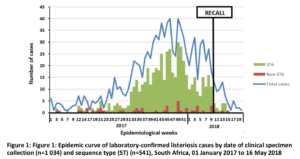
NICD Listeria Situation Report Update:  1038 cases have been reported from 01 January 2017 to 22 May 2018. The number of new cases reported each week has decreased since the implicated products were recalled on 04 March 2018 (Figure 1). Neonates ≤28 days of age are the most affected age group, followed by adults aged 15 – 49 years of age (Figure 2). Most cases have been reported from Gauteng Province (58 %, 607/1038), followed by Western Cape (13%, 130/1038) and KwaZulu-Natal (7%, 76/1038) provinces (Table 1).

The non-profit group Stop Foodborne Illness has extended the application deadline for the Dave Theno Food Safety Fellowship until June 15.

The fellowship program is a partnership with the Michigan State University Online Food Safety Program. The fellow will live in Chicago and work with Stop Foodborne Illness while completing a 12-credit online Food Safety Certificate with Michigan State University. The fellowship includes housing, benefits, salary and tuition.

Eligible applicants include recent graduates (2016-2018) with a food science or animal science undergraduate degree from a U.S. Land Grant University. The non-profit organization said preference will be given to those seeking a career in the food industry or food regulation.

About Dave Theno
At age 66, food safety pioneer Dave Theno was hit and killed by a large wave while swimming with his grandson in Hawaii on June 19, 2017.

At the time of his death, Theno was CEO of Gray Dog Partners Inc., based in Del Mar, CA. He been CEO for the food safety consulting business since 2009.

Theno made history in food safety circles after he was hired as senior vice president and chief food safety officer for Jack-in-the-Box in 1993. The San Diego fast food chain was reeling from a massive and deadly outbreak of E. coli O157:H7. Four deaths and hundreds of illnesses were blamed on the burger chain.

At Jack in the Box, Theno implemented a comprehensive Hazard Analysis and Critical Control Point (HACCP) plan. He was instrumental in requiring finished product test-and-hold protocols for hamburger. The safety measure initially irked those in the meat industry, but was later almost universally adopted.

Theno was also actively involved in numerous food industry and scientific organizations. In May 2017 he posthumously received the lifetime achievement award at the Food Safety Summit as part of the annual NSF Food Safety Innovation awards.

The Dave Theno fellow will:

  • Work in the Stop Foodborne Illness office 35 hours a week;
  • Complete two projects defined by the Stop and MSU Online Food Safety Directors;
  • Participate in weekly Safe Food Coalition calls; with possible travel to Washington, D.C.;
  • Assist the community coordinator in identified initiatives;
  • Help staff Stop’s booth at conferences, including the 2019 International; Association for Food Protection conference in Louisville, KY;
  • Attend “Creating a Food Safety Culture Executive Education” at MSU, May 21-24, 2019; and
  • Finish the MSU Food Safety Certificate coursework (12 credits).

A studio apartment, which is provided for the duration of the fellowship, is located in Chicago’s Ravenswood neighborhood. According to the organization it is wholly furnished, including full kitchen, basic cable and utilities. The Stop Foodborne Illness office is in the same building as the fellowship apartment.

In order to be considered for the fellowship, the application and supplemental materials must now be received by the organization no later than the extended deadline of June 15, 2018.

Applicants will need official transcripts from their degree granting university and three letters of recommendation (2 academic, 1 personal). Additionally, applicants will need a Statement of Intent outlining their background, professional interests, their reason for wanting this fellowship, and how they believe it will help their future career.

To review and begin the application process click here.

About STOP Foodborne Illness 
STOP Foodborne Illness is a national nonprofit public health organization dedicated to preventing illness and death from foodborne pathogens by advocating for sound public policies, building public awareness and assisting those impacted by foodborne illness.

Former FDA Deputy Commissioner of Foods and current board member for STOP, Mike Taylor, said the organization helped create a culture of food safety that has been the driver of “everything that’s happened since [1993] … It’s absolutely clear that [STOP is the] catalyst, and that change of mindset has had a transformative effect on the food system in this country.”

We are in the unique position to know many, but not all (yet), of the “points of sale” – restaurants and grocery stores.  Having over 100 clients allows us to dig deep into their purchase history and consumption history.  We have already determined clusters of illnesses linked to Panera, Texas Roadhouse, Red Lobsters and Papa Murphy’s.  We also have identified a processor – Freshway.  We have reached out to several other retailers, suppliers, processors and growers to ask (first nicely and then with a subpoena) if they will cooperate or not.  We will continue our efforts and share what we find with the FDA and the public.

I will not complain here – again – why the FDA refuses to name those involved – from farms, distributors, processors and  retailers (stores and restaurants).  But you can read my thoughts here.

Directly from the FDA:

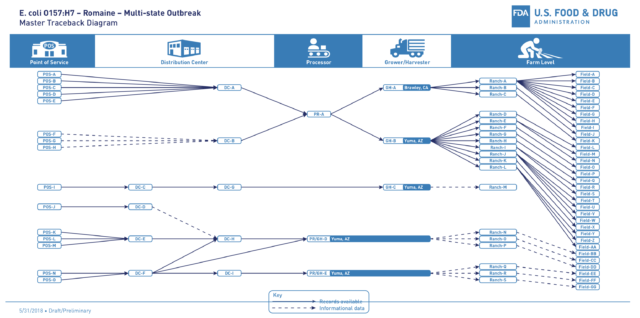
What does this traceback diagram (Redacted) tell us?

It says that there isn’t a simple or obvious explanation for how this outbreak occurred within the supply chain. If the explanation was as simple as a single farm, or a single processor or distributor, we would have already figured that out. The traceback diagram does show us that the contamination with E. coli O157:H7 was unlikely to have happened near the end of the supply chain (such as at a distributor) because there are no common distributors among the places that received and sold or served contaminated lettuce. The contamination likely happened at, or close to, the Yuma growing area.

Our task now is to investigate what happened. We are actively evaluating a number of theories about how romaine lettuce grown on multiple farms in the same growing region could have become contaminated around the same time. It’s possible that contamination occurred on multiple farms at once, through some sort of environmental contamination (e.g., irrigation water, air/dust, water used for pesticide application, animal encroachment). Another possibility is that it happened just after the lettuce left the farm. We are examining all possibilities and as we investigate we learn more about a potential common source we will communicate this information with growers and consumers. But the source and mode of contamination may remain difficult to identify.

Our efforts are complicated by the fact that romaine lettuce is a perishable commodity with a short shelf life of a couple of weeks. None of the lettuce that likely made people sick was available for testing because of the time between the incubation period of E. coli O157:H7 (the time between exposure to the lettuce and the onset of illness) and the time it takes to seek health care and collect specimens from ill people, test those specimens, report the illnesses to public health officials, fingerprint the pathogen to make sure it is part of the outbreak, and interview the ill people to identify where and when they were exposed.  By that time, the lettuce they ate which could have made them ill is long gone.

The Journal-Times reports that the Ashland-Boyd County Kentucky Health Department investigated a case of Hepatitis A diagnosed on May 23 in an employee who worked at McDonald’s Restaurant located at 2550 Winchester Avenue in Ashland, Kentucky.

The investigation found that the risk of restaurant patrons becoming infected was very low. However, McDonald’s is working with the health department to prevent any new cases from arising in the community as a result of this case. All employees, including the diagnosed case, received the Hepatitis A vaccine prior to the May 23 diagnosis. The Winchester Avenue McDonald’s voluntarily closed after notification of the confirmed case to complete extensive disinfection of the facility.

Interesting, the Journal-Times reported that the McDonald’s chain previously established a required hepatitis A vaccination policy for all workers.

This is great, considering a hepatitis A outbreak that has sickened thousands and killed dozens in California, Utah, Michigan, Arizona, Indiana, Kentucky and West Virginia and likely other states, has been brewing for a year.

On May 26 according to WSAZ, a case of hepatitis A was diagnosed in a food worker at the McDonald’s in Grayson, Kentucky. The McDonald’s is located along Carol Malone Boulevard in Grayson.

The Carter County Health Department says all employees at the restaurant received the hepatitis A vaccine before the diagnosis, including the person who was diagnosed. The restaurant closed voluntarily after notification about the diagnosis to sanitize the facility.

The corporate office brought in crews on Saturday, the day of the diagnosis, who disinfected the restaurant. Health officials say the risk of becoming infected if you ate at the restaurant is very low, however, the Carter County Health Department is working with McDonald’s to prevent any new cases from arising.

You have to wonder what the impetus of vaccinating food service workers was?

According to Business Insider, on April 11, 2018 McDonald’s stock dropped on following reports of an investigation of an employee who handled food while infected with hepatitis A. On Thursday, the health department of Madison County, Kentucky, reported it is investigating a single case of hepatitis A linked to an employee working while infectious at a McDonald’s in the town of Berea.

Whatever the motive, great job Ronald.

King 5 News reports that Seattle and King County public health officials are investigating an E.coli outbreak at several Homegrown restaurants in the Seattle area.

Officials say four people have tested positive for Shiga-producing E. coli (STEC) after eating food at three different Homegrown restaurants in King County: Redmond, Kirkland, and Seattle at the Westlake Avenue location.

All four people – three adults and one child – ate the chicken pesto chicken sandwich during April 24-26, 2018. Victims suffered abdominal cramps and diarrhea, with one person reporting they had bloody diarrhea.

Health investigators inspected the three Homegrown locations and identified potential risk factors, such as handwashing facilities violations at two of three locations and a cold holding temperature violation at one of them. All three restaurants were required to complete a thorough cleaning and disinfection.

Investigators were also looking into the various ingredients of the chicken pesto sandwich. Since then, all Homegrown locations in King County have stopped selling the chicken pesto sandwich during the investigation.

  • The number of reported cases per week has decreased since the implicated products were recalled on 04 March 2018 with a total of 64 cases reported since 5 March 2018 (average 6.4 cases/week), whereas 249 cases were reported for the 10-week period prior to the recall (average 24.9 cases/week).
  • Prior to 2017, an average of 60 to 80 laboratory-confirmed listeriosis cases per year (approximately 1 per week), were reported in South Africa. In July 2017, an increase in laboratory-confirmed cases of listeriosis was reported to National Institute for Communicable Diseases (NICD) which was followed by investigations into the reported increase. On 05 December 2017, the listeriosis outbreak was declared by the Minister of Health, Dr. Aaron Motsoaledi. The source of the outbreak was identified as ready-to-eat processed meat products manufactured at Enterprise Foods’ Polokwane production facility. A recall of affected products was initiated on 04 March 2018.

  • 1 034 cases have been reported from 01 January 2017 to 16 May 2018. The number of new cases reported each week has decreased since the implicated products were recalled on 04 March 2018 (Figure 1). Neonates ≤28 days of age are the most affected age group, followed by adults aged 15 – 49 years of age (Figure 2). Most cases have been reported from Gauteng Province (59%, 606/1 034), followed by Western Cape (13%, 130/1 034) and KwaZulu-Natal (7%, 75/1 034) provinces (Table 1).

  • All clinical isolates received at NICD are undergoing whole genome sequencing (WGS). A total of 543 clinical isolates have undergone WGS to date (Figure 1); 92% (499/541) belong to the sequence type 6 (ST6) outbreak strain, and the remainder belong to thirteen different sequence types.
  • Listeriosis outbreak situation report draft _21May2018_final

According to the CDC, as of May 15, 2018, 172 people infected with the outbreak strain of E. coli O157:H7 have been reported from 32 states.  Alaska (8), Arizona (8), California (39), Colorado (3), Connecticut (2), Florida (1), Georgia (4), Idaho (11), Illinois (2), Iowa (1), Kentucky (1), Louisiana (1), Massachusetts (3), Michigan (5), Minnesota (12), Mississippi (1), Missouri (1), Montana (8), Nebraska (1), New Jersey (8), New York (5), North Dakota (2), Ohio (6), Oregon (1), Pennsylvania (21), South Dakota (1), Tennessee (3), Texas (1), Utah (1), Virginia (1), Washington (7), and Wisconsin (3).

Illnesses started on dates ranging from March 13, 2018 to May 2, 2018.

Ill people range in age from 1 to 88 years, with a median age of 29. Sixty-five percent of ill people are female. Of 157 people with information available, 75 (48%) have been hospitalized, including 20 people who developed hemolytic uremic syndrome, a type of kidney failure.

One death was reported from California.

Illnesses that occurred after April 21, 2018, might not yet be reported due to the time it takes between when a person becomes ill with E. coli and when the illness is reported. This takes an average of two to three weeks.

According to the FDA, the last shipments of romaine lettuce from the Yuma growing region were harvested on April 16, 2018, and the harvest season is over. It is unlikely that any romaine lettuce from the Yuma growing region is still available in people’s homes, stores, or restaurants due to its 21-day shelf life. The most recent illnesses reported to CDC started when romaine lettuce from the Yuma growing region was likely still available in stores, restaurants, and in peoples’ homes.

The FDA has identified Harrison Farms of Yuma, Arizona, as the grower and sole source of the whole-head romaine lettuce that sickened several people in an Alaskan correctional facility, but has not determined where in the supply chain the contamination occurred.

The traceback investigation indicates that the illnesses associated with this outbreak cannot be explained by a single grower, harvester, processor, or distributor. While traceback continues, the FDA will focus on trying to identify factors that contributed to contamination of romaine across multiple supply chains.  The agency is examining all possibilities, including that contamination may have occurred at any point along the growing, harvesting, packaging, and distribution chain before reaching consumers.