
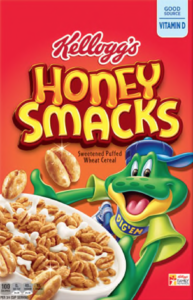
I took the time to fully read FDA Warning Letter sent to Kerry, Inc., that manufactured Honey Smacks for Kellogg’s.  Here is the somewhat redacted beginning:

The United States Food & Drug Administration (FDA) inspected your Kerry, Inc. facility, located at 320 West Gridley Road, Gridley, IL 61744-8723 from June 14 to 29, 2018. The inspection was initiated as (b)(4) in three environmental swabs taken from your (b)(4) cereal (“cereal”) production rooms during FDA’s inspection. Further, FDA’s Whole Genome Sequencing (WGS) analysis of the three isolates of (b)(4).

Here are the highlights/lowlights of the Warning Letter:

Between September 29, 2016 and May 16, 2018, you repeatedly found Salmonella throughout your facility, including in cereal production rooms. During this time period, you had 81 positive Salmonella environmental samples and 32 positive Salmonella vector samples (samples taken in response to finding a positive on routine testing), including four Salmonella (b)(4) samples in the cereal coating room (Line (b)(4)) and one Salmonella (b)(4) sample in the cereal (b)(4) room (Line (b)(4)). Further, you had repeated findings of other Salmonella species in some production lines and rooms used for the manufacture of cereal. These repeated findings of Salmonella in your environment should have resulted in a reanalysis of your food safety plan as required by 21 CFR § 117.170(b)(4) and the identification of contamination of RTE cereal with environmental pathogens as a hazard requiring a preventive control (i.e., sanitation preventive control).

So, in the coming days, as I explain to clients how a company, like Kerry, can seem to ignore 113 positive Salmonella samples and continue to manufacture and ship the Sugar Smacks. The Kerry, the FDA and Kellogg’s will need to explain this to the general public.  My clients and a part of the public is included in:

Total Salmonella Illnesses: 135
Hospitalizations: 34
Last illness onset: 8/29/2018

From Food Safety News:

By Dan Flynn on September 24, 2018

A new edition of “Poisoned: The True Story of the Deadly E. Coli Outbreak That Changed the Way Americans Eat” by Jeff Benedict has been shipped to distributors by book publishers Thomson-Shore.

In the new edition, Benedict catches up with America’s best-known food safety lawyer in South Africa where the world’s largest ever listeriosis outbreak was underway with eerie parallels to America’s 1993 E. coli outbreak, which “Poisoned”explores in detail.

Twenty-five years after that game-changing E. coli O157: H7 outbreak, Benedict finds food safety lawyer Bill Marler older and grayer, but still going from one food safety crisis to another. And South Africa’s listeriosis outbreak is the worst of its kind ever, according to the World Health Organization.

The new edition of “Poisoned” is the first since the original hardback came out in 2011, followed by the paperback in 2014. Its release comes as Benedict, one of America’s top nonfiction writers, finds his book, “Tiger Woods,” riding atop the New York Times Best Seller list.

In the new second edition of “Poisoned,” he reports on Marler teaming up with South African human rights lawyer Richard Spoor to seek justice for more than 1,000 Listeria victims, including the more than 200 that died. “Nearly half of the victims were newborns that had been infected during gestation,” Benedict reports.

Benedict took some time out of one of his increasingly busy days to answer a few questions from Food Safety News (FSN). Here’s what we learned:

FSN: Jeff, we did not know just how busy you’ve been. Congratulations sir, on your new book, “Tiger Woods.” It’s a No. 1 New York Times bestseller with stunning reviews. How does that feel?

JB: “It was a privilege to write the biography of the world’s greatest golfer. Tiger is a Shakespearian figure whose popularity transcends sport. The great thing is that his comeback is a triumphant tale that has captured the attention of the world.”

FSN: About half of your books involve the world of sports. In addition to golf, you’ve authored serious works about college and pro football, the NBA, Indian gaming, and domestic violence involving athletes. How do you follow so many sports and still get anything done?

JB: “It’s not so much about following so many sports. When I write a book, I do full immersion into the subject matter, whether it’s a biography about a famous athlete or an exposé on a phony Indian tribe that built the world’s largest casino. Once I’m into a book, I pretty much block out everything else.”

FSN: You also made famous action on the Supreme Court with “Little Pink House,” the takings case out of New London, CT. Your book was made into a movie that was in theaters earlier this year. What was your role in that?

JB: “I was an executive producer on the film, which starred Catherine Keener and Jeanne Tripplehorn. One of my responsibilities was to persuade David Crosby to compose an original theme song, which turned out to be one of my favorite aspects of working on the film.”

FSN: In returning to “Poisoned” to write for the new edition, were you surprised to find so many instances of foodborne illness still occurring 25 years after the events your first wrote about?

JB: “Not really. What’s interesting is the diversity of foods that are now responsible for E. coli outbreaks. When the Jack in the Box outbreak, which is the subject of “Poisoned,” happened 25 years ago, E. coli poisoning was traced to contaminated ground beef. That used to be the norm. Now E. coli is found in leafy greens and other foods. It shows, in part, how complex our food system has become.”

FSN: Poisoned is a must read for anyone in the food safety community and many will likely want to read the updated version. Beyond this professional community, do you know who makes up the audience for a book like “Poisoned” with it’s behind the scenes look at food safety?

JB “I chose a narrative style that I thought would appeal to parents, especially mothers. I also tried to write the story in a cinematic way. It’s a very visual story. And I remain hopeful that one day it will find its way to the screen.

FSN: Jeff, you’ve been highly productive as an author and producer during the past decade and longer. What’s next for you?

JB:   “The biography of LeBron James.”

Editor’s notes: Jeff Benedict is licensed to practice law in Connecticut. He’s a distinguished professor of writing and mass media at Southern Virginia University. He is represented by Richard Pine at InkWell Management in New York City.

Poisoned FOREWARD 6-29-18

I have been a frequent advocate for more transparency at the FDA when it comes to outbreaks and recalls – especially of Class I Recalls – and a frequent critic of its failure to disclose retailers – where the recalled product was sold – and its failure to disclose manufacturers – where the product was produced.  Commissioner Gottlieb seems to be taking a major leap forward in allowing consumers more information on at lease where tainted product has been sold.

I had just finished by speech at the South American IAFP Conference, when the FDA Alert fell into my in box – Statement from FDA Commissioner Scott Gottlieb, M.D., on new FDA commitment to disclose retailer information for certain food recalls to improve consumer safety.

So, here is Commissioner Gottlieb’s press statement in part.

A bit of History –The agency has not traditionally released lists of specific retailers where recalled foods may have been purchased. This is because certain supply chain information is confidential between the supplier and retailer…. But there are some cases where additional information about the retailers selling potentially harmful product may be key to protecting consumers such as when the food is not easily identified as being subject to a recall from its retail packaging and the food is likely to be available for consumption. It is particularly important in situations where the product has already been linked to foodborne illness.

Retail Disclosure –… That’s why today the FDA issued new draft guidance that describes situations when disclosing retail information for products undergoing recalls is appropriate. The draft guidance outlines the circumstances when the FDA intends to make public the retail locations that may have sold or distributed a recalled human or animal food. These circumstances will particularly apply in situations associated with the most serious recalls, where consumption of the food has a reasonable probability of causing serious adverse health consequences or death to humans or animals.

Retail Disclosure continued –… Based on this new policy, moving forward the FDA intends to publicize retail consignee lists for food recalls when the food is not easily identified as being subject to a recall from its retail packaging, or lack thereof, and if the food is likely to be available for consumption…. The new draft guidance also states that the FDA may disclose retail consignee lists in certain recall situations, including when a recalled food is related to a foodborne illness outbreak and where the information is most useful to consumers….

Perhaps, this says it all? –… I remain committed to investing in the FDA’s food program, building on our successes, and to applying the FDA’s food safety expertise to protect American families and keep our Nation safe.

As of September 19, 2018, 18 people infected with the outbreak strain of E. coli O26 were reported from 4 states – Colorado (10), Florida (15), Massachusetts (1) and Tennessee (1). Illnesses started on dates ranging from July 5, 2018 to July 25, 2018. Ill people ranged in age from one year to 75, with a median age of 16. Sixty-seven percent of ill people were male. Of 18 people with information available, 6 (33%) were hospitalized, including one person who died in Florida.

Epidemiologic, laboratory, and traceback evidence indicates that ground beef from Cargill Meat Solutions was a likely source of this outbreak.

In interviews, ill people answered questions about the foods they ate and other exposures in the week before they became ill. Fourteen (100%) of 14 people interviewed reported eating ground beef. Ill people purchased ground beef from several different grocery stores, including Publix Super Markets, Inc.

USDA-FSIS conducted traceback investigations from stores where ill people reported buying ground beef. Initial information collected from ill people in Florida indicated that the ground beef was purchased from various Publix grocery stores. On August 30, 2018, Publix Super Markets, Inc. recalled ground chuck products sold in several Florida counties.

Further traceback investigation by USDA-FSIS identified Cargill Meat Solutions in Fort Morgan, Colorado as the source of the contaminated ground beef linked to illness, including the recalled ground beef sold at Publix stores in Florida. On September 19, 2018, Cargill Meat Solutions recalled ground beef products that were produced and packaged on June 21, 2018. Products are labeled with the establishment number “EST. 86R” inside the USDA mark of inspection. The products were shipped to retailers nationwide.

Laboratory testing identified the outbreak strain of E. coli O26 in leftover ground beef collected from the home of one ill person in Florida. WGS analysis showed that the E. coli O26 strain identified in the leftover ground beef was highly related genetically to the E. coli O26 strain isolated from ill people.

Cargill Ground Beef 2018 – 17 Ill, 1 Death – E. coli O26

On Aug. 16, 2018, FSIS was notified of an investigation of E. coli O26 illnesses. FSIS, the Centers for Disease Control and Prevention, and state public health and agriculture partners determined that raw ground beef was the probable source of the reported illnesses. The epidemiological investigation identified 17 illnesses and one death with illness onset dates ranging from July 5 to July 25, 2018.  On August 30thPublix Super Markets Inc., a Lakeland, Fla., retail grocery store chain recalled an undetermined amount of ground beef products made from chuck that may be contaminated with Escherichia coli O26.  On September 19th, Cargill Meat Solutions, a Fort Morgan, Colorado establishment, recalled approximately 132,606 pounds of ground beef products made from the chuck portion of the carcass that may be contaminated with Escherichia coli O26,

A bit of History:

Cargill Ground Beef 2012 – 40 Ill – Salmonella

On July 22, 2012 Cargill Meat Solutions announced a recall of 29,339 pounds of fresh ground beef products due to possible contamination with Salmonella Enteritidis. Using epidemiologic and traceback data public health investigators in 8 states (MA, ME, NH, NY, RI, VA, VT, and WV) and the CDC linked 40 patients diagnosed with S. Enteritidis to consumption of Cargill ground beef sold at Hannaford grocery stores in Massachusetts, Maine, New Hampshire, New York and Vermont. Among 40 persons for whom information is available, illness onset dates ranged from June 6, 2012 to July 9, 2012. Eleven patients were hospitalized. The Vermont Department of Health isolated the outbreak strain in leftover product.

Cargill Meat Solutions Ground Turkey 2011 – 181 Ill – Salmonella

The U.S. Department of Agriculture’s Food Safety and Inspection Service(FSIS) issued a public health alert, on July 29, due to concerns about illnesses caused by Salmonella Heidelberg that associated with the use and the consumption of ground turkey. The alert was initiated after continuous medical reports, ongoing investigations and testing conducted by various departments of health across the nation determined an association between consumption of ground turkey products and illness. On August 3, Cargill Meat Solutions issued a recall of ground turkey products. The products subject to recall bear the establishment number “P-963” inside the USDA mark of inspection. On August 4, the Centers for Disease Control published their first outbreak summary. The Salmonella Heidelberg was multi-drug resistant, resistant to ampicillin, streptomycin, tetracycline, and gentamycin. The CDC began their investigation on May 23, after recognizing an “unusual clustering” of Salmonella Heidelberg cases. About the same time, routine surveillance by a federal food monitoring system found the same strain of Salmonella Heidelberg in ground turkey in stores. On July 29, the initial outbreak strain and a second, closely related, strain of Salmonella Heidelberg was isolated from a sample of leftover unlabeled frozen ground turkey from the home of an outbreak case in Ohio. Since February 27, 2011, a total of 23 ill persons were reported to Pulse Net with this second, closely related, strain. Eighty-four ill persons were infected with the initial strain. The consumer product sample originated from the Cargill Meat Solutions Corporation establishment in Springdale, Arkansas. On September 11, Cargill Meat Solutions recalled an additional, approximately 185,000 pounds, of ground turkey contaminated with an identical strain of Salmonella Heidelberg that had led to the earlier recall on August 3. As of September 27, no illnesses had been linked to the additionally recalled, ground turkey products.

Cargill Meat Solutions/BJ’s Wholesale Club Ground Beef 2010 – 3 Ill – E. coli O26

A recall of ground beef was issued on August 28 when three people developed illnesses caused by rare strain of E. coli O26 after they had eaten the product. The ground beef produced by Cargill Meat Solutions, of Pennsylvania and was distributed to BJ’s Wholesale Clubs in New York, Maine, Connecticut, Virginia, New Jersey, New Hampshire, Massachusetts, and Maryland.

Beef Packers, Inc., Cargill, Ground Beef 2009 – 2 Ill – Salmonella

In December, Beef Packers, Inc., owned by Cargill, recalled over 20,000 pounds of ground beef contaminated with a drug-resistant strain of Salmonella Newport. The company issued an earlier recall in August 2009, due to contamination of ground beef with the same strain of Salmonella Newport. This contaminated ground beef was produced in September and was distributed to Safeway grocery stores in Arizona and New Mexico. The Arizona Department of Health linked two illnesses to the ground beef.

Beef Packers, Inc., Cargill, Ground Beef 2009 – 68 Ill – Salmonella

A Beef Packers, Inc. plant in California owned by Cargill, distributed approximately 830,000 pounds of ground beef that was likely contaminated with Salmonella Newport. The beef was shipped to distribution centers in Arizona, California, Colorado, and Utah where it was repackaged into consumer-sized packages and sold under different retail brand names. The contaminated beef contained a strain of Salmonella resistant to several commonly used antibiotics (called MDR-AmpC resistance). Sixty-eight outbreak associated cases were reported by 15 states. Most of the ill in Colorado had purchased the ground beef at Safeway grocery stores.

Cargill Ground Beef Sold at Sam’s Club Stores 2007 – 46 Ill – E. coli O157:H7

A multistate outbreak of E. coli O157:H7 began in August and led to the eventual recall of 845,000 pounds of Cargill ground beef. Forty-six cases were reported by 15 states. Interviews with the case-patients found a common exposure of Cargill hamburger.

Emmpak/Cargill Ground Beef 2002 – 57 Ill – E. coli O157:H7

Wisconsin epidemiologists noted a cluster of E. coli O157:H7 cases. The health department interviewed case-patients and found a common exposure. All victims had eaten ground beef from Emmpak, a meat producer. The same strain of E.coli O157:H7 was isolated from the ground beef. The case investigation resulted in a 2.8-million-pound recall of Emmpak meat and resulted in related illnesses in at least six states. The responsible Emmpak plant was closed for inadequate sampling and testing procedures.

Cargill Deli Turkey 2000  – 29 Ill – Listeria

A case-control study implicated sliced, processed, turkey deli meat in a multistate (11 state) outbreak. A traceback investigation identified a single processing plant in Texas as the likely source of the outbreak. The company recalled 16 million pounds of processed meat. The same plant had been implicated in a Listeria contamination involving the same strain of Listeria more than a decade previously.

Today the CDC reported that it, public health and regulatory officials in several states, and the U.S. Food and Drug Administration (FDA) are investigating a multistate outbreak of Salmonella Enteritidis infections.

As of September 7, 2018, 14 people infected with the outbreak strain of Salmonella Enteritidis have been reported from Alabama and Tennessee.

Illnesses started on dates ranging from July 10, 2018 to August 7, 2018 Ill people range in age from 1 year to 94, with a median age of 31. Fifty percent are female. Of 9 people with information available, 2 (22%) have been hospitalized. No deaths have been reported.

Epidemiologic and traceback evidence indicates that shell eggs from Gravel Ridge Farms in Cullman, Alabama are a likely source of the outbreak.

On September 8, 2018, Gravel Ridge Farms recalled cage-free large eggs because they might be contaminated with Salmonella Enteritidis bacteria. Recalled eggs were sold in grocery stores and to restaurants in Alabama, Georgia, and Tennessee. The FDA website has a list of the grocery stores where recalled eggs were sold. Consumers who have any Gravel Ridge Farms cage-free large eggs in their homes should not eat them. Return them to the store for a refund or throw them away. Restaurants and retailers should not serve or sell recalled Gravel Ridge Farms cage-free large eggs.

As some of the readers might know, in my spare time I am the managing partner at Marler Clark in Seattle.  Our long-time Epidemiologist, Patti Waller, has moved into semi-retirement and is running www.outbreakdatabase.com for us.  Katrina Deardorff, who has been with us for a nearly two years, has decided to take a job back in the public sector, and we wish her well.

So, I am working here on a Saturday (not that uncommon), thinking about how to replace the irreplaceable, but knowing how important this job is to the quality of work we do at Marler Clark.

Minimum requirements are a Masters in Public Health or Epidemiology and some experience in foodborne disease investigations and willingness to live in Seattle.

Please send your resume and salary requirements to me at bmarler@marlerclark.com.  Also, take a chance to see the below.  I think it helps understand the job and its importance.

SPEAKER: William Marler, Managing Partner, Marler Clark, The Food Safety Law Firm
TIME: 4:30 – 5:30 pm
LOCATION: Wynne Courtroom and atrium, Inlow Hall, 530 W. New York Street, Indianapolis, IN
CONTACT: Hall Center for Law and Health at centerlh@iupui.edu

Please join the Indiana University Robert H. McKinney School of Law Hall Center for Law and Health Grand Rounds on Thursday, September 13th at 4:30pm.

William Marler, Managing Partner, Marler Clark, The Food Safety Law Firm

This is a free event, but registration is required.

Bio:

An accomplished attorney and national expert in food safety, William (Bill) Marler has become the most prominent foodborne illness lawyer in America and a major force in food policy in the U.S. and around the world.  Marler Clark, The Food Safety Law Firm, has represented thousands of individuals in claims against food companies whose contaminated products have caused life altering injury and even death.

He began litigating foodborne illness cases in 1993, when he represented Brianne Kiner, the most seriously injured survivor of the historic Jack in the Box E. coli O157:H7 outbreak, in her landmark $15.6 million settlement with the company.  The 2011 book, Poisoned: The True Story of the Deadly E. coli Outbreak that Changed the Way Americans Eat, by best-selling author Jeff Benedict, chronicles the Jack in the Box outbreak and the rise of Bill Marler as a food safety attorney.

For the last 25 years, he has represented victims of nearly every large foodborne illness outbreak in the United States.  He has filed lawsuits against such companies as Chili’s, Chi-Chi’s, Cargill, ConAgra, Dole, Excel, Golden Corral, KFC, McDonald’s, Odwalla, Peanut Corporation of America, Sheetz, Sizzler, Supervalu, Taco Bell and Wendy’s, securing over $600,000,000 for victims of E. coli, Salmonella, and other foodborne illnesses.

Among the most notable cases he has litigated, Bill counts those of nineteen-year-old dancer Stephanie Smith, who was sickened by an E. coli-contaminated hamburger that left her brain damaged and paralyzed, and Linda Rivera, a fifty-seven-year-old mother of six from Nevada, who was hospitalized for over 2 years after she was stricken with what her doctor described as “the most severe multi-organ [bowel, kidney, brain, lung, gall bladder, and pancreas] case of E. coli mediated HUS I have seen in my extensive experience.”

New York Times reporter Michael Moss won a Pulitzer Prize for his coverage of Smith’s case, which was settled by Cargill in 2010 for an amount “to care for her throughout her life.” Linda’s story hit the front page of the Washington Post and became Senate Majority Leader Harry Reid’s touchstone for successfully moving forward the Food Safety Modernization Act in 2010.

Bill Marler’s advocacy for a safer food supply includes petitioning the United States Department of Agriculture to better regulate pathogenic E. coli, working with nonprofit food safety and foodborne illness victims’ organizations, and helping spur the passage of the 2010-2011 FDA Food Safety Modernization Act.  His work has led to invitations to address local, national, and international gatherings on food safety, including testimony before the U.S. House of Representatives Committee on Energy and Commerce.

At little or no cost to event organizers, Bill travels widely and frequently to speak to food industry groups, fair associations, and public health groups about the litigation of claims resulting from outbreaks of pathogenic bacteria and viruses and the issues surrounding it.  He gives frequent donations to industry groups for the promotion of improved food safety and has established numerous collegiate science scholarships across the nation.

He is a frequent writer on topics related to foodborne illness.  Bill’s articles include “Separating the Chaff from the Wheat: How to Determine the Strength of a Foodborne Illness Claim”, “Food Claims and Litigation”, “How to Keep Your Focus on Food Safety”, and “How to Document a Food Poisoning Case” (co-authored with David Babcock.)  He is the publisher of the online news site, Food Safety News and his award-winning blog, www.marlerblog.com is avidly read by the food safety and legal communities. He is frequent media guest on food safety issues and has been profiled in numerous publications.

In 2010 Bill was awarded the NSF Food Safety Leadership Award for Education and in 2008 earned the Outstanding Lawyer Award by the King County Bar Association.  He has also received the Public Justice Award from the Washington State Trial Lawyers Association.

Bill graduated from the Seattle University School of Law in 1987, and in 1998 was the Law School’s “Lawyer in Residence.”  In 2011 he was given Seattle University’s Professional Achievement Award.  He is a former board member of the Washington State Trial Lawyers, a member of the board of directors of Bainbridge Youth Services, former President of the Governor-appointed Board of Regents at Washington State University.

Parking:

Due to road construction on or near campus, we recommended parking at the IUPUI Sports Garage at 875 West New York Street.  Please note this is a change from previous years.

Parking is available for a nominal fee (credit/debit card) at the Sports Garage, as well as the Gateway Garage.

Special Accommodations:

Individuals with disabilities who need special assistance should call (317) 278-4789 no later than one week prior to the event. Special arrangements can be made to accommodate most needs.

Prior E. coli outbreak in 2009 and recall in 2013.

The Department of Health cautioned consumers today to be aware of the risks of drinking raw milk especially for infants and young children, older adults, pregnant women, and people with weakened immune systems.

“Raw milk doesn’t go through the pasteurization process where harmful germs and bacteria are destroyed. This puts infants, young children, the elderly, pregnant women and those with a weakened immune system at a greater risk of illness when they drink it,” said Dr. Scott Lindquist, Washington state communicable disease epidemiologist.

Lab results recently confirmed a child under 5 years old from Island County and resident in their 70s of Clallam County became ill with an E. coli infection after drinking Dungeness Valley Creamery raw milk.

E. coli infections may cause severe diarrhea, stomach cramps and bloody stool. Symptoms generally appear three to four days after exposure, but can take up to nine days to appear. In some cases, the infection causes a serious disease resulting in kidney failure.

Individuals who have any of these symptoms after consuming raw milk should consult their health care provider and notify their local health departments.

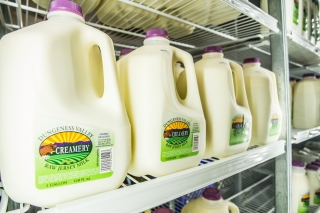
In 2009 an outbreak was linked to the consumption of raw, unpasteurized, whole milk produced by the Dungeness Valley Creamery. There were a total of three cases. There were two E. coli strains implicated. One strain was confirmed and was E. coli O121. The other strain was suspected and was E. coli O157:H7. Raw milk was legal to sell and buy in Washington, provided the dairy underwent a series of inspections and was licensed. This dairy had been licensed since 2006.

In 2013, the Washington State Department of Agriculture (WSDA) is warned consumers not to drink Dungeness Valley Creamery brand raw Jersey whole milk, raw Jersey skim milk, and raw Jersey cream because the products may be contaminated with Escherichia coli bacteria (E. coli) that can cause serious illness.

Dungeness Valley Creamery raw Jersey cream, raw Jersey whole milk and raw Jersey skim milk with any Best Buy dates of 03/02 or later may be contaminated. The firm sells its products in gallon, half gallon, quart and pint containers. Today’s health alert includes all container sizes of the unpasteurized milk products.

The health alert is being initiated after routine sampling by WSDA found toxin-producing E. coli in a sample of raw cream. Based in Sequim, the Dungeness Valley Creamery and WSDA are continuing their investigation into the source of the problem. Currently, no human illnesses have been linked with these products.

Some strains of E. coli produce a toxin called Shiga toxin that can lead to severe illness. Shiga toxin-producing E. coli infections may cause severe diarrhea, stomach cramps, and bloody stool. Symptoms generally appear three to four days after exposure, but can take as long as nine days to appear. Anyone experiencing these symptoms should contact a health care provider.

The infection sometimes causes hemolytic uremic syndrome, a serious disease in which red blood cells are destroyed and the kidneys fail. Infants, children, pregnant women, the elderly and those with compromised immune systems are especially at risk.

According to the Dungeness Valley Creamery website, the firm’s products are sold at the following retail locations:
• Bainbridge Island: Real Foods; Pan D’Amore; Walt’s Lynwood Center Market
• Bothell: Tru Health
• Bremerton: CJ’s Evergreen General Store; Fresh Local
• Federal Way: Marlene’s Market & Deli
• Issaquah: Front Street Red Apple
• Longview: Country village Nutrition Shoppe
• Olympia: Olympia Food Co-op East; Olympia Food Co-op West
• Port Angeles: Country Aire; Good To Go
• Port Townsend: Port Townsend Food Co-op
• Poulsbo: Abundantly Green
• Seattle: Madison Market; My Asia’s Essentials; Pike Place Market Creamery
• Sequim: Sequim Prairie Grange; Red Rooster Grocery; Sunny Farms Farm Store
• Tacoma: Marlene’s Market & Deli
• Vancouver: Chuck’s Produce; Neighbors Market