

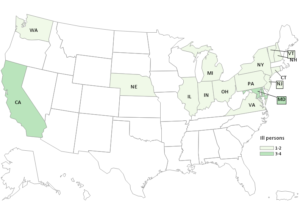
 According to the CDC, fifty-nine people infected with the outbreak strain of Shiga toxin-producing E. coli O157:H7 have been reported from 15 states and the District of Columbia. Illnesses started on dates ranging from October 5, 2018 to November 16, 2018. Twenty-three people have been hospitalized, including two people who developed hemolytic uremic syndrome, a type of kidney failure. No deaths have been reported. In Canada, as of December 13, 2018, there have been 28 confirmed cases of E. coli illness investigated in Ontario (5), Quebec (19), New Brunswick (1), and British Columbia (3). The illnesses in British Columbia were related to travel to Quebec, Ontario and the United States. Individuals became sick between mid-October and mid-November 2018. Ten individuals have been hospitalized, and two individuals suffered from hemolytic-uremic syndrome (HUS), which is a severe complication that can result from an E. coli infection. No deaths have been reported. Individuals who became ill are between 2 and 93 years of age.
The above numbers will grow.
And, there are the real people I have spoken to in last week related to this outbreak:
- Husband with wife in rehabilitation after nearly two-month hospitalized in ICU with HUS. She is still on dialysis three times a week and will be for rest of her life.
- Airline pilot who stopped over in Toronto and has now been hospitalized for weeks in the US with HUS.
- Father of Canadian child who ate romaine lettuce while on vacation in California and has been hospitalized with HUS for seven weeks in Vancouver, BC.
- Mom tonight who I spoke to as her daughter was undergoing a bowel resection do to E. coli O157:H7.
- Another mom whose daughter spent 15 days in the hospital undergoing several blood transfusions after being diagnosed with HUS.
Real people.
 Fifty-nine people infected with the outbreak strain of Shiga toxin-producing E. coli O157:H7 have been reported from 15 states and the District of Columbia. Since the last
 Summary
 That is the Microbiological Date Program – deceased.
  In 2017 in Canada, a total, of 42 cases of E. coli O157 illness were reported in five eastern provinces: Ontario (8), Quebec (15), New Brunswick (5), Nova Scotia (1), Newfoundland and Labrador (13). Seventeen individuals were hospitalized. One individual died. Individuals who became ill were between the ages of 3 and 85 years of age. The majority of cases (74%) were female.
 As of today, forty-three people infected with the outbreak strain of Shiga toxin-producing E. coli O157:H7 have been reported from 12 states. Illnesses started on dates ranging from October 8, 2018 to October 31, 2018. Sixteen people have been hospitalized, including one person who developed hemolytic uremic syndrome, a type of kidney failure.
 Thirty-two people infected with the outbreak strain of Shiga toxin-producing E. coli O157:H7 have been reported from 11 states.
 In 2017, the CDC, several states, and the U.S.
 The Thanksgiving meal is the largest many cooks prepare each year. Getting it just right, especially the turkey, brings a fair amount of pressure whether or not a host is experienced with roasting one. The United States Department of Agriculture’s (USDA) Food Safety and Inspection Service (FSIS) is issuing food safety recommendations on