
V&T Meat and Food, Calgary, Alberta and Hiep Thanh Trading, Edmonton, Alberta, are recalling certain raw pork products from the marketplace due to possible E. coliO157:H7 contamination.Consumers, food service establishments, retailers, distributors and manufacturers in Alberta, should not consume, serve, use, or sell certain raw pork products sold by these two retailers/distributors because the raw pork products may be contaminated with E. coliO157:H7.The affected raw pork products have only been distributed in Alberta.  All raw pork products sold from these locations, during the identified time periods, are affected by this recall.

These raw pork products may have been sold by other retailers. Consumers who are unsure if they have the affected products are advised to check with their retailer.

This recall was triggered by the E. coli O157:H7 foodborne outbreak investigation led by Alberta Health Services (http://www.albertahealthservices.ca/10353.asp) and supported by the Canadian Food Inspection Agency (CFIA) that has sickened 152.

And, do not be surprised that it is in pork:

Samadpour M, Ongerth JE, Liston J, Tran N, Nguyen D, Whittam TS, Wilson RA, Tarr PI. 1994. Occurrence of Shiga-like toxin-producing Escherichia coli in retail fresh seafood, beef, lamb, pork, and poultry from grocery stores in Seattle, Washington. Applied and Environmental Microbiology 60 (3): 1038-1040 Samadpour et al (1994), found non-O157 STEC in 9 (18%) of 51 pork samples, 10 (48%) of 21 lamb samples, 5 (63%) of 8 veal samples, 4 (12%) of 33 chicken samples, 1 (7%) of 15 turkey samples, 6 (10%) of 62 fish samples, and 2 (5%) of 44 shellfish samples tested.

Fratamico PM, Bagi LK, Bush EJ, Solow BT. 2004. Prevalence and characterization of Shiga toxin-producing Escherichia coli in swine feces recovered in the National Animal Health Monitoring System’s Swine 2000 study. Applied and Environmental Microbiology 70(12):7173-8. Fratamico et al., (2004) determined that 70% of 687 swine fecal samples tested positive for the presence of Shiga toxin, and found that most of the serogroups isolated have been associated with human illness. These authors concluded that swine could be a potential reservoir of STEC strains that cause human illness, but conceded that the extent to which swine play a role in the epidemiology of human infection needs further investigation.

Shiga toxigenic and atypical enteropathogenic Escherichia coli in the feces and carcasses of slaughtered pigs 14.dec.12 Foodborne Pathogens and Disease. December 2012, 9(12): 1119-1125 Clarissa Araújo Borges, Lívia Gerbasi Beraldo, Renato Pariz Maluta, Marita Vedovelli Cardozo, Beatriz Ernestina Cabilio Guth, Everlon Cid Rigobelo, and Fernando Antônio de Ávila http://online.liebertpub.com/doi/abs/10.1089/fpd.2012.1206#utm_source=ETOC&utm_medium=email&utm_campaign=fpd Abstract Escherichia coli is a pathogen of major importance in swine and public health. To determine the prevalence of Shiga toxigenic E. coli (STEC) and enteropathogenic E. coli (EPEC), samples were collected from the feces and carcasses of swines. In total, 441 samples were collected in four samplings, of which 141 samples tested positive for either the stx1, stx2, and/or eae genes. From the positive samples, one STEC and 15 atypical EPEC (aEPEC) isolates were obtained, and all originated from the same sampling. In addition to eae, lpfAO157/OI-141, ehxA, toxB, and lpfAO113were present in the aEPEC isolates. The only
stx2-containing isolate carried stx2e and belonged to serotype O103:HNT. Resistance to four or more antimicrobials was found in almost half of the isolates, and some isolates shared the same fingerprint patterns by enterobacterial repetitive intergenic consensus–polymerase chain reaction (ERIC-PCR). The presence of
certain virulence genes and the high level of resistance to antimicrobials, as well as the possible fecal contamination of carcasses showed that some of the isolates are of public health concern.

Escherichia coli O157:H7: Animal reservoir and sources of human infection 31.mar.11 Foodborne Pathogens and Disease. April 2011, 8(4): 465-487 Witold A. Ferens, Carolyn J. Hovde http://www.liebertonline.com/doi/abs/10.1089/fpd.2010.0673 Abstract This review surveys the literature on carriage and transmission of enterohemorrhagic Escherichia coli (EHEC) O157:H7 in the context of virulence factors and sampling/culture technique. EHEC of the O157:H7 serotype are worldwide zoonotic pathogens responsible for the majority of severe cases of human EHEC disease. EHEC O157:H7 strains are carried primarily by healthy cattle and other ruminants, but most of the bovine strains are not transmitted to people, and do not exhibit virulence factors associated with human disease. Prevalence of EHEC O157:H7 is probably underestimated. Carriage of EHEC O157:H7 by individual animals is typically short-lived, but pen and farm prevalence of specific isolates may extend for months or years and some carriers, designated as supershedders, may harbor high intestinal numbers of the pathogen for extended periods. The prevalence of EHEC O157:H7 in cattle peaks in the summer and is higher in postweanedcalves and heifers than in younger and older animals. Virulent strains
of EHEC O157:H7 are rarely harbored by pigs or chickens, but are found in turkeys. The bacteria rarely occur in wildlife with the exception of deer and are only sporadically carried by domestic animals and synanthropic rodents and birds. EHEC O157:H7 occur in amphibian, fish, and invertebrate carriers, and can colonize plant surfaces and tissues via attachment mechanisms different from those mediating intestinal attachment. Strains of EHEC O157:H7 exhibit high genetic variability but typically a small number of genetic types predominate in groups of cattle and a farm environment. Transmission to people occurs primarily via ingestion of inadequately processed contaminated food or water and less frequently through contact with manure, animals, or infected people.

Tullia’s is recalling Tullia’s Italian Meatless Pasta Sauce after tests revealed its acidity was low enough to allow the growth of the organism that causes botulism.  The sauce is labeled in blue ink with the code 530140. The batch includes 16 and 32 ounce sizes.

The sauce is sold at Rosauer’s, Yoke’s, Egger’s on West Rosewood, Trading Company Stores in Spokane, Main Market and Albertson’s at Wandermere Mall.

Botulism is potentially fatal, but the company has not been notified of any illnesses associated with the sauce. The decision to recall the product was made after a review by the Washington state Department of Agriculture.

Tjs Place of Kirkland Washington is voluntarily recalling approx. 20 containers of Basil Pesto Pasta packed in 8 oz plastic tubs because it has the potential to be contaminated with Listeria monocytogenes, an organism which can cause serious and sometimes fatal infections in young children, frail or elderly people, and others with weakened immune systems. Although healthy individuals may suffer only short-term symptoms such as high fever, severe headache, stiffness, nausea, abdominal pain and diarrhea, listeria infection can cause miscarriages and stillbirths among pregnant women.

The recalled Basil Pesto Pasta was sold between the dates 8/18/14 and 8/21/14. The Basil Pesto Pasta affected by this recall has a sticker on the side of the container with either of the following codes: 0825, 0826, 0827, 0828

Basil Pesto Pasta was distributed in convenience stores, pharmacies, cafes and espresso stands located in King and Snohomish counties in Washington State.

The firm is not aware of any reported illnesses to date.

The potential for contamination was discovered after routine testing by the Washington State Department of Agriculture (WSDA) revealed the presence of Listeria monocytogenes in a container of the Basil Pesto Pasta.

Tjs Place has suspended production and distribution of the product while WSDA and the company continue to investigate the source of the problem.

Food Safety News reports that the sale of raw milk from Treasured Sunrise Acres in Parma, ID, has been put on hold until further notice by the Idaho Department of Agriculture after recently testing positive for Cryptosporidium.

Milk from Treasured Sunrise Acres tested positive for the parasite the week of Aug. 24, according to news reports. Two Canyon County residents who consumed the dairy’s raw goat milk reportedly became ill.

State officials said anyone who purchased raw goat or cow milk from the dairy or any retail outlets selling it on or after Aug. 24 should not consume the milk but should discard it. The milk was apparently sold in stores in Boise, Caldwell, Ketchum and Star.

Cryptosporidium is a microscopic parasite that can cause stomach cramps or pain, dehydration, nausea, vomiting, fever and weight loss. However, the most common symptom is watery diarrhea, although some people have no symptoms at all. Cryptosporidium can be spread in several ways, but is most often transmitted by drinking and recreational water.  Symptoms of Cryptosporidiosis generally begin two to 10 days (average is seven days) after becoming infected with the parasite and usually last about one to two weeks in people with healthy immune systems.

Researchers at the University of California, San Diego have produced the first complete genome sequencing of a strain of E. coli that is a common cause of outbreaks of food poisoning in the United States. Although the E. coli strain EDL933 was first isolated in the 1980s, it gained national attention in 1993 when it was linked to an outbreak of food poisoning from Jack-in-the-Box restaurants in the western United States. Their paper published online Aug. 14 in the journal Genome Announcements reports the full, complete sequence with no gaps. Their analysis includes so-called jumping genes that can move around the same genome, sometimes causing damage to individual genes or enabling antibiotic resistance.

“With a complete genome sequence, we can now pinpoint the precise location of all such elements, which might help to track and treat future outbreaks,“ said Ramy Aziz, the senior author on the paper. Aziz led the research as a visiting scientist working in Bernhard Palsson’s Systems Biology Research Group at UC San Diego Jacobs School of Engineering. Aziz is also a professor at Cairo University in Egypt.

The genome sequence for this historical strain was first published in 2001, but there were many gaps in the genome that could not be closed with the sequencing technology available to scientists in 2001. Given the importance of this strain as a major cause of food poisoning, Palsson’s Systems Biology Research Group recently sequenced its genome using a combination of sequencing data from instruments made by Pacific Biosciences and Illumina.

“New sequencing and assembly methods are enabling a full expose of pesky pathogens; there is no place to hide genetic characteristics anymore.  The full genetic delineation of multiple pathogenic strains is likely to not only improve our understanding of their characteristics, but to find and exploit their vulnerabilities, said Palsson, the Galletti Professor of Bioengineering at UC San Diego.

The research was supported by a National Institutes of Health grant (GM098105).

4C Foods Corp. is recalling its 6-oz. glass jars of “4C Grated Cheese HomeStyle Parmesan”, UPC 0-41387-32790-8 with code dates BEST BY JUL 21 2016 and JUL 22 2016 due to possible contamination with Salmonella. This recall does not impact any other 4C cheese products.

Salmonella is an organism that can cause serious and sometimes fatal infections in young children, elderly people, and others with weakened immune systems. Healthy persons infected with Salmonella often experience fever, diarrhea, nausea, vomiting and abdominal pain. In rare circumstances, infection with Salmonella can result in the organism getting into the bloodstream and producing more severe illnesses.

No illnesses have been reported to date in connection with this problem.

On July 24, 2014, Product was distributed to: IA, IL, MI, MN, ND, NE, SD, and WI through retail stores.

Item is packed as 12 glass jars per case, code dates BEST BY JUL 21 2016 and JUL 22 2016 can be located on jar back side toward bottom portion.

The potential risk was brought to 4C’s attention by FDA during routine testing. This recall affects 308 cases that were shipped of the affected date codes.

The U.S. Food and Drug Administration (FDA) along with the Centers for Disease Control and Prevention (CDC) and Texas officials have been investigating an outbreak of Cyclospora infections in the state of Texas.  According to the CDC, reported cyclosporiasis cases have returned to baseline levels in Texas.

As of August 26, 2014, CDC has been notified of 133 cases of Cyclospora infection in Texas among Texas residents who did not travel outside the country within the two weeks prior to becoming ill.  Four hospitalizations have been reported in Texas.  Texas state health officials reported that most cases of the illness occurred in June and July 2014.

Epidemiological and traceback investigations have been conducted at four different restaurants in Texas, where multiple unrelated ill persons reportedly have eaten. All the ill persons in these four clusters reported having eaten a food item containing fresh cilantro in the 2-14 days before they became ill.  Preliminary FDA and Texas state traceback investigation indicates that cilantro suppliers in Puebla, Mexico were a source of the cilantro that was served at the four restaurants.

Also as of August 26, 2014, the CDC had been notified of 304 ill persons with confirmed Cyclospora infection in 2014; of these, 207 ill persons from the following states had no history of international travel within two weeks before onset of illness: Arkansas, California, Connecticut, Florida, Illinois, Maine, Maryland, Massachusetts, Michigan, Minnesota, Montana, Nebraska, Pennsylvania, New Jersey, New York (and New York City), Texas, Virginia, Wisconsin, and Washington.

  • Most (133; 64%) of the cases were reported from Texas.
  • Most (133; 64%) of the cases were reported in July 2014.
  • Most (176; 85%) of the illness onset dates occurred in June and July.
  • Among 183 persons with available information, 7 (4%) have reported being hospitalized. No deaths have been reported.
  • Among 204 persons with available information, ill persons range in age from 3 to 88 years, with a median age of 49 years.
  • Among 204 persons with available information, 115 (56%) of ill persons are female.

CNN’s Moni Basu is reporting from the trial of former executives of the now defunct Peanut Corporation of America – “Peanut butter killed his mom; now son watches company brass stand trial.”  It is well worth the read.

Beginning in November 2008, CDC (Centers for Disease Control) PulseNet staff noted a small and highly dispersed, multistate cluster of Salmonella Typhimurium isolates. The outbreak consisted of two pulsed field gel electrophoresis (PFGE) defined clusters of illness. The first cluster displayed a unique primary enzyme (XbaI) restriction pattern and an uncommon secondary enzyme (BlnI) pattern. The second cluster had two closely related XbaI patterns that were very similar to the first cluster and a BlnI pattern that was indistinguishable from the first cluster. Illnesses continued to be revealed through April, 2009, when the last CDC report on the outbreak was published. Peanut butter and peanut butter containing products produced by the Peanut Corporation of America plant in Blakely, Georgia, were implicated.

At least 716 people were sickened and at least nine died.


Total of 15 people in Minnesota identified with same strain of bacteria; no new cases since July 10.  As many as three cases in three other states possibly linked.

State health officials have identified green whole head cabbage as the likely source of an E. coli O111 outbreak that sickened 15 people in Minnesota in July.

The cabbage was likely contaminated at some point prior to distribution to restaurants.

Routine monitoring by the Minnesota Department of Health (MDH) identified the 15 cases of illness associated with Shiga toxin-producing E. coli O111. Bacterial isolates from all of the cases had the same DNA fingerprint. This genetic strain of E. coli O111 had not been seen in the United States previously.

MDH investigators were able to interview 14 of the cases: 13 of them ate at 9 different Applebee’s restaurants in Minnesota, and one ate at Yard House.

Many cases had reported eating the Oriental Chicken Salad at Applebee’s, leading Applebee’s to voluntarily and out of an abundance of caution pull the menu item and specific ingredients from the salad from their menu for a time. It was returned to the menu after Applebee’s obtained different sources for the ingredients.

The common food item across all foods consumed by cases was green whole head cabbage.

Minnesota officials traced the cabbage to a common supplier outside of Minnesota and continue to work with the United States Food and Drug Administration (FDA) to investigate its source. The FDA examination of the potentially involved farms is still ongoing.

Single cases of illness that match the outbreak strain have occurred in three other states.

The illnesses occurred between June 25 and July 3. Four of the people who became ill were hospitalized and all have recovered. No new cases connected with this outbreak have been identified in Minnesota since July 10.

Symptoms of illness caused by E. coli O111 typically include stomach cramps and diarrhea, often with bloody stools, but only a low-grade or no fever. People usually become ill two to five days after exposure, but this time period can range from one to at least eight days. Most people recover in five to 10 days. Complications from infection are more common among those with weaker immune systems, including young children and the elderly. As with E. coli O157:H7, infection with E. coli O111 should not be treated with antibiotics, as this practice might promote further complications.

Alberta Health Services investigates every case of E. coli O157:H7 confirmed in every Zone, as part of routine operations.

The following cases are being investigated for potential links to the E. coli O157:H7 outbreak in Alberta.

This investigation is ongoing.

At this time, it is not known whether these cases are linked to the outbreak.

Alberta Health Services has also not confirmed source(s) of illness related to this outbreak, at this time.

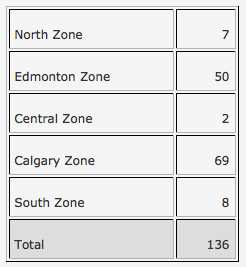
Confirmed Cases of E.coli O157:H7  July 15, 2014 to August 28, 2014: