

On Friday, December 5, more than 100 people gathered at Nackawic Community Hall for a turkey dinner sponsored by a local church.   In the hours following the traditional meal of turkey, vegetables, gravy and pies, dozens of those attendants fell ill. About 30 people reported signs of gastrointestinal illness, diarrhea and abdominal pain.

On Monday morning, 87-year-old Bessie Scott died. Early autopsy reports suggest a gastrointestinal illness could be to blame, although the health department is still investigating.

Public health officials have taken samples of the dinner’s leftovers and are trying to determine the exact cause of the infections.

“All the types of food that were served, how those foods were prepared, the sources of each of those foods, where they came from in terms of grocery stores versus home-made versus…all of those elements are being looked at,” Dr. Jennifer Russell, New Brunswick’s acting Chief Medical Officer of Health, told CTVNews.

AP reports that school and health officials are trying to find out what sickened dozens of people after a sports banquet for a metro Atlanta high school.

WSB-TV reports that more than 100 people experienced symptoms such as nausea, vomiting and diarrhea after the banquet Monday night in Roswell. They included several football players, their relative and coaches from Centennial High School.

Centennial Principal Kibbey Crumbley said in a memo to the players and parents that the symptoms can be associated with many viruses and bacteria that could possibly be related to food-borne pathogens.

The Fulton County Health Department said in a statement that they’re doing laboratory tests and interviewing people who attended the banquet in an attempt to track down the source of the illness.

Seattle Times’ JoNel Aleccia reports tonight that Washington state health officials have ordered an emergency harvest closure and a multistate recall of all shellfish from a portion of Washington’s Mason County’s Hammersley Inlet after at least a dozen people who ate raw oysters became ill.

According to Alleccia, Norovirus is suspected in the illnesses reported last month; laboratory tests confirmed the infection in two people, health officials said.

The recall announced Thursday includes nearly 4,000 dozen oysters and nearly 3,000 pounds of Manila clams from the area processed from Nov. 10 to Dec. 5. The shellfish was sent to a dozen states including Oregon, Nevada, Florida, Minnesota, Illinois, California, New York, Maine, Georgia, Massachusetts, New Jersey and Virginia.

Norovirus is a highly contagious gastrointestinal illness that spreads easily via contaminated surfaces, food or person-to-person contact.

Colorado Local health officials said they hope a norovirus outbreak in Buena Vista that left approximately 20 people ill in mid-November will serve as a reminder to area restaurants and food providers to be extra cautious.

Chaffee County Public Health received complaints from five people saying they were ill after eating food from the Subway in Buena Vista, according to a restaurant inspection report.

Lab tests on samples from the five individuals all tested positive for norovirus — an extremely contagious virus that can cause stomach pain, nausea, diarrhea and vomiting, according to the Centers for Disease Control and Prevention (CDC).

Public Health estimates roughly 20 people, mostly students at Buena Vista High School, might have fallen ill in the outbreak.

An investigation by Chaffee County Environmental Health Manager Victor Crocco, who declined to name the restaurant, found that one employee reported feeling ill the day after the illness was originally reported.

The restaurant was cited for three noncritical items, according to the inspection report, but the items cited likely did not lead to the outbreak, Crocco said.

Norovirus is the leading cause of illness and outbreaks from contaminated food in the U.S., according to the CDC. While an infected person can shed billions of norovirus particles, it only takes contact with as few as 18 particles to become infected.

The Marler Clark Christmas potluck is next week.

According to news reports, the food poisoning outbreak at an office Christmas party at Maitland Colonnades on Wednesday sickened 55 people, and 25 were transported to area hospitals – a “staph” party?

Health department officials are conducting interviews and running tests on food samples and bodily fluids to find the source.

The Florida Department of Business and Professional Regulations, which licenses restaurants and caterers, has identified Kitchen Divas as the caterer of the event. The company was last inspected in July. It passed inspection but had five violations, four of which were basic, such as shelf under preparation table soiled with food debris and standing water in hand-wash sink. One was intermediate: the probe thermometer was not within the intended measuring range of use.

At least five health department epidemiologists are performing what’s called a trace-back investigation. They’re talking to patients, the business and the caterer to find the common link.

“They certainly think it was a food-borne illness,” said Dain Weister, public information officer for Florida Department of Health in Orange and Seminole Counties.

Given that people got sick quickly with diarrhea and vomiting, “the immediate organism that comes to mind is Staph,” said Alfred Aleguas, managing director of the Tampa poison center. Staph is one of the most common causes of food poisoning, he said.  Staphylococcus aureus, or staph, is a common bacterium found on the skin and nose of nearly a quarter of people and animals. It usually doesn’t cause an illness, but it can make several types of toxins, some of which cause food poisoning.

Here is my take on local radio.

Food Safety News reports that Massachusetts state and local health department officials are investigating 19 Salmonella cases linked to a restaurant in Holyoke,  Brian Fitzgerald, Holyoke’s health director, told a local TV station that officials were trying to figure out why people were apparently sickened after eating at the Delaney House in Holyoke between Nov. 11 and 15, 2014.

Investigative reports from the Massachusetts Department of Public Health indicate that 19 confirmed Salmonella cases and additional potential cases were traced back to 10 different events held at the Delaney House.

The restaurant has not been shut down, although the state asked local health officials to order the management to comply with several alleged food code violations.

Five food handlers and one non-food handling employee at the restaurant also tested positive for Salmonella. Some of the infected food handlers reportedly worked at events outside of the Delaney House, including the Log Cabin, a take-out restaurant, and various catered events.

Del Monte Fresh Produce N.A., Inc. (“Del Monte Fresh”) announced today the voluntary recall of fresh cut fruit containing Gala red apples grown in Pennsylvania.

The affected product was distributed to a limited number of customers in a few States in North East US and is being recalled because these apples have the potential to be contaminated with Listeria monocytogenes, an organism that can cause serious and sometimes fatal infections in young children, frail or elderly people, and others with weakened immune systems.

Listeriosis symptoms may include fever and muscle aches, sometimes preceded by diarrhea and other gastrointestinal distress, according to the Centers for Disease Control and Prevention. Although healthy individuals may suffer only short-term symptoms such as high fever, severe headache, stiffness, nausea, abdominal pain and diarrhea, Listeria infection can cause miscarriages and stillbirths among women who are pregnant.

A total of 3,051 consumer packages containing fresh cut red apples were distributed to Giant Eagle, Amazon Fresh, Sunoco, Peter’s Fruit, Wegmans, Sheetz and 7-Eleven and have “Best If Enjoyed By” dates of 12/3/14, 12/6/14, 12/7/14 and 12/8/14. The fresh cut red apples have a red color skin.

The recalled fresh cut fruit packages containing red apples were distributed for sale in clear plastic containers with one of the following labels and markings.

Go here for full list.

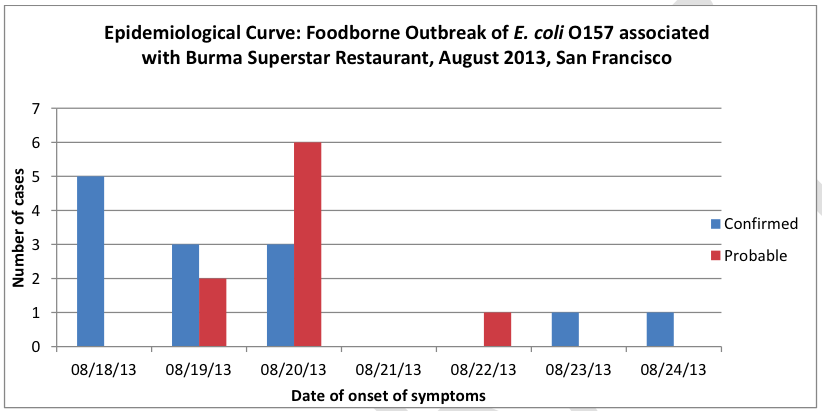
I am off to the Seattle airport this morning heading to San Francisco to attend a status conference on the litigation pending between two young adults that suffered a modest infection and two siblings that developed hemolytic uremic syndrome (HUS) and a popular San Francisco restaurant – Burma Superstar.  The restaurant was linked to an E. coli O157:H7 outbreak that sickened nearly two dozen – some seriously.  Here are the details of the Burma Superstar Outbreak Investigation Report:

Between Friday, August 23 and Monday, August 26, 2013, the San Francisco Department of Public Health Communicable Disease Control Unit (SFDPH CDCU) received eight reports of laboratory- confirmed Escherichia coli (E. coli) O157;H7 infection in unrelated San Francisco residents. This number of reports represented a marked increase over the background incidence of E. coli O157:H7 in San Francisco of less than 1 case per month. The eight reports were received from three clinical laboratories. Case-patient residences were geographically dispersed throughout San Francisco but suggested moderate to high socioeconomic status. CDCU initiated standard follow-up interviews with all case-patients.  While no common exposures or demographic characteristics were immediately apparent, cases tended to be younger, salad-eating, local-market shoppers.

On August 26, SFDPH requested assistance from the California Emerging Infections Program (CEIP), and an investigation was initiated to ascertain the source of infections and prevent further illnesses.  The California Department of Public Health Microbial Diseases Laboratory (MDL) was asked to prioritize Pulse-Field Gel Electrophoresis (PFGE) testing of E. coli O157:H7 isolates from San Francisco and the surrounding counties. On August 28, 2013, a Health Alert was sent to local clinicians notifying them of the observed increase in cases, recommending increased testing for symptomatic patients, reminding them of the reporting requirement, and requesting forwarding of E. coli O157:H7 isolates to the SFDPH Public Health Laboratory.

Case-patients were re-interviewed with a detailed hypothesis-generating questionnaire. The hypothesis-generating questionnaire identified a common restaurant and dates of exposure: Burma Superstar restaurant on August 16 and 17.   On August 30, a joint press release was issued by SFDPH and Burma Superstar in order to inform the public and assist in case finding. A total of 22 confirmed and probable case-patients were identified. A case-control study and a dining group level cohort study were initiated to identify suspect food items.  A garlic noodle dish was strongly associated with illness, but the specific ingredient causing disease was not identified. An environmental investigation resulted in recommendations for the restaurant that included improved hand washing and food handling, as well as a requirement for Food Safety training. Although the outbreak was self-limited, lessons learned from this response may improve SFDPH’s response to future similar events.

Neptune Manufacturing agreed to a permanent injunction amid claims that it did not ensure a safe environment for seafood production.  The Order prohibits Neptune from committing violations of the federal Food, Drug, and Cosmetic Act, and it requires Neptune to cease all manufacturing operations.

FDA inspections dating back to 2006 “documented a pattern of continuing conduct of insanitary conditions resulting in the persistent presence of Listeria monocytogenes.”  The FDA conducted its most recent inspection in December 2013, allegedly documenting a failure by Neptune with regard to “Hazard Analysis and Critical Control Point plans that control for Clostridium botulinum and L. mono hazards.”

Inspectors noted the observation of cutting utensils “with dried pieces of fish on them, and exposed cracks, pits and crevices on the floor allowed water to pool in them, increasing the risk of L. mono contamination.”

FDA samples taken from the brining room, the smoking-drying room and the walk-in cooler, where finished products are stored, all tested positive for L. mono, the Justice Department alleged, noting that these are “critical areas.”