

CDC, public health and regulatory officials in multiple states, and the U.S. Food and Drug Administration (FDA) investigated a multistate outbreak of Cyclospora cayetanensis infections.
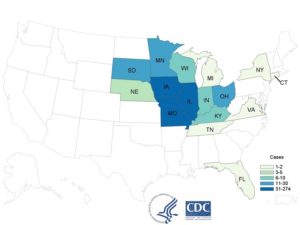 As of September 11, 2018, CDC was notified of 511 laboratory-confirmed cases of Cyclospora infections in people from 15 states and New York City who reported consuming a variety of salads from McDonald’s restaurants in the Midwest.
Twenty-four (24) people were hospitalized. No deaths were reported.
Epidemiologic and traceback evidence indicated that salads purchased from McDonald’s restaurants were one likely source of this outbreak.
On July 13, 2018, McDonald’s voluntarily stopped selling salads at over 3,000 locations in 14 states. The company has since reportedExternal that it has replaced the supplier of salad mix in those states.
On July 26, 2018, the FDA completed final analysis of an unused package of romaine lettuce and carrot mix distributed to McDonald’s by the Fresh Express processor in Streamwood, IL. The analysis confirmed the presence of Cyclospora in that sample.

What is cyclospora? Cyclospora is a parasite composed of one cell, too small to be seen without a microscope. The organism was previously thought to be a blue-green alga or a large form of cryptosporidium. Cyclospora cayetanensis is the only species of this organism found in humans. The first known human cases of illness caused by cyclospora infection (that is, cyclosporiasis) were first discovered in 1977. An increase in the number of cases being reported began in the mid-1980s, in part due to the availability of better diagnostic techniques. Over 15,000 cases are estimated to occur in the United States each year. The first recorded cyclospora outbreak in North America occurred in 1990 and was linked to contaminated water. Since then, several cyclosporiasis outbreaks have been reported in the U.S. and Canada, many associated with eating fresh fruits or vegetables. In some developing countries, cyclosporiasis is common among the population and travelers to those areas have become infected as well.
Where does cyclospora come from? Cyclospora is spread when people ingest water or food contaminated with infected stool. For example, exposure to contaminated water among farm workers may have been the original source of the parasite in raspberry-associated outbreaks in North America. Cyclospora needs time (one to several weeks) after being passed in a bowel movement to become infectious. Therefore, it is unlikely that cyclospora is passed directly from one person to another. It is not known whether or not animals can be infected and pass infection to people.
What are the typical symptoms of Cyclospora infection? Cyclospora infects the small intestine (bowel) and usually causes watery diarrhea, bloating, increased gas, stomach cramps, loss of appetite, nausea, low-grade fever, and fatigue. In some cases, vomiting, explosive diarrhea, muscle aches, and substantial weight loss can occur. Some people who are infected with cyclospora do not have any symptoms. Symptoms generally appear about a week after infection. If not treated, the illness may last from a few days up to six weeks. Symptoms may also recur one or more times. In addition, people who have previously been infected with cyclospora can become infected again.
What are the serious and long-term risks of cyclospora infection? Cyclospora has been associated with a variety of chronic complications such as Guillain-Barre syndrome, reactive arthritis or Reiter’s syndrome, biliary disease, and acalculous cholecystitis. Since cyclospora infections tend to respond to the appropriate treatment, complications are more likely to occur in individuals who are not treated or not treated promptly. Extraintestinal infection also appears to occur more commonly in individuals with a compromised immune system.
How is cyclospora infection detected? Your health care provider may ask you to submit stool specimen for analysis. Because testing for cyclospora infection can be difficult, you may be asked to submit several stool specimens over several days. Identification of this parasite in stool requires special laboratory tests that are not routinely done. Therefore, your health care provider should specifically request testing for cyclospora if it is suspected. Your health care provider might have your stool checked for other organisms that can cause similar symptoms.
How is cyclospora infection treated? The recommended treatment for infection with cyclospora is a combination of two antibiotics, trimethoprim-sulfamethoxazole, also known as Bactrim, Septra, or Cotrim. People who have diarrhea should rest and drink plenty of fluids. No alternative drugs have been identified yet for people with cyclospora infection who are unable to take sulfa drugs. Some experimental studies, however, have suggested that ciprofloxacin or nitazoxanide may be effective, although to a lesser degree than trimethoprim-sulfamethoxazole. See your health care provider to discuss alternative treatment options.
How can Cyclospora infection be prevented? Avoiding water or food that may be contaminated is advisable when traveling. Drinking bottled or boiled water and avoiding fresh ready-to-eat produce should help to reduce the risk of infection in regions with high rates of infection. Improving sanitary conditions in developing regions with poor environmental and economic conditions is likely to help to reduce exposure. Washing fresh fruits and vegetables at home may help to remove some of the organisms, but cyclospora may remain on produce even after washing.
 Now that is a mouthful of some pathogens.
 This year marks the 25th anniversary of a massive E. coli outbreak, which hit 73 Jack in the Box restaurants in Washington, Idaho, Oregon and California; sickened 700 people; sent 171 to the hospital; and killed four. The anniversary is a somber but noteworthy milestone for accomplished food safety attorney Bill Marler ’87.
 It is said that it is always hard to get the first olive out of the jar and it is the same in settlements. It was hard fought, but the resolutions of the cases were fair and my hope is that these corporate defendants and their insurers see that it is in everyone’s best interest to take care of customers who were sickened by their product sooner rather than later.
 The Spring 2018 E. coli O157:H7 Romaine Lettuce Outbreak: In 2018 in the United Sates, 210 people infected with the outbreak strain of E. coli O157 were reported from 36 states. 96 people were hospitalized, including 27 people who developed a type of kidney failure called hemolytic uremic syndrome (HUS). 5 deaths were reported from Arkansas, California, Minnesota (2), and New York. In Canada, 8 cases of E. coli O157 that were genetically similar to the U.S. outbreak linked to romaine lettuce coming from the Yuma growing region in the U.S. The 8 Canadian illnesses were reported in 5 provinces: British Columbia, Alberta, Saskatchewan, Ontario and Quebec. 1 of the Canadian cases was hospitalized with HUS and no deaths were reported in Canada. Through our own traceback, we have uncovered numbers restaurant clusters which have led to processor clusters, and in some instances, farms.
 The Summer 2018 E. coli O26 Ground Beef Outbreak: As of September 19, 2018, 18 people infected with the outbreak strain of E. coli O26 were reported from 4 states. Illnesses started on dates ranging from July 5, 2018 to July 25, 2018. Ill people ranged in age from one year to 75, with a median age of 16. Sixty-seven percent of ill people were male. Of 18 people with information available, 6 (33%) were hospitalized, including one person who died in Florida. Epidemiologic, laboratory, and traceback evidence indicates that ground beef from Cargill Meat Solutions was a likely source of this outbreak.
 The Summer 2018 Salmonella Adelaide Cut Fruit Outbreak: As of July 24, 2018, 77 people infected with the outbreak strain of Salmonella Adelaide were reported from nine states – Arkansas 1, Florida 1, Illinois 7, Indiana 14, Kentucky 1, Michigan 39, Missouri 11, Ohio 2, Tennessee 1. Illnesses started on dates ranging from April 30, 2018, to July 2, 2018. Ill people ranged in age from less than 1 year to 97, with a median age of 67. Among ill people, 67% were female. Out of 70 people with information available, 36 (51%) were hospitalized. No deaths were reported. Epidemiologic and traceback evidence indicated that pre-cut melon supplied by the Caito Foods, LLC of Indianapolis, Indiana was the likely source of this multistate outbreak.
 The
The  Summary
 Four people were killed Saturday when part of a crane fell from the construction site of a future Google building.
 I will be in lovely Minneapolis for the coming week meeting with defense counsel and the insurers for the manufacturers of E. coli O26-tainted ground beef, Salmonella-tainted cut fruit and E. coli O157:H7-tainted romaine lettuce who sickened dozens in 2018. I hear the weather in Minnesota may still have some snow in it, but heck, it also will be my birthday Friday.
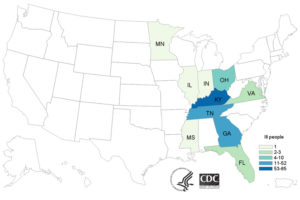 What we also do know – According to the CDC and 10 state health agencies, a total of 177 people infected with the outbreak strain of E. coli O103 have been reported from 10 states – Georgia (41), Kentucky (65), Ohio (10), Tennessee (52), Virginia (2), Indiana (1), Florida (3), Illinois (1), Mississippi (1) and Minnesota (1). The Illnesses started on dates from March 1, 2019, to April 14, 2019. Ill people range in age from less than 1 year to 84 years, with a median age of 18. Fifty-one percent are female. Twenty-one people have been hospitalized. However, fortunately, no deaths and no cases of hemolytic uremic syndrome have been reported.
 Why does in take time to count the ill and come to a conclusion as to a common cause – The CDC says that illnesses that occurred after March 29, 2019, might not yet be reported due to the time it takes between when a person becomes ill with E. coli and when the illness is reported. This takes an average of two to three weeks. The truth is that takes time for people to become ill – onset (between ingestion and illness) can be 1 to 10 days. It then takes time for tests to be run to confirm an infection and then to have the E. coli “genetically fingerprinted” using PFGE and the good people at CDC Pulsenet. Then it takes time to interview people and to ask them to recall what they consumed in the 1-10 before they became ill. And, finally it takes time to see what the growing number of ill across 10 states do and do not have in common. It simply takes time.
 It is therefore possible that we are seeing the end of the outbreak. And, in looking at the “Epi Curve,” the trend line is down. Perhaps the number of ill, assuming all tainted product is eventually recalled, might crest 200. However, this sadly is still the largest E. coli outbreak linked to ground beef in decades (think 1993
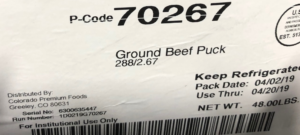
  K2D Foods, doing business as Colorado Premium Foods, in Carrollton, Georgia, recalled approximately 113,424 pounds of raw ground beef products on April 23, 2019 after an unopened, intact ground beef collected as part of the ongoing investigation from a unnamed restaurant location, where multiple case-patients reported dining, tested positive for E. coli O103. The products subject to recall bear establishment number “EST. 51308” inside the USDA mark of inspection on the boxes. These items were shipped to distributors in Port Orange, Florida and Norcross, Georgia for further distribution to restaurants.
 Grant Park Packing in Franklin Park, Illinois, recalled approximately 53,200 pounds of raw ground beef products on April 24, 2019 after an unopened, intact, packages of ground beef collected as part of the ongoing investigation tested positive for E. coli O103 at an FSIS laboratory. The sample was collected at an unnamed point of service where multiple case patients ate. The products subject to recall bear establishment number “EST. 21781” inside the USDA mark of inspection. These items were shipped to Minnesota for further distribution and Kentucky for institutional use.
 On the anniversary of my 5,000th blog post (I’m n0w at 6388) I wrote: