
The Wisconsin Department of Health Services, Wisconsin Department of Agriculture, Trade and Consumer Protection, Minnesota Department of Health, and Wisconsin local health departments are working with the Food and Drug Administration and Centers for Disease Control and Prevention to investigate an ongoing multi-state outbreak of salmonellosis linked to consumption of certain Del Monte vegetable trays. To date, all ill patients associated with this outbreak, three in Wisconsin and one in Minnesota, have reported consuming a Del Monte vegetable tray purchased from a Wisconsin or Minnesota Kwik Trip location prior to their illness.  Kwik Trip is cooperating with regulatory officials and has removed all Del Monte vegetable trays from their stores. These patients reported becoming ill between April 13 and April 27, 2019. It is possible additional illnesses will be reported due to the delay from when a person becomes ill to when it is reported to public health agencies.

The Del Monte vegetable trays associated with the investigation contain broccoli, cauliflower, carrots, and dill dip. Del Monte vegetable trays may also have been distributed to other retailers in Wisconsin. Investigation for product distribution is ongoing. Consumers are advised to not eat the following products:

Del Monte Vegetable Tray (containing broccoli, cauliflower, carrots, and dill dip) 6 oz.
Del Monte Vegetable Tray (containing broccoli, cauliflower, carrots, and dill dip) 12 oz.

Del Monte Vegetable Trays, where have I heard that before:

As of September 5, 2018, 250 people were infected with Cyclospora reported from 4 states.

Illnesses started on dates ranging from May 14, 2018 to June 20, 2018. Ill people ranged in age from 13–79 years with a median age of 45. Among ill people, 52% were female. Eight people (3%) were hospitalized. No deaths were reported.

Epidemiologic evidence indicated that pre-packaged Del Monte Fresh Produce vegetable trays containing broccoli, cauliflower, carrots, and dill dip were the likely source of these infections.

In interviews, ill people answered questions about the foods they ate in the 2 weeks before they became ill. Ill people reported eating pre-packaged Del Monte Fresh Produce vegetable trays containing broccoli, cauliflower, carrots, and dill dip. Ill people reported buying pre-packaged Del Monte Fresh Produce vegetable trays containing broccoli, cauliflower, carrots, and dill dip in the Midwest. Most people reported buying the trays at Kwik Trip convenience stores

On June 15, 2018, Del Monte Fresh Produce recalled 6 oz., 12 oz., and 28 oz. pre-packaged vegetable trays containing fresh broccoli, cauliflower, celery sticks, carrots, and dill dip. Recalled products were sold in clear, plastic clamshell containers.

As they say “down under” – “good on ya”

However, if history is a guide, please remain vigilant.

Date Vehicle Etiology Confirmed
Cases
States/Provinces
July 1995 Lettuce (leafy green; red; romaine) E. coli O157:H7 74 1:MT
Sept. 1995 Lettuce (romaine) E. coli O157:H7 20 1:ID
Sept. 1995 Lettuce (iceberg) E. coli O157:H7 30 1:ME
Oct. 1995 Lettuce (iceberg; unconfirmed) E. coli O157:H7 11 1:OH
May-June 1996 Lettuce (mesclun; red leaf) E. coli O157:H7 61 3:CT, IL, NY
May 1998 Salad E. coli O157:H7 2 1:CA
Feb.-Mar. 1999 Lettuce (iceberg) E. coli O157:H7 72 1:NE
Oct. 1999 Salad E. coli O157:H7 92 3:OR, PA, OH
Oct. 2000 Lettuce E. coli O157:H7 6 1:IN
Nov. 2001 Lettuce E. coli O157:H7 20 1:TX
July-Aug. 2002 Lettuce (romaine) E. coli O157:H7 29 2:WA, ID
Nov. 2002 Lettuce E. coli O157:H7 13 1:Il
Dec. 2002 Lettuce E. coli O157:H7 3 1:MN
Oct. 2003-May 2004 Lettuce (mixed salad) E. coli O157:H7 57 1:CA
Apr. 2004 Spinach E. coli O157:H7 16 1:CA
Nov. 2004 Lettuce E. coli O157:H7 6 1:NJ
Sept. 2005 Lettuce (romaine) E. coli O157:H7 32 3:MN, WI, OR
Sept. 2006 Spinach (baby) E. coli O157:H7 and other serotypes 205 Multistate and Canada
Nov./Dec. 2006 Lettuce E. coli O157:H7 71 4:NY, NJ, PA, DE
Nov./Dec. 2006 Lettuce E. coli O157:H7 81 3:IA, MN, WI
July 2007 Lettuce E. coli O157:H7 26 1:AL
May 2008 Romaine E. coli O157:H7 9 1:WA
Oct. 2008 Lettuce E. coli O157:H7 59 Multistate and Canada
Nov. 2008 Lettuce E. coli O157:H7 130 Canada
Sept. 2009 Lettuce: Romaine or Iceberg E. coli O157:H7 29 Multistate
Sept. 2009 Lettuce E. coli O157:H7 10 Multistate
April 2010 Romaine E. coli O145 33 5:MI, NY, OH, PA, TN
Oct. 2011 Romaine E. coli O157:H7 60 Multistate
April 2012 Romaine E. coli O157:H7 28

1:CA

Canada

June 2012 Romaine E. coli O157:H7 52 Multistate
Sept. 2012 Romaine E. coli O157:H7 9 1:PA
Oct. 2012 Spinach and Spring Mix Blend E. coli O157:H7 33 Multistate
Apr. 2013 Leafy Greens E. coli O157:H7 14 Multistate
Aug. 2013 Leafy Greens E. coli O157:H7 15 1:PA
Oct. 2013 Ready-To-Eat Salads E. coli O157:H7 33 Multistate
Apr. 2014 Romaine E. coli O126 4 1:MN
Apr. 2015 Leafy Greens E. coli O145 7 3:MD, SC, VA
June 2016 Mesclun Mix E. coli O157:H7 11 3:IL, MI, WI
Nov. 2017 Leafy Greens E. coli O157:H7 67 Multistate and Canada
Mar. 2018 Romaine E. coli O157:H7 219 Multistate and Canada
De. 2018 Romaine E. coli O157:H7 91 Multistate and Canada


Vienna Beef Ltd., a Chicago, Ill. establishment, is recalling approximately 2,030 pounds of beef frank links products that may be contaminated with extraneous materials, specifically metal, the U.S. Department of Agriculture’s Food Safety and Inspection Service (FSIS) announced today.

The beef frank links items were produced on May 2, 2019. The following products are subject to recall:

  • 10-lb. cases containing “SKINLESS BEEF FRANKFURTERS 6” 8’s 10#” with case code 013180 and package code 9122 represented on the label.
  • 10-lb. cases containing “SKINLESS BEEF FRANKFURTERS 6” 11’s 10#” with case code 013312 and package code 9122 or 9123 represented on the label.
  • 10-lb. cases containing “SKINLESS BEEF FRANKFURTERS 7” 9’s 10#” with case code 013490 and package code 9122 or 9123 represented on the label.

The products subject to recall bear establishment number “EST. 1” inside the USDA mark of inspection. These items were shipped to food service locations in Illinois, Indiana, and Wisconsin.

The problem was discovered by the establishment and reported to FSIS.

The United States Food and Drug Administration, along with the Centers for Disease Control and Prevention (CDC), and state and local partners, are investigating a multistate outbreak of Salmonella Concord illnesses linked to “Karawan Tahini and Halva” brand tahini imported from Israel.

The FDA has been working with the state of New York and New York City. The New York City Department of Health and Mental Hygiene tested samples of Karawan tahini and found that the product contained Salmonella.

Total Illnesses: 4
Hospitalizations: 1
Deaths: 0
Last illness onset: March 23, 2019
States with Cases: New York (2), Massachusetts (1), Texas (1)

Based on the positive product sample, the available epidemiological data, and traceback data from the investigation, the FDA has requested that the product be voluntarily recalled. Discussions with the U.S. agent for the firm, as well as foreign public health partners are ongoing and additional information will be provided as it becomes available.

The label of the product that tested positive for Salmonella identified Brodt Zenatti Holdings, LLC, of Jupiter, Fla., as the importer of that specific tahini, however, other importers may have also imported “Karawan Tahini and Halva” branded tahini. The investigation is ongoing, but at this time the current outbreak does not appear to be related to the previous 2018-2019 outbreak of Salmonella Concord linked to tahini.

The tahini of concern may be labelled as either “Karawan Tahini” or as “El Karawan Tahini.”  Consumers should avoid eating this tahini. This tahini was sold in bulk to retailers and restaurants and was also available to consumers at retail locations and online. It may have also been used in other food products sold to consumers. Consumers should be aware that this product has a shelf life of two years and should check their homes for tahini with either label. Consumers with this tahini in their home should not eat it and should discard it. Consumers with concerns about tahini consumed outside the home should ask their restaurant or retailer if the product they have purchased contains this tahini. Retailers and restaurants should throw the product out and sanitize any surfaces that may have come in contact with this tahini.

Tahini is made from sesame seeds and can be served on its own or used as an ingredient in Mediterranean and Middle Eastern style dishes, such as hummus, falafel, and baba ganoush.

The definitive article on the devastating 2017-2018 Listeria Outbreak linked to Tiger Brand Polony dropped into my inbox by Anthony M. Smith, Nomsa P. Tau, Shannon L. Smouse, Mushal Allam, Arshad Ismail, Ntsieni R. Ramalwa, Bolele Disenyeng, Mimmy Ngomane, and Juno Thomas – Foodborne Pathogens and Disease – http://doi.org/10.1089/fpd.2018.2586

In South Africa, a progressive increase in listeriosis cases was noted from mid-June 2017, heralding what was to become the world’s largest listeriosis outbreak. A total of 1060 cases were reported for the period January 1, 2017 to July 17, 2018. We describe laboratory activities, experiences, and results of whole-genome sequencing (WGS) analysis of Listeria monocytogenes isolates associated with this outbreak. Bacteria were identified using the VITEK-2 COMPACT 15 microbial identification system. WGS was performed using Illumina MiSeq technology. WGS data were analyzed using CLC Genomics Workbench Software and free-to-use on-line analysis tools/pipelines. Multilocus sequence typing (MLST) showed that 91% of clinical isolates were sequence type 6 (ST6), determining that the outbreak was largely associated with L. monocytogenes ST6. Epidemiological and laboratory findings led to investigation of a large ready-to-eat processed meat production facility in South Africa, named Enterprise Foods. L. monocytogenes ST6 was found in environmental sampling swabs of the production facility and in ready-to-eat processed meat products (including polony, a product similar to bologna sausage) manufactured at the facility. ST6 isolates, sourced at the Enterprise Foods [Tiger Brands] production facility and from Enterprise food products, were shown by single nucleotide polymorphism (SNP) analysis to be highly related to clinical isolates; these nonclinical ST6 isolates showed <10 SNP differences when compared to clinical ST6 isolates. Core-genome MLST showed that clinical ST6 isolates and Enterprise-related ST6 isolates had no more than 4 allele differences between each other, suggestive of a high probability of epidemiological relatedness. WGS data interpreted together with epidemiological data concluded that the source of the listeriosis outbreak was ready-to-eat processed meat products manufactured by Enterprise Foods. Listeriosis has now been added to the South African list of mandatory notifiable medical conditions. Surveillance systems have been strengthened to facilitate prevention and early detection of listeriosis outbreaks.

Full Article

As I hit 62 a few days ago, there has been an increase in the number of people asking me the “retirement” question.  After 31 years – 26 doing what I do now – I get the question.  But, when I wake up to emails like this, why would I ever think about retiring:

Just wanted to let you know how much I appreciate your blog. As a food defense professional, I do track all the FDA recalls and such. However, I do appreciate your commentary and perspective.

Last week I attended the Food Safety Summit in Chicago and I had to chuckle. In several sessions over many days I heard over and over again…”If you don’t do X, you will face Bill Marler.” I think this is a great testimony to the work you do and holding folks accountable.

So, despite the grey hair, I am not going anywhere soon.

Had a great opportunity to get on the line with some of my favorite people with one of the very best online sources of everything food.  Here is the interview:

From meat and eggs to leafy greens, four experts weigh in on the safety of the U.S. food supply over the past decade and lay out strategies to improve it.

Listeria in smoked salmon, pieces of metal in chicken strips, undeclared allergens in frozen Chinese food and meatballs, E.coli in ground beef, and mold in corn used for animal feed. This is a partial list of the foods recall in the U.S. from just the last few weeks. In our increasingly consolidated, industrialized food system, stories like these have become commonplace. And yet, unless they are associated with documented illnesses or deaths—such as last year’s two outbreaks of E. coli on Romaine lettuce in Yuma, Arizona, which led to hundreds of illnesses and at least five deaths—they rarely make front page news.

The question of just how safe our food is, and what can be done to make it safer, has been occupying scientists, advocates, lawmakers, and public health officials for decades, and the last 10 years have been especially contentious.

In 2011, President Obama signed into law the most significant piece of food-safety legislation since the 1930s. The Food Safety Modernization Act (FSMA) came in response to a wave of food-borne illnesses and granted the U.S. Food and Drug Administration (FDA) broad new powers to inspect and regulate food products and producers.

At the same time, the country’s food safety system remains complicated—the U.S. Department of Agriculture (USDA) remains responsible for inspecting all meat, poultry, and eggs, while the FDA inspects everything else. Under this situation, a frozen pepperoni pizza would undergo three USDA inspections, while a frozen cheese pizza from the same company would receive just one FDA inspection.

While designed and intended to save lives and protect people, food safety regulations can bring financial and operational burdens to farmers and other food producers, especially those with small- and medium-sized operations. And the growing interest in and demand for cottage food laws and “food sovereignty” bills hint at a grass-roots resistance to what some producers might see as overreaching regulations.

To celebrate Civil Eats’ 10th anniversary, we have been conducting a series of roundtable discussions touching on some of the most important topics we have covered since 2009. In the conversation below, we invited four experts to weigh in on the state of food safety. Marion Nestle is an author and the Paulette Goddard Professor, of Nutrition, Food Studies, and Public Health, Emerita, at New York University; Bill Marler is the managing partner of Marler Clark, a Seattle, Washington, based law firm that specializes in foodborne illness cases and founder and publisher of Food Safety NewsRebecca Spector is the West Coast director for the advocacy nonprofit Center for Food Safety; and Judith McGeary is an attorney, farmer, advocate, and the executive director of the Farm and Ranch Freedom Alliance, a Texas-based organization that advocates for policies to support independent family farmers.

Civil Eats’ editor-in-chief, Naomi Starkman, and associate editor Christina Cooke facilitated the wide-ranging discussion. The conversation has been edited for clarity and brevity.

Here is the full meal deal.

Since the last update on April 26, 2019, 19 more ill people were added to this outbreak.
As of May 13, 2019, 196 people infected with the outbreak strain of E. coli O103 have been reported from 10 states -Florida 5, Georgia 49, Illinois 1, Indiana 1, Kentucky 69, Minnesota 1, Mississippi 1, Ohio 12, Tennessee 55 and Virginia 2. CDC is reporting the 196 illnesses that the PulseNet laboratory network has confirmed are part of this outbreak. States are investigating additional illnesses that might be a part of this outbreak.

Illnesses started on dates from March 1, 2019, to April 19, 2019. Ill people range in age from less than 1 year to 84 years, with a median age of 19. Fifty-two percent are female. Of 174 people with information available, 28 (16%) have been hospitalized. No deaths and two cases of hemolytic uremic syndrome have been reported.

This multistate investigation began on March 28, 2019, when officials in Kentucky and Georgia notified CDC of this outbreak. Epidemiologic and laboratory evidence indicates that ground beef is the likely source of this outbreak.

In interviews, ill people answered questions about the foods they ate and other exposures in the week before they became ill. Of the 147 people interviewed, 115 (78%) reported eating ground beef. This percentage is significantly higher than results from a survey pdf icon[PDF – 787 KB] of healthy people. Ill people bought or ate ground beef from several different grocery stores and restaurants. Many ill people bought large trays or chubs of ground beef from grocery stores and used the meat to make dishes like spaghetti sauce and sloppy joe.

Officials in Tennessee collected ground beef from a restaurant where ill people reported eating. Laboratory testing identified the outbreak strain of E. coli O103 in the ground beef collected in Tennessee.

Two companies recalled raw ground beef products because they may be contaminated with E. coli. Grant Park Packing in Franklin Park, Ill., recalled approximately 53,200 pounds of raw ground beef products on April 24, 2019. K2D Foods, doing business as Colorado Premium Foods, in Carrollton, Ga., recalled approximately 113,424 pounds of raw ground beef products on April 23, 2019. These products were sold to restaurants and institutions.

USDA-FSIS and state regulatory officials continue to collect products for testing and continue their traceback investigations to determine the source of ground beef supplied to grocery stores and restaurants where ill people ate. At this time, no common supplier, distributor, or brand of ground beef has been identified that could account for the whole outbreak.

Almost 70 people have fallen ill in New Zealand with Salmonella infections from alfalfa sprouts.

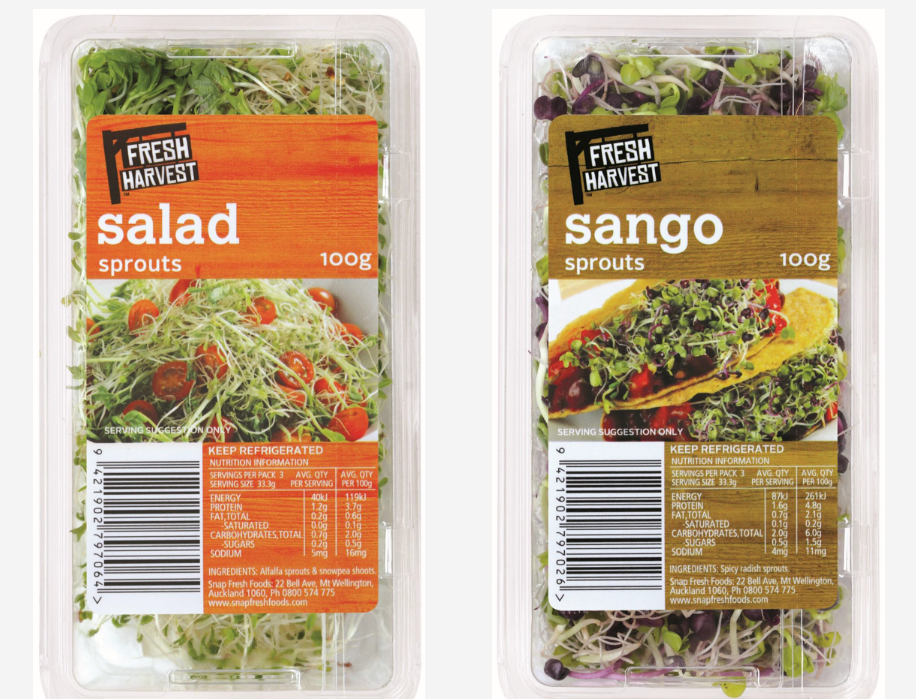
GSF Fresh New Zealand recalled some of its Pams, Sproutman and Fresh Harvest branded sprout products because of a “production process concern” at the end of March.

Recalled Pams brand sprouts

“Salmonella Typhimurium phage type 108/170 was the causative pathogen identified from cases, sprouts and spent irrigation water tested in this outbreak. Subtyping using Multiple Locus Variable-Number Tandem Repeat Analysis (MLVA) and whole genome sequencing methods were performed on isolates to confirm cases in the outbreak as well as the outbreak source,” said the spokesman.

Analysis of information from people who got sick and test results confirmed the strain of Salmonella was identical to a strain detected in alfalfa sprouts and indicates the product is the likely source of illness.

There were only four cases of this phage type identified in 2018, 13 in 2017 and 19 in 2016.

Recalled sprouts had best before dates of March 31 to April 4. GSF New Zealand is one of the largest produce manufacturers in New Zealand, according to the firm’s website. The company operates a plant in Auckland which manufactures fresh produce for restaurants throughout the country.

Recalled Fresh Harvest brand sprouts

Fresh Harvest brand products were sold in Countdown, Fresh Choice and SuperValue supermarkets throughout the North Island. Pams Superfoods Super Salad Mix was sold in supermarkets across New Zealand. Other Pams brand sprouts affected by the recall were only sold in supermarkets around the North Island. Sproutman brand products were sold in stores and retail outlets across the country.

Pams brand sprouts sold in the South Island are made by a different supplier, Southern Alps Sprouts Ltd, and were not affected by the recall.

Onset date of the first known case was Dec. 23, 2018. The most recent case was reported on April 1, 2019. Between that period there were 67 confirmed and two probable infections. The majority of cases – 66 – fell ill between Jan. 23 to 25. No deaths were reported, but 17 people needed hospital treatment.

Cases were predominantly in the North Island and from the following District Health Boards: Waitemata (13 cases), Counties Manukau (8), Waikato, MidCentral and Hutt Valley (6 each), Capital and Coast (5), Wairarapa (4), Northland, Auckland and Hawke’s Bay (3 each), Lakes, Tairawhiti, Taranaki and Southern (2 each), Bay of Plenty, Whanganui, Nelson Marlborough and Canterbury (1 each).

The people affected ranged in age from 2 to 92 years old and almost two-thirds were women.

MPI advises consumers that the only way to make all varieties of sprouts safe is to cook them thoroughly.

The agency also recommends not to serve raw sprouts to young children and babies, the frail elderly, pregnant women, people who’ve recently had an operation and those who have a chronic illness or have been advised to take extra care with food safety.

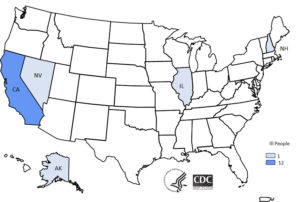
The CDC and public health and regulatory officials in California, Nevada, Alaska, Illinois and New Hampshire are investigating a multistate outbreak of Vibrio parahaemolyticus, Shigella flexneri, STEC non-O157, Vibrio albensis, Campylobacter lari, and norovirus genogroup 1 illnesses linked to raw oysters harvested from Estero El Cardon estuary in Baja California Sur, Mexico. On May 6, one U.S. distributor of oysters harvested from Estero El Cardon issued a voluntary recall  On May 7, Estero El Cardon was closed to further oyster harvesting pending investigation.

Epidemiologic and traceback evidence for these cases indicated people ate raw oysters harvested from Estero El Cardon in Baja California Sur, Mexico. State public health officials identified additional illnesses among people who also ate raw oysters from the same harvest area.

As of May 10, 2019, 16 ill people have been reported from five states. Ill people in this outbreak have been infected with multiple pathogens causing illness, including Vibrio parahaemolyticus, Shigella flexneri, STEC non-O157, Vibrio albensis, Campylobacter lari, and norovirus genogroup 1.

In interviews, ill people answered questions about the foods they ate and other exposures in the week before they became ill. All 15 people who were interviewed reported eating raw oysters from different restaurants in California and Nevada. State health officials collected traceback information for 15 cases and found that oysters were shipped by SOL AZUL, S.A. DE C.V. (MX 01 SS) and harvested from Estero El Cardon (an estuary).

Illnesses started on dates ranging from December 16, 2018 to April 4, 2019. Among 15 people with information available, ages range from 26 to 80 years, with a median age of 38. Sixty-seven percent are male. Of 15 people with clinical information available, 2 (13%) hospitalizations were reported. Illnesses might not yet be reported due to the time it takes between when a person becomes ill and when the illness is reported. This can take 4 or more weeks.