

According to data collected by FERN, as of May 13 at 12pm ET, at least 206 meatpacking and processed food plants and 9 farms have confirmed cases of Covid-19, and at least two meatpacking plants and five processed food plants are currently closed. At least 15,525 workers  (14,136 meatpacking workers, 1,017 food processing workers, and 372 farmworkers) have tested positive for Covid-19 and at least 60 workers (55 meatpacking workers and 5 food processing workers) have died. 

Lack of food worker safety will lead to a lack of food security.
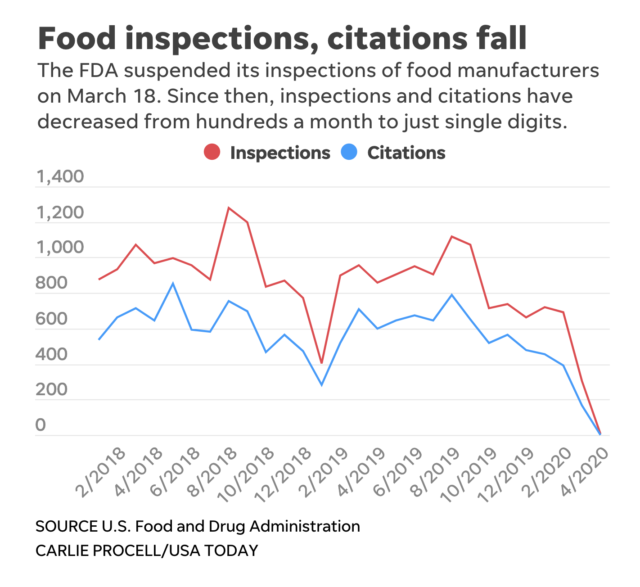
Kyle Bagenstose of  USA Today did a deep dive into food safety in today’s article: “Inspections, citations, recalls slashed: Coronavirus is testing America’s food safety net.”  The lack of inspections and recalls are of great concern.

In addition, the questions raised about foodborne illness investigations (or the lack thereof) are of even great concern, as I weighed in on:

Another weak link in the food safety chain involves doctors, patients and health departments.  

Typically, outbreak investigations start at the local level, when a sick patient visits a doctor and a stool sample is taken. Those samples are then collected through a series of commercial and public health laboratories before being uploaded into the PulseNet database.

But hospitals and health departments are understandably focused on COVID-19, said William Marler, an attorney with Marler Clark in Seattle who specializes in food safety.

“If a kid gets acute kidney failure caused by E. coli, normally there would be a health worker there interviewing them to find out the common denominator for their illness,” Marler said. “Are they able to do that? I think the answer is probably not.”

There are additional signs such shortfalls may be occurring.

On a national call with consumer groups last week, CDC officials said several state health departments reported trouble keeping up with stool sample testing and asked for federal support. One state, which was not identified by the CDC, requested further help with interviewing patients to determine what they ate.

Janet Hamilton, executive director of the Council of State and Territorial Epidemiologists says her organization has also been holding weekly COVID-19 calls with health officials from across the country. 

Asked about whether state health departments were struggling to keep up with foodborne illness responsibilities, Hamilton did not offer specifics but said such agencies were being crunched by years of budget cuts even before coronavirus.

“Of course, protecting the nation’s food supply is critical,” Hamilton said, “but what we need is consistent, dedicated funding to support our public health infrastructure, to ensure we’re ready to respond to foodborne illnesses, as well as any other kind of outbreak.”

Many experts said they believe the drop-off in sampling may be caused by Americans choosing to stay home rather than seek treatment and testing for stomach problems.

“There’s no question that people who have called us over the last couple of months, have gone, ‘I don’t really want to go to the doctor because of COVID,’” Marler said. “Clearly some of the mild cases of foodborne illness are not going to get caught.”

Marler added that there may also be changes to risk factors for foodborne illness, with less eating out at restaurants and more people eating out at home.

But he said we probably won’t not have all the answers until after the pandemic has subsided.

“It’s going to be an interesting time after all this is over,” he said, “to sort of do an analysis of the whole food safety system and what impact COVID did or did not have.

So, let me get this right, the President orders meat processing plants to open and a Governor orders to withhold information about COVID illnesses in those same plants.

From the CDC as of May 1: COVID-19 cases among U.S. workers in 115 meat and poultry processing facilities were reported by 19 states. Among approximately 130,000 workers at these facilities, 4,913 cases and 20 deaths occurred. Factors potentially affecting risk for infection include difficulties with workplace physical distancing and hygiene and crowded living and transportation conditions.

Now the Nebraska News Channel reports that hours before workers at a Nebraska City food processing plant were informed of prevalence of COVID-19 in the workplace, Gov. Pete Ricketts announced that state health workers will no longer be able to report COVID-19 data from meat processing plants.

Grant Brueggemann of the Southeast District Health Department says he expects county-by-county cases to still be reported, but not specific data on food processors.

The Southeast District has previously reported seven cases within its boundaries and has not indicated a workplace for any of them.

Elkhorn Logan Valley Health Director Gina Uhing had provided updates on the Tyson plant in Madison, Neb.  Her final report indicated 220 cases. Public Health Solutions’ last report prior to the governor’s order said the Smithfield Plant in Crete had seen 139 positive cases.

Gov.  Pete Ricketts said Wednesday that the state won’t be releasing specific numbers of cases at meatpacking plants, saying it’s a matter of privacy.

President Trump has classified U.S. meat plants as critical infrastructure. The President’s order prevents local health agencies from closing plants down.

With COVID-19, what will 2020 bring?

According to FoodNet data published in the recent Morbidity and Mortality Weekly Report, in 2019, compared with the previous 3 years, the incidence of infections caused by pathogens transmitted commonly through food increased (for CampylobacterCyclospora, STEC, VibrioYersinia) or remained unchanged (for Listeria, Salmonella, Shigella).

These data indicate that Healthy People 2020 targets for reducing foodborne illness will not be met.

Serotype Enteritidis has been the most common cause of Salmonella infections at FoodNet sites since 2007 and incidence has not decreased. Eggs were the major source of Enteritidis infections in the 1980s. Chicken was recognized as another important source during the late 1990s. Infantis moved from the ninth most common Salmonella serotype among infected persons during 1996–1998 to the sixth most common in 2019. Many infections are now caused by a new, highly resistant strain found in chicken. The incidence of some serotypes has declined. Typhimurium moved from the most common serotype during 1996–1998 to the third most common in 2019. Heidelberg, the third most common serotype during 1996–1998, is no longer among the top 20. These decreases might be partly related to the widespread practice of vaccinating chickens against Typhimurium, which shares antigens with Heidelberg. This observation, combined with a marked decline in Enteritidis infections in the United Kingdom after implementation of widespread chicken vaccination and improved farm hygiene, suggests that targeting other serotypes through poultry vaccination could be one way to reduce human illnesses in the United States.

Laboratory-diagnosed non-O157 STEC infections continue to increase. Although STEC O157 infections appear to be decreasing, outbreaks linked to leafy greens continue.

Produce is also an important source for CyclosporaListeria, and Salmonella. Although adoption of syndromic panels could be contributing to the large increase in Cyclospora, increased exposure to this pathogen cannot be excluded. Continued implementation of FDA’s Produce Safety Rule (e.g., expanded surveillance inspections of foreign and domestically grown produce) is needed, as are innovative approaches for preventing contamination.

Advances in laboratory science continue to revolutionize enteric disease clinical diagnostics and surveillance. Many laboratories now use CIDTs to detect infections that would have previously been undiagnosed. In 2019, public health laboratories fully transitioned the standard subtyping method for clinical bacterial isolates from pulsed-field gel electrophoresis to WGS. WGS provides detailed information to more effectively recognize outbreaks, determine resistance patterns, and investigate reoccurring, emerging, and persisting strains. However, because CIDTs do not yield isolates needed to perform WGS, the full potential of these new technologies can only be realized when laboratories are fully able to culture CIDT-positive specimens.

With health officials now focused (understandably) on the COVID-19 pandemic, it will be interesting to see if foodborne illnesses decline in 2020 and the cause of the decline..

Infections from five of eight pathogens tracked by the CDC are on the rise.  See MMWR this week.
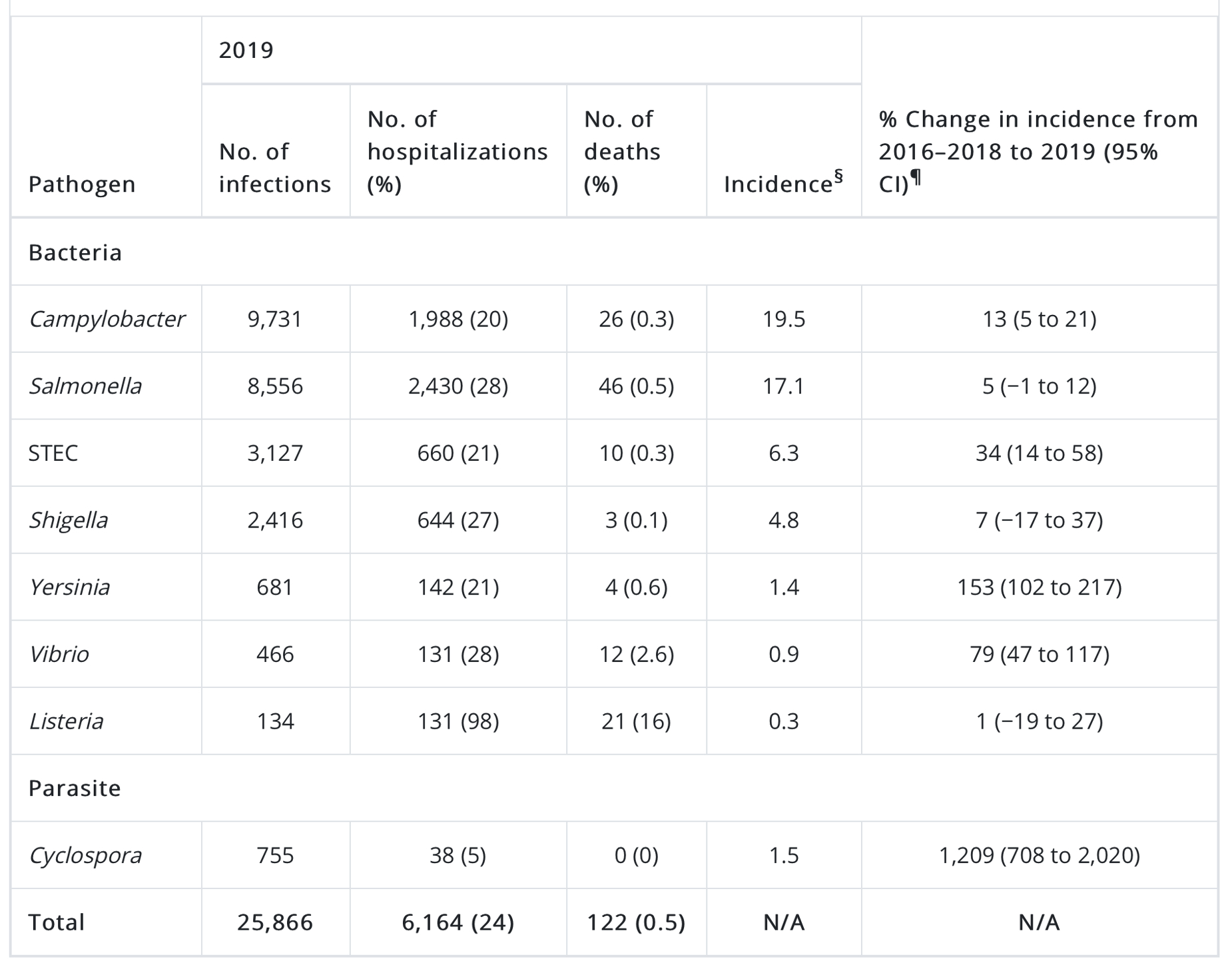
Initial analysis of data comparing the period from 2016-2018 with numbers for 2019 (see table below) shows that the federal government’s Healthy People 2020 targets for reducing foodborne illness will not be met, according to the Morbidity and Mortality Weekly Report (MMWR) published by the Centers for Disease Control and Prevention.

The bad news could be softened if businesses would adopt proven food safety measures, according to the research team.

“. . . progress in controlling major foodborne pathogens in the United States has stalled,” according to the report. “To better protect the public and achieve forthcoming Healthy People 2030 foodborne disease reduction goals, more widespread implementation of known prevention measures and new strategies that target particular pathogens and serotypes are needed.”

A network of labs in 10 states, dubbed FoodNet, tracks the eight foodborne pathogens covered in the report: Campylobacter, Cyclospora, Listeria, Salmonella, Shigella, shiga toxin-producing E. coli (STEC), Vibrio, and Yersinia. Infections caused by Listeria, Salmonella, and Shigella remained flat. Illnesses from all other pathogens showed increases.

The research team specifically held up leafy greens and other fresh produce as problematic.

“Laboratory-diagnosed non-O157 STEC infections continue to increase. Although STEC O157 infections appear to be decreasing, outbreaks linked to leafy greens continue. Produce is also an important source for Cyclospora, Listeria, and Salmonella,” according to the report.

The chicken industry also got attention in the report.

“Reductions in Salmonella serotype Typhimurium suggest that targeted interventions — e.g., vaccinating chickens and other food animals — might decrease human infections,” states the report.

“. . . Reducing contamination during food production, processing, and preparation will require more widespread implementation of known prevention measures and of new strategies that target particular pathogens and serotypes.”

While Campylobacter and Salmonella were responsible for the most illnesses, proportionally, trends in incidence among several Salmonella serotypes varied. 

Researchers gave a nod to technology, specifically culture independent diagnostic tests (CIDTs), but they say better testing cannot account for the significant increases of infections from some pathogens and no change in others.

Number of laboratory-diagnosed bacterial and parasitic infections, hospitalizations, and deaths, incidence and percentage change compared with 2016–2018 average annual incidence rate, by pathogen —10 U.S. sites, Foodborne Diseases Active Surveillance Network (FoodNet),* 2016–2019

Click to enlarge

Abbreviations: CI = confidence interval; N/A = not applicable; STEC = Shiga toxin-producing Escherichia coli.
* Data collected from laboratories in Connecticut, Georgia, Maryland, Minnesota, New Mexico, Oregon, Tennessee, and selected counties in California, Colorado, and New York.
Data are preliminary.
§ Cases per 100,000 population.
Percentage change reported as increase or decrease. CIs not including zero are statistically significant.

So says the press release from the Department of Justice today.

Here is something that I wrote almost 5 years ago today:

After watching the Blue Bell Listeria Outbreak unfold over the last months – especially after reading the FDA’s 483’s, I think it is time for the President and CEO of Blue Bell to consult with criminal counsel.  True, perhaps he did not know that his Broken Arrow Plant had Listeria positives going back over years, but knowledge is not necessary for the FDA and a US Attorney to prosecute – just ask the Jensens and DeCosters.

Congress passed the Federal Food, Drug, and Cosmetic Act in 1938 in reaction to growing public safety demands.  The primary goal of the Act was to protect the health and safety of the public by preventing deleterious, adulterated or misbranded articles from entering interstate commerce.  Under section 402(a)(4) of the Act, a food product is deemed “adulterated” if the food was “prepared, packed, or held under insanitary conditions whereby it may have become contaminated with filth, or whereby it may have been rendered injurious to health.” A food product is also considered “adulterated” if it bears or contains any poisonous or deleterious substance, which may render it injurious to health.  The 1938 Act, and the recently signed Food Safety Modernization Act, stand today as the primary means by which the federal government enforces food safety standards.

Chapter III of the Act addresses prohibited acts, subjecting violators to both civil and criminal liability. Provisions for criminal sanctions are clear:

Felony violations include adulterating or misbranding a food, drug, or device, and putting an adulterated or misbranded food, drug, or device into interstate commerce.  Any person who commits a prohibited act violates the FDCA.  A person committing a prohibited act “with the intent to defraud or mislead” is guilty of a felony punishable by years in jail and millions in fines or both.

A misdemeanor conviction under the FDCA, unlike a felony conviction, does not require proof of fraudulent intent, or even of knowing or willful conduct.  Rather, a person may be convicted if he or she held a position of responsibility or authority in a firm such that the person could have prevented the violation.  Convictions under the misdemeanor provisions are punishable by not more than one year or fined not more than $250,000, or both.

The legal jargon aside, if you are a producer of food and knowingly or not sell adulterated food, you can (and should) face fines and jail time.  Mr. Kruse, I know you are a lawyer, but you should get another one.

The inspection observations of the most recent completed FDA inspections at the Blue Bell production facilities in Brenham, Texas, Broken Arrow, Okla., and Sylacauga, Ala. are available:

More from the Justice Department:

Texas-based ice cream manufacturer Blue Bell Creameries L.P. agreed to plead guilty to charges it shipped contaminated products linked to a 2015 listeriosis outbreak, and the company’s former president was charged in connection with a scheme to cover up the incident, the Justice Department announced today.

In a plea agreement filed with a criminal information in federal court in Austin, Texas, Blue Bell agreed to plead guilty to two misdemeanor counts of distributing adulterated ice cream products and pay a criminal fine and forfeiture amount totaling $17.25 million.  Blue Bell also agreed to pay an additional $2.1 million to resolve civil False Claims Act allegations regarding ice cream products manufactured under insanitary conditions and sold to federal facilities.  The total $19.35 million in fine, forfeiture, and civil settlement payments constitutes the second largest-ever amount paid in resolution of a food-safety matter.

In a related case, Blue Bell’s former president, Paul Kruse, also was charged with seven felony counts related to his alleged efforts to conceal from customers what the company knew about the listeria contamination.

“American consumers rely on food manufacturers to take necessary steps to provide products that are safe to eat,” said Assistant Attorney General Jody Hunt of the Department of Justice’s Civil Division.  “The Department of Justice will take appropriate action where food manufacturers ignore poor factory conditions or fail to abide by required recall procedures when problems are discovered.”

The plea agreement and criminal information filed today against Blue Bell in the U.S. District Court for the Western District of Texas alleges that the company distributed ice cream products that were manufactured under insanitary conditions and contaminated with Listeria monocytogenes, in violation of the Food, Drug and Cosmetic Act.  According to the plea agreement, Texas state officials notified Blue Bell in February 2015 that two ice cream products from the company’s Brenham, Texas factory tested positive for Listeria monocytogenes, a dangerous pathogen that can lead to serious illness or death in vulnerable populations such as pregnant women, newborns, the elderly, and those with compromised immune systems.  Blue Bell directed its delivery route drivers to remove remaining stock of the two products from store shelves, but the company did not recall the products or issue any formal communication to inform customers about the potential listeria contamination.  Two weeks after receiving notification of the first positive listeria tests, Texas state officials informed Blue Bell that additional testing confirmed listeria in a third product.  Blue Bell again chose not to issue any formal notification to customers regarding the positive tests.

Here is Kruse Indictment – 1-main

From professor Lytton in the Conversation:

Governors around the country are attempting to restart the economy by easing restrictions put in place to prevent the spread of COVID-19. The prospect of returning to “normal” amid a pandemic has businesses lobbying Congress to grant them sweeping immunity from civil liability for failure to adequately protect workers and customers from infection.

Senate Majority Leader Mitch McConnell has warned of an “avalanche” of lawsuits that will stymie economic recovery efforts if Congress does not act quickly. He said he won’t let another coronavirus bailout pass the Senate unless it also shields companies from coronavirus-related liability.

My research on the role of civil lawsuits in reducing foodborne illness outbreaks suggests that fears of excessive litigation are unwarranted. What’s more, the modest liability exposure that does exist is important to ensuring businesses take reasonable coronavirus precautions as they reopen their doors.

How not to be careless

As a general matter, businesses are subject to civil liability for carelessness that causes injury to others. The law defines carelessness as a failure to exercise “reasonable care.”

In applying this standard, courts consider several factors:

If the answer to one or more of the questions is no, then a court may conclude that the business was careless and is subject to liability for damages to customers who suffered harm.

In the context of the current pandemic, I believe that reasonable care sets a clear standard for business owners. Invest in cost-effective precautions like ensuring employees wear masks and gloves and keeping customers apart. Follow the guidance of health officials and all health and safety regulations. Keep up with what other similar businesses are doing to prevent infection. Use common sense.

Law abiding, thoughtful business owners – those who care about the safety of their employees and their patrons – are likely to exercise reasonable care to prevent COVID-19 transmission with or without the threat of a lawsuit.

For example, the owner of a nail salon in Georgia recently described her plans for reopening. The salon will accept patrons by appointment only, conduct pre-screening telephone interviews for signs of illness, limit the number of people in the salon at any one time, take temperatures before allowing people to enter, require hand-washing, equip employees and patrons with masks and gloves, and sanitize all work areas between appointments.

Conscientious business owners like this have no reason to fear a lawsuit alleging they failed to take reasonable precautions.

Predictions of “frivolous” lawsuits appear to be generating unnecessary anxiety among business groups. But they shouldn’t. Personal injury lawyers representing victims work on a contingency fee basis. This means that they only earn fees when they bring cases with a strong enough chance of winning to reach a favorable settlement or a judgment.

Lawyers have no incentive to bring sure losers, and they risk being disciplined for professional misconduct if they do so. For these reasons, frivolous lawsuits are rare and highly unlikely in the context of COVID-19 transmission claims against businesses.

Exaggerated fears

Even for business owners who fail to take reasonable precautions, the prospect of a lawsuit is still remote.

To successfully sue a business for COVID-19 transmission, a patron would have to prove that he or she contracted COVID-19 from the business and not from some other source. However, most people infected with COVID-19 currently have no reliable way of identifying the source of their infection. The gap of three to 11 days between infection and illness, the difficulty of recalling all of one’s contacts during that interval and limited testing for the virus present formidable obstacles to establishing causation.

Moreover, a business would not be liable to patrons who knowingly and voluntarily assumed the risk of infection. Patrons of crowded stores or businesses where many customers and employees are not wearing masks, for example, would not have viable legal claims even if they can prove carelessness and causation.

Sending a strong signal

Because of these considerable challenges, viable legal claims related to COVID-19 are likely to be extremely rare.

Yet even occasional lawsuits act as a nudge, encouraging the entire business community to adopt reasonable precautions. This is one of the lessons of civil litigation arising out of foodborne illness outbreaks.

As I document in my 2019 book, “Outbreak: Foodborne Illness and the Struggle for Food Safety,” a small handful of high-profile lawsuits against food companies have encouraged businesses at every link along the supply chain to improve their safety practices. That’s what happened after lawsuits against Jack in the Box over contaminated hamburgers in 1993 and Dole over E. coli in baby spinach in 2006.

Similarly, the prospect of liability for COVID-19 transmission is likely to encourage business owners to invest in cost-effective precautions, follow the advice of public health authorities, adopt industry safety standards and use common sense.

Shielding business owners from this liability is one kind of immunity that will not help end the current crisis.

Thanks professor Lytton.

Our offices have been essentially empty for the last month.

We have been successfully working remotely since early March and all lawyers and staff have continued to work hard and produce the high quality legal work that Marler Clark is known for.

We are starting to plan for the “new normal.”  Here are some thoughts.  I know I have a number of very smart subscribers, so feel free to give me any input that will make my staff safer.

Note:  Harvard researchers have opined that people around the world might need to practice some level of social distancing intermittently through 2022 to stop the disease from surging again and overwhelming hospital systems, unless hospital capacity is increased, or effective vaccines and treatments are developed. Businesses should begin to make plans that provide adequate social distancing within the workplace. And, they should also be prepared to demonstrate that when regulatory restrictions are eased, they can accommodate physical distancing for both their employees and customers.

Of course, I am assuming that we will continue to see a lack of COVID-19 testing for the disease of for antibodies.  In a perfect world, I would hope to have tests available.

Marler Clark Office Changes:

  • Tape markers on the floor to remind everyone of how far 6 feet is (i.e., tape on floor behind each cubicle that is being used, and outside each publicly used door, in kitchen, etc.)
  • Put a sign in elevator reminding everyone that only one person is to ride at a time
  • Put up some reminders for regular hand-washing (i.e. in the bathroom, in the kitchen, by the exits, and around cubicles for hand washing every 2 hours or more often when moving about)
  • Place caddies by entrances to office with hand sanitizer, masks, wipes, and thermometers (a noninvasive type that doesn’t require touching the skin)
  • Place hand sanitizer dispensers, sanitizer wipes and no-touch waste bins at strategic places in office (kitchen, printer room, elevator, conference rooms, sitting areas, archives, at cubicles)
  • Ask employees to use their own thermometers to check temperature before coming to work and before departing home
  • Masks made available for use upon entry to office. No need to use masks at desk all day, only coming and leaving office, or when conferring or meeting with others, or walking around office or in common areas
  • Message other businesses in building so that all are compliant with elevator and stairwell limits
  • Create elevator waiting areas tape markers and hang signs about elevator use/hand-washing
  • Turn on whatever type of air filtration is available to keep air clean and virus-free

Office Etiquette:

  • No more than 5 people in the office at any time and work separated by at least one cubicle
  • Each person works 2-3 days in the office, including weekends – schedule either created by one person or to incorporate people’s workday preferences
  • People should drive, walk, or ride bikes (pay for parking) – No public transportation
  • Employees to take temperature at the beginning of their work time – will work on a honor system (normal temp: 5–37.5 °C (97.7–99.5 °F)
  • Employees to stay at least 6 ft from others and wear masks when conferencing, walking around the office or in common areas
  • Hand wash or sanitize before using common areas – printer room, kitchen, conference room – and wash hand after using the bathroom
  • No more than one person at a time in common areas– printer room, kitchen, conference room
  • All food coming in should be from home to avoid outside contamination
  • Each person must sanitize their workspace at the end of day, and each person assigned one other area to sanitize (kitchen, supply room, bathrooms)
  • Cleaning service should be disinfecting on a weekly basis, at least
  • Stay home if any signs of respiratory illness (coughing, fever, sore throat, fatigue, trouble breathing)
  • If sickness occurs while at work, employee should inform the whole office and sanitize anything they touched before leaving

Up from last months count of 39 , the CDC announced today that a total of 51 people infected with the outbreak strain of E. coli O103 were reported from 10 states – Idaho, Utah, Wyoming, Texas, Iowa, Missouri, Illinois, Florida, Virginia and New York.

Illnesses started on dates ranging from January 6, 2020, to March 15, 2020. Ill people ranged in age from 1 to 79 years, with a median age of 29 years. Fifty-five percent of ill people were female. Of 41 ill people with information available, 3 were hospitalized and no deaths were reported.

Epidemiologic, traceback, and laboratory evidence indicated that clover sprouts were the source of this outbreak.

Seventeen (63%) of 27 people interviewed reported eating sprouts at a Jimmy John’s restaurant. Jimmy John’s LLC reported that all of their restaurants stopped serving clover sprouts on February 24, 2020. Clover sprouts are no longer available at Jimmy John’s restaurants.

Additionally, FDA identified the outbreak strain of E. coli O103 in samples of Chicago Indoor Garden products that contain sprouts. On March 16, 2020, Chicago Indoor Garden recalled all products containing red clover sprouts.

FDA’s traceback investigationexternal icon showed that a common seed lot was used to grow both the sprouts recalled by Chicago Indoor Garden and sprouts that were served at some Jimmy John’s locations. The same seed lot was also used to grow sprouts linked to an outbreak of the same strain of E. coli O103 infections in 2019.

We have filed lawsuits in Utah and Iowa – more to follow.

Recognizing the impact on our communities, we have donated nearly $100,000 to local food banks.  We have also donated $20,000 to area restaurants to serve people in need and to help keep restaurant employees employed.  We are honored to also be serving dinners and lunches to local Police and Fire departments and a local medical clinic that is doing COVID-19 testing.

We need to do more, and we will.  We all need to do more, and I urge all to do what they can.

Marler Clark lawyers and employees have been working from home (well, most – some keep coming to the office) since late February.  Everyone has been all set up at home with phones, faxes, printers, etc., to serve the needs of our clients.

Things have been a challenge.  Courts are closed and hearings are being done via video and phone, albeit slowly.  However, we continue to push the process.

Getting medical records, bills and health department records have slowed, but every day the paralegals “gently” push to get the records needed to prosecute cases.

If anyone is having an issue on their case or need assistance, please email me at bmarler@marlerclark.com or call me at 1-206-794-5043.

Marler Clark is here to serve.