My inbox and phone blew up in the last two days after my clients received this unsolicited letter from Daily Harvest warning my clients of the danger of their product. The letter is dated July 29th, but arrived in most of my clients’ mail boxes over the last two days.

Daily Harvest has once again warned my clients to throw out the product. Fortunately, many of my clients saved the products and they are now being tested by an independent lab and the FDA. The product is also being fed to mice, which I am happy to report are still alive. We also were able to get tara on the open market and have asked a Court to order Daily Harvest to provide then independent lab with samples. I have offered to share all results with both Daily Harvest and the FDA.

Did I mention that my clients received an unsolicited letter from an adverse party?

The ethics of that aside, I suppose we should all thank Daily Harvest for reminding everyone that it is admitting once again that its product poisoned hundreds.

Better late than Never?

It has been a long time since Wendy’s has been across from me in a Court – and that is a good thing for Wendy’s and its customers.  However, now with the CDC reporting nearly 40 E. coli O157:H7 cases in Ohio, Michigan, Pennsylvania and Indiana, some hospitalized and some, mostly children, developed hemolytic uremic syndrome (HUS).  Michigan is reporting over 100 cases and Ohio will report near 50 next week.  The FDA is reporting that the likely ingredient is a hybrid romaine iceberg lettuce used on hamburgers.  Expect next week to learn that the lettuce was likely grown in California and processed and distributed by a major leafy green manufacturer.

Interestingly, the arch of my relationship with Wendy’s has also been the arch of the change between ground beef as the primary vector in E. coli outbreaks to leafy greens. From the Jack in the Box outbreak in 1993 (yes, nearly 30 years) to the ConAgra E. coli outbreak in 2002, nearly 100% of my law firm’s revenue was E. coli cases linked to beef, primarily ground beef hamburgers. HUS used to be called “the hamburger disease.” Since 2003 hamburger cases have dwindled (there was a slight spike in 2006/2007) to a handful a year. I have repeatedly commended the beef industry and FSIS for “putting me out of business.” Now most of my work is with contaminated fresh fruits and vegetables, with romaine lettuce being the main culprit. I wonder when the leafy green industry and the FDA will take the challenge that the beef industry and FSIS took and “put me out of business – please.”

I guess they are not quite ready to do that.

We have been retained by nearly a dozen victims who were hospitalized, including a child who developed HUS.  One lawsuit was filed on Ohio. Our goal, with or without Wendy’s assistance, is to identify the supply chain of this hybrid lettuce and find out why once again we are looking at another leafy green E. coli outbreak (see chart below).

But first a brief Marler Clark History with Wendy’s and E. coli and Lawsuits:

On August 22, 2000, Marion County Health Department (MCHD) investigators contacted the Oregon Health Department to report that several county residents were suffering from E. coli O157:H7 infections. 

MCHD conducted a case-control study to determine the source of the apparent E. coli outbreak and quickly learned that several cases had eaten at a Wendy’s restaurant located at 2375 Commercial St. SE in Salem. Pulsed field gel electrophoresis was conducted on E. coli isolates from patients’ stool specimens, and the PFGE pattern, or DNA fingerprint, obtained confirmed the epidemiologic link between case-patients, including one victim whose only exposure to Wendy’s was a restaurant in Tualatin, Oregon. 

The health department investigation revealed that cross contamination from contaminated ground beef may have been the outbreak source, as several victims had not eaten ground beef products. Marion County Inspectors found several food-handling problems that likely resulted in cross-contamination, causing E. coli bacteria in the meat to contaminate other foods. These included:

  • Food-preparation staff-soaked lettuce in the first compartment of a three-compartment sink that was used to rinse bloody meat-juice-covered pans in which raw hamburger patties had been held, without cleaning and sanitizing the sink between uses.
  • Food-preparation staff used a cleaning and sanitizing “wet towel, dry towel” process, whereby a shelf above the grill that held raw hamburger patties was wiped clean first with a dry towel, then with a sanitized-soaked wet towel. The dry, bloody meat-juice-soaked towel was used for hand wiping in both the grill area and the sandwich assembly area (where raw products are placed on cooked burgers).
  • Poor hand washing was observed.

MCHD concluded that cross-contamination occurred between the meat that was supplied to both the Salem and Tualatin Wendy’s Restaurants and other food items that did not undergo a further “kill step.” 

Marler Clark represented fifteen victims, some who developed hemolytic uremic syndrome (HUS), of the Wendy’s E. coli outbreak in claims against the restaurant chain. The claims were resolved in 2001 – 2002.

In June of 2006, lettuce served in dishes prepared by a Wendy’s restaurant in Ogden, Utah, was the source of an E. coli O121:H19 outbreak. Following an investigation into an E. coli O121:H19 outbreak among attendees of a CORE Academy luncheon held at Orion Junior High School in Harrisville, Utah, on June 30, the Weber-Morgan Health Department (WMHD) announced that four people had become ill with E. coli O121:H19 infections after eating iceberg lettuce prepared at the Wendy’s restaurant located at 2500 N 400 E in North Ogden, Utah. WMHD announced that three of the four people who were confirmed ill with E. coli infections after eating the food prepared by Wendy’s had developed hemolytic uremic syndrome (HUS)

WMHD’s investigation into the E. coli outbreak revealed that more than 300 people were potentially exposed to E. coli at the CORE Academy luncheon. Two individuals who ate salads at the CORE luncheon were confirmed ill with E. coli O121:H19; one developed HUS. Further investigation revealed that one ill individual consumed hamburgers purchased at the Wendy’s restaurant on June 27, 28, and 29 and developed HUS.

Marler Clark filed a lawsuit against Wendy’s on August 11, 2006. The lawsuit was filed on behalf of a family who became ill with E. coli O121:H19 infections after the mother attended the CORE Academy conference in Harrisville and became ill. One child was hospitalized with HUS. The firm also represented two women who became ill with E. coli O121:H19 infections and HUS and suffered acute kidney failure. All the claims were resolved in 2007 – 2008.

E. coli outbreaks associated with lettuce, specifically the “pre-washed” and “ready-to-eat” varieties, are by no means a new phenomenon. In fact, the frequency with which this country’s fresh produce consuming public has been hit by outbreaks of pathogenic bacteria is astonishing. Here are just a sample of E. coli outbreaks based on information gathered by the Center for Science in the Public Interest, Kansas State University, Barf Blog and the Centers for Disease Control and Prevention:

DateVehicleEtiologyConfirmed
Cases
States/Provinces
July 1995Lettuce (leafy green; red; romaine)E. coli O157:H7741:MT
Sept. 1995Lettuce (romaine)E. coli O157:H7201:ID
Sept. 1995Lettuce (iceberg)E. coli O157:H7301:ME
Oct. 1995Lettuce (iceberg; unconfirmed)E. coli O157:H7111:OH
May-June 1996Lettuce (mesclun; red leaf)E. coli O157:H7613:CT, IL, NY
May 1998SaladE. coli O157:H721:CA
Feb.-Mar. 1999Lettuce (iceberg)E. coli O157:H7721:NE
Oct. 1999SaladE. coli O157:H7923:OR, PA, OH
Oct. 2000LettuceE. coli O157:H761:IN
Nov. 2001LettuceE. coli O157:H7201:TX
July-Aug. 2002Lettuce (romaine)E. coli O157:H7292:WA, ID
Nov. 2002LettuceE. coli O157:H7131:Il
Dec. 2002LettuceE. coli O157:H731:MN
Oct. 2003-May 2004Lettuce (mixed salad)E. coli O157:H7571:CA
Apr. 2004SpinachE. coli O157:H7161:CA
Nov. 2004LettuceE. coli O157:H761:NJ
Sept. 2005Lettuce (romaine)E. coli O157:H7323:MN, WI, OR
Sept. 2006Spinach (baby)E. coli O157:H7 and other serotypes205Multistate and Canada
Nov./Dec. 2006LettuceE. coli O157:H7714:NY, NJ, PA, DE
Nov./Dec. 2006LettuceE. coli O157:H781 3:IA, MN, WI
July 2007LettuceE. coli O157:H7261:AL
May 2008RomaineE. coli O157:H791:WA
Oct. 2008LettuceE. coli O157:H759Multistate and Canada
Nov. 2008LettuceE. coli O157:H7130Canada
Sept. 2009Lettuce: Romaine or IcebergE. coli O157:H729Multistate
Sept. 2009LettuceE. coli O157:H710Multistate
April 2010RomaineE. coli O145335:MI, NY, OH, PA, TN
Oct. 2011RomaineE. coli O157:H760Multistate
April 2012RomaineE. coli O157:H7281:CACanada
June 2012RomaineE. coli O157:H752Multistate
Sept. 2012RomaineE. coli O157:H791:PA
Oct. 2012Spinach and Spring Mix BlendE. coli O157:H733Multistate
Apr. 2013Leafy GreensE. coli O157:H714Multistate
Aug. 2013Leafy GreensE. coli O157:H7151:PA
Oct. 2013Ready-To-Eat SaladsE. coli O157:H733Multistate
Apr. 2014RomaineE. coli O12641:MN
Apr. 2015Leafy GreensE. coli O14573:MD, SC, VA
June 2016Mesclun MixE. coli O157:H7113:IL, MI, WI
Nov. 2017Leafy GreensE. coli O157:H767Multistate and Canada
Mar. 2018RomaineE. coli O157:H7219Multistate and Canada
Oct. 2018RomaineE. coli O157:H762Multistate and Canada
Nov. 2019 RomaineE. coli O157:H7167Multistate
Dec. 2020Leafy GreensE. coli O157:H740Multistate
Jan. 2021Baby SpinachE. coli O157:H715Multistate
Mar. 2022Packaged SaladE. coli O157:H710Multistate

The Food Safety Law Firm: 

Marler Clark, The Food Safety Law Firm, is the nation’s leading law firm representing victims of E. coli outbreaks and hemolytic uremic syndrome (HUS). The E. coli lawyers of Marler Clark have represented thousands of victims of E. coli and other foodborne illness infections and have recovered over $850 million for clients. Marler Clark is the only law firm in the nation with a practice focused exclusively on foodborne illness litigation. Our E. coli lawyers have litigated E. coli and HUS cases stemming from outbreaks traced to ground beef, raw milk, lettuce, spinach, sprouts, and other food products. The law firm has brought E. coli lawsuits against such companies as Jack in the Box, Dole, ConAgra, Cargill, Wendy’s and Jimmy John’s. We have proudly represented such victims as Brianne KinerStephanie Smith and Linda Rivera.

If you or a family member became ill with an E. coli infection or HUS after consuming food and you’re interested in pursuing a legal claim, contact the Marler Clark E. coli attorneys for a free case evaluation.

Additional Resources:

Yesterday the CDC reported that 37 people in four states – Ohio, Michigan, Pennsylvania and Indiana – have been sickened by E. coli O157:H7 – likely after consuming hamburgers with lettuce at area Wendy’s. County and State Departments of Health are reporting higher numbers, so expect this “fast moving” outbreak to grow over the coming days as more illnesses are confirmed.

Wendy’s responded on its blog: “We are fully cooperating with public health authorities on their ongoing investigation of the regional E. coli outbreak reported in certain midwestern states. While the CDC has not yet confirmed a specific food as the source of that outbreak, we are taking the precaution of removing the sandwich lettuce from restaurants in that region. The lettuce that we use in our salads is different, and is not affected by this action. As a company, we are committed to upholding our high standards of food safety and quality.”

The FDA went into a bit more detail.

The FDA is supporting the Centers for Disease Control and Prevention (CDC), and state and local authorities in an investigation of an outbreak of Shiga toxin-producing Escherichia coli (E. coli) O157:H7 illnesses linked to an unknown food.

A specific food has not yet been confirmed as the source of this outbreak, but according to CDC, many sick people report eating burgers and sandwiches with romaine lettuce at Wendy’s restaurant locations in Michigan, Ohio, and Pennsylvania before getting sick. Based on this preliminary information, Wendy’s has removed the romaine lettuce being used for burgers and sandwiches in Indiana, Michigan, Ohio, and Pennsylvania as a precautionary measure. Wendy’s uses a different type of romaine lettuce for salads. At this time, CDC is not advising that people avoid eating at Wendy’s restaurants in the affected states or to stop eating romaine lettuce. Additional information is available in CDC’s Investigation Notice.

The CDC is working with state and local health departments to gather information from patients and examine other evidence to identify what was commonly eaten among the people who became ill. The FDA is using this information to trace back and identify the source of suspect food(s), including romaine lettuce, to help confirm or rule out products as the source of the outbreak by identifying any convergence, or commonalities, in the supply chain and to help identify any potential source(s) of contamination.

Investigators are working to confirm whether romaine lettuce is the source of this outbreak, and whether romaine lettuce served at Wendy’s restaurants was served or sold at other businesses. This is an ongoing and rapidly evolving investigation and additional information will be provided as we learn more about the potential source of this outbreak. Additionally, FDA will issue an Outbreak Advisory when and if an FDA regulated product is confirmed as the source of this outbreak.

Based on preliminary information, Wendy’s has removed the romaine lettuce being used for burgers and sandwiches in Indiana, Michigan, Ohio, and Pennsylvania as a precautionary measure. The romaine lettuce used on Wendy’s burgers is a romaine and iceberg lettuce hybrid that is smaller than regular romaine heads and is not the same type of lettuce used in Wendy’s salads. The product being replaced was identified as a product of interest based on available meal information from ill people and commonalities in the product source and supply chain. This is an ongoing investigation and state and federal partners continue working to confirm whether this lettuce is the source of the outbreak.

While I wait with the rest of you hitting refresh on the CDC website waiting on an update on the numbers ill and the cause of the “E. coli Outbreak with Unknown Food Source,” I am reminded by how many times I have been asked why it takes so long to figure these outbreaks out. To borrow from the Beatles, it is a “long and winding road.”

In all CDC announcements of a foodborne outbreak is this caveat: As mentioned above, the true number of sick people in an outbreak is likely higher than the number reported, and the outbreak may not be limited to the states with known illnesses. This is because some of the recent illnesses have not yet be reported to PulseNet as it usually takes 3 to 4 weeks to determine if a sick person is part of an outbreak. In addition, some people recover without medical care and are not tested for E. coli. State and local public health officials are interviewing people about the foods they ate in the week before they got sick.

See below for an illustration. First, you need contaminated food being consumed and then that person being ill enough to seek medical attention from a health care provider. Incubation periods (time between ingestion and symptom onset) can be hours to months depending on the pathogen. You also have to account for the tainted product itself – highly tainted or sporadically? Self-stable, Frozen or perishable? The point being, are you seeing a large quick spike in sick people, or a handful over weeks, months or years? If something does not appear out of the ordinary it can be overlooked.

So, if someone is sick enough to seek medical attention, does that provider take a stool or blood culture (as opposed to a PCR test) to determine the likely pathogen and that test result may take days to return. If the provider does order a test and it comes back positive for a reportable pathogen (some are and some are not reportable – more on that another day), then the provider should report the illnesses to the local and state health authorities and the culture – if available – is sent to the state health department lab for further genetic testing. This process may take days or even weeks.

Assuming that the provider reported the illness and sent the culture to the lab, now comes the “Epi” work. Public health investigators attempt to contact the ill person or the person’s family to determine what the person did and/or consumed during the incubation period for the identified bacteria, virus or other pathogen. Remember, depending on the pathogen, the incubation could be a few hours (like Norovirus) or months (like Listeria). Also, complicating things are how broadly was the offending product sent – locally, across the country or internationally, and, how many people are sick. The unfortunate fact is that the broader the product went and the more people sickened – quickly – the better the chance of determining the tainted product.

Now, assuming that a food product is identified, then the traceback and recall begins.

Like I said, a “long and winding road.”

Although the CDC is still reporting only 29 ill in Ohio and Michigan total. On the ground in the states there are different numbers.

The Ohio Department of Health said cases had been reported in Wood, Lucas, Mahoning, Clermont, Cuyahoga, Franklin, Lorain, and Summit counties. Thus far Wood county has reported 20 illnesses.

The Michigan Department of Health and Human Services (MDHHS), the Michigan Department of Agriculture and Rural Development (MDARD) and three local health departments – Kent, Ottawa and Oakland – are investigating a recent increase in the number of illnesses related to E. coli bacteria.  Thus far MDHHA has reported 98 illnesses.

Although ground beef may still be a possibility for the vector of the outbreak (HUS used to be called “the hamburger disease”), it seems unlikely in 2022 we would be seeing that much undercooking occurring across such a wide geographical area. In addition, although the first decade of my practice was hamburger and E. coli, the last two decades have been leafy greens and E. coli. Also, the epi curve seems a bit tight – July 26 to August 6 – which to me argues for a perishable product. However, with the CDC reporting 38% of the illnesses are women, that argues against leafy greens as most outbreaks involving leafy greens have 60% or more being women.

My bet is leafy greens.

E. coli outbreaks associated with lettuce, specifically the “pre-washed” and “ready-to-eat” varieties, are by no means a new phenomenon. In fact, the frequency with which this country’s fresh produce consuming public has been hit by outbreaks of pathogenic bacteria is astonishing. Here are just a sample of E. coli outbreaks based on information gathered by the Center for Science in the Public Interest, Kansas State University, Barf Blog and the Centers for Disease Control and Prevention:

DateVehicleEtiologyConfirmed
Cases
States/Provinces
July 1995Lettuce (leafy green; red; romaine)E. coli O157:H7741:MT
Sept. 1995Lettuce (romaine)E. coli O157:H7201:ID
Sept. 1995Lettuce (iceberg)E. coli O157:H7301:ME
Oct. 1995Lettuce (iceberg; unconfirmed)E. coli O157:H7111:OH
May-June 1996Lettuce (mesclun; red leaf)E. coli O157:H7613:CT, IL, NY
May 1998SaladE. coli O157:H721:CA
Feb.-Mar. 1999Lettuce (iceberg)E. coli O157:H7721:NE
Oct. 1999SaladE. coli O157:H7923:OR, PA, OH
Oct. 2000LettuceE. coli O157:H761:IN
Nov. 2001LettuceE. coli O157:H7201:TX
July-Aug. 2002Lettuce (romaine)E. coli O157:H7292:WA, ID
Nov. 2002LettuceE. coli O157:H7131:Il
Dec. 2002LettuceE. coli O157:H731:MN
Oct. 2003-May 2004Lettuce (mixed salad)E. coli O157:H7571:CA
Apr. 2004SpinachE. coli O157:H7161:CA
Nov. 2004LettuceE. coli O157:H761:NJ
Sept. 2005Lettuce (romaine)E. coli O157:H7323:MN, WI, OR
Sept. 2006Spinach (baby)E. coli O157:H7 and other serotypes205Multistate and Canada
Nov./Dec. 2006LettuceE. coli O157:H7714:NY, NJ, PA, DE
Nov./Dec. 2006LettuceE. coli O157:H781 3:IA, MN, WI
July 2007LettuceE. coli O157:H7261:AL
May 2008RomaineE. coli O157:H791:WA
Oct. 2008LettuceE. coli O157:H759Multistate and Canada
Nov. 2008LettuceE. coli O157:H7130Canada
Sept. 2009Lettuce: Romaine or IcebergE. coli O157:H729Multistate
Sept. 2009LettuceE. coli O157:H710Multistate
April 2010RomaineE. coli O145335:MI, NY, OH, PA, TN
Oct. 2011RomaineE. coli O157:H760Multistate
April 2012RomaineE. coli O157:H7281:CACanada
June 2012RomaineE. coli O157:H752Multistate
Sept. 2012RomaineE. coli O157:H791:PA
Oct. 2012Spinach and Spring Mix BlendE. coli O157:H733Multistate
Apr. 2013Leafy GreensE. coli O157:H714Multistate
Aug. 2013Leafy GreensE. coli O157:H7151:PA
Oct. 2013Ready-To-Eat SaladsE. coli O157:H733Multistate
Apr. 2014RomaineE. coli O12641:MN
Apr. 2015Leafy GreensE. coli O14573:MD, SC, VA
June 2016Mesclun MixE. coli O157:H7113:IL, MI, WI
Nov. 2017Leafy GreensE. coli O157:H767Multistate and Canada
Mar. 2018RomaineE. coli O157:H7219Multistate and Canada
Oct. 2018RomaineE. coli O157:H762Multistate and Canada
Nov. 2019 RomaineE. coli O157:H7167Multistate
Dec. 2020Leafy GreensE. coli O157:H740Multistate
Jan. 2021Baby SpinachE. coli O157:H715Multistate
Mar. 2022Packaged SaladE. coli O157:H710Multistate

Most current information:

The Ohio Department of Health said that cases had been reported in Wood, Lucas, Mahoning, Clermont, Cuyahoga, Franklin, Lorain and Summit counties. Four people in Ohio have been hospitalized in connection with the outbreak, the department said.  Thus far Wood county has reported 20 illnesses.

The Michigan Department of Health and Human Services (MDHHS), the Michigan Department of Agriculture and Rural Development (MDARD) and three local health departments – Kent, Ottawa and Oakland – are investigating a recent increase in the number of illnesses related to E. coli bacteria.  Thus far MDHHA has reported 98 illnesses.

The CDC posted this today:

A food has not yet been identified as the source of this fast-moving outbreak. So far, illnesses have only been reported from Michigan and Ohio.

The CDC, public health and regulatory officials in several states (in addition to Ohio and Michigan?), the U.S. Food and Drug Administration (FDA), and the U.S. Department of Agriculture’s Food Safety and Inspection Service (USDA-FSIS) – I do not recall a CDC post recently that included working with both the FSIS (regulates, Beef, Pork, Poultry and Catfish) and the FDA (regulates everything else).

Here are some details:

29 Illnesses- 14 in Ohio (Wood County Health Department reports 20) and 15 in Michigan (Michigan Department of Health reports 98).

Illnesses onset dates: July 26, 2022, to August 6, 2022.

Age: 6 to 91 years, median age of 21 years, and 38% are female (hmm, what do 62% of men eat?).

17 people with information available, 9 have been hospitalized.

A food has not yet been identified as the source and this investigation is ongoing. So, meat, leafy greens or something else? As you will see from the below, the genetics are tight – this clearly is is a one bug outbreak from one source.

Present Outbreak – Ill people range in age from 6 to 91 years, with a median age of 21 years, and 38% are female.

Produce: 862 cases, ~67% female

Packaged salads, 2021, 10 cases, 100% female

Baby spinach, 2021, 15 cases, 80% female

Leafy greens, 2020, 40 cases, 60% female

Chopped salad kits, 2019, 10 cases, 60% female

Romaine, 2019, 167 cases, 64% female

Romaine, 2018, 62 cases, 66% female

Romaine, 2018, 210 cases, 67% female

Leafy greens, 2017, 25 cases, 67% female

RTE Salads, 2013, 33 cases, 60% female

Spinach and spring mix, 2012, 33 cases, 63% female

Romaine, 2011, 58 cases, 59% female

Spinach, 2006, 199 cases, 71% female

Beef/Meat: 442 cases, ~49% female

Bison, 2019, 33 cases, 52% female

Ground beef, 2019, 209 cases, 51% female

Ground beef, 2018, 18 cases, 33% female

Beef products, 2016, 11 cases, 45% female

Ground beef, 2014, 12 cases, 42% female

Beef, 2010, 21 cases, 43% female

Beef, 2009, 26 cases, 50% female

Beef, 2009, 23 cases, 36% female

Ground beef, 2008, 49 cases, 57% female

Ground beef, 2007, 40 cases, 45% female

Looking at the NCBI database, these are the most likely WGS fingerprints (in red) are in this subcluster

30 Isolates Selected

Distance between selected isolates: minimum = 0 SNPs, maximum = 2 SNPs, average = 0 SNPs

Target creation date range: 2022-08-09 to 2022-08-15 

Well, more tomorrow.

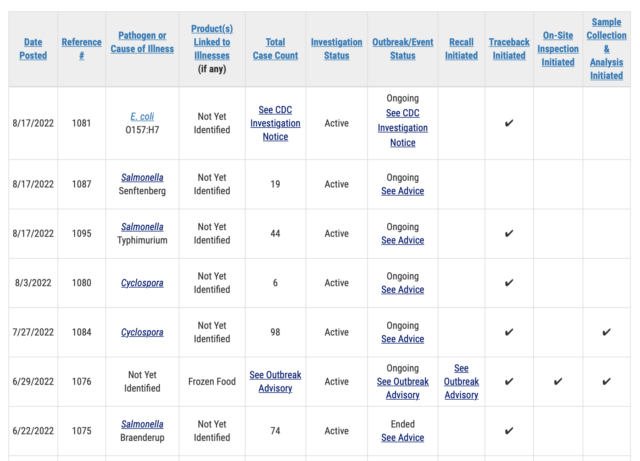
New or fairy new outbreaks should remind us all how much the FDA does with the limited resources it has. Here is most of the latest:

An outbreak of E. coli O157:H7 (ref# 1081) in an unidentified product was added to the table and FDA has initiated a traceback investigation. CDC has issued an Investigation Notice.  

An outbreak of Salmonella Senftenberg (ref# 1087) in an unidentified product was added to the table.

An outbreak of Salmonella Typhimurium (ref# 1095) in an unidentified product was added to the table and traceback has been initiated.

For the outbreak of Salmonella Braenderup (ref# 1075) in an unidentified product, the outbreak has ended.

For the outbreak of Cyclospora in an unidentified product (ref# 1084), the case count has increased from 77 to 98.

And, of course Daily Harvest:

Total Adverse Illness Events: 329*
Hospitalizations: 113*
Deaths: 0
Last illness onset: July 16, 2022*
States with Adverse Illness Events: AZ, CA, CO, CT, DE, FL, GA, IL, IN, IA, MD, MA, MN, MS, MI, MO, MT, NV, NH, NJ, NY, NC, OH, OK, OR, PA, RI, SC, SD, TN, TX, UT, VT, VA, WA, WI

Here is a link to the FDA.

Cases of E. coli in Wood County appear to be related, according to a Tuesday update by the Wood County Health Department.

Of the samples sent to Ohio Department of Health for testing, five have come back and all of those have been the same serotype, said Beth Peery, public health information and education manager.

“That tells us that there may be a link between cases. Approximately 30% of Shiga Toxin E. coli (STEC) cases are this serotype, so it’s not definitive but does help us identify next steps to pursue in the investigation,” Peery said.

“At this stage, we are working with state and federal partners to explore what those links could be and understand next steps. As we explore possible links, various partners at the state and federal level can help us better understand the value of individual lines of inquiry.”

No new cases or hospitalizations have been identified since yesterday. The last reported illness had an onset date of Aug. 9, Peery said.

As of Monday, there had been 18 cases, including six hospitalizations, reported.

Health Commissioner Ben Robison briefed the board of health about the outbreak at Thursday’s meeting. At that time there were 15 cases.

The age range of cases is 13-60 years.

Ohio: According to Wood County Department of Health, sixteen people in Wood County, Bowling Green, Ohio area have come down with E. coli in the past week, prompting the health department to begin investigating. From 2016 to 2020 the county only saw twenty-seven cases altogether. Those who have fallen ill range from ages 13 to 60 years old and those who contract the virus can experience different levels of sickness and gastrointestinal symptoms. Out of the 16 people who have contracted the virus in Wood County, five are currently in the hospital.  One woman who I spoke to tonight was just released and indicated that the health department seems to be focusing on a local restaurant. The Wood County Health Department has sent lab samples to the Ohio Department of Health to learn whether the illnesses are connected. Results, and more information, are expected early next week.

Michigan: The Ottawa County Department of Public Health in Holland, Michigan is alerting the public to The Ottawa County Department of Public Health in Holland, Michigan is alerting the public to increasing cases of Shiga-toxin producing E. coli infections in the community. The Department is currently monitoring twelve cases of STEC, which is significantly higher than the typical number of cases reported at this time of the year. The Department is working with the Michigan Department of Agriculture and Rural Development (MDARD) and the Michigan Department of Health and Human Services (MDHHS) to investigate possible links between the cases. Five of the twelve cases (two children) have been hospitalized for their symptoms.

E. coli: Marler Clark, The Food Safety Law Firm, is the nation’s leading law firm representing victims of E. coli outbreaks and hemolytic uremic syndrome (HUS). The E. coli lawyers of Marler Clark have represented thousands of victims of E. coli and other foodborne illness infections and have recovered over $800 million for clients. Marler Clark is the only law firm in the nation with a practice focused exclusively on foodborne illness litigation. Our E. coli lawyers have litigated E. coli and HUS cases stemming from outbreaks traced to ground beef, raw milk, lettuce, spinach, sprouts, and other food products.  The law firm has brought E. coli lawsuits against such companies as Jack in the Box, Dole, ConAgra, Cargill, Wendy’s, and Jimmy John’s.  We have proudly represented such victims as Brianne KinerStephanie Smith and Linda Rivera.

Additional Resources: If you or a family member became ill with an E. coli infection or HUS after consuming food and you’re interested in pursuing a legal claim, contact the Marler Clark E. coli attorneys for a free case evaluation.

Nearly a month ago I urged the FDA to follow Frank Sinatra’s advice to “float down to Peru.” I do not know if the FDA has, but they long ago should have.

As you know, I have sued Daily Harvest, and after asking who manufactured the French Lentil + Leek Crumbles, and being rebuffed, I was able to determine that the manufacturer was Stone Gate, and they were brought into the litigation. I then asked both Daily Harvest and Stone Gate who was the Tara supplier, and was also rebuffed.

Well, I got a tip who the supplier was and I heard from the supplier’s lawyer today. As a courtesy I will wait until next week to add them into the litigation as well. My guess is the I will be “float[ing] down to Peru,” to determine other entities in the manufacturing, exporting and importing supply chain.

I will also be asking Courts next week to order Daily Harvest and Stone Gate to supply the victims with Tara samples so that we can independently test the product to try and determine what is sickening their customers – that only seems right?

By the way, I assume that the FDA is not only testing Daily Harvest and Revive products, but also the Tara used by both companies?

It still does seems like this is the perfect time for the FDA to “float down to Peru” and see what is up with Tara? It does not seem that far:

I leave you with the rest of the lyrics: