

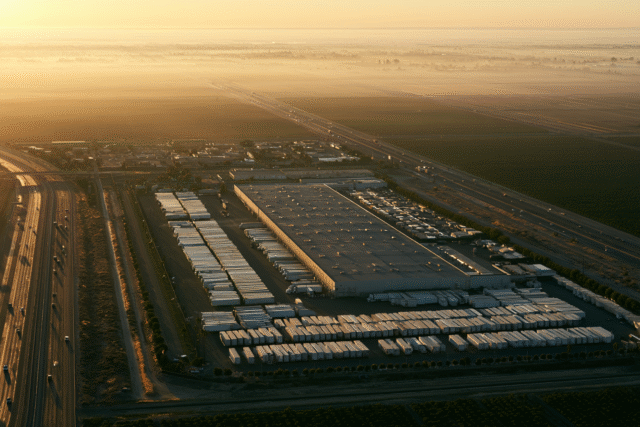
CNBC’s Brandon Gomez published a piece on Friday on how Taylor Farms became integral to America’s food supply — roughly $7.3 billion in sales last year, 40 percent of the salad kits sold in American grocery stores, and a customer list that runs from Walmart, Kroger, Whole Foods and Target to McDonald’s, Taco Bell and Chipotle. The scale is real, and CNBC’s central point is the right one: when a supplier this size has a problem, the problem has the supplier’s reach. What the piece compresses into a paragraph is the record behind that point. Since 2009, eight multistate outbreaks have traced to Taylor Farms product, and in three of the largest, no recall ever reached the public.
The scale CNBC describes is national infrastructure.
Taylor Farms was founded in 1995 and grew by acquisition into one of the world’s largest fresh-cut produce companies, handling much of the chain itself — washing, chopping, packaging, labeling, refrigerating and shipping what hundreds of farms grow. Chains buy from Taylor Farms because it can deliver consistent product at a volume almost no one else can. That is precisely what makes the company something more than a vendor. A supplier moving 40 percent of the country’s grocery salad kits is infrastructure, and this summer showed what happens when infrastructure fails: Walmart recalling bagged salads, Taco Bell pulling lettuce at restaurants, and a parasite counted in every corner of the country.
Eight outbreaks in seventeen years is also part of how the company became integral.
Credit to Gomez for doing what too few business stories do — going to the record. His piece cites the list I compiled of every verifiable Taylor Farms outbreak and whether each one led to a recall, and notes the five complaints Marler Clark has filed so far in this outbreak, in Ohio, Michigan and Kentucky. The chronology in that post: Salmonella Typhimurium in shredded lettuce in 2009; Cyclospora in 2013, with 631 people sick across 25 states and a traceforward running through the same Guanajuato growing region at issue today; E. coli O157:H7 in celery in Costco chicken salad in 2015; E. coli O121 in romaine served at Panera and Chipotle in late 2021; a Cyclospora cluster at a single Colorado restaurant, Taco del Gnar, in 2023; E. coli O157:H7 on slivered onions served on McDonald’s Quarter Pounders in October 2024; E. coli O157:H7 in romaine in November 2024; and Cyclospora in iceberg lettuce in 2026. Alongside the outbreaks sits a recall roster — Salmonella, Listeria, E. coli, undeclared allergens — stretching across more than a dozen Taylor Farms corporate entities.
The gap between the outbreak list and the recall list is the part CNBC did not have room for.
Three of the largest outbreaks on that list — 2013, the 2021 romaine cluster, and November 2024 — produced no recall at all. Two more produced direct notice to foodservice customers and nothing the public could read. The two outbreaks that killed someone are also the two where the public was never given a recall notice. And 2026 added a third category: a recall that arrived on time, in public, at enormous scale — FDA’s own enforcement file puts it at 236,192 cases across products well beyond iceberg lettuce — and still could not reach food that had already been eaten, because Cyclospora’s incubation period outruns the shelf life of a salad.
The $200 million food safety claim has to sit next to the outcome.
Taylor Farms told CNBC it spends more than $200 million a year on food safety, its biggest area of funding by several orders of magnitude. Taken at face value, that is under three cents of every sales dollar — but the honest measure of a food safety program is never the spend. It is the outcome. As of FDA’s August 27 update, the agency counts 11,458 cases across 20 states with 495 hospitalizations, and on August 28 it classified the recall Class I. CDC’s August 25 update counts 17,180 confirmed cases, 11,844 more unconfirmed, 922 hospitalizations, and illness in 48 states plus the District of Columbia. My own state-by-state tally puts the floor above 32,500. CDC’s surveillance season for cyclosporiasis runs May 1 through August 31 — it closes today, and this outbreak filled it.
CNBC also notes, correctly, that FDA has never reported a positive product sample — symptoms take weeks to appear and lettuce is long gone by the time anyone looks. That is not a point in the company’s favor. It is the reason you cannot test your way out of Cyclospora. Prevention at the source — clean water, sanitation, the water testing Taylor Farms promised at this same plant in 2013 — and traceability fast enough to matter are the only tools that work.
Consolidation makes transparency and traceability non-negotiable.
None of this is an argument that big is bad. It is an argument that big carries obligations proportionate to reach. When one company’s product touches nearly every major grocer and restaurant chain in the country, its food safety failures are national events, and the rules should treat them that way: full FSMA 204 traceability implemented without further delay, a public recall notice every time contaminated product ships — not quiet direct notice to foodservice accounts — and the names of companies named while people can still act on them. Taylor Farms has now suspended iceberg sourcing from central Mexico and commissioned an outside review of the facility there. Both steps are welcome. Both are also admissions that the company’s scale demanded more than the system ever required of it.
CNBC asked how Taylor Farms became integral to America’s food supply. The answer includes the acquisitions, the refrigerated trucks, and forty percent of the salad aisle. It also includes seventeen years of outbreaks — and a recall record that too often left the public reading nothing at all.