

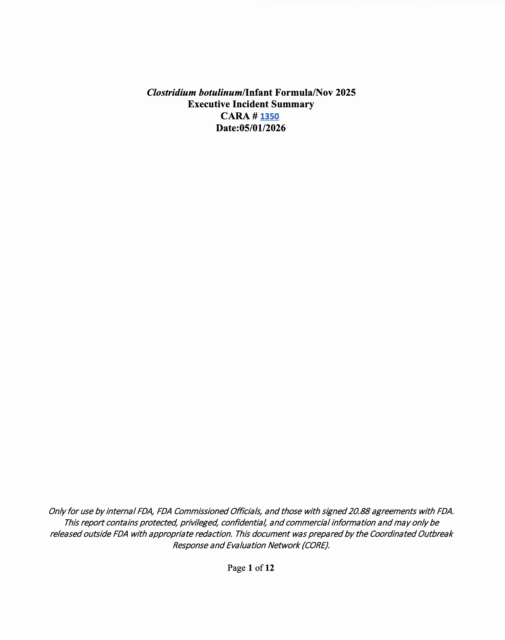
The Food and Drug Administration’s outbreak response network, CORE, closed the ByHeart infant botulism investigation with an Executive Incident Summary dated May 1, 2026, filed as CARA #1350. It counts 48 infants in 17 states, 28 confirmed and 20 probable, with illness onsets from December 24, 2023 to November 29, 2025, everyone hospitalized and treated with BabyBIG. Its conclusion is a sentence the public has not seen stated this plainly: “Even though there are several hypotheses, investigational findings could not identify the source or root cause of contamination of the powdered infant formula.” I received it under FOIA request 2026-4033. It is heavily redacted. What survived is worth reading. What was removed is worth asking about.
The organism was found from the dairy dryer to the sealed can, and FDA still cannot say where it started.
FDA collected 26 samples. Two were positive for Clostridium botulinum type A: a base-mix retain from Blendhouse Allerton in Iowa, and a retain of powdered milk from Dairy Farmers of America in Fallon, Nevada. Five samples run at New York’s Wadsworth Center produced two more positives, an unopened can from Arizona, lot 251481P2, and a second DFA milk-powder retain. The California Department of Public Health found it in an opened can, lot 251131P2. ByHeart’s own laboratory reported 12 positives across finished product, base powder and organic whole milk powder, including toxin type B in finished lot 252161P2 and both A and B in the milk powder. The 35 opened consumer cans CDC tested were all negative.
Sequencing sorted 37 isolates, 16 from infants and 21 from product, into 17 distinct strains. Strain 11 ties a DFA milk-powder retain, ByHeart’s milk powder, ByHeart finished formula, the unopened Arizona can and a sick infant in New Jersey at a mean of 7.5 SNPs, the cluster FDA first described publicly in February. Strain 2 ties a second DFA retain to finished lot 251261P2, the lot seven infants reported being fed. Strain 8 ties a California infant to ByHeart product and base powder; strain 6 ties three infants to the opened California can. In the report’s words, “the distribution and comingling of ingredients likely contributed to the widespread nature of the contamination.” A full preventive-controls inspection at the DFA dryer “did not find any objectional findings.” Of 12 field assignments, one produced a Form 483, at Allerton on January 22, 2026: no qualified individual documenting corrective actions, food-contact surfaces not shown to be cleaned and sanitized, and process-specification deviations not evaluated for public health significance. Portland got none.
Three matches the report does not explain. Strain 11 also matches a 2022 isolate from broccoli and cheddar soup. The Washington infant’s isolate, strain 4, matches a 2011 isolate from Aichi, Japan at one SNP and nothing in the product. Strain 1, in finished formula and FDA’s base mix, is an “inconclusive match” to a 2015 Ohio potato salad cluster.
FDA had been inside the Allerton plant nine months before the outbreak and wrote it up.
The Incident Briefing lays out the inspection history. Allerton was inspected in February 2025 and classified Voluntary Action Indicated, with a three-item 483: an ingredient, its name redacted, “not held under conditions to prevent adulteration”; failure to eliminate harborage “when issues with rodents arose during the year 2024-2025”; and floor conditions not adequately monitored “when there were findings of confirmed Cronobacter sakazakii.” A 2022 inspection at the same plant cited insanitary conditions and inadequate written preventive controls and was followed by a regulatory meeting. The Reading, Pennsylvania plant drew a Warning Letter in August 2023, and an Official Action Indicated inspection that December, and has not run since September 30, 2023. Portland, inspected in March 2025, drew no action. I have written about this history before. The briefing adds the number that should have moved things: ByHeart held roughly 1 percent of powdered formula sales, yet of 36 BabyBIG-treated infants with any powdered formula exposure between August 1 and November 10, 2025, 15 had been fed ByHeart. FDA’s analysts called that “highly unusual” and “a significant epidemiological signal.”
The log records a death complaint the final count does not mention.
The Incident Objectives entry for November 28, 2025 reads in full: “CORE received a new consumer complaint – a second death reported FL case – case reported consuming ByHeart formula and passed away August 31st. No medical records / death certificate yet.” Nothing in the released file returns to it. The summary reports that “none died,” and Florida is not among the 17 states. It may have been resolved as no exposure or no botulism. The record as released shows the complaint arriving and never shows it closing. It also calls this a “second” death report, and the first appears nowhere. Families who fed this formula are entitled to know how both were run down.
Six companies received the contaminated milk powder lots, and every name is blacked out.
On January 28 and February 3, 2026, CORE sent six traceability assignments to firms that had received Organic West Milk lots of whole milk powder that tested positive for C. botulinum, asking for all distribution to infant formula manufacturers over the prior two years. The result: “None of the firms identified any infant formula manufacturers as customers that were supplied whole milk powder.” All six company names are withheld under Exemption 4 as confidential commercial information. Nara Organics had been selling formula through Target and its own site since July 2025, inside the window FDA asked about. Eight weeks after the last assignment closed, Nara-fed infants in California, Pennsylvania and Washington began falling ill, and on August 27 FDA reported that a Nara infant’s isolate matches a ByHeart clinical sample, a ByHeart base-powder sample and four unopened ByHeart cans, and that the shared supplier and dryer “indicate that there is a common source of contamination between the two outbreaks.” I wrote in June that an incomplete customer list left Nara off during the ByHeart trace-forward. Whether any of the six sold to Nara or its contract manufacturer is the question this file could answer and does not.
Also withheld under Exemption 4: every base-mix and milk-powder lot number; the number of lots traced at each step back to the 22 dairies; the region those dairies sit in; and three of the retailers that carried the product.
Every objective the response team set is withheld as deliberative.
The Incident Objectives form for Operational Period 7, February 17 to March 27, 2026, has its objectives box redacted in full under Exemption 5. The Incident Briefing’s “Current and Planned Objectives” page is redacted in full the same way. A separate block, withheld under Exemptions 6 and 7(D), personal privacy and confidential source, appears twice directly after the description of the plants. Exemption 5 is discretionary. On an outbreak that hospitalized 48 babies and is now genetically joined to a second, the objectives the response team set for itself are the part of this file the public has the strongest claim to read.
What the public should take from this file.
Five things. The Health Hazard Evaluation signed December 5, 2025 rated the hazard “life-threatening” and “likely to occur,” and no root cause was ever found. The contamination was in the incoming milk powder, from a dryer that serves more than one formula brand, and the file will not say where else those lots went. CDC expanded the case definition on December 5, 2025 back to March 23, 2022, the first day of production, and five days later added ten confirmed infants sickened between December 2023 and July 2025, none earlier. ByHeart told FDA one of its positive lots carried a November 15, 2024 production date, yet the recall reached only lots still within expiry: the 2023 and 2024 babies were fed formula that was never recalled. FDA had 70 consumer complaints by November 20, 2025, and had to send warning letters to four retailers on December 12 because recalled formula was still on shelves. And FDA’s Nara page, updated August 27, says its root cause investigation is ongoing, and it cannot yet tell whether the milk was contaminated before or during drying. The next day ByHeart announced FDA has “no further questions” on its root cause submission, a submission the public has not yet seen.
What the public should still see from this file.
FDA should release the objectives pages and the six company names; a supplier’s interest in keeping its customer list private does not outweigh the interest of parents in knowing what that supplier’s milk went into. FDA should say how the Florida death report, and the one before it, were resolved. ByHeart should release the submission it is citing. Fifty-two babies across two brands were hospitalized on the same supply chain, and the t-shirts go to Congress in September because the rule that would require testing this ingredient for this organism still does not exist.
Full Report:
https://www.marlerblog.com/files/2026/08/FOIA-2026-4033_Redacted.pdf