

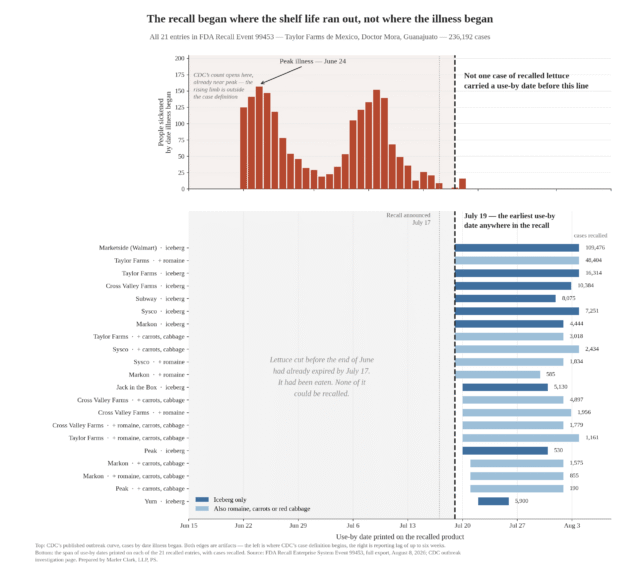
Three weeks ago, Taylor Farms recalled iceberg lettuce from its plant in Doctor Mora, Guanajuato. The July 17 notice named no customers, published no volume, and identified the buyers only by eight two-letter codes. Everything it left out has been sitting in FDA’s recall enterprise database since the day the recall was announced, in a record called Event 99453. Twenty-one separate product entries. I first went through it by hand today, one entry at a time, and then found there is an export button that hands you all twenty-one at once. Here is what is in it.
The recall covers 236,192 cases. That figure appears nowhere — not on FDA’s website, not in the company’s announcement, not in any story I have read. FDA’s system does not total the entries. It lists them, each with its own case count, and there is no sum anywhere on the screen. Nobody had to decide to withhold the number. It does not exist until somebody sits down and adds it up.
Start with the names, because that is the part that should never have taken three weeks. The public got CV, JB, MARK, MKTSD, PK, SUB, SY and TF. The federal record spells them out: Cross Valley Farms, which is US Foods’ private label; Marketside, which is Walmart’s; Markon; Peak; Sysco; Jack in the Box; Yum; Taylor Farms itself; and Subway.
Subway is 8,075 cases of quarter-inch shredded lettuce across fourteen lot codes. It is the largest single restaurant chain in this recall — larger than Yum at 5,900 cases, larger than Jack in the Box at 5,130. Subway has said nothing about this outbreak in three weeks. Jack in the Box put its own name out on July 18 without being made to and told reporters which states had received the product. The chain that volunteered is the one everybody has heard about. The chain that stayed quiet is the one nobody has written about, and it is the bigger of the two. That is not a coincidence.
The Yum (Taco Bell) entry is 5,900 cases of quarter-inch shredded iceberg, and it has four lot codes. Four. They come from two days of production, Wednesday July 8 and Saturday July 11. The use-by dates run fourteen days past production, the shortest spec in the recall, and the earliest of them is July 22 — the latest starting point in the entire file. Whatever went to Yum under this recall was cut no earlier than July 8.
CDC’s median illness onset in this outbreak is June 22, and Cyclospora takes about a week to make somebody sick after they eat it. The median patient was exposed in the middle of June, and the first patients well before that. The customer sitting closest to the exposure that defines this outbreak had the narrowest recall of anyone in the file: two days of lettuce, weeks after people were already in the hospital.
There is a reason for that, and it is arithmetic rather than epidemiology. Every recalled item carries a use-by date, and not one of the 236,192 cases has a use-by date earlier than July 19 — two days after the recall was announced. Lettuce cut before the end of June had already expired by July 17. It had been eaten. You cannot recall it. The front edge of this recall is not a finding about when contamination started. It is the recall date minus the shelf life.
Doctor Mora did not open its doors in late June 2026. It is the same plant at the center of a Cyclospora outbreak in 2013, which means it has been shipping into this country for at least thirteen years. I said on July 19 that this recall could not have reached the lettuce that made the first thousands of people sick. I did not know then that FDA’s own file would prove it.
The next thing in the file is that this was never only an iceberg recall. FDA annotates every entry with what is actually in the product. Iceberg alone accounts for 167,504 cases. The remaining 68,688 — twenty-nine percent — is something more: lettuce and romaine blends at fifty-fifty, seventy-thirty and eighty-twenty; garden salad mixes with carrots and red cabbage; and salads carrying all four. Romaine, carrots and red cabbage came out of Doctor Mora and went into this recall, and the FDA outbreak page, the CDC outbreak page and every news story I have read say iceberg.
The company’s answer deserves to be stated fairly and stated first. Taylor Farms says on its Cyclospora information hub that the recall is limited to iceberg grown and processed at its central Mexico facility, and that its retail branded salad kits and chopped kits are unaffected. Those blends and mixes are foodservice packs — four five-pound bags to a case, six five-pound bags to a case — so the retail sentence holds as written. What separates a recalled Taylor Farms garden salad mix from a retail salad kit is pack size and sales channel, not what is inside the bag.
The lot codes show something the product names do not. Take TFMX191A02, one production run on Friday, July 10. It appears in thirteen of the twenty-one entries in this recall. It went out as plain shredded iceberg, as a lettuce and romaine blend, as a carrot and red cabbage salad mix, and as a four-vegetable salad with separate baggies — to Cross Valley Farms, Markon, Peak, Sysco and Taylor Farms’ own label, carrying four different use-by dates depending on the buyer. It is not the only one. Nine separate lot codes in this recall span all four product types.
I want to be careful about what that does and does not prove. The code almost certainly tracks the iceberg, with the romaine and the carrots and the cabbage blended in from somewhere else, so this is not evidence that the romaine was contaminated. It is evidence that one run of iceberg from Doctor Mora ended up in four different kinds of bag under five different companies’ names — and that when people were told to check their refrigerators for iceberg lettuce, some of them were holding a garden salad.
Then the volume, which has not been public in any form until now. Marketside — Walmart — is 109,476 cases, nearly half the recall by itself and the only entry aimed at consumers rather than restaurants. Four items, roughly ninety lot codes, ten to twelve bags to a case. That is well over a million bags of lettuce sold to Walmart shoppers. Taylor Farms’ own label is 68,897 cases. Cross Valley Farms is 19,016. Sysco is 11,519, Subway 8,075, Markon 7,459, Yum 5,900, Jack in the Box 5,130 and Peak 720.
Markon deserves its own sentence for a different reason. It is not a restaurant. It is a foodservice purchasing cooperative whose member distributors resell to independent operators who never see the Markon name on anything. A recall notice that reaches Markon has not yet reached the kitchen holding the lettuce. It is two more steps away, and nothing in the public record tells you whether it ever arrived.
Two more things sit in the distribution field, and I cannot explain either one. FDA’s recall record lists twenty-seven states, and West Virginia is not among them — while FDA’s own outbreak page lists West Virginia as an outbreak state, one of the original five. Same agency, same recall, two answers.
And at the end of the field, one line: foreign distribution, Mexico. The recalled lettuce went into the Mexican domestic market as well as the American one. I cannot find a Mexican recall notice anywhere. That does not mean there is not one. It means I cannot find it, and so far as I can tell nobody has asked.
Three weeks in, all twenty-one entries still read “Not Yet Classified.” No recall number assigned. No classification date. Status: ongoing. That matters more than it sounds, because the weekly Enforcement Report — the place FDA tells the public and the trade to look for recalls — only publishes a recall once the agency has classified it by hazard.
There is one field I do not understand at all. Every row carries a report date of August 19, 2026 — eleven days from now — while the classification is still blank and the recall number is still empty. I do not know what that means.
What do we now need from the FDA?
- Classify the recall, so that it appears where the public and the trade are told to look.
- Publish the customer names with the notice, not in a database you have to already know exists in order to search.
- Reconcile the state lists.
- Say what happened to the product that stayed in Mexico.
- Produce the import history for the Doctor Mora plant, because that record will show how much, if any, lettuce crossed the border in May and June — the lettuce that is not in this recall, and that the sick people likely already ate.
Every number above comes out of FDA’s own enforcement record for Event 99453, and every link is here so you can check my work. The national case counts and the outbreak reporting are worth reading alongside it.
Check my work:
https://www.marlerblog.com/files/2026/08/08-08-2026_enforce_rpt.pdf