

On August 9, 2013, Taylor Farms de Mexico stopped shipping salad mix and leafy greens from Mexico to the United States, and notified FDA three days later. Over the following week FDA, CDC and five Mexican agencies walked the processing plant at Doctor Mora, Guanajuato, and five farms identified by traceback. On August 25 the company started shipping again with FDA’s concurrence. The part worth reading now is not that FDA let it reopen. It is the price FDA set, and what has been done about it since.
That outbreak sickened 631 people across 25 states. Iowa and Nebraska accounted for 239 restaurant-associated illnesses, tied by epidemiology and traceback to bagged salad mix from Taylor Farms de Mexico. Texas reported 278 cases, at least 25 of them linked to Puebla cilantro from an unrelated producer. The cause of more than a hundred others was never determined.
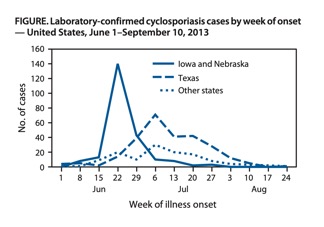
Laboratory-confirmed cyclosporiasis cases by week of illness onset, United States, 2013, with Iowa and Nebraska, Texas, and all other states shown separately. CDC, Morbidity and Mortality Weekly Report, November 1, 2013.
Start with what the company said before the government asked it for anything. On the Friday FDA named Taylor Farms de Mexico, chairman and chief executive Bruce Taylor emailed reporters that the plant already ran an extensive testing program in Mexico covering both water sources and raw product. “All our tests have been negative,” he wrote. FDA noted that its last inspection of the facility, in 2011, had turned up no notable issues.
Two weeks later FDA set the reopening terms. The agency agreed to the resumption on the strength of the environmental assessment and its review of a Cyclospora sampling plan the firm had put in place — a comprehensive program covering leafy greens and other products from its farms and its processing facility, reaching past the leaf to include “both sampling of their products and water”, along with continued monitoring of sanitary conditions. Contemporaneous coverage put it plainly: the company had pledged to systematically test its products and its water supply. I wrote about it that week.
Now read the sentence the company is publishing this month. Its July 24 statement says that according to FDA there are “no confirmed positive sample results for product testing.” Read it twice, for what it does not say. In 2013 the claim was product and water. In 2026 the claim is product. The water has quietly dropped out of the sentence.
I went looking for the results — thirteen years of them, from a program a company announced, a regulator reviewed, and a plant reopened on. I could not find one. Not a summary, not a count, not a season, not an audit that names the program, not a follow-up inspection report, not a line in any FDA update after August 2013. Nothing from the company, nothing from FDA, nothing from COFEPRIS, nothing from a third party. FDA’s own Cyclospora sampling in those years went to cilantro, basil and parsley, not to Mexican iceberg. That absence raises questions someone with subpoena power will be asking. Did the program run in 2014? In 2019? This spring? Which water, how often, by which method, and who ever saw the results?
The 2013 assessment already shows what a water testing record can look like in practice. FDA’s environmental assessment identified three ranches of interest. One entered the assessment only because the team reviewing the firm’s own irrigation water testing records found a positive fecal coliform result off drip irrigation tape. It had triggered no corrective action. The firm scored its water on a rolling mean of five samples — a mean at or below 126 MPN per 100 milliliters, no single sample at or above 235 — and one positive was not enough to move the mean or breach the ceiling. The record existed. The number was in it. The system was built so that nothing had to happen. It was also, start to finish, a bacterial system: FDA’s own guidance says fecal indicator testing will not identify Cyclospora cayetanensis, and that chlorine is not effective against it.
Anyone tempted to argue that water simply cannot be tested for this parasite should read what FDA did in Florida. During the 2020 bagged salad outbreak — 690 illnesses across thirteen states — the agency sampled regional water management canal C-23, west of Port St. Lucie, and detected Cyclospora cayetanensis with its own validated method. That canal had supplied irrigation water to a farm identified in the traceback. Genotyping could not tie the canal organism to the clinical cases, and FDA said so. It then told Florida growers to consider Cyclospora when assessing their own operations. It can be done. It has been done. Nobody has published having looked in Guanajuato — where, as I wrote last week, a public thermal-water bathing complex has stood eight hundred feet from the processing building since before FDA ever walked the property.
The same 2013 record carries a second unmet obligation. The assessment told the firm to determine whether Cyclospora is a reasonably likely hazard in that growing region and, if it is, to re-evaluate the wash step used on salad mix. No one has produced a document showing either was done.
A disclosure. My firm represents people sickened in this outbreak and has filed cases naming Taylor Farms entities as defendants. Everything above is on the public record either way.
There is now a committee of Congress in a position to settle this. On July 27 the ranking member of House Oversight, Rep. Robert Garcia, wrote to Bruce Taylor demanding documents on sanitary conditions, quality control and contamination at Taylor Farms de Mexico going back to January 1, 2013. Answers are due August 10. The letter went to the same executive who told reporters in 2013 that the plant was testing its water and that every test had come back clean. It would take one line to close the loop: produce the sampling program described to FDA in August 2013, and every product and water result generated under it since.
One piece of water testing at that plant does exist, and it is three weeks old. Between July 18 and 20, COFEPRIS inspected the facility, and Mexico’s national reference laboratory and the state public health laboratory reported its lettuce and its water free of Cyclospora cayetanensis and free of fecal coliforms. I include it because it is real and because the company will otherwise include it for me. I would also note when it was taken: after production had been suspended, and roughly two months after the median illness onset.
Which is the whole difficulty with a negative sample. If a clean result cannot exonerate, then thirteen years of clean results would not exonerate either. And if there are not thirteen years of them — if the water half of that program thinned out, or lapsed, or was never built the way it was described to FDA — then the sentence being published this month is doing work the record cannot support.
Michigan reported 9,253 illnesses on Monday, up 1,077 in three days. CDC’s outbreak count has not moved off 1,947 since Friday. Add up what the fifty states themselves report and the floor is past sixteen thousand people. A company said it was testing the water at Doctor Mora, a federal agency reopened a plant on that promise, and thirteen years later not one result from it has ever been made public. Somebody should ask to see them.