

 It is expected that the Nevada and Southern Nevada Health District will update the public on the Firefly outbreak by the numbers ill and the likely serotype of the Salmonella. We learned today from a stool culture that the illnesses are Salmonella Group B, but the serotype has not yet been listed. Group B consists
Las Vegas Firefly Salmonella Outbreak: What was the cause? How big will it get? Lawsuit to tell.
Over the last few days we have been retained by dozens of Las Vegas residents sickened by Salmonella after eating a Firefly during April 21-24. We filed the first Salmonella Lawsuit on Friday. Download Complaint.
The people who have called are likely counted as part of the 86 that the Southern Nevada Health District
Lawsuit to be Filed against Firefly in Las Vegas Salmonella Outbreak
 For those who thought I would be focused on the Food Safety News booth and helping Jeff Benedict sell “Poisoned” while I worked on my speech for the Food Safety Summit, guess again.
We will be filing the first, of what will likely be many Salmonella lawsuits (Download Complaint) against Firefly, the Las
Confidential Settlement Reached in Minnesota E. coli O157:H7 Death
 In December 2009 the Minnesota Department of Health (MDH) uploaded results of molecular testing by Pulsed Field Gel Electrophoresis (PFGE) of an E. coli O157:H7 isolate cultured from a patient stool specimen to PulseNet, a national database of molecular subtyping or “fingerprinting” of foodborne disease causing bacteria. The Minnesota isolate was assigned PulseNet 2-enzyme pattern
Why Retailers in Colorado are Ultimately Responsible for Selling Listeria-Tainted Cantaloupe that Sickened 40 – Killing Nine
There were no “Innocent Sellers” in this tragedy. Retailers in Colorado have both a moral and legal responsibility to those who were sickened, and the families of those who died, after consuming Listeria-tainted cantaloupe.
The 2011 Listeria Cantaloupe outbreak was the most deadly in the United States in nearly 100 years. Colorado was by far the hardest hit of the 28 states involved. Download Outbreak Summary and Exhibits No. 1, No. 2, No. 3, No. 4, No. 5 and No. 6.
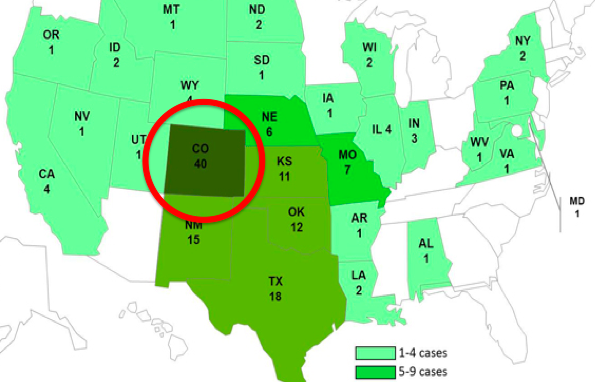 The final report of the CDC totaled 147 persons infected with any of the five outbreak-associated subtypes of Listeria monocytogenes from 28 states. The number of infected persons identified in each state was as follows: Alabama (1), Arkansas (1), California (4), Colorado (40), Idaho (2), Illinois (4), Indiana (3), Iowa (1), Kansas (11), Louisiana (2), Maryland (1), Missouri (7), Montana (2), Nebraska (6), Nevada (1), New Mexico (15), New York (2), North Dakota (2), Oklahoma (12), Oregon (1), Pennsylvania (1), South Dakota (1), Texas (18), Utah (1), Virginia (1), West Virginia (1), Wisconsin (2), and Wyoming (4).
Among persons for whom information was available, reported illness onset ranged from July 31, 2011 through October 27, 2011. Ages ranged from <1 to 96 years, with a median age of 78 years. Most ill persons were over 60 years old. Fifty-eight percent of ill persons were female. Among the 145 ill persons with available information on whether they were hospitalized, 143 (99%) were hospitalized. Thirty-three outbreak-associated deaths were reported: Colorado (9), Indiana (1), Kansas (3), Louisiana (2), Maryland (1), Missouri (3), Montana (1), Nebraska (1), New Mexico (5), New York (2), Oklahoma (1), Texas (2), and Wyoming (2). Among persons who died, ages ranged from 48 to 96 years, with a median age of 81 years. In addition, one woman pregnant at the time of illness had a miscarriage. Ten deaths not attributed to listeriosis occurred among persons who had been infected with an outbreak-associated subtype.
Ultimately, the entire chain of distribution[1] – from farm to grocer (including auditors) – bears responsibility for this outbreak. Who is more responsible – the farmer who grew the product, the auditor who looked the other way, or the retailer who simply cared that there was something on the shelf to sell? That will be up to a jury to decide.
Few of us when we buy something like a cantaloupe in a grocery store could ever imagine that a grocer would ever claim that it has no moral or legal responsibility for selling you a product that sickened you or killed you husband or wife. This is especially true when the grower is not financially responsible – bankrupt. The moral issues aside, here are the legal reasons why a retailer will not escape responsibility or liability.
Strict Liability of Distributors and/or Sellers of the Products, “Innocent Sellers”Continue Reading Why Retailers in Colorado are Ultimately Responsible for Selling Listeria-Tainted Cantaloupe that Sickened 40 – Killing Nine
Class Action Lawsuit Filed after 450 Alta Restaurant Patrons required to get Hepatitis A Vaccine
 Marler Clark, the nation’s leading law firm representing victims of foodborne illness outbreaks, and Underberg & Kessler filed a class action lawsuit today against Alta Restaurant. The lawsuit was filed in New York County Superior Court on behalf of named plaintiff Michael Piacente and other restaurant patrons who received hepatitis A vaccinations after alleged
Dakota Premium Foods Linked to Jouni Meats and Gab Halal Foods Salmonella Outbreak?
 A great thing about having a blog is getting interesting information. I got this email a few weeks ago:
“Jouni Meats and Gab Halal Foods both purchased meat from one common slaughter source provider: Dakota Premium Foods, Est # 357, in S. Saint Paul, MN. Dakota Premium Foods is a subsidiary of American Foods Group
CSU’s Cantaloupe Safety Symposium Seems to Skip Consumer Victims
The Fort Collins Coloradoan reports that Colorado State University will host a Cantaloupe Safety Symposium that will compare findings from recent multistate outbreaks of Listeria and Salmonella.
“The Cantaloupe Safety Symposium: Moving from Response to Prevention” is part of CSU’s work advancing the science and knowledge of food safety, as well as sharing best practices
Foodborne Illness Rates Continue to Fall – And, that is a Good Thing
Work at Marler Clark has been a bit slower in both 2011 and 2012 – and, that really is a good thing. Less work translates into less illnesses – and, that is even a better thing. Kudos, to our regulators and producers of food for taking a chunk out of my workload. The trends below
Poisoned coming out in paperback in May
I got a call this morning from Jeff Benedict, author of Poisoned, that the book is coming out in paperback in a few weeks. Hard to believe that in has been 20 years since Jack in the Box E. coli O157:H7 outbreak.
