
Skip to content
AT%20FOOD%202The Hawaii State Department of Health (DOH) is issuing a recall notice for frozen, raw oysters imported from Korea and sold in bulk to distributors and food establishments in Hawaii. The individually quick frozen (IQF) raw oysters on the half shell are packaged under the Dai One Food Company label. The shellfish harvest dates are

lsMore than 120 Boston College students have taken ill after eating at the same Chipotle at 1924 Beacon Street in Brighton.

“Since late Sunday evening, more than 120 BC students have reported to BC Health Services with symptoms consistent with the norovirus,” Boston College spokesman Jack Dunn said in a statement on Wednesday.

The

maxresdefaultFortune reported today that Chipotle Chief Financial Officer Jack Hartung laid a good chunk of blame of how big a problem the recent multi-state (E. coli) outbreak (not to mention the recent Minnesota Salmonella Outbreak, the California and Boston Norovirus Outbreaks and the secret July Seattle E. coli Outbreak) has become for Chipotle on two

Ventura County Public Health had reported that 98 customers and 17 employees were sickened on August 18 and 19, 2015. After customers reported the illnesses to Chipotle, the restaurant notified health department officials and closed on Friday afternoon to clean and bring in new food before reopening on Saturday for lunch. An inspection of the

map_seattle_maineLate Monday, Chipotle closed a restaurant in Boston after Boston College said 30 of its students complained of gastrointestinal symptoms after eating at the chain. The school said it was working with health authorities to investigate the cause.

This morning Chipotle says it believes Norovirus is to blame for sickening Boston College students who ate

Just got this notice from building management:

All,
 
We are sending out this letter to make you aware of a potential case of Norovirus reported by a tenant in the building.  Norovirus is contagious and symptoms usually show up 12 to 48 hours after exposure, however an infected person can remain contagious for up to

Screen Shot 2015-06-11 at 8.58.09 PMThe Cowfish restaurant in the Southpark Charlotte Mecklenburg County, North Carolina area has voluntarily closed for the rest of the week after two additional patrons and an employee developed stomach flu symptoms.

Cowfish management has been proactive and in constant contact with the Health Department since multiple customers and employees became sick last week. The

With a mouse as a mascot, does a viral outbreak seem that odd?

MPR and AP report that Minnesota health officials are trying to track down people who may have been exposed to norovirus at a Chuck E. Cheese restaurant in Woodbury last weekend.

“As of (Wednesday), we know there had been 60 calls made

On May 17, 2014 the Hawaii Department of Health (HDOH) learned of an outbreak of gastrointestinal illnesses among Royal Hawaiian Hotel guests and restaurant patrons.  People who had attended a wedding dinner reception held on May 15 at the Azure Restaurant, a guest food establishment at the hotel, had reported symptoms to the hotel general

An Introduction to Norovirus

The Centers for Disease Control and Prevention (CDC) estimates that noroviruses cause nearly 21 million cases of acute gastroenteritis annually, making noroviruses the leading cause of gastroenteritis in adults in the United States. [1] According to a relatively recent article in the New England Journal of Medicine:

The Norwalk agent was the first virus that was identified as causing gastroenteritis in humans, but recognition of its importance as a pathogen has been limited because of the lack of available, sensitive, and routine diagnostic methods. Recent advances in understanding the molecular biology of the noroviruses, coupled with applications of novel diagnostic techniques, have radically altered our appreciation of their impact. Noroviruses are now recognized as being the leading cause of epidemics of gastroenteritis and an important cause of sporadic gastroenteritis in both children and adults.

Of the viruses, only the common cold is reported more often than a norovirus infection—also referred to as viral gastroenteritis. [2]

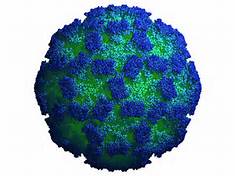
Nature has created an ingenious bug in norovirus. [3] The round blue ball structure of norovirus is actually a protein surrounding the virus’s genetic material. [4]  The virus attaches to the outside of cells lining the intestine, and then transfers its genetic material into those cells.  Once the genetic material has been transferred, norovirus reproduces, finally killing the human cells and releasing new copies of itself that attach to more cells of the intestine’s lining. [5]

Norovirus (previously called “Norwalk-like virus” or NLV) is a member of the family Caliciviridae. The name derives from the Latin for chalice—calyx—meaning cup-like, and refers to the indentations of the virus surface. [6] The family of Caliciviridae consists of several distinct groups of viruses that were first named after the places where outbreaks occurred.  The first of these outbreaks occurred in 1968 among schoolchildren in Norwalk, Ohio.  The prototype strain was identified four years later, in 1972, and was the first virus identified that specifically caused gastroenteritis in humans.  Other discoveries followed, with each strain name based on the location of its discovery—e.g., Montgomery County, Snow Mountain, Mexico, Hawaii, Parmatta, Taunton, and Toronto viruses.  A study published in 1977 found that the Toronto virus was the second most common cause of gastroenteritis in children.  Eventually this confusing nomenclature was resolved, first in favor of calling each of the strains a Norwalk-like virus, and then simply, a norovirus – the term used today.

Humans are the only host of norovirus, and norovirus has several mechanisms that allow it to spread quickly and easily.  Norovirus infects humans in a pathway similar to the influenza virus’ mode of infection. In addition to their similar infective pathways, norovirus and influenza also evolve to avoid the immune system in a similar way.  Both viruses are driven by heavy immune selection pressure and antigenic drift, allowing evasion of the immune system, which results in outbreaks.  Norovirus is able to survive a wide range of temperatures and in many different environments.  Moreover, the viruses can spread quickly, especially in places where people are in close proximity, such as cruise ships and airline flights, even those of short duration. [7] As noted by the CDC in its Final Trip Report:

Noroviruses can cause extended outbreaks because of their high infectivity, persistence in the environment, resistance to common disinfectants, and difficulty in controlling their transmission through routine sanitary measures.Continue Reading Norovirus – a Nasty Bug