
The posts I recently did on Jack in the Box and Odwalla prompted some readers to ask what other stories I had.  Unfortunately, I have a very large plate full.  Perhaps by retelling some of these stories others will be prompted to pay just a bit(e) more attention to food safety.

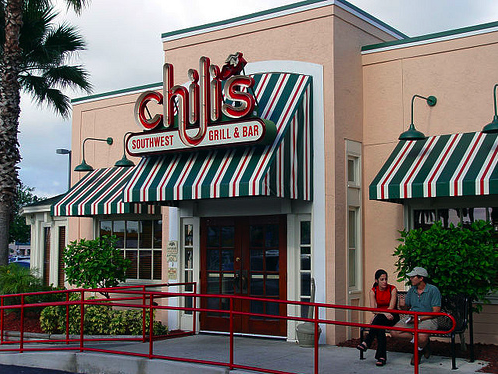
On June 30, 2003, Lake County Health Department (LCHD) received a report from Lake Forest Hospital indicating that a patient was ill with a Salmonella infection. The LCHD immediately contacted the patient and interviewed him, using a questionnaire that is standard for the epidemiological investigation of foodborne illness outbreaks. One of the first things learned by the interviewer was that the patient had recently eaten at the Chili’s Grill & Bar in Vernon Hills, Illinois.

About an hour after receiving this first report, a second person contacted LCHD to report that a family member had become ill after eating at Chili’s in Vernon Hills. This prompted the LCHD to send investigators to the restaurant to inspect it. What they found was disturbing. The restaurant’s dishwashing machine was broken and corroded; the tube that fed chlorine into the machine was plugged, preventing proper sanitization of dishes. Employees told the investigators that the machine had not worked properly for at least a week. In fact, according to the LCHD Final Report, “[e]mployees had wrapped plastic bags around the line to stop the chlorine from spraying into the air.” Despite the obvious broken condition of the dishwasher, the restaurant management still had done nothing to get the machine “repaired” that is, until caught by the health department.

During their inspection, the investigators also found food not stored at proper temperatures in the cooler. And following questioning of the on-duty manager, investigators learned that three employees, plus another manager, had called in sick that day with flu symptoms.

The next day, LCHD received two new reports of individuals with Salmonella infections who had eaten at Chili’s on June 26, while Chili’s management reported six more ill employees. With evidence of the outbreak-source growing increasingly clear, investigators returned to the restaurant to instruct employees on hand-washing procedures, require the use of nailbrushes, and to issue a glove-use order. This meant that no further bare-hand contact of food was to be allowed at the restaurant. The investigators also collected stool samples from the employees there in addition to interviewing each one of them regarding gastrointestinal symptoms. As a result of these interviews, investigators discovered thirteen employees who had been allowed to work despite suffering from diarrhea and other symptoms.

Because of the large number of infected employees identified, the LCHD ordered the restaurant to close. A statement issued by LCHD Executive Director Dale Gallassie announced that:

Due to the large number of ill employees, and the high potential for spread of this illness, Chili’s was required to cease all operation or face suspension or revocation of its food service permit, at which time Chili’s management made the decision to voluntarily close the establishment.Continue Reading A Salmonella Outbreak to Remember: 2003 Vernon Hills Chili’s

I have thought a lot over the last 20 years about what lessons can be drawn from the tragedy that was the 1993 Jack in the Box E. coli O157:H7 outbreak. Knowing the children—many who are now nearing 30—who still bear the scars of eating a hamburger, and knowing the parents of those who died,

In December 2009 the Minnesota Department of Health (MDH) uploaded results of molecular testing by Pulsed Field Gel Electrophoresis (PFGE) of an E. coli O157:H7 isolate cultured from a patient stool specimen to PulseNet, a national database of molecular subtyping or “fingerprinting” of foodborne disease causing bacteria.  The Minnesota isolate was assigned PulseNet 2-enzyme pattern

Over the years we have investigated, and pieced together, several leafy green outbreaks that are never publicly announced despite being the cause of severe illness.  Here is an outbreak from 2009 that should have prompted a multi-state public health warning and recall, but was instead quietly put under the “leafy green cone of silence” as

Lauren Beth Rudolph died on December 28, 1992 in her mother’s arms due to complications of an E. coli O157:H7 infection – Hemolytic Uremic Syndrome. She was only 6 years, 10 months, and 10 days old when she died. Her death, the deaths of three other children, and the sicknesses of 600 others, were eventually