
We filed a lawsuit today on behalf of a woman sickened with hemolytic uremic syndrome (HUS) from eating at the Schnuck’s salad bar in 2011.  Her medical bills were nearly $100,000.  Although we attempted to resolve the case without litigation, the grocery store and the supply chain seem incapable of apportioning fault among themselves.  Sometimes, that is what a jury needs to do.

On March 23, 2012 the Centers for Disease Control and Prevention (CDC) issued its final update on the multistate outbreak of E. coli O157:H7 infections linked to romaine lettuce.[1]  The outbreak investigation was assigned outbreak code 1110MOEXH-2.   Genetically, the outbreak strain was identified by Pulsenet pattern designations EXHX01.0047/EXHA26.0015.  At the completion of the investigation on March 21, 2012, 58 persons residing in 9 states were infected with the outbreak strain of E. coli O157:H7.  The number of ill persons identified in each state is as follows:  Arizona (1), Arkansas (2), Illinois (9), Indiana (2), Kansas (3), Kentucky (1), Minnesota (3), Missouri (38), and Nebraska (1).

Among persons for whom information was available, illnesses began from October 10, 2011 to November 4, 2011.  Ill persons ranged in age from one to 94 years, with a median age of 29 years old.  Sixty-three percent (63%) were female.  Among persons for whom information was available, illnesses began from October 9, 2011 to November 7, 2011.  Ill persons ranged in age from 1 to 94 years, with a median age of 28 years.  Among the 49 ill persons with available information, 33 (67%) were hospitalized, and 3 developed hemolytic uremic syndrome (HUS).  No deaths were reported.


Collaborative investigative efforts of state, local, and federal public health agencies indicated that romaine lettuce sold primarily at several locations of a single grocery store chain, Schnucks, was the likely source of illnesses in this outbreak.  Contamination occurred before the product reached Schnucks stores.

During October 10 to November 4, 2011, public health officials in several states and CDC conducted an epidemiologic study by comparing foods eaten by 22 ill and 82 well persons, including 45 well persons who shopped at a Schnucks grocery store during the week of October 17, 2011.  Analysis of this study indicated that eating romaine lettuce was associated with illness.  Ill persons (85%) were significantly more likely than well persons (46%) to report eating romaine lettuce in the week before illness.  Ill persons (85%) were also significantly more likely than well persons (46%) to report shopping at a Schnucks store.  Among ill and well persons who shopped at Schnucks, ill persons (89%) were significantly more likely than well persons (9%) to report eating a salad from the salad bar at Schnucks.  Several different types of lettuce were offered on the Schnucks salad bars.  Of 18 ill persons who reported the type of lettuce eaten, 94% reported eating romaine lettuce.  No other type of lettuce or other item offered on the salad bar was reported to be eaten by more than 55% of ill persons.

Ill persons reported purchasing salads from salad bars at Schnucks between October 5 and October 24, 2011.  A total of nine (9) store locations were identified where more than one (1) ill person reported purchasing a salad from the salad bar in the week before becoming ill.  This included two (2) separate locations where four (4) ill persons reported purchasing a salad at each location.  For locations where more than one (1) ill person reported purchasing a salad from the salad bar and the date of purchase was known, dates of purchase were all within four (4) days of other ill persons purchasing a salad at that same location.  Schnucks voluntarily removed suspected food items from the salad bar on October 26, 2011.  Romaine lettuce served on salad bars at all locations of Schnucks had come from a single lettuce processing facility owned and operated by Vaughan Foods, Inc., located in Moore, Oklahoma.  Vaughan Foods was also the sole distributor of processed romaine lettuce to Schnucks stores.

The FDA and several state agencies conducted traceback investigations for romaine lettuce to try to identify the source of contamination.  Traceback investigations focused on ill persons who had eaten at salad bars at several locations of Schnucks, and on ill persons at two college campuses, in Minnesota (1 ill person) and Missouri (2 ill persons).  Traceback analysis determined that a single common lot of romaine lettuce harvested from “Farm A” was used to supply Schnucks locations as well as the Centennial Dining Hall at the University of Minnesota during the time of the illnesses.  This lot was also provided to a distributor that supplied lettuce to the university campus in Missouri, but records were not sufficient to determine if this lot was sent to this university campus.  Preliminary findings of investigation at Farm A did not identify the source of the contamination.  Farm A was no longer in production during the time of the investigation.

The Minnesota case in this outbreak was critical to both the epidemiological and traceback analysis.  The Minnesota case’s stool isolate was indistinguishable from the outbreak strain on PFGE analysis.  Minnesota Department of Agriculture documents establish that C & E Farms (more specifically Gubser Ranch Lot 21R23, harvested 10/05/2011 and 10/06/2011) was a supplier of romaine lettuce via FoodSource to GO Fresh, which is the Minnesota processor that prepared and sold the romaine lettuce product that ultimately sickened the University of Minnesota student.

The conclusion from this traceback investigation is that C&E Farms was the only common supplier of romaine lettuce to both Vaughan’s and Go Fresh, and both of these entities utilized the raw romaine from Gubser Ranch Lot 21R23 in the production of lettuce that wound up in Schnucks grocery stores during the outbreak exposure period, as well as at University of Minnesota’s Centennial Hall.  Additionally, counsel for Vaughans has confirmed that Vaughan’s was not buying or receiving any romaine product from Bogiatto, Dole, D’arrigo, Epic Veg, or Green Giant during September or October 2011.  The reason that this is relevant is because Go Fresh received romaine lettuce product from these suppliers during the relevant time frame.

Bartlett Milling Company has initiated a limited recall of certain horse feeds due to potential Rumensin[1] contamination. The products were distributed to customers and retailers in North Carolina, South Carolina, Tennessee and Virginia.

Rumensin contamination can result in health problems, including mortality, in horses. The products and lot number involved in the recall are:

50 lb. bags of Bartlett Pasture Horse 10 Feed – Lot 288

50 lb. bags of Cleveland Carolina Champion Horse Feed – Lot 288

The recalled products were packaged in typical brand-specific feed bags. Lot numbers are printed on the front and back of each bag.

Retailers have been contacted and instructed to immediately withdraw from sale the recalled product and to notify customers who purchased the product. Customers should discontinue feeding the product immediately. Customers who purchased this product should return remaining bags to their retailer.


[1] Rumensin is the only FDA-approved feed ingredient for lactating and dry cows that increases milk production efficiency by delivering more milk per pound of feed while maintaining milk’s natural wholesomeness.

A lot of people don’t like being lawyers. I love what I do. But part of the reason is that I get to translate what I’ve learned to teach people what they need to do to avoid these problems to begin with. I’m a very lucky lawyer.

I had a chance to talk with Jenna Greene of The National Law Journal last week.  The Q&A was published today.

Where you see food—a rare hamburger, a salad with alfalfa sprouts, a slice of cantaloupe—Bill Marler sees pathogens. A name partner at Seattle’s Marler Clark, he has represented victims in every major food poisoning outbreak for three decades, winning more than $600 million for his clients.

Every day, Marler’s work revolves around people who became ill— vomiting, bloody diarrhea, organ failure, coma, sometimes death—from something innocuous that they ate.

Knowing that, how does he sit down at the table and pick up a fork?

The National Law Journal talked to Marler about food safety. The interview was edited for clarity and length. Continue Reading The National Law Journal: Q&A: Food Safety Lawyer Bill Marler on What Not to Eat

Raw Macadamia nuts, some diced, and sold under the Shurfine, Western Family, Hyvee, Market Pantry, Pear’s Gourmet, Cash-Wa Distributing, Pegler Sysco, and Mayan Gold brands were recalled late Friday by Bellevue, NE-based Marathon Ventures Inc.

The recall came after the U.S Food and Drug Administration (FDA) found Salmonella contamination during routine testing. It’s too early to know if there are any illnesses associated with the recall.

Marathon said it has informed the FDA of its actions and is cooperating fully with the ongoing investigation.

Consumers who have purchased the items listed below should not consume this product and should return it to the store of purchase for a full refund or replacement.The recalled raw Macadamia nuts were sold after March 11, 2014, through grocery, food service and other retail outlets throughout the country.

The complete recall list with UPC and lot numbers can be found here.

 Second time recently CDC has linked tainted food product to illnesses by genomic sequencing – see earlier report of Salmonella nut butter outbreak and recall.

According to the CDC, whole-genome sequences of the Listeria monocytogenes strains isolated from recalled quesito casero cheese produced by Oasis Brands, Inc. were found to be highly related to sequences of Listeria strains isolated from one person who became ill in September 2013 and two persons who became ill in June and August 2014.

These three ill persons were reported from three states: New York (1), Tennessee (1), and Texas (1).

All ill persons were hospitalized. One death was reported in Tennessee. One illness was related to a pregnancy and was diagnosed in a newborn.

All ill persons were reported to be of Hispanic ethnicity and reported consuming Hispanic-style soft cheese. The two persons who were able to answer questions about specific varieties of Hispanic-style soft cheeses reported consuming quesito casero, though neither could remember the brand.

Several recalls of cheese and dairy products produced by Oasis Brands, Inc. due to possible Listeria monocytogenes contamination have been announced by FDA.

On August 4, 2014, Oasis Brands, Inc. voluntarily recalled quesito casero (fresh curd) due to possible Listeria monocytogenes contamination after the pathogen was isolated from quesito casero produced by this firm.

On October 6, 2014, Oasis Brands, Inc. recalled cuajada en hoja (fresh curd) after U.S. Food and Drug Administration (FDA) isolated Listeria monocytogenes from environmental samples collected from the production facility.

On October 16, 2014, Oasis Brands, Inc. recalled various cheese and dairy products sold under the Lacteos Santa Martha brand.


Maine Health official today are in the process of filing a court order to detain a health care worker for 21 days who MAY have been exposed to the Ebola virus in Africa – but does NOT have Ebola.

However, those same officials refuse to name the restaurant in Cumberland County, Maine where a food service worker with an acute Hepatitis A infection worked while infectious from September 29 to October 11, 2014.

According to news reports, the employee’s illness and food and beverage preparation practices might have placed patrons at risk for a Hepatitis A infection.  However, the agency was notified of the illness beyond the 14-day window of opportunity for post-exposure prophylaxis vaccines to be most effective.

Maine health officials encouraged health care providers to remain vigilant for Hepatitis A infection in persons with symptoms – fever, jaundice, nausea, clay-colored stool, dark urine, malaise, abdominal discomfort, or anorexia.  The Hepatitis A virus is transmitted via the fecal-oral route, commonly through consumption of contaminated food or water.  Persons will begin to exhibit symptoms 15-50 days after exposure to the virus. A person is considered infectious approximately two weeks prior to symptom onset until one week after onset of symptoms.

Yes, Billion – Per Year[1]

I suppose you can call this the economic reason why I still have a job.

The Economic Research Service of the United States Department of Agriculture recently provided Cost Estimates of Foodborne Illnesses for the major foodborne illnesses in the United States as of 2013.  This data includes:

  • Detailed identification of specific disease outcomes for foodborne infections caused by 15 major pathogens in the United States
  • Associated outpatient and inpatient medical care expenditures
  • Associated lost wages/productivity losses
  • Cost of premature deaths

Disease outcomes include both acute illness and chronic disease that sometimes follow these acute illnesses. The 15 pathogens studied account for over 95 percent of the illnesses and deaths from foodborne illnesses acquired in the United States.

The Economic Research Service estimates build on the foodborne disease estimates from the Centers for Disease Control and Prevention; peer-reviewed synthesis of data on medical costs, and economic, medical and epidemiological literature; and publicly available data on wages.

I decided to focus on 7 of the pathogens – Campylobacter, E. coli O157:H7, non-E. coli O157:H7 – shiga-toxin producing E. coli, Listeria, Norovirus, Salmonella and Shigella.

Campylobacter [2]– Total yearly cost – $1,928,787,166:

The CDC estimates yearly cases of illness at 845,024.  Of those, 45,631 saw a physician and 8,463 were hospitalized.  Of those hospitalized, 76 died.  Long-term complication – primarily Guillan Barre Syndrome (GBS) – accounted for 1,916 people and of those 86 died.

  • Medical costs of those just visiting a physician – $20,318,753.  Hospitalization costs – $121,332,675 and post-hospitalization costs – $1,140,269.  Medical costs for those with GBS – $320,416,057.  Premature death costs for those hospitalized – $657,959,135 and for those with GBS – $748,428,516.
  • Wage loss and productivity loss for those that were ill but did not visit a physician – $44,709,190; for those who visited a physician and recovered – $8,043,747; for those hospitalized – $4,305,437; and, for post-hospitalization recovery – $2,133,387.
  • Cost of premature deaths – $748,428,516.

E. coli O157:H7 [3]– Total yearly cost – $271,418,690:

The CDC estimates yearly cases of illness at 63,153.  Of those, 11,737 sought a physician’s assistance.  1,806 were hospitalized and 10 died, but did not develop hemolytic uremic syndrome (HUS).  302 did develop HUS and recovered with 12 dying acutely and 10 dying a premature death at a later point.

  • For those that did not seek medical care, medical expenses were modest at $135,960.  For those that sought medical care, but were not hospitalized, medical expenses were $4,929,205.  Hospitalized, non-HUS – $16,485,464.  Hospitalized, HUS – $2,854,946.  Hospitalized HUS and end stage renal disease (ESRD) with later premature death – $8,917,815.  Medical expenses for those hospitalized who died without HUS – $72,955; for those who died with HUS – $667,360.
  • Wage loss/productivity loss for those who did not seek medical attention – $1,431,031; for those who sought medical attention – $2,477,897; hospitalized, non-HUS – $1,110,585; hospitalized, HUS – $22,515; Hospitalized HUS and ESRD with later premature death – $588,895; hospitalized, non-HUS, death – $7,678; hospitalized, HUS, death – $4,431.
  • The cost of the premature deaths were as follows:  Hospitalized HUS and ESRD with later premature death – $558,008,517; hospitalized, non-HUS, death – $69,258,856; hospitalized, HUS, death – $103,888,284.

non-E. coli O157:H7 [4]– Total yearly cost – $27,364,561:

The CDC estimates yearly cases of illness at 112,752[5].  91,526 did not seek medical attention; 20,955 did.  271 people were hospitalized.  231 did not develop HUS; 39 developed HUS and recovered; and, there was 1 death.

  • Medical expenses for those who did not seek medical care – $252,525.  It was $8,800,355 for those who sought medical care, but were not hospitalized.  For those hospitalized, non-HUS – $2,108,605; hospitalized, HUS – $2,169,066; Hospitalized HUS and ESRD with later premature death – $947,410.
  • Wage and productivity loss for those who did not seek medical attention – $2,657, 911; for those who sough medical attention, but were not hospitalized – $4,423,987; for those hospitalized, non-HUS – $142,053; hospitalized, HUS – $2,908; hospitalized HUS and ESRD with later premature death – $58,889.
  • The cost of the 1 premature death – $5,800,852.

Listeria [6]– Total yearly cost – $2,834,444,202:

The CDC estimates yearly cases of illness at 1,591.  Only 136 were sickened and did not visit a physician and all others – 1,173 were hospitalized.  Mothers hospitalized – 189; others hospitalized with moderate illness – 33.  Severe illnesses were 697 with 247 deaths.

  • The medical cost for hospitalized mothers – $6,434,883; including infants – $31,208,947.  Other adult medical costs for moderate illness – $1,078,656; for severe illness for those who recovered – $68,513,832; medical costs for those that died – $16,181,967.
  • Productivity and wage loss was modest across all categories at $2,016,273
  • The cost of premature deaths – $2,138,172,640.

Norovirus [7]– Total yearly cost – $2,255,827,318:

The CDC estimates yearly cases of illness at 5,461,731.  4,906,357 did not require a visit to a physician.  540,711 saw a physician.  14,663 were hospitalized and 149 people died.

  • Medical expenses for those who visited a physician only – $240,768,547.  For those hospitalized – $355,175,098.
  • Wage and productivity loss totaled $367,964,198.
  • The cost of premature deaths – $1,289,946,198.

Salmonella [8]– Total yearly cost – $3,666,600,031:

The CDC estimates yearly cases of illness at 1,027,561.  934,241 did not seek medical attention.  73,984 were seen by a physician – with 19,336 being hospitalized.  There were 378 deaths.

  • Medical costs for those seeing a physician – $32,943,851.  Hospital costs were $277,217,134 with post-hospitalization cases of $2,577,468.
  • Productivity and wage loss – $52,810,195 for those who did not seek medical care.  For those who only saw a physician – $13,911,195; hospitalized and post hospital recovery – $14,659,244.
  • Premature death costs – $3,272,480,959.

Shigella [9]– Total yearly cost – $137,965,962:

The CDC estimates yearly cases of illness at 131,254.  Most did not seek medical treatment – 120,348.  1,456 were hospitalized and there were 10 deaths.

  • Total medical expenses – $42,130,731.
  • Total wage and productivity loss – $9,261,661
  • Premature death costs – $86,573,570.

I guess I still have work to do.


[1] Of course this does not account for business losses that includes lost sales, recall cost, advertising costs, litigation costs, etc.

[2] See, www.about-campylobacter.com According to the CDC, Campylobacteriosis is an infectious disease caused by bacteria of the genus Campylobacter. Most people who become ill with campylobacteriosis get diarrhea, cramping, abdominal pain, and fever within two to five days after exposure to the organism. The diarrhea may be bloody and can be accompanied by nausea and vomiting. The illness typically lasts about one week. Some infected persons do not have any symptoms. In persons with compromised immune systems, Campylobacter occasionally spreads to the bloodstream and causes a serious life-threatening infection.

[3] See, www.about-ecoli.com According to the CDC, Escherichia coli (abbreviated as E. coli) are a large and diverse group of bacteria. Although most strains of E. coli are harmless, others can make you sick. Some kinds of E. coli can cause diarrhea, while others cause urinary tract infections, respiratory illness and pneumonia, and other illnesses. Still other kinds of E. coli are used as markers for water contamination—so you might hear about E. coli being found in drinking water, which are not themselves harmful, but indicate the water is contaminated. It does get a bit confusing—even to microbiologists.

[4] In 2012 E. coli O26, O11, O103, O121, O45 and O145 were declared adulterants by the USDA/FSIS – http://www.foodpoisonjournal.com/food-policy-regulation/fsis-to-declare-the-big-six-non-o157-stecs-adulterants/#.VFK5G9ZvZqI

[5] ERS Spreadsheet indicated 63,153, but that is incorrect.

[6] See, www.about-listeria.com  According to the CDC, Listeriosis, a serious infection usually caused by eating food contaminated with the bacterium Listeria monocytogenes, is an important public health problem in the United States. The disease primarily affects older adults, pregnant women, newborns, and adults with weakened immune systems.

[7] See, www.about-norwalk.com According to the CDC, Norovirus is a very contagious virus. You can get norovirus from an infected person, contaminated food or water, or by touching contaminated surfaces. The virus causes your stomach or intestines or both to get inflamed (acute gastroenteritis). This leads you to have stomach pain, nausea, and diarrhea and to throw up.

[8] See, www.about-salmonella.com According to the CDC, Salmonellosis is an infection with bacteria called Salmonella. Salmonella germs have been known to cause illness for over 100 years. They were discovered by an American scientist named Salmon, for whom they are named.  Most persons infected with Salmonella develop diarrhea, fever, and abdominal cramps 12 to 72 hours after infection. The illness usually lasts 4 to 7 days, and most persons recover without treatment. However, in some persons, the diarrhea may be so severe that the patient needs to be hospitalized. In these patients, the Salmonella infection may spread from the intestines to the blood stream, and then to other body sites and can cause death unless the person is treated promptly with antibiotics. The elderly, infants, and those with impaired immune systems are more likely to have a severe illness

[9] See, www.about-shigella.com According to the CDC, Shigellosis is an infectious disease caused by a group of bacteria called Shigella. Most who are infected with Shigella develop diarrhea, fever, and stomach cramps starting a day or two after they are exposed to the bacteria. Shigellosis usually resolves in 5 to 7 days. Some people who are infected may have no symptoms at all, but may still pass the Shigella bacteria to others.

Shenandoah Growers Inc. of Harrisonburg, VA, announced Wednesday that one lot of its conventional fresh-cut cilantro was being recalled due to the potential of Salmonella contamination.

The company said the single lot, consisting of 465 plastic clamshell containers in all, was shipped to two customers in Maryland and Alabama (one retail distribution center and one wholesaler) on Oct. 8 and 9, 2014.

Only two of the company’s products are affected by this recall, and each bears the lot code “15 273283″ stamped on the front of the package. The two products are Shenandoah Growers brand conventional fresh-cut cilantro in 0.75-ounce plastic clamshells and Giant brand conventional fresh-cut cilantro in 2.5-ounce plastic clamshells.

Due to perishability, the recalled products are very likely no longer available in the marketplace, the company stated. No illnesses have been reported to date, and no other products sold by Shenandoah Growers are affected.

Anyone who purchased either of these products bearing the lot number indicated above and still has it in their possession is advised to dispose of it.

The grower initiated this recall after receiving test results on Oct. 28 that one of four routine samples taken on Oct. 8 by the Virginia Department of Agriculture and Consumer Services revealed the presence of Salmonella. Concurrent testing of samples from the same lot conducted by an independent laboratory as part of the company’s internal testing program contained no findings of contamination.

Today the USDA’s Food Safety and Inspection Service posted a 13-page distribution list of retail stories in CO, ID, IL, MA, ME, MI, MN, MT, ND, NH, NV, RI, VT, UT, WI and WY which may have received this recalled product.)

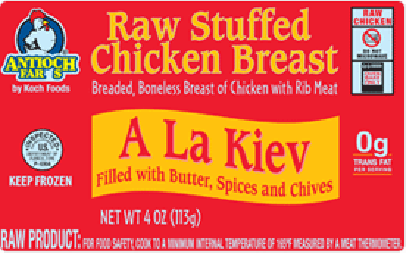
Chicago-based Aspen Foods Division of Koch Meats is recalling 28,980 pounds of chicken products shipped to Minnesota that may be contaminated with Salmonella Enteritidis. The U.S. Department of Agriculture requested that Aspen Foods conduct this recall after the product was found to have caused an outbreak in Minnesota that has sickened at least six people.