thI just got this email – can I have your support?

William,

The nomination deadline for The Expert Institute’s Best Legal Blog Contest has been set for August 21st. That means there’s only three weeks left to nominate your favorite legal blog for a chance to win one of our three cash prizes, as well as a permanent position on The Expert Institute’s best legal blogs page.

Want to get in on the action? It’s easy – just fill out the nomination for on the official contest page here: https://www.theexpertinstitute.com/blog-contest/

We’ve already had more than 150 great blogs come to our attention, with some scoring as many as 40 unique nominations. This is important since nomination process is competitive; only blogs with the most nominations will be selected to compete in the voting round of the competition.

Feel free to reach out to me directly if you have any questions about the nomination process!

Thanks,

Joe

Joseph O’Neill | Senior Associate, Marketing

E: joe@theexpertinstitute.com | P: (888) 858-9511 Ext. 825 

75 Maiden Lane | Suite 704 | New York, NY 10038
7b301fea4b134c79ac975fca9969cd9bThe North Dakota Department of Health is investigating a possible cluster of Shiga toxin-producing E. coli (STEC) infections in eastern North Dakota.

Five cases have been reported, all are less than 18 years of age and all reported attending the Red River Valley Fair in West Fargo, which was held July 7 through 12.

At least one of the cases has been diagnosed with hemolytic uremic syndrome (HUS), a severe complication of STEC infections, in which red blood cells are damaged and can cause kidney damage and kidney failure. Four of the five have been hospitalized.

“We are in the early stages of this investigation and are asking people who became sick with diarrhea or bloody diarrhea for more than 24 hours within ten days of attending the fair to let us know,” said Michelle Feist, a health department epidemiologist. “Although the cases reported having contact with animals while at the fair, we are looking into other possible exposures as well.”

STEC is a bacterial infection that can cause abdominal cramping, nausea, vomiting, diarrhea and bloody diarrhea. Symptoms can be severe resulting in dehydration and electrolyte imbalances. People usually get sick within 3 to 4 days from the time of infection, but it can take as long as 10 days for symptoms to appear.

People who have symptoms of STEC should consult with their health care provider.

STEC is shed in the stool of infected animals and people. STEC infections can result from eating contaminated food, drinking contaminated water, coming into contact with animals that are carrying STEC and can be spread from person to person through inadequate hygiene. Undercooked meats, especially ground beef, contaminated produce or sprouts and attending petting zoos have all been implicated in STEC outbreaks in the U.S. Animals may be infected and not have symptoms but can shed the bacteria.

First, see www.fair-safety.com – this is nothing new.

cilantro$100 says Trump puts out a press release.

FDA Investigators found:

  • Human feces and toilet paper found in growing fields and around facilities; Inadequately maintained and supplied toilet and hand washing facilities (no soap, no toilet paper, no running water, no paper towels) or a complete lack of toilet and hand washing facilities;
  • Food-contact surfaces (such as plastic crates used to transport cilantro or tables where cilantro was cut and bundled) visibly dirty and not washed;
  • Water used for purposes such as washing cilantro vulnerable to contamination from sewage/septic systems;
  • In addition, at one such firm, water in a holding tank used to provide water to employees to wash their hands at the bathrooms was found to be positive for Cyclospora cayetanensis.

The Centers for Disease Control and Prevention (CDC) and state public health officials have identified annually recurring outbreaks (in 2012, 2013, and 2014) of cyclosporiasis in the United States, which have been associated with fresh cilantro from the state of Puebla, Mexico. There is currently (in July 2015) another ongoing outbreak of cyclosporiasis in the United States in which both the Texas Department of State Health Services and the Wisconsin Department of Health Services and the Wisconsin Department of Agriculture, Trade and Consumer Protection have identified cilantro from the Mexican state of Puebla as a suspect vehicle with respect to separate illness clusters.

Texas DSHS has received reports of 205 Cyclosporiasis cases from around Texas this year, prompting an investigation into the infections in hopes of determining a common source. People who have a diarrheal illness lasting more than a few days or diarrhea accompanied by a severe loss of appetite or severe fatigue should contact their health care provider.

Past outbreaks have been associated with cilantro from the Puebla area of Mexico. While the investigation into the current outbreak is ongoing, imported cilantro has been identified as a possible source of some infections. The U.S. Food and Drug Administration recently issued an import alert detaining cilantro from that area coming into the U.S.

DSHS recommends thoroughly washing fresh produce, but that may not entirely eliminate the risk because Cyclospora can be difficult to wash off. Cooking will kill the parasite.

Cyclospora cayetanensis is a human-specific protozoan parasite that causes a prolonged and severe diarrheal illness known as cyclosporiasis. In order to become infectious, the organism requires a period outside of its host. Illnesses are known to be seasonal and the parasite is not known to be endemic to the United States. Cyclosporiasis occurs in many countries, but it seems to be most common in tropical and subtropical regions. People become infected with C. cayetanensis by ingesting sporulated oocysts, which are the infective form of the parasite. This most commonly occurs when food or water contaminated with feces is consumed. An infected person sheds unsporulated (immature, non-infective) C. cayetanenis oocysts in the feces.

As I said to ABC News:

Bill Marler, a Seattle-based food safety lawyer, said the number of cyclospora outbreaks in recent years is worrying.

“Banning the product is probably a bit past due given the numbers of outbreaks that have occurred, “said Marler. “The fact is that cyclospora is called an emerging pathogen. It’s relatively new bug making people sick in the U.S.”

Lucky Peach asked me to give a differing perspective on “Hamburger Month.”  Now you know why I am seldom asked to dinner.

Attorney Bill Marler has won more than $600 million for clients since he and his partners formed Marler Clark in 1998. Marler rose to fame—or notoriety, if you’re a food producer—in 1993, when he successfully litigated a series of suits against Jack in the Box on behalf of children who contracted E. coli from eating the fast food joint’s tainted beef. We asked him to explain the ten worst E. Coli outbreaks that he’s seen.

meat-_v2E. coli O157:H7 did not burst onto the scene in the early 1990s, as many in the big food business like to think. It slowly crept into our food supply, spreading in the enormous feedlots that began to dot the U.S. landscape during the last century. The bacteria is now endemic and can be found in cows, sheep, and wild animals such as boar, elk, and deer. As few as fifty E. coli O157:H7 bacteria are enough to cause human illness—and as many as 100,000 can fit on the head of a pin.

Once this strain of E. coli makes it into our small intestine, it can damage the intestinal wall, causing severe cramping and bloody diarrhea. In some instances, the toxin that the bacteria releases gets into the human bloodstream, damaging red blood cells and causing severe complications like kidney failure, stroke, brain damage, and death.

I wrote an op-ed for the Denver Post in 2002 entitled: “Put me out of business. Please.” In it, I discussed how between 1993 and 2002, at least 95 percent of my law firm Marler Clark’s revenue was from E. coli cases linked to hamburger meat. Now, it is almost zero—which is not to say that there are no cases, but that big beef processors have gotten serious about keeping E. coli O157:H7 out of the food supply. Still, I find that knowing your history is a great motivator to maintain and champion continuing diligence—because one person sickened by careless meat processing is too many. Here, then, is a rundown of the most significant E. coli outbreaks in America.

FEBRURARY 1982: 47 ill

The first time E. coli O157:H7 was linked to an outbreak was in 1982, when contaminated hamburgers were sold at McDonald’s outlets in Oregon and Michigan. The source was suspected to be a meat plant in Michigan, which had distributed the beef patties to the restaurants. At the time, the serotype O157 was thought of as a rare occurrence; the only known previous isolation of E. coli O157:H7 was from a case of hemorrhagic colitis (a disease that causes inflammation and ulcers in the colon and rectum) in 1975. This outbreak got barely a mention in the media.

NOVEMBER 1986: 37 ill

Cases of E. coli O157:H7 were detected throughout Washington state in November 1986, after a physician in eastern Washington hospitalized three patients with hemorrhagic colitis that progressed to thrombotic thrombocytopenic purpura, a condition where small clots form within the body’s small blood vessels. The beef was traced back to the farms, where cattle were shown to be carrying the disease. This was not a big outbreak, but it was an important one: it prompted Washington state to be one of the first states to make E. coli O157:H7 a reportable event, and state health officials changed the food code to increase the internal temperature for hamburger from 140 to 155 degrees—the only state in the country to do so.

NOVEMBER 1992/JANUARY 1993: 501 ill; 151 hospitalized; 4 deaths

In January 1993, a physician from Children’s Hospital and Medical Center in Seattle reported that there had been an increase in emergency room visits for bloody diarrhea and hemolytic uremic syndrome, when red blood cells break down and start blocking the kidneys’ filtering system. A study implicated Jack in the Box’s hamburgers, resulting in a multi-state recall of the remaining product. Only 20 percent of the product was still around by the time of the recall; this amounted to 272,672 hamburger patties. No specific slaughter plant or farm was ever identified as the source of the contaminated meat. This was the first event to illustrate the disastrous potential of outbreaks tied to restaurant chains.

At the time of the outbreak, culturing for E. coli in clinical laboratories was being done incorrectly, and many health departments were not actively tracking and investigating the illness.

NOVEMBER 2000: 46 ill; 24 hospitalized

In November of 2000, Minnesota health officials detected a group of people who were infected with the same strain of E. coli O157:H7—most of whom had consumed ground beef from SuperValu’s Cub Food stores. The American Foods Group (AFG) had supplied beef to the SuperValu/Cub Food stores and to 178 independent retailers, and E. coli O157:H7 was isolated from at least twenty-three different meat samples during the investigation. A total of forty-two cases were reported in Minnesota, one case was discovered in Wisconsin, and three cases in Ohio.

On December 4, the American Foods Group recalled the ground beef. USDA records showed that the company had been cited by federal inspectors for a variety of problems, including nine instances where fecal matter had been spotted on the meat and the presence of Salmonella.

JUNE 2002: 28 ill; 7 hospitalized; 1 death

After the Colorado Department of Health identified an outbreak of E. coli O157:H7 among its residents, the same strain started popping up in cases around the country. The initial investigation pointed to ground beef purchased at Kroger’s grocery stores, which was produced by ConAgra Beef Company. On June 30, independent of the outbreak, the ConAgra Beef Company issued a nationwide recall of 354,200 pounds of ground beef produced on May 31—a recall that had resulted from routine microbiological testing that had been conducted by the USDA. After the outbreak was detected and the plant was inspected, the ground-beef recall was expanded, and an additional 18.6 million pounds of fresh and frozen ground beef and beef trimmings were recalled. Turns out that evidence of E. coli O157:H7 contamination had been ignored since January 2001—more than a year before this outbreak was detected.

I think it was at this point that the industry truly began paying more attention to E. coli O157:H7 through intervention, testing, and safer handling practices—and when I first started to see a drop in the number of recalls and outbreaks.

AUGUST 2007: 47 ill

In early October 2007, Minnesota health department officials noticed a cluster of three E. coli O157:H7 cases with the same genetic pattern. Interviews with the patients—and, later, with patients in Wisconsin, North Carolina, and Tennessee—found a common exposure of Cargill hamburger. Sam’s Club was a major purchaser of the Cargill frozen hamburgers, and eventually recalled 845,000 pounds of Cargill ground beef. The outbreak became the focus of the New York Times story “The Burger That Shattered Her Life,” which won the author a Pulitzer Prize.

OCTOBER 2007: 40 ill; 21 hospitalized

Frozen Topp’s brand ground-beef patties gathered from patients’ homes and from unopened packages around the country yielded E. coli O157:H7 with several different genetic patterns—and forty of those cases were matched with the same genetic fingerprint pattern that was found in the ground beef. Confusingly—and maddeningly—the USDA’s Food Safety and Inspection Service refused to recall hamburger that was linked to an illness unless the package was unopened—somewhat of a difficult feat given that it must be opened before someone can consume it.

MAY 2008: 79 ill; 32 hospitalized

Kroger was put back in the spotlight in May of 2008, when an investigation linked ground beef purchased at one of several Kroger stores in Michigan and Ohio to an outbreak of E. coli O157:H7. The ground beef was traced to Nebraska Beef, Ltd., a beef processor. On June 30, Nebraska Beef Ltd. announced a recall of 531,707 pounds of ground beef—and four days later, they expanded the recall to include all beef manufacturing trimmings and other products intended for use in raw ground beef produced between May 16 and June 26, totaling approximately 5.3 million pounds. Nebraska Beef would later be implicated in July in another, separate outbreak of E. coli O157:H7. This was a company simply more interested in production than safety.

MARCH 2009: 23 ill; 6 hospitalized

In June 2009, a multi-state outbreak was discovered involving ground beef produced by the JBS USA beef company. Samples from unopened packages of ground beef recovered from a patient’s home were tested by the Michigan Public Health Laboratory, which yielded E. coli O157:H7 that matched the DNA fingerprint of the outbreak strain. The beef was sold in the United States and Mexico, and Mexican health officials banned further importation of the meat. (I always find it a bit amusing when other countries ban our food products; U.S. companies tend to be so gleeful when they can point the finger at some food manufacturer from somewhere outside the U.S., with the underlying implication that they must be dirty. The truth is that contamination can happen anywhere.

JUNE 2014: 3 ill; 3 hospitalized; 1 death

The Massachusetts Department of Public Health, the Centers for Disease Control and Prevention, and the USDA FSIS identified three patients diagnosed with E. coli O157:H7 who became ill after consuming ground beef sold at Whole Foods stores in Massachusetts. Although there were few victims, the results were vicious; all three were hospitalized, and one child died. This outbreak was linked to grass-fed, organic beef: a product that many consider to be safe, but clearly is not, or not more so than other beef. The danger comes from improper or careless handling, not from how the cows live.

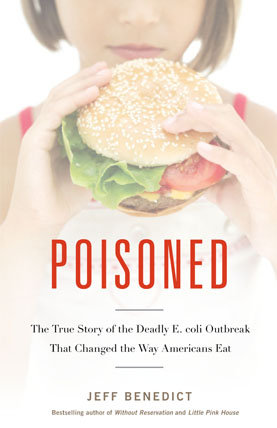
If you are attending the International Association for Food Protection (IAFP) Conference in Portland this week, be sure to visit the Food Safety News (nearly 1,000,000 unique visitors per month) booth 603 to sign up as a subscriber to Food Safety News (over 25,000 already) and get a chance to win the book Poisoned. Editors and reporters Cathy Siegner, James Andrews and Dan Flynn will be in attendance both covering the conference and manning the booth, as will Chuck Jolly (our ad guy) and Julie, Olivia and Sydney Marler.

Also, be sure to follow Food Safety News on twitter @foodsafetynews (over 27,500 followers) and friend Food Safety News on Facebook (over 145,000 friends).

poisoned-cover-bleed

blackpeppercorns_448x253(1)The Kroger Co. said today it is recalling Kroger Ground Cinnamon, Kroger Garlic Powder, Kroger Coarse Ground Black Pepper and Kroger Bac’n Buds sold in its retail stores due to possible contamination from Salmonella.

A sample of Kroger Garlic Powder from a store in North Augusta, South Carolina was tested by the FDA and found to be contaminated with Salmonella. To date, no illnesses have been reported in connection with these products. Out of an abundance of caution, the company has recalled all four seasonings produced on the same equipment in the same facility.

Stores under the following names in the 31 states where Kroger operates are included in this recall: Kroger, Ralphs, Food 4 Less, Foods Co., Fred Meyer, Fry’s, King Soopers, City Market, Smith’s, Dillons, Baker’s, Gerbes, Jay C, Ruler Foods, Pay Less, Owen’s, and Scott’s.

Kroger has removed the potentially affected items from store shelves and initiated its customer recall notification system that alerts customers who may have purchased recalled Class 1 products through register receipt tape messages and phone calls.

Kroger is recalling the following items:

Product UPC Codes Size
Kroger Ground Cinnamon 1111070034 Sell by: May 19 18PS4 18.3 oz
Kroger Garlic Powder 1111070039 Sell by: May 18 17PS4 24.7 oz
Kroger Coarse Ground

Black Pepper

1111070041 Sell by: May 18 18PS4

Sell by: May 19 18PS4

17.1 oz
Kroger Bac’n Buds 1111070025 Sell by: May 20 18PS4 12.0 oz

pork-chopsWashington State health officials are working with state and local partners to investigate several cases and clusters of Salmonella infections that appear to be linked to eating pork. The ongoing investigation of at least 56 cases in eight counties around the state includes food served at a variety of events.

Disease investigators continue to explore several sources from farm to table, and are focused on an apparent link to pork consumption or contamination from raw pork. Salmonellosis, the illness caused by infection with Salmonella, can cause severe and even bloody diarrhea, fever, chills, abdominal discomfort, and vomiting. Serious bloodstream infections may also occur.

As of July 23, the 56 cases include residents of King (44), Snohomish (4), Mason (2), Thurston (2), Pierce (1), Grays Harbor (1), Yakima (1), and Clark (1) counties. Five of the cases were hospitalized; no deaths have been reported. All were infected with the same strain of Salmonella bacteria. The disease investigation shows a potential exposure source for several cases was whole roasted pigs, cooked and served at private events. The source of contamination remains under investigation by state and local health officials and federal partners.

stewart-parnell-hearing.0Sentencing is September 21 – See, Sentencing Brief.

AP’s Russ Bynum reports that Federal court officers are recommending what attorneys are calling an “unprecedented” sentence of life in prison for a peanut executive convicted in a salmonella-poisoning case. Former Peanut Corporation of American owner Stewart Parnell was convicted last fall of selling truckloads of peanut butter from his southwest Georgia plant to food processors even after they tested positive for Salmonella.  Food containing the tainted peanuts was blamed for killing nine people and sickened more than 700.  The U.S. Probation Office prepared the recommendation for Parnell’s upcoming sentencing. It was revealed in a court filing by prosecutors Wednesday.

As I said to the AP:

Bill Marler is a lawyer for victims sickened by peanut butter from Parnell’s plant. He called the recommended sentence “unprecedented.”

In fact, Marler and other experts say the trial of Parnell and two co-defendants last year was the first federal food-poisoning case to be tried by an American court. A jury convicted Parnell of 71 counts including conspiracy, obstruction of justice, wire fraud and other crimes related to a salmonella outbreak in 2008 and 2009. The Centers for Disease Control linked the outbreak to nine deaths and 714 illnesses. It prompted one of the largest food recalls in U.S. history.

“Life in prison, especially in a food case, it’s frankly unprecedented,” said Marler, who has represented victims of food-borne illnesses for two decades. “But the case itself, on a factual basis, is unprecedented.”

Marler said he suspects the judge and prosecutors will think carefully before deciding to pursue a life sentence for Parnell. Still, he said, even the possibility of such a stiff sentence sends a message to food companies.

“The same shock or sobering impact that you and I have talking about it, you multiply that by 100 for some food executive sitting in an office,” Marler said.

As Stewart’s lawyer said:

Parnell attorney Ken Hodges went further, calling it, “truly absurd.”

Well, it’s certainly not “truly absurd.”

After a 35-day trial, a federal jury on September 19, 2014, found Stewart Parnell, former owner and chief executive of Peanut Corporation of America, guilty of 71 counts of conspiracy, interstate shipments fraud, wire fraud, obstruction of justice, introduction of adulterated food into interstate commerce with intent to defraud or mislead, and introduction of misbranded food into interstate commerce with intent to defraud or mislead.

His brother, peanut broker, Michael Parnell, was convicted on 29 counts of a smaller but similar list of multiple convictions. Mary Wilkerson, the former quality manager at PCA’s peanut processing plant was convicted on one of two charges of obstruction of justice.

Two other PCA employees, former plant manager Samuel Lightsey and former operations manager Daniel Kilgore, were also charged but pleaded guilty before trial under agreements that saw them become government witnesses. They are be sentenced on October 1.

As I said to the Wall Street Journal:

“It was an extraordinary verdict that could result in an extraordinary amount of time in jail for a food crime,” said Bill Marler, a Seattle lawyer who represents victims of food-borne illnesses, including some in the Peanut Corp. case.

And, to USA Today:

William Marler, a Seattle-based food safety lawyer representing the victims, called the recommendation “unprecedented” but not necessarily a surprise, given the 71 felony counts with a standard punishment range of one to 10 years per count.

Marler said he spoke with several of the family members of those who died in the Parnell case. “A lot of them are quite relieved,” Marler told USA TODAY. “These are people whose family members died from eating peanut butter, so you can understand where they may not have much sympathy for Mr. Parnell.”

Marler also noted that President Obama’s administration has been aggressive in food safety prosecutions, and he pointed out as examples the May announcement that ConAgra Foods agreed to pay more than $11 million in fines related to a salmonella outbreak, and the April sentencing of Iowa egg producer Jack DeCoster and his son for selling tainted eggs.

2023560198The Seattle Times reports that as many as 16 people were likely sickened with salmonella poisoning from raw eggs used in Father’s Day weekend brunch dishes served at Tallulah’s restaurant in Seattle’s Capitol Hill neighborhood, health officials said Wednesday.

Victims in the June 21 outbreak ranged in ages from 4 to 71, officials with Public Health — Seattle & King County said. There were nine confirmed cases and seven probable cases of infection, including one person who was hospitalized.

The infections were traced to crab and ham eggs Benedict dishes, which typically include a sauce made from raw eggs. Managers at the restaurant at 550 19th Ave. E reported the problem to health officials after receiving complaints from customers. Restaurant staff have been cooperative with the environmental health and epidemiologic investigation, officials said.

An investigation of the egg supplier and distributor conducted by the Washington State Department of Agriculture revealed no violation of regulations regarding temperature control, storage or handling, officials said. The producer reported no recent positive tests for salmonella bacteria, although they don’t routinely test raw shell eggs.

map-07-21-2015As of July 20, 2015, 62 people infected with the outbreak strain of Salmonella Paratyphi B variant L(+) tartrate(+) have been reported from 11 states. Eleven ill people have been hospitalized. No deaths have been reported.  The number of ill people reported from each state is as follows: Arizona (11), California (34), Illinois (1), Michigan (1), Minnesota (4), Mississippi (1), New Mexico (6), South Dakota (1), Virginia (1), Washington (1), and Wisconsin (1).

Epidemiologic and laboratory findings indicate that frozen raw tuna is the likely source of the infections.

On July 21, 2015, Osamu Corporation announced two voluntary recalls of frozen yellowfin tuna from one processing plant in Indonesia. The two recalls include:

All frozen tuna (loin, saku, chunk, slice, and ground market forms) sold to restaurants and grocery stores throughout the U.S. from May 9, 2014 to July 9, 2015. Affected products can be identified by four-digit purchase order numbers 8563 through 8599 located on each product carton box.

One lot of frozen yellowfin tuna chunk meat distributed to AFC Corporation for use in sushi franchises in grocery stores throughout the U.S. from May 20, 2015 to May 26, 2015. The affected lot can be identified by lot number 68568.