The 11th Circuit spoke today:

“With respect to both Stewart and Michael, the evidence of guilt was overwhelming.”  The former PCA chief executive, Stewart Parnell will continue his sentence of 28 years for selling misbranded food, introducing adulterated food into interstate commerce, fraud, conspiracy and other charges related to knowingly allowing peanut butter contaminated with Salmonella to enter the stream of commerce.  His brother Michael will continue serving 20 years for the same offenses.

The Court also found that “the evidence that Wilkerson did know of positive Salmonella results in 2008 was overwhelming. And while the obstruction of justice charge against Wilkerson was based on a single question and answer to Agent Gray during the investigation, the evidence is very clear that defendant Wilkerson lied to Agent Gray about not having knowledge of positive test results.” She will continue serving a five-year prison term for obstruction of justice.
Here is the full decision

I have thought a lot over the last 25 years about what lessons can be drawn from the tragedy that was the 1993 Jack in the Box E. coli O157:H7 outbreak. Knowing the children—many who are now nearing 35—who still bear the scars of eating a hamburger, and knowing the parents of those who died, makes it difficult for me to see the benefit of those losses.

My first reaction is, “Why does it always seem to take a tragedy before we seem to be able to act?” Whether it was reinforcing the cockpit doors after the horror of 9/11, or now finally having a dialogue about automatic weapons post-Newtown, we have seemed nearly incapable of preventing a tragedy before it has happened multiple times, or with such force that ignoring it any longer is impossible. Frankly, not being able to look ahead to prevent disasters seems so ingrained in human DNA that I am not sure of a ready fix.

Human evolution aside, I think there are lessons that can be learned from Jack in the Box that have meaning in the food safety world both in the past and in the future. First, like all food safety failures, and the outbreaks that stem from them, the Jack in the Box outbreak was completely preventable—in other words, Jack in the Box had warnings enough to have prevented the outbreak. And second, after the outbreak there will always be facts—and documents—that prove it.

In March of 1992 the Washington State Board of Health mandated that the internal cook temperature for ground beef should be 155 degrees, not the 140 degrees that all other of the 49 states used based on the Federal Food Code. Washington was ahead of the curve because health officials had investigated an earlier outbreak linked to undercooked ground beef. Officials reached out to all restaurants in the State with the new standards. Although Jack in the Box leaders initially claimed that they knew nothing of the changes—and perhaps they did not directly—but the new standards were found in files in corporate headquarters in San Diego.

Finding the Washington State Food Code in the bottom drawer of a cabinet was certainly not the best “find” in the litigation. Far from it; a bit of context might be in order.

Although the outbreak was announced in mid-January 1993, aggressive litigation and discovery did not really commence until late 1993. It lasted through the end of 1994. During that time, I received nearly 50 boxes of paper from the lawyers representing Jack in the Box and its meat suppliers. From those documents and the dozens of depositions taken, it became clear that Jack in the Box had more than just the new cook temperatures in its desk drawer. Scattered (on purpose) within the boxes were documents that showed that Jack in the Box knew of the new cook-temperature guidelines and simply chose to ignore them.

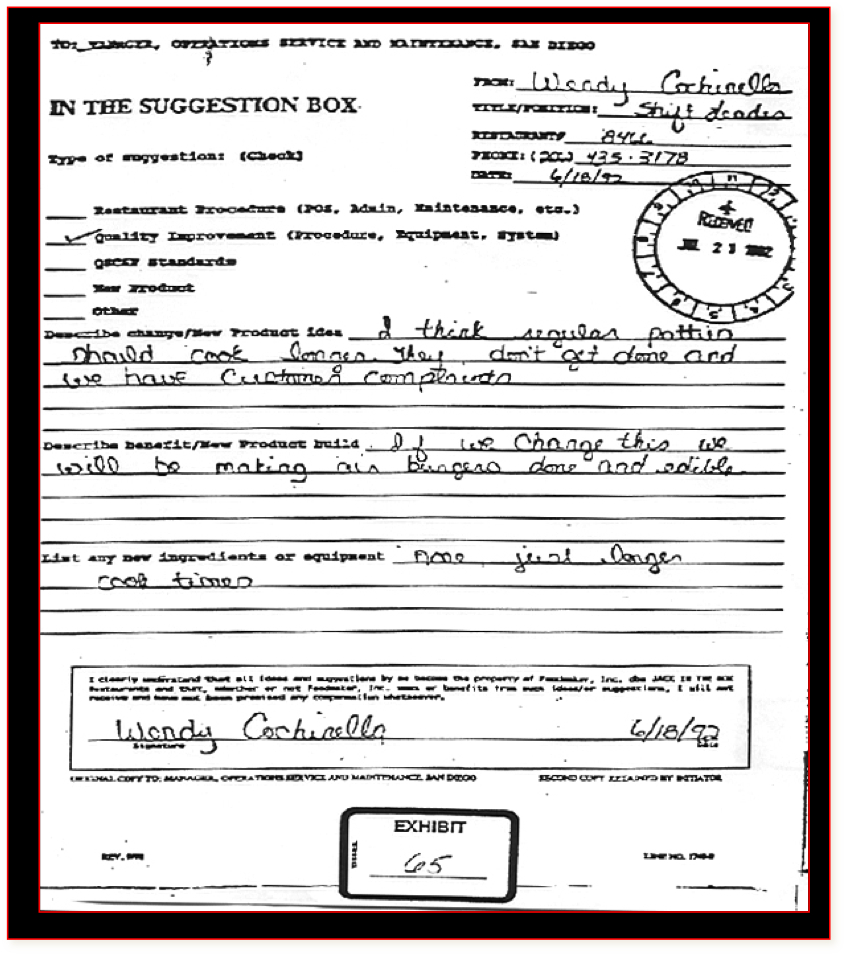
On June 18, 1992—five months before the Jack in the Box E. coli outbreak struck its hometown of San Diego and seven months before it would hit the Pacific Northwest—Wendy Cochinella, the shift leader at the Arlington, Washington restaurant faxed the below “IN THE SUGGESTION BOX” to Jack in the Box corporate headquarters in San Diego:

She wrote:

“I think regular patties should cook longer. They don’t get done and we have customer complaints.”

“If we change this we will be making our burgers done and edible.”

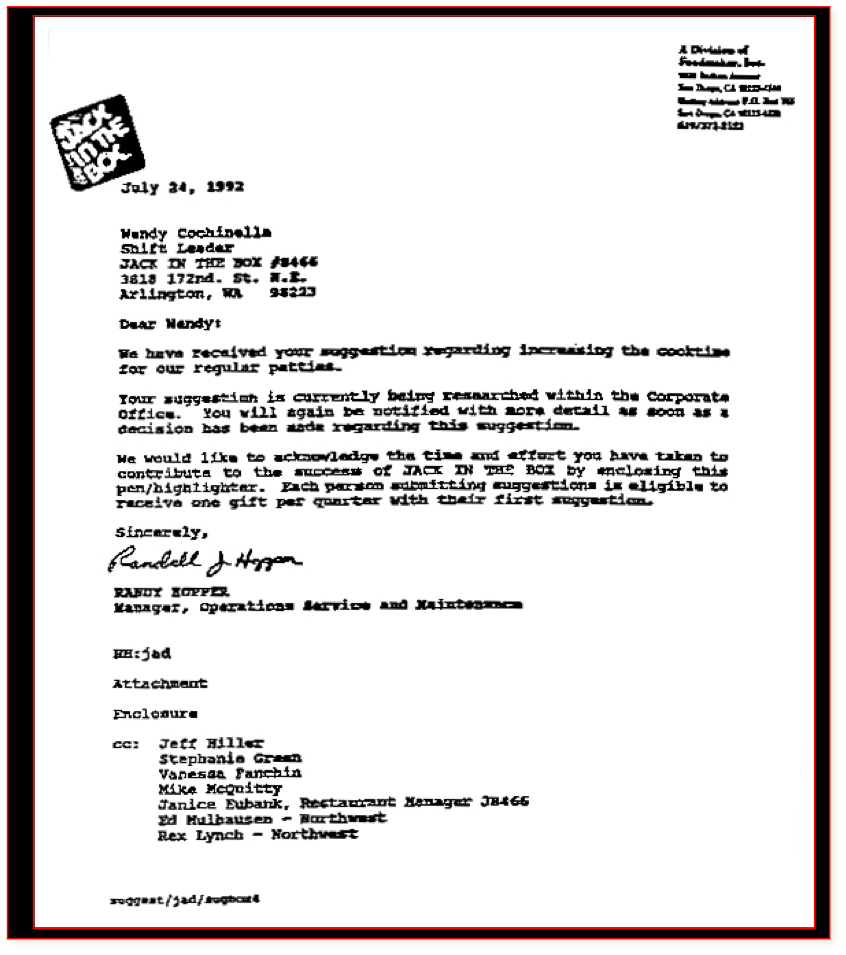
After just over a month, Wendy (and most of the Jack in the Box food safety team) received the below response from corporate headquarters. Wendy also received a pen highlighter (I always thought they should have made her at least Vice-President):

It reads:

We have received your suggestion regarding increasing the cook time for our regular patties.

Your suggestion is currently being researched within the corporate offices. You will again be notified with more detail as soon as a decision has been made regarding this suggestion.

We would like to acknowledge the time and effort you have taken to contribute to the success of JACK IN THE BOX by enclosing this pen/highlighter. Each person submitting suggestions is eligible to receive one gift per quarter with their first suggestion.

But it did not end there. No, Jack in the Box wanted to see if they could make “[their] burgers done and edible.” What they found in their corporate kitchen was that sometimes they could reach internal temperatures of 155 degrees and above on new grills with the two-minute cook time, but often—too often—internal temperatures of 140 degrees or below were reached on older grills with the two-minute cook time. E. coli O157:H7 bacteria can survive at 140 degrees for two minutes, but not at 155.

So, what was the response?

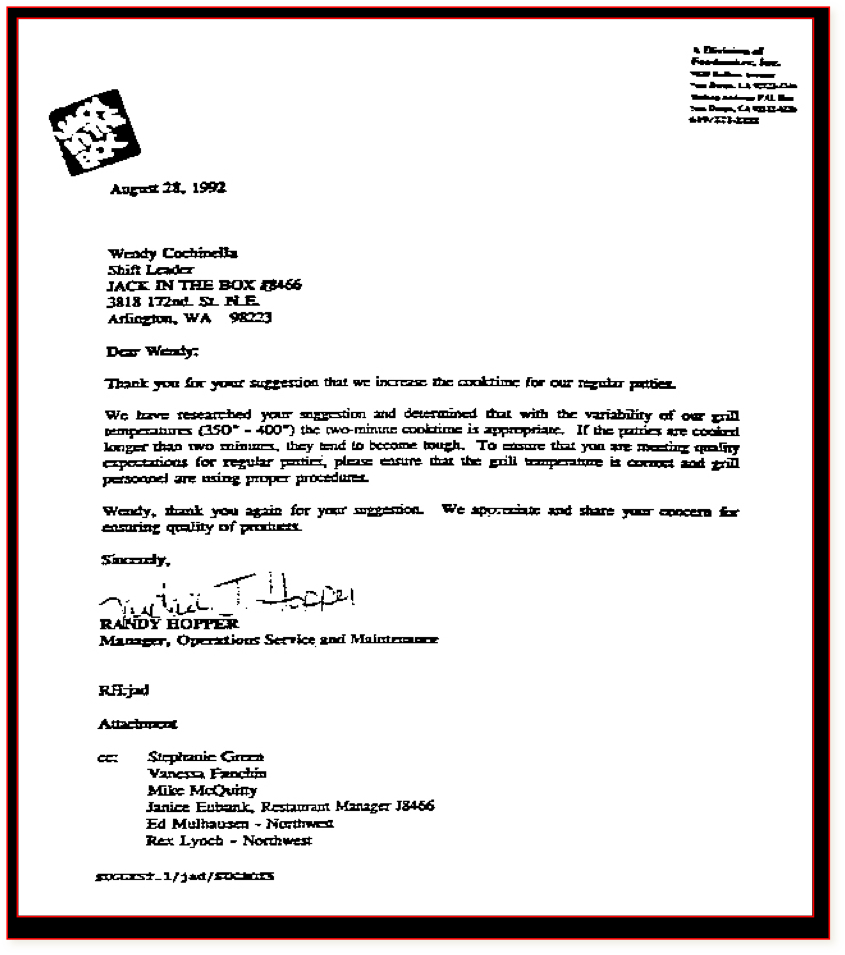
Yes, you guessed it, the two-minute cook time was more important than having “burgers done and edible.” Wendy’s next communication from corporate headquarters indicated that a cook time longer than two minutes made burgers “tough.”

Wendy and the Jack in the Box food safety team received the following communication from superiors:

We have researched your suggestion and determined that with the variability of our grill temperatures (350° – 400°) the two-minute cook time is appropriate. If the patties are cooked longer than two minutes, they tend to become tough. To ensure that you are meeting quality expectations for regular patties, please ensure that the grill temperature is correct and grill personnel are using proper procedures.”

And, as they say, the rest is history—a tragic history.  Weeks after the outbreak was announced Jack in the Box changed the cook time from two minutes to two minutes and fifteen seconds – yes, fifteen seconds.

  • Multistate Salmonella Outbreak, Jimmy John’s Restaurants Sprouts 2018

As of January 18, 2018, eight people infected with the outbreak strain of Salmonella Montevideo have been reported from Illinois, Wisconsin and Minnesota. Illnesses started on dates ranging from December 20, 2017 to January 3, 2018. Ill people range in age from 26 to 50, with a median age of 34. All 8 (100%) are female. No hospitalizations and no deaths have been reported.  Evidence indicates that raw sprouts served at Jimmy John’s restaurants are a likely source of this multistate outbreak.

Federal, state, and local health and regulatory officials are conducting traceback investigations from the six Jimmy John’s locations where ill people ate raw sprouts. These investigations are ongoing to determine where the sprouts were distributed, and to learn more about the potential route of contamination. 

  • Multistate E. coli O121 Outbreak, Jimmy John’s Restaurants Alfalfa Sprouts 2014

19 Sickened – Public health officials in California, Idaho, Michigan, Montana, Utah and Washington collaborated with their federal partners at the Centers for Disease Control and Prevention (CDC) and the Food and Drug Administration (FDA) to investigate an outbreak of E. coli O121 that occurred in May 2014.  A total of 19 persons with the outbreak strain, identified by PulseNet PFGE Pattern Identification Numbers EXKX01.0011/EXKA26.0001, were reported.  Among persons for whom information was available, dates of illness onset ranged from May 1, 2014 to May 20, 2014.  Ill persons ranged from 11 years to 52 years.  Seven of 16 persons for whom information was available were hospitalized.  No ill person developed hemolytic uremic syndrome and no deaths were reported.

Epidemiologic and traceback investigations conducted by public health officials implicated raw clover sprouts produced by Evergreen Fresh Sprouts, LLC of Hayden, Idaho as the likely source of this outbreak.  Thirteen (81%) of 16 ill persons reported eating raw clover sprouts in the week before becoming ill.  Ill persons in Washington and Idaho reported eating sprouts in sandwiches at several local food establishments including several Jimmy John’s Gourmet Sandwiches locations, the Pita Pit, and Daanen’s Deli.

As part of the investigation the FDA performed a traceback analysis and determined that Evergreen Fresh Sprouts supplied sprouts to seven restaurants with outbreak associated cases.  This analysis used documents collected directly from the distributors and the grower, Evergreen Fresh Sprouts, as well as documents collected by the states from the points of service.

The FDA conducted several inspections at the Evergreen Fresh Sprouts facility in May and June.  During the inspections FDA investigators observed a number of unsanitary conditions, including condensate and irrigation water dripping from rusty valves, a rusty and corroded watering system in the mung bean room, tennis rackets (used to scoop mung bean sprouts) that had scratches, chips and frayed plastic; a pitchfork (used to transfer mung bean sprouts) that had corroded metal, and a squeegee (used to agitate mung bean sprouts inside a soak vat) that had visible corroded metal and non-treated wood.

On June 26, 2014 the FDA and CDC held a meeting with the owner of Evergreen Fresh Sprouts to advise the firm of FDA’s concerns that the seed lot used to row clover sprouts linked to this outbreak might be contaminated and to encourage Evergreen Fresh Sprouts to discontinue using that seed lot.  The owner of Evergreen Fresh Sprouts agreed to stop using the suspected lot of seeds.

  • Multistate E. coli O26 Outbreak, Jimmy John’s Restaurants Alfalfa Sprouts 2012

29 Sickened – A total of 29 individuals infected with the outbreak strain of E. coli O26 were reported from 11 states, including:  Alabama (1), Arkansas (1), Iowa (5), Kansas (2), Michigan (10), Missouri (3), Ohio (3), Pennsylvania (1), Washington (1), Wisconsin (1), and West Virginia (1).

Of the 27 ill persons with available information, 23 (85%) reported consuming sprouts at Jimmy John’s restaurants in the 7 days preceding illness.  Among 29 ill persons, illness onset dates ranged from December 25, 2011 to March 3, 2012.  Ill persons range in age from 9 years to 57 years old, with a median age of 26 years.  89% of ill persons are female.  Among the 29 ill persons, 7 (24%) were hospitalized. None developed HUS, and no deaths were reported.

Preliminary traceback information identified a common lot of clover seeds used to grow clover sprouts served at Jimmy John’s restaurant locations where ill persons ate.  FDA and states conducted a traceback that identified two separate sprouting facilities; both used the same lot of seed to grow clover sprouts served at these Jimmy John’s restaurant locations.  On February 10, 2012, the seed supplier-initiated notification of sprouting facilities that received this lot of clover seed to stop using it.

Results of the epidemiologic and traceback investigations indicated eating raw clover sprouts at Jimmy John’s restaurants was the likely cause of this outbreak.

  • Sprouters Northwest, Jimmy John’s Restaurants Clover Salmonella Sprouts Outbreak 2010

7 Sickened – Sprouters Northwest of Kent, Washington, issued a product recall after the company’s clover sprouts had been implicated in an outbreak of Salmonella Newport in Oregon and Washington. At least some of the cases had consumed clover sprouts while at a Jimmy John’s restaurant. Jimmy John’s Restaurants are a restaurant chain that sells sandwiches. Concurrent with this outbreak, a separate Salmonella outbreak (Salmonella, serotype I 4,5,12,i- ; see Multistate Outbreak, Tiny Greens Organic Farm, Jimmy John’s Restaurants), involving alfalfa sprouts served at Jimmy John’s restaurants was under investigation. The recall of Northwest Sprouters products included: clover; clover & onion; spicy sprouts; and deli sprouts. The Sprouters Northwest products had been sold to grocery stores and wholesale operations in Washington, Oregon, Idaho, Alaska, British Columbia, Saskatchewan, and Alberta. The FDA inspection found serious sanitary violations.

  • Multistate Salmonella Outbreak, Tiny Greens Organic Farm, Jimmy John’s Restaurants Alfalfa Sprouts 2010

140 Sickened – On December 17, the Illinois Department of Health announced that an investigation was underway into an outbreak of Salmonella, serotype I4,[5],12:i:-. Many of the Illinois cases had eaten alfalfa sprouts at various Jimmy John’s restaurants in the Illinois counties of: Adams, Champaign, Cook, DuPage, Kankakee, Macon, McHenry, McLean, Peoria, and Will counties. The sprouts were suspected to be the cause of the illnesses. On December 21, Jimmy John Liautaud, the owner of the franchised restaurant chain, requested that all franchisees remove sprouts from the menu as a “precautionary” measure. On December 23, the Centers for Disease Control revealed that outbreak cases had been detected in other states and that the outbreak was linked with eating alfalfa sprouts while at a nationwide sandwich chain. On December 26, preliminary results of the investigation indicated a link to eating Tiny Greens’ Alfalfa Sprouts at Jimmy John’s restaurant outlets. The FDA subsequently advised consumers and restaurants to avoid Tiny Greens Brand Alfalfa Sprouts and Spicy Sprouts produced by Tiny Greens Organic Farm of Urbana, Illinois. The Spicy Sprouts contained alfalfa, radish and clover sprouts. On January 14, 2011, it was revealed that the FDA had isolated Salmonella serotype I4,[5],12:i:- from a water runoff sample collected from Tiny Greens Organic Farm; the Salmonella isolated was indistinguishable from the outbreak strain. The several FDA inspections of the sprout growing facility revealed factors that likely led to contamination of the sprouts.

  • CW Sprouts, Inc., SunSprout Sprouts, “restaurant chain (Chain A),” a.k.a. Jimmy John’s Salmonella Outbreak 2009

256 Sickened – In February, Nebraska Department of Health and Human Services officials identified six isolates of Salmonella Saintpaul. Although this is a common strain of Salmonella, during 2008, only three cases had been detected in Nebraska and only four subtypes of this outbreak strain had been identified in 2008 in the entire USA. As additional reports were made, a case control study was conducted; alfalfa sprout consumption was found to be significantly related to illness. The initial tracebacks of the sprouts indicated that although the sprouts had been distributed by various companies, the sprouts from the first cases originated from the same sprouting facility in Omaha, Nebraska. Forty-two of the illnesses beginning on March 15 were attributed to sprout growing facilities in other states; these facilities had obtained seed from the same seed producer, Caudill Seed Company of Kentucky. The implicated seeds had been sold in many states. On April 26, the FDA and CDC recommended that consumers not eat raw alfalfa sprouts, including sprout blends containing alfalfa sprouts. In May, FDA alerted sprout growers and retailers that a seed supplier, Caudill Seed Company of Kentucky, was withdrawing all alfalfa seeds with a specific three-digit prefix.  Many of the illnesses occurred at “restaurant chain (Chain A).”

  • Jimmy John’s Restaurant Alfalfa Sprouts and Iceberg Lettuce E. coli Outbreak 2008

28 Sickened – Several University of Colorado students from one sorority became ill with symptoms of bloody diarrhea and cramping. Additional illnesses were reported. E. coli O157:NM(H-) was determined to be the cause. Consumption of alfalfa sprouts at the Jimmy John’s Restaurants in Boulder County and Adams County were risk factors for illness. In addition, the environmental investigation identified Boulder Jimmy John’s food handlers who were infected with E. coli and who had worked while ill. The health department investigation found a number of critical food handling violations, including inadequate handwashing. The fourteen isolates from confirmed cases were a genetic match to one another.

The Illinois Department of Public Health (IDPH), along with the Centers for Disease Control and Prevention, the Food and Drug Administration, and other state and local health departments, is investigating a recent cluster of Salmonella ser. Montevideo infections.  Two cases have been identified in Illinois residents.  People in Illinois reported becoming ill on December 20 and 26, 2017.  Based on a review of produce, suppliers, and items consumed, investigators believe the most likely source of the infection is sprouts from multiple Jimmy John’s locations.
To reduce the risk to additional customers, IDPH has requested that all Jimmy John’s restaurants in Illinois remove sprouts from their menus until the investigation is complete.  IDPH is also reminding restaurants not to let food handlers with diarrhea work.  If you have developed symptoms of Salmonella infection after eating food at a Jimmy John’s restaurant please contact your health care provider or local health department.

Symptoms of Salmonella may include headache, muscle aches, diarrhea, vomiting, abdominal cramping, chills, fever, nausea, and dehydration.  Symptoms usually appear 6 to 72 hours after ingesting the bacteria, but can be longer.  Most illnesses resolve on their own and do not require treatment other than drinking fluids to stay hydrated.  If your symptoms persist or are severe, promptly contact your health care provider.

Salmonella bacteria live in the intestinal tracts of humans and other animals.  Almost any food can be contaminated with Salmonella.  Person-to-person transmission of Salmonella occurs when an infected person’s feces, from his or her unwashed hands, contaminates food during preparation, or comes into direct contact with another person.

2014 Outbreak of E. coli O121 Linked to Raw Clover Sprouts from Evergreen Fresh Sprouts

On May 21, 2014 an outbreak of E. coli O121 linked to consumption of clover sprouts was announced by health officials in Washington and Idaho. On August 1, 2014 the CDC declared the outbreak over. In total 19 patients had been confirmed with E. coli…Read More »

2013 E. coli O157:H7 outbreak at Denver area Jimmy John’s Restaurants

Public health officials investigated an outbreak of E. coli O157:H7 that occurred among customers of three Denver area Jimmy John’s restaurants. A total of 8 people became sick. Meal dates ranged between October 5 and October…Read More »

Jimmy John’s Restaurants Raw Clover Sprouts 2011

On February 15, 2012, the Centers for Disease Control first announced an ongoing investigation into illnesses linked to the consumption of raw clover sprouts consumed at Jimmy John’s Restaurants in several states. The illnesses were caused by E. co…Read More »

Sprouters Northwest/Jimmy John’s Restaurants Clover Sprouts 2010

Sprouters Northwest of Kent, Washington, issued a product recall after the company’s clover sprouts had been implicated in an outbreak of Salmonella Newport in Oregon and Washington. At least some of the cases had consumed clover sprouts while at a …Read More »

Multistate Outbreak, Tiny Greens Organic Farm, Jimmy John’s Restaurants Alfalfa Sprouts 2010

On December 17, the Illinois Department of Health announced that an investigation was underway into an outbreak of Salmonella, serotype I4,[5],12:i:-. Many of the Illinois cases had eaten alfalfa sprouts at various Jimmy John’s restaurants in the …Read More »

Jimmy John’s Restaurant Alfalfa Sprouts and Iceberg Lettuce 2008

Several University of Colorado students from one sorority became ill with symptoms of bloody diarrhea and cramping. Additional illnesses were reported. E.coli O157:NM(H-) was determined to be the cause. Consumption of alfalfa sprouts at the Jimmy …Read More »

Jimmy John’s today announced it has directed all locations chain-wide to temporarily stop serving sprouts as a precautionary measure while it investigates seven consumer complaints in Illinois and Wisconsin.

Jimmy John’s made the decision after an investigation in the last 24-hours indicated that sprouts purchased from two growers in Minnesota, originating from two common seed sub-lots, could be linked to seven food safety complaints received over a one-week period in December in Illinois and Wisconsin.

“Food safety and the welfare of our customers are our top priorities and not negotiable in our business,” said James North, President and CEO. “We have been working closely with the Departments of Health in Illinois and Wisconsin, as well as their federal counterparts, as they investigate the claims. While the results of the investigation are not conclusive and we are still gathering more information, we have voluntarily directed all franchisees to remove sprouts as a precautionary measure from all supply and distribution.”

North added, “Customers can have complete confidence that all of our ingredients are of the quality they have come to know and expect from our brand.”

CDC, public health and regulatory officials in several states, and the U.S. Food and Drug Administration (FDA) are investigating a multistate outbreak of Salmonella infections.

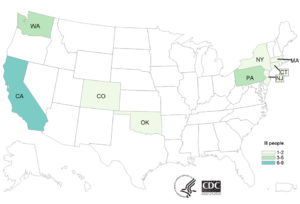
As of January 12, 2018, 25 people infected with the outbreak strains of Salmonella I 4,[5],12:b:- (24 people) or Salmonella Newport (1 person) have been reported from 9 states – California, Colorado, Connecticut, Massachusetts, New Jersey, New York, Oklahoma, Pennsylvania, and Washington. One more ill person infected with the outbreak strain of Salmonella I 4,[5],12:b:- has been reported from Canada.

Illnesses started on dates ranging from May 11, 2017 to November 4, 2017. Ill people range in age from 1 year to 82, with a median age of 19. Among ill people, 19 (76%) are male. Six people (24%) report being hospitalized. No deaths have been reported.
Epidemiologic, laboratory, and traceback evidence indicates that Coconut Tree Brand frozen Shredded Coconut is the likely source of this multistate outbreak. This investigation is ongoing.

Throughout the outbreak investigation, state and local health officials have collected different food items from restaurants where ill people consumed Asian-style dessert drinks. In November 2017, laboratory testing of a sample from coconut milk made in one restaurant in New York did not identify the outbreak strain of Salmonella I 4,[5],12:b:-, but did identify a strain of Salmonella Newport. This sample was from coconut milk made with Coconut Tree Brand frozen Shredded Coconut, as well as other ingredients. WGS showed that the Salmonella Newport isolated from the coconut milk was closely related genetically to a Salmonella Newport isolate from an ill person from Massachusetts who had consumed an Asian-style dessert drink.

In December 2017, officials in Massachusetts collected food items from a restaurant where that ill person had consumed Asian-style dessert drinks. One sample from frozen shredded coconut identified a strain of Salmonella that was new to the PulseNet database and has not been linked to any illnesses. This sample was from an unopened package of Coconut Tree Brand Frozen Shredded Coconut. As a result, on January 3, 2018, Evershing International Trading Company recalled all Coconut Tree Brand Frozen Shredded Coconut. The recalled product was packaged in 16-ounce plastic bags.

Officials in Massachusetts returned to the restaurant and collected more Coconut Tree Brand frozen Shredded Coconut in January 2018. On January 12, laboratory testing confirmed that samples from that frozen shredded coconut identified the outbreak strain of Salmonella I 4,[5],12:b:-. Laboratory testing of other samples identified several types of Salmonella bacteria, including Salmonella Javiana, Salmonella Rissen, and Salmonella Thompson. These samples were from unopened packages of Coconut Tree Brand Frozen Shredded Coconut sold before January 3, 2018. CDC is reviewing the PulseNet database to determine if the other Salmonella isolates from the frozen shredded coconut are linked to any illnesses.

The frozen shredded coconut linked to this outbreak was used as an ingredient in Asian-style dessert drinks served at restaurants. The product was also sold in grocery stores and markets in several states. Frozen shredded coconut can last for several months if kept frozen and may still be in retail stores or in people’s homes. CDC recommends that retailers not sell, restaurants not serve, and consumers not eat recalled Coconut Tree Brand frozen Shredded Coconut.

SONY DSC

Tony Turnbull of the Times dropped this headscratcher on us the morning: “Cooking with your Mouth:  Why using a knife for chopping your carrots is so last year.” Like the story of drinking – very expensive – “raw water,” eating food that has been prepared in someone elses mouth sounds a bit more likely coming from the Onion, than the more conventional media.  And, as he pointed out deeper in the story, the video of the “cook” was in fact a spoof.

But in case you are wondering why it might have been a bad idea in any event, here is a bit on what can come from ones mouth to yours:

Infectious diseases can be spread through saliva or shared foods and drinks. When a person accidentally consumes microbe-contaminated items, such as saliva, the swallowing action of the tongue wipes the microbes against the back of the throat, allowing the microbe to enter the body. Infections, such as mononucleosis, caused by Epstein-Barr virus and cytomegalovirus are examples of infections spread via oral transmission from virus-containing saliva. Other infectious microbes that spread through saliva do so by sticking to the inner surface of the cheeks and mouth, the tongue, or teeth. An example is the bacterium Streptococcus, which can cause an array of infections, including gum disease strep throat. As a result, microbes that are found in the saliva can generally be found in other parts of the respiratory tract, including the nose and throat. Therefore, even colds and flu (and other respiratory infections) can potentially be spread through the saliva. Certain other infections causing ulcerations in the mouth can also be spread through saliva, such as cold sores (herpes virus) and hand, foot and mouth disease.

The South African National Institute of Communicable Diseases (NICD) revealed on Friday that the death toll has risen from 61 to 67‚ and still the source of the outbreak — said to be the worst on record in world history — remains unknown.

About 40% of those who have died were babies less than four weeks old‚ pregnant woman being 20 times more likely to contract listeriosis from eating food contaminated with the listeria pathogen than other healthy adults.

The NICD reported that “final data” was only available for 21% of the 748 confirmed cases of listeriosis‚ of which 42% had died; the average mortality rate is between 20% and 25%.

Those with confirmed listeriosis were patients in state and private hospitals — roughly two thirds in state hospitals (65%) and a third (35%) in private hospitals.

The NICD has warned that because of “recent challenges” in state laboratory information system data since mid-November “and a possible lag in reporting as a result of the public holidays”‚ case numbers for the last six weeks of 2017 were likely to change on a daily basis “and trends must be interpreted with caution”.

Via genome sequencing, the NICD has established that, in most cases‚ the listeria came from a single source‚ thought to be a particular product or range of products. Pretoria-based microbiologist and food safety expert Dr Lucia Anelich said the “culprit” was most likely a product eaten by consumers across the country and “extremely often”.

Listeriosis symptoms develop any time between two and 30 days after eating food contaminated with the listeria pathogen. In pregnant women, they include mild, flu-like symptoms‚ headaches‚ muscle aches‚ fever‚ nausea and vomiting‚ and if the infection spreads to the nervous system it can cause a stiff neck‚ disorientation or convulsions.

High on the list of foods known to have caused other listeriosis outbreaks are ready-to-eat foods that consumers don’t cook or heat before eating‚ primarily deli meats — such as slices of ham‚ polony and cooked chicken.

“Deli meats are obviously consumed by a wide variety of people in the population‚ whether it’s a cheaper cut or a more expensive one‚” Anelich said. “But other products might also be just as implicated‚ and it’s really difficult to point a finger in a specific direction‚ considering we have absolutely no other leads at this stage.”

The program includes three days of sessions facilitated by Frank Yiannas, Vice President of Food Safety & Health, Walmart, USA and Adjunct Professor in the Online Master of Science in Food Safety Program at MSU.The program also includes guest lectures by William “Bill” Marler, Managing Partner, Marler Clark LLP PS, and The Robert Leader Endowed Lecture with Guest Lecturer Dr. Patricia Griffin, Chief of the US Centers for Disease Control and Prevention’s (CDC) Enteric Diseases Epidemiology Branch.

Frank Yiannas  Patricia Griffin, CDC  Bill Marler

The program will be conducted at the James B. Henry Center for Executive Development at Michigan State University. Evening activities include a welcome reception at the University Club of MSU on Tuesday, May 22; dinner and a tour of the internationally celebrated Eli and Edythe Broad Art Museum on Wednesday, May 23 and a “tailgate” dinner at the Huntington Club at Spartan Stadium on Thursday, May 24.

Yiannas is the author of Food Safety Culture – Creating a Behavior-based Food Safety Management System and Food Safety = Behavior (30 Proven Techniques to Enhance Employee Compliance). He is also Vice–Chair of the Global Food Safety Initiative (GFSI) and past President of the International Association for Food Protection.

NOTE: Cancellations are subject to a $100.00 administrative fee. No refunds will be granted after May 1, 2018. Send cancellation requests in writing to Esther Haviland at estherh@msu.edu.

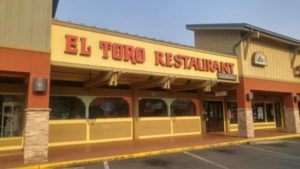
According to the Pierce County Department of Health, the week started with 41 reports of ill diners, which led to the closure of El Toro in Tacoma’s Westgate neighborhood Monday. By Wednesday, reports of ill customers had extended to its sister restaurant in University Place and that location also closed for sanitizing.
So far, about 10-15 people have reported illness after dining at the University Place location at 3820 Bridgeport Way W. The Tacoma location had 391 reports as of Thursday at its Westgate location at 5716 N. 26th St.

Diners who became ill reported they dined at the University Place location Jan. 6. At the Westgate location, diners became ill after visiting the restaurant between Dec. 31 and Jan. 8.

There might be more: The health department still is investigating reports. The numbers could increase.

“We don’t yet have an exact number because we have not interviewed all the people who have made illness reports. We continue to receive additional illness reports,” the health department said in a statement.

“We know two staff members at the Tacoma location worked while ill during the time customers there dined and later got sick. It’s still unclear if the outbreaks at the two locations are connected,” the health department reported. “Because of the nature of norovirus outbreaks, we may never know the exact affected items that caused illness. We know all the cases have dining at the El Toro Restaurants in common.”

If you ate at an El Toro and became ill, contact the health department to file a report at 253-798-4712. Email food@tpchd.org or make an online report at tpchd.org/reportfoodborneillness.

Vomiting, diarrhea and generally feeling horrible. Also, some patients will experience a fever and headache. If you’re struck with norovirus, staying hydrated is important. The illness usually lasts one to three days. Symptoms after an infection can appear between 12 to 48 hours later.

E. coli bacteria

In the United States, CDC, several states, and the U.S. Food and Drug Administration continue to investigate a multistate outbreak of 24 STEC O157:H7 infections in 15 states. Since CDC’s initial media statement on December 28, seven more illnesses have been added to this investigation. The last reported illness started on December 12, 2017.

The likely source of the outbreak in the United States appears to be leafy greens, but officials have not specifically identified a type of leafy greens eaten by people who became ill.  Leafy greens typically have a short shelf life, and since the last illness started a month ago, it is likely that contaminated leafy greens linked to this outbreak are no longer available for sale. Canada identified romaine lettuce as the source of illnesses there, but the source of the romaine lettuce or where it became contaminated is unknown.

Whole genome sequencing (WGS) showed that the STEC O157:H7 strain from ill people in the United States is closely related genetically to the STEC O157:H7 strain from ill people in Canada. WGS data alone are not sufficient to prove a link; health officials rely on other sources of data, such as interviews from ill people, to support the WGS link. This investigation is ongoing. Because CDC has not identified a specific type of leafy greens linked to the U.S. infections, and because of the short shelf life of leafy greens, CDC is not recommending that U.S. residents avoid any particular food at this time.

In the United States, a total of 24 STEC O157:H7 infections have been reported from California (4), Connecticut (2), Illinois (1), Indiana (2), Maryland (3), Michigan (1), Nebraska (1), New Hampshire (2), New Jersey (1), New York (1), Ohio (1), Pennsylvania (2), Vermont (1), Virginia (1), and Washington (1). Illnesses started on dates from November 15 through December 12, 2017. Among the 18 ill people for whom CDC has information, nine were hospitalized, including one person in California who died. Two people developed hemolytic uremic syndrome, a type of kidney failure.

The Public Health Agency of Canada identified romaine lettuce as the source of the outbreak in Canada. In the United States, the likely source of the outbreak appears to be leafy greens, but health officials have not identified a specific type of leafy greens that sick people ate in common.

State and local public health officials continue to interview sick people in the United States to determine what they ate in the week before their illness started. Of 13 people interviewed, all 13 reported eating leafy greens. Five (56%) of nine ill people specifically reported eating romaine lettuce. This percentage was not significantly higher than results from a survey of healthy people in which 46% reported eating romaine lettuce in the week before they were interviewed.  Based on this information, U.S. health officials concluded that ill people in this outbreak were not more likely than healthy people to have eaten romaine lettuce.  Ill people also reported eating different types and brands of romaine lettuce. Currently, no common supplier, distributor, or retailer of leafy greens has been identified as a possible source of the outbreak. CDC continues to work with regulatory partners in several states, at the U.S. Food and Drug Administration, and the Canadian Food Inspection Agency to identify the source.

Although the most recent illness started on December 12, there is a delay between when someone gets sick and when the illness is reported to CDC. For STEC O157:H7 infections, this period can be two to three weeks. Holidays can increase this delay. Because of these reporting delays, more time is needed before CDC can say the outbreak in the United Stated is over. This investigation is ongoing.

On January 10, 2018, the Public Health Agency of Canada reported that an outbreak of Shiga toxin-producing E. coli O157:H7 infections (STEC O157:H7) they had identified was linked to romaine lettuce appears to be over. As of January 10, 2018, there were 42 cases of E. coli O157 illness reported in five eastern provinces: Ontario (8), Quebec (15), New Brunswick (5), Nova Scotia (1), and Newfoundland and Labrador (13). Individuals became sick in November and early December 2017. Seventeen individuals were hospitalized. One individual died. Individuals who became ill were between the ages of 3 and 85 years of age. The majority of cases (74%) were female. It urged the public to avoid eating romaine lettuce until more is known about the contamination.