
Four people were killed Saturday when part of a crane fell from the construction site of a future Google building.

Investigating what caused a crane to collapse in downtown Seattle Saturday, killing four people and injuring four others, might take six months to a year.

The Washington state Department of Labor and Industries will head the investigation into GLY Construction, subcontractors Northwest Tower Crane and Omega Morgan, and Morrow Equipment Company.

In November 2006, King 5 reported that Thursday’s fatal crane accident in Bellevue is focusing a lot of attention on the industry, which has done a pretty good job in the area of safety. But went terribly and tragically wrong after the operator told firefighters he heard a cracking noise at the base of the crane.

When it happens, it’s pretty catastrophic.

Seattle Attorney Bill Marler represented a worker killed in the collapse of a crane inside the Kingdome in 1994. He says that accident was blamed on operator error. “To the extent you can figure out what happened, hopefully, one of these things won’t happen again,” he said.

The victim in the 2006 collapse was identified today as Matt Ammon, 31, a Microsoft employee for five months. The King County Medical Examiner’s Office said Ammon died of rib and pelvis injuries and other fractures.  Ammon lived in a fourth-floor apartment in the 248-unit Pinnacle BellCentre.  The Operator in crane wreck has history of drug abuse.

A decade ago, William Marler, a Seattle Attorney, sued Ness Cranes in relation to the Kingdome crane accident of 1994, which killed two men. The general contractor on that project, Pacific Components, was also sued.  His criminal background will be relevant only if operator error is at least partially responsible for the collapse, or if he did not perform an inspection properly, said Marler, the lawyer.

“You have to have some causal link between one and the other,” he said.

“The reality is that there is no public entity in inspecting cranes,” said Seattle lawyer Bill Marler. “It’s really the companies inspecting themselves.”

GAPS IN SAFETY CONTROLS

# The state does not require drug tests before crane operators are hired.

# The state did no safety inspections at the site of Thursday’s accident.

# Cranes must be inspected before each use, but it is usually done by the operator.

# A statewide crane-safety organization created after the deadly 1994 Kingdome crane accident is no longer active.

I found an interesting website on prior crane-related accidents – www.craneaccidents.com

I will be in lovely Minneapolis for the coming week meeting with defense counsel and the insurers for the manufacturers of E. coli O26-tainted ground beef, Salmonella-tainted cut fruit and E. coli O157:H7-tainted romaine lettuce who sickened dozens in 2018.  I hear the weather in Minnesota may still have some snow in it, but heck, it also will be my birthday Friday.
Here is the case lineup:

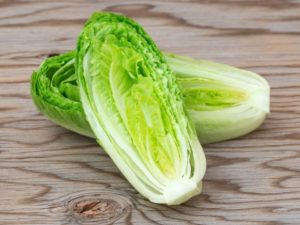
The Spring 2018 E. coli O157:H7 Romaine Lettuce Outbreak:  In 2018 in the United Sates, 210 people infected with the outbreak strain of E. coli O157 were reported from 36 states. 96 people were hospitalized, including 27 people who developed a type of kidney failure called hemolytic uremic syndrome (HUS). 5 deaths were reported from Arkansas, California, Minnesota (2), and New York. In Canada, 8 cases of E. coli O157 that were genetically similar to the U.S. outbreak linked to romaine lettuce coming from the Yuma growing region in the U.S. The 8 Canadian illnesses were reported in 5 provinces: British Columbia, Alberta, Saskatchewan, Ontario and Quebec. 1 of the Canadian cases was hospitalized with HUS and no deaths were reported in Canada. Through our own traceback, we have uncovered numbers restaurant clusters which have led to processor clusters, and in some instances, farms.
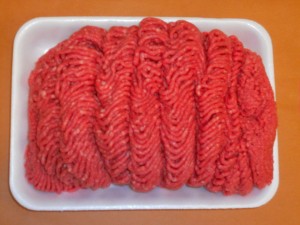
The Summer 2018 E. coli O26 Ground Beef Outbreak:  As of September 19, 2018, 18 people infected with the outbreak strain of E. coli O26 were reported from 4 states. Illnesses started on dates ranging from July 5, 2018 to July 25, 2018. Ill people ranged in age from one year to 75, with a median age of 16. Sixty-seven percent of ill people were male. Of 18 people with information available, 6 (33%) were hospitalized, including one person who died in Florida. Epidemiologic, laboratory, and traceback evidence indicates that ground beef from Cargill Meat Solutions was a likely source of this outbreak.

The Summer 2018 Salmonella Adelaide Cut Fruit Outbreak: As of July 24, 2018, 77 people infected with the outbreak strain of Salmonella Adelaide were reported from nine states – Arkansas 1, Florida 1, Illinois 7, Indiana 14, Kentucky 1, Michigan 39, Missouri 11, Ohio 2, Tennessee 1. Illnesses started on dates ranging from April 30, 2018, to July 2, 2018. Ill people ranged in age from less than 1 year to 97, with a median age of 67. Among ill people, 67% were female. Out of 70 people with information available, 36 (51%) were hospitalized. No deaths were reported. Epidemiologic and traceback evidence indicated that pre-cut melon supplied by the Caito Foods, LLC of Indianapolis, Indiana was the likely source of this multistate outbreak.
Wish the parties luck in finding common ground on these strict product liability cases.

What we know is that illnesses began March 1 and it is now almost May 1 – why did it take so long to figure out that 177 people with E. coli O103 were linked to ground beef? Why do we do not yet know the original source of the contamination?  Why is the public not being told the location where known illnesses occurred? Finally, are more people going to get sick?

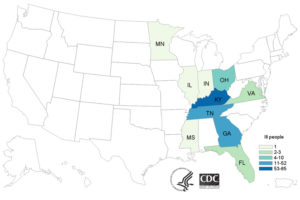
What we also do know – According to the CDC and 10 state health agencies, a total of 177 people infected with the outbreak strain of E. coli O103 have been reported from 10 states – Georgia (41), Kentucky (65), Ohio (10), Tennessee (52), Virginia (2), Indiana (1), Florida (3), Illinois (1), Mississippi (1) and Minnesota (1). The Illnesses started on dates from March 1, 2019, to April 14, 2019. Ill people range in age from less than 1 year to 84 years, with a median age of 18. Fifty-one percent are female. Twenty-one people have been hospitalized. However, fortunately, no deaths and no cases of hemolytic uremic syndrome have been reported.

Why does in take time to count the ill and come to a conclusion as to a common cause – The CDC says that illnesses that occurred after March 29, 2019, might not yet be reported due to the time it takes between when a person becomes ill with E. coli and when the illness is reported. This takes an average of two to three weeks.  The truth is that takes time for people to become ill – onset (between ingestion and illness) can be 1 to 10 days.  It then takes time for tests to be run to confirm an infection and then to have the E. coli “genetically fingerprinted” using PFGE and the good people at CDC Pulsenet. Then it takes time to interview people and to ask them to recall what they consumed in the 1-10 before they became ill.  And, finally it takes time to see what the growing number of ill across 10 states do and do not have in common.  It simply takes time.

It is therefore possible that we are seeing the end of the outbreak. And, in looking at the “Epi Curve,” the trend line is down.  Perhaps the number of ill, assuming all tainted product is eventually recalled, might crest 200.  However, this sadly is still the largest E. coli outbreak linked to ground beef in decades (think 1993 Jack in the Box).

Recall too that early on that Kentucky health authorities reported that the outbreak might well be related to “fast food.”  In part, that might well be because the median age of the ill is 18, and that they generally consume more “fast food” than the average consumer?  Also, the younger, but not too young, age likely accounts for less severe illness, but it also may be a less virulent STEC E. coli?

So, why have we not learned the ultimate source of the E. coli O103 contamination?  And, what I mean by ultimate source is where the originating contamination occurred.

According to investigators, ill people in this outbreak report eating ground beef at home and in restaurants. Ill people in this outbreak ate ground beef from many sources. Investigators continue to trace other sources for ground beef. Authorities say that at this time, no common supplier, distributor, or brand of ground beef has been identified that could account for the whole outbreak.

However, the investigators caught a scientific break of sorts.  E. coli O103 was identified in samples of ground beef collected from two locations (not disclosed) where ill people reported eating – one in Kentucky and one in Tennessee. Laboratory testing identified the outbreak strain of E. coli O103 in both of the ground beef samples.  Presumably, we will hear shortly that the E. coli O103 found in the samples of beef are matches to the E. coli O103 found in the 177 ill.  Here is what we know about the positive tests and what we do not know about the locations.

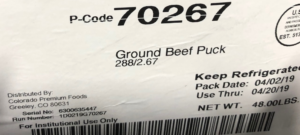
K2D Foods, doing business as Colorado Premium Foods, in Carrollton, Georgia, recalled approximately 113,424 pounds of raw ground beef products on April 23, 2019 after an unopened, intact ground beef collected as part of the ongoing investigation from a unnamed restaurant location, where multiple case-patients reported dining, tested positive for E. coli O103. The products subject to recall bear establishment number “EST. 51308” inside the USDA mark of inspection on the boxes. These items were shipped to distributors in Port Orange, Florida and Norcross, Georgia for further distribution to restaurants.
Grant Park Packing in Franklin Park, Illinois, recalled approximately 53,200 pounds of raw ground beef products on April 24, 2019 after an unopened, intact, packages of ground beef collected as part of the ongoing investigation tested positive for E. coli O103 at an FSIS laboratory. The sample was collected at an unnamed point of service where multiple case patients ate. The products subject to recall bear establishment number “EST. 21781” inside the USDA mark of inspection. These items were shipped to Minnesota for further distribution and Kentucky for institutional use.

The first next question is where did K2D and Grant Park get the beef that went into the packages that tested positive?  Were there multiple sources?  Is there a common supplier?

However, even if the answer comes to the beef served at the “unnamed restaurant location” in Kentucky and the “unnamed point of service” in Tennessee, what accounts for all the other ill in Kentucky and Tennessee and the case in Georgia, Ohio, Virginia, Indiana, Florida, Illinois, Mississippi and Minnesota.

Much more work needs to be done and much more needs to be uncovered and disclosed.

On the anniversary of my 5,000th blog post (I’m n0w at 6388) I wrote:

In 2002, I wrote an Op-ed for the Denver Post entitled: “Put me out of business. Please.”

For this trial lawyer, E. coli has been a successful practice – and a heart-breaking one. I’m tired of visiting with horribly sick kids who did not have to be sick in the first place. I’m outraged with a food industry that allows E. coli and other poisons to reach consumers, and a federal regulatory system that does nothing about it…. And, with a little luck, it will force one damn trial lawyer to find another line of work.

From the Jack in the Box E. coli outbreak of 1993 until the 2002 ConAgra E. coli outbreak, at least 95% of Marler Clark revenue was E. coli cases linked to hamburger.  Today, it is nearly zero.  That is success.  To the beef industry – thank you for meeting the challenge.  The millions spent on interventions, and the countless hours of food safety professionals, made the difference.

That all being said, there is still much the industry can do.  Shiga-toxin producing E. coli will always be an issue.  Listeria and antibiotic resistant Salmonella and Campylobacter, and other bad bugs we do not even know about, lurk around the corner.  The industry cannot let up.  Even with the success there still have been isolated tragedies like Stephanie Smith who remind you the battle will likely always have to be fought.

But, for now, hats off to you.

Hopefully, it was not a premature congratulations?  Here is where we were a few moments ago:

As of April 25, 2019, 177 people infected with the outbreak strain of E. coli O103 have been reported from 10 states. CDC is reporting the 177 illnesses that the PulseNet laboratory network has confirmed are part of this outbreak. States are investigating additional illnesses that might be a part of this outbreak.

Illnesses started on dates from March 1, 2019, to April 14, 2019. Ill people range in age from less than 1 year to 84 years, with a median age of 18. Fifty-one percent are female. Of 143 people with information available, 21 (15%) have been hospitalized. No deaths and no cases of hemolytic uremic syndrome have been reported.

This multistate investigation began on March 28, 2019, when officials in Kentucky and Georgia notified CDC of this outbreak. Epidemiologic and laboratory evidence indicates that ground beef is the likely source of this outbreak.

As of April 25, 2019, 177 people infected with the outbreak strain of E. coli O103 have been reported from 10 states. CDC is reporting the 177 illnesses that the PulseNet laboratory network has confirmed are part of this outbreak. States are investigating additional illnesses that might be a part of this outbreak.

Illnesses started on dates from March 1, 2019, to April 14, 2019. Ill people range in age from less than 1 year to 84 years, with a median age of 18. Fifty-one percent are female. Of 143 people with information available, 21 (15%) have been hospitalized. No deaths and no cases of hemolytic uremic syndrome have been reported.

Illnesses that occurred after March 29, 2019, might not yet be reported due to the time it takes between when a person becomes ill with E. coli and when the illness is reported. This takes an average of two to three weeks.

This multistate investigation began on March 28, 2019, when officials in Kentucky and Georgia notified CDC of this outbreak. Epidemiologic and laboratory evidence indicates that ground beef is the likely source of this outbreak.

In interviews, ill people answered questions about the foods they ate and other exposures in the week before they became ill. Of the 125 people interviewed, 100 (80%) reported eating ground beef. This percentage is significantly higher than results from a survey pdf icon[PDF – 787 KB] of healthy people. Ill people bought or ate ground beef from several different grocery stores and restaurants. Many ill people bought large trays or chubs of ground beef from grocery stores and used the meat to make dishes like spaghetti sauce and sloppy joe.

Officials at USDA-FSIS, in Kentucky, and in Tennessee collected ground beef from a restaurant and an institution where ill people reported eating. Laboratory testing identified the outbreak strain of E. coli O103 in the ground beef collected in Tennessee. E. coli O103 was identified in the ground beef collected in Kentucky, but laboratory results are pending to determine if it is closely related to the E. coli O103 identified in ill people.

State Ill People
Florida 3
Georgia 41
Illinois 1
Indiana 1
Kentucky 65
Minnesota 1
Mississippi 1
Ohio 10
Tennessee 52
Virginia 2
Total 177

Two companies recalled raw ground beef products because they may be contaminated with E. coli. Grant Park Packing in Franklin Park, Ill., recalled approximately 53,200 pounds of raw ground beef products on April 24, 2019. K2D Foods, doing business as Colorado Premium Foods, in Carrollton, Ga., recalled approximately 113,424 pounds of raw ground beef products on April 23, 2019. These products were sold to restaurants and institutions.

USDA-FSIS and state regulatory officials continue to collect products for testing and continue their traceback investigations to determine the source of ground beef supplied to grocery stores and restaurants where ill people ate. At this time, no common supplier, distributor, or brand of ground beef has been identified that could account for the whole outbreak.

Criminal prosecutions in food cases have been quiet for the last few years.

Outbreak 2: The recent multistate investigation began on April 2, 2019, when CDC’s PulseNet identified the Salmonella Carrau outbreak. As of April 24, 2019, 117 people infected with the outbreak strain of Salmonella Carrau have been reported from 10 states – Minnesota, Iowa, Missouri, Michigan, Illinois, Wisconsin, Indiana, Ohio, Kentucky and Alabama.

Illnesses started on dates ranging from March 4, 2019, to April 8, 2019. Ill people range in age from less than one to 98 years, with a median age of 53. Fifty-eight percent are female. Of 88 people with information available, 32 (36%) have been hospitalized. No deaths have been reported.

Epidemiologic and traceback evidence indicate that pre-cut melon supplied by Caito Foods LLC of Indianapolis, Ind. is the likely source of this multistate outbreak.

Outbreak 1: Less than a year ago, on July 24, 2018, the CDC reported that 77 people infected with the outbreak strain of Salmonella Adelaide were reported from nine states – Arkansas, Florida, Illinois, Indiana, Kentucky, Michigan, Missouri, Ohio, Tennessee.

Illnesses started on dates ranging from April 30, 2018, to July 2, 2018. Ill people ranged in age from less than 1 year to 97, with a median age of 67. Among ill people, 67% were female. Out of 70 people with information available, 36 (51%) were hospitalized. No deaths were reported.

Epidemiologic and traceback evidence indicated that pre-cut melon supplied by the Caito Foods, LLC of Indianapolis, Indiana was the likely source of this multistate outbreak.

So, what about criminal sanctions? Could a person in a “position of responsibility or authority in a firm” above face criminal sanctions? Perhaps. Should they? That is a debate to have. It would make me nervous if I sat in a position of authority in one of the companies above or one of their suppliers.

By way of background, in 1938 Congress passed the Federal Food, Drug, and Cosmetic Act (FDCA) in reaction to growing public food safety demands.  The primary goal of the Act was to protect the health and safety of the public by preventing deleterious, adulterated or misbranded articles, including food, from entering interstate commerce.

Under section 402(a)(4) of the Act, a food product is deemed “adulterated” if the food was “prepared, packed, or held under insanitary conditions whereby it may have become contaminated with filth, or whereby it may have been rendered injurious to health.” A food product is also considered “adulterated” if it bears or contains any poisonous or deleterious substance, which may render it injurious to health. Chapter III of the Act addresses prohibited acts, subjecting violators to both civil and criminal liability.

Felony violations include adulterating or misbranding a food, drug, or device, and putting an adulterated or misbranded food, drug, or device into interstate commerce.  Any person who commits a prohibited act violates the FDCA.  A person committing a prohibited act “with the intent to defraud or mislead” is guilty of a felony punishable by years in jail and millions in fines or both. The key here is an intentional act.

A misdemeanor conviction under the FDCA, unlike a felony conviction, does not require proof of fraudulent intent, or even of knowing or willful conduct.  Rather, a person may be convicted if he or she held a position of responsibility or authority in a firm such that the person could have prevented the violation – prevented the tainted product from entering interstate commerce. Again, unlike a felony and misdemeanor charge is a crime with no intent.  Convictions under the misdemeanor provisions are punishable by not more than one year or fined not more than $250,000, or both.

The past as a guide? Here are four cases where prosecutors brought criminal charges – the first three are misdemeanor charges and the last a felony charge:

  • In 1998 in what was the first criminal conviction in a large-scale food-poisoning outbreak, Odwalla Inc. pleaded guilty to violating Federal food safety laws and agreed to pay a $1.5 million fine for selling tainted apple juice that killed a 16-month-old girl and sickened 70 other people in several states in 1996. Odwalla, based in Half Moon Bay, California pleaded guilty to 16 counts of unknowingly delivering ”adulterated food products for introduction into interstate commerce” in the October 1996 outbreak, in which a batch of its juice infected with the toxic bacteria E. coli O157:H7 sickened people in Colorado, California, Washington and Canada. Fourteen children developed a life-threatening disease (hemolytic uremic syndrome -HUS) that ravages kidneys. At the time, the $1.5 million penalty was the largest criminal penalty in a food poisoning case.  Odwalla also was on court-supervised probation for five years, meaning that it had to submit a detailed plan to the food and drug agency demonstrating its food safety precautions and that any subsequent violations could have resulted in more serious charges.
  • In 2012 Eric Jensen, age 37, and Ryan Jensen, age 33, brothers who owned and operated Jensen Farms, a fourth generation cantaloupe operation, located in Colorado, presented themselves to U.S. marshals in Denver and were taken into custody on federal charges brought by the U.S. Attorney’s Office with the Food and Drug Administration – Office of Criminal Investigation. According to the six-count indictment, Eric and Ryan Jensen unknowingly introduced adulterated (Listeria-tainted) cantaloupe into interstate commerce. The indictment further stated that the cantaloupe was prepared, packed and held under conditions, which rendered it injurious to health.  The outbreak sickened over 147, killing over 33 in 28 states in the fall of 2011.  The Jensen’s faced up to six years in jail and $1,500,000 in fines each. The eventually pleaded guilty and were sentenced to five years probation.
  • In 2013, Austin “Jack” DeCoster and his son, Peter DeCoster, both faced charges stemming from a Salmonella outbreak caused by their Iowa egg farms in 2010.  The Salmonella outbreak ran from May 1 to November 30, 2010, and prompted the recall of more than a half-billion eggs. And, while there were 1,939 confirmed infections, statistical models used to account for Salmonella illnesses in the U.S. suggested that the eggs might have sickened more than 62,000 people. The family business, known as Quality Egg LLC, pleaded guilty in 2015 to a federal felony count of bribing a USDA egg inspector and to two misdemeanors of unknowingly introducing adulterated food into interstate commerce. As part of the plea agreement, Quality Egg paid a $6.8-million fine and the DeCosters $100,000 each, for a total of $7 million.  Both DeCosters were sentenced to three months in jail. They are appealing the jail sentence.
  • In 2015 ConAgra Foods agreed to plead guilty and pay $11.2 million in connection with the shipment of Salmonella contaminated peanut butter linked to a 2006 through 2007 nationwide outbreak of that sickened over 700. ConAgra signed a plea agreement admitting that it unknowingly introduced Peter Pan and private label peanut butter contaminated with Salmonella into interstate commerce during the 2006 through 2007 outbreak.
  • In 2014 former Peanut Corporation of America owner Stewart Parnell, his brother and one-time peanut broker, Michael Parnell, and Mary Wilkerson, former quality control manager at the company’s Blakely, Georgia, plant, faced a federal jury in Albany, Georgia. The 12-member jury found Stewart Parnell guilty on 67 federal felony counts, Michael Parnell was found guilty on 30 counts, and Wilkerson was found guilty of one of the two counts of obstruction of justice charged against her. Two other PCA employees earlier pleaded guilty. The felony charges of introducing adulterated food into interstate commerce, “with the intent to defraud or mislead,” stemmed from a 2008 to 2009 Salmonella outbreak that sickened 714 and left nine dead. Stewart Parnell is now spending 28 years in prison and Michael 20. Mary Wilkerson is going to jail for 5 years.

If I was Caito, I would be nervous.

Bill Marler, food safety advocate and foodborne attorney since 1993, whose Seattle law firm, Marler Clark, has been contacted by victims of the recent E. coli O103 ground meat outbreak, and recent Salmonella outbreaks linked cut fruit and ground tuna, called today on those companies responsible to pay the medical bills and lost wages of all individuals who became ill.

“We know that at least 156 people became ill with E. coli infections after eating tainted beef and 130 became ill from eating either cut fruit or ground tuna. Unfortunately, those numbers will like rise in the coming week,”  Marler said.  “The cost of treating victims of E. coli and Salmonella infections can run in the tens of thousands of dollars, or in a severe case, even in the hundreds of thousands of dollars,” Marler continued. “These families need these companies to do more than promise to cooperate in the investigation into these outbreaks. They need to know that these companies intend to fulfill their corporate responsibility by looking out for their customers,” Marler added.

Marler noted that over the last two decades in other outbreak-situations, companies such as Chi-Chi’s, Dole, Jack in the Box, Con Agra, Odwalla and Sheetz advanced medical costs for outbreak victims whose illnesses were traced to their food products.

Since the Jack in the Box E. coli outbreak in 1993, where Bill recovered $15,600,000 for one of its victims, Bill has represented thousands of E. coli, Salmonella, Listeria, Hepatitis A and other foodborne illness victims against the largest corporations in the US and around the world. Total recoveries on behalf of victims are in excess of $650,000,000.

Dozens of times a year Bill speaks to industry and government throughout the United States, Canada, Europe, Africa, China and Australia on why it is important to prevent foodborne illnesses.  He is also a frequent commentator on food litigation and food safety on Marler Blog . Bill is also the publisher of Food Safety News.

Campylobacter, with poultry as a major source, is still the most commonly identified foodborne illness since FoodNet tracking began in 2013. Also, the incident of Salmonella Enteritidis, the most common Salmonella subtype for which poultry and eggs are often the source, has not declined over the last 10 years. Compared with 2015-2017 levels, incidence significantly increased in 2018 for Cyclospora (399%), Vibrio (109%), Yersinia (58%), STEC E. coli (26%), Campylobacter (12%), and Salmonella (9%).

Not much of a surprise to those who follow my blog.  Looks like biggest culprits are Chicken and Leafy Greens.

The CDC reported today that the incidence of three major foodborne pathogens Campylobacter, Salmonella  Enteritidis  and STEC E. coli has increased in 2018.

The Bug – Campylobacter: Campylobacter continues to be the most commonly identified infection in FoodNet since 2013.

What is the Government and Industry doing about it: Poultry is a major source of Campylobacter. In August 2018, FSIS began using a new testing method; in a study of that method, Campylobacter was isolated from 18% of chicken carcasses and 16% of chicken parts sampled. FSIS currently makes aggregated test results available and intends to update performance standards for Campylobacter contamination.

The Bug – Salmonella:  The incidence of infections with Salmonella Enteritidis has not declined in over 10 years.

What is the Government and Industry doing about it: Salmonella Enteritidis is adapted to live in poultry, and eggs are an important source of infections. By 2012, FDA had implemented the Egg Safety Rule, which requires preventive measures during the production of eggs in poultry houses and requires subsequent refrigeration during storage and transportation, for all farms with ≥3,000 hens. In December 2018, FSIS reported that 22% of establishments that produce chicken parts failed to meet the Salmonella performance standard. The percentage of samples of chicken meat and intestinal contents that yielded Enteritidis were similar in 2018 to those during 2015–2017.

The Bug – E. coli:  STEC E. coli has increased in 2018.

What is the Government and Industry doing about it: Produce is a major source of foodborne illnesses. During 2018, romaine lettuce was linked to two multistate outbreaks of STEC O157 infections. FDA is implementing the Produce Safety Rule, with routine inspections of large produce farms planned this spring. Because produce is a major component of a healthy diet and is often consumed raw, making it safer is important for improving human health.

Full Report:


Link between two producers of meat and the recalls unclear (How are the two connected?  Presumably a common supplier?) except that both recalls were prompted by positive E. coli O103 tests on “Unopened, intact, packages of ground beef collected as part of the ongoing investigation tested positive for E. coli O103 at an FSIS laboratory.”

Recall No. 2 landed in my inbox about 9PM Wednesday night on the ongoing E. coli O103 outbreak that has now sickened a total of 156 people infected with the outbreak strain of E. coli O103 from 10 states. Twenty people have been hospitalized.  This 2nd recall states:

Grant Park Packing, a Franklin Park, Ill. establishment, is recalling approximately 53,200 pounds of raw ground beef products that may be contaminated with E. coli O103, the U.S. Department of Agriculture’s Food Safety and Inspection Service (FSIS) announced today.

The bulk raw ground beef was produced on October 30-31, 2018 and November 1, 2018.  The following products are subject to recall:

  • 40-lb. bulk cardboard boxes of “North Star Imports & Sales, LLC. 100% GROUND BEEF BULK 80% LEAN/ 20% FAT” marked “FOR INSTITUTIONAL USE ONLY” with lot code GP.1051.18 and pack dates 10/30/2018, 10/31/2018, and 11/01/2018.

The products subject to recall bear establishment number “EST. 21781” inside the USDA mark of inspection. These items were shipped to Minnesota for further distribution and Kentucky for institutional use.

FSIS and its public health partners, including the Centers for Disease Control and Prevention (CDC) and the Kentucky Department for Public Health, have been investigating an outbreak of E. coli O103. Unopened, intact, packages of ground beef collected as part of the ongoing investigation tested positive for E. coli O103 at an FSIS laboratory. The sample was collected at a point of service where multiple case patients ate. At this time, there is no definitive link between this positive product and the ongoing E. coli O103 outbreak. Further traceback and product analysis continues to determine if the recalled products are related to the E. coli O103 outbreak.

The first recall hit my inbox abut 10PM on Tuesday.  That recall states:

FSIS reported moments ago, K2D Foods, doing business as (DBA) Colorado Premium Foods, a Carrolton, Ga. establishment, is recalling approximately 113,424 pounds of raw ground beef products that may be contaminated with E. coli O103, the U.S. Department of Agriculture’s Food Safety and Inspection Service (FSIS) announced today.  This is a Class I Recall.

The raw ground beef items were produced on March 26, March 29, April 2, April 5, April 10, and April 12, 2019.  The following products are subject to recall:

  • Two 24-lb. vacuum-packed packages in cardboard boxes containing raw “GROUND BEEF PUCK” with “Use Thru” dates of 4/14/19, 4/17/19, 4/20/19, 4/23/19, 4/28/19, and 4/30/19.

The products subject to recall bear establishment number “EST. 51308” inside the USDA mark of inspection on the boxes. These items were shipped to distributors in Ft. Orange, Fla. and Norcross, Ga. for further distribution to restaurants.

FSIS and its public health partners, including the Centers for Disease Control and Prevention (CDC) and the Tennessee Department of Health, have been investigating an outbreak of E. coli O103. Unopened, intact ground beef collected as part of the ongoing investigation from a restaurant location, where multiple case-patients reported dining, tested positive for E. coli O103. At this time, there is no definitive link between this positive product and the ongoing E. coli O103 outbreak. Further traceback and product analysis continues to determine if the recalled products are related to the E. coli O103 outbreak.

The CDC, public health and regulatory officials in several states, and the U.S. Food and Drug AdministrationExternal are investigating a multistate outbreak of Salmonella Carrau infections.

Public health investigators are using the PulseNet system to identify illnesses that may be part of this outbreak. PulseNet is the national subtyping network of public health and food regulatory agency laboratories coordinated by CDC. DNA fingerprinting is performed on Salmonella bacteria isolated from ill people by using techniques called pulsed-field gel electrophoresis (PFGE) and whole genome sequencing (WGS). CDC PulseNet manages a national database of these DNA fingerprints to identify possible outbreaks. WGS gives a more detailed DNA fingerprint than PFGE. WGS showed that isolates from ill people were closely relatedly genetically. This means that people in this outbreak are more likely to share a common source of infection.

The multistate investigation began on April 2, 2019, when PulseNet identified the outbreak. As of April 24, 2019, 117 people infected with the outbreak strain of Salmonella Carrau have been reported from 10 states – Minnesota, Iowa, Missouri, Michigan, Illinois, Wisconsin, Indiana, Ohio, Kentucky and Alabama.

Illnesses started on dates ranging from March 4, 2019, to April 8, 2019. Ill people range in age from less than one to 98 years, with a median age of 53. Fifty-eight percent are female. Of 88 people with information available, 32 (36%) have been hospitalized. No deaths have been reported.

Illnesses might not yet be reported due to the time it takes between when a person becomes ill and when the illness is reported. This takes an average of 4 weeks.

Epidemiologic and traceback evidence indicate that pre-cut melon supplied by Caito Foods LLC of Indianapolis, Ind. is the likely source of this multistate outbreak.

In interviews, ill people answered questions about the foods they ate and other exposures in the week before they became ill. Forty-six (73%) of 63 people interviewed reported eating pre-cut melons purchased at grocery stores, including pre-cut cantaloupe, watermelon, honeydew, or a fruit salad mix or fruit tray with melon. Five additional people reported eating pre-cut melon outside the home.

Information collected from stores where ill people shopped indicates that Caito Foods LLC supplied pre-cut melon to these stores. On April 12, 2019, Caito Foods, Inc. recalledExternal pre-cut watermelon, honeydew melon, cantaloupe, and pre-cut fruit medley products containing one of these melons produced at the Caito Foods LLC facility in Indianapolis, Ind.