

Had a great opportunity to get on the line with some of my favorite people with one of the very best online sources of everything food. Here is the interview:

From meat and eggs to leafy greens, four experts weigh in on the safety of the U.S. food supply over the past decade and lay out strategies to improve it.
Listeria in smoked salmon, pieces of metal in chicken strips, undeclared allergens in frozen Chinese food and meatballs, E.coli in ground beef, and mold in corn used for animal feed. This is a partial list of the foods recall in the U.S. from just the last few weeks. In our increasingly consolidated, industrialized food system, stories like these have become commonplace. And yet, unless they are associated with documented illnesses or deaths—such as last year’s two outbreaks of E. coli on Romaine lettuce in Yuma, Arizona, which led to hundreds of illnesses and at least five deaths—they rarely make front page news.
The question of just how safe our food is, and what can be done to make it safer, has been occupying scientists, advocates, lawmakers, and public health officials for decades, and the last 10 years have been especially contentious.
In 2011, President Obama signed into law the most significant piece of food-safety legislation since the 1930s. The Food Safety Modernization Act (FSMA) came in response to a wave of food-borne illnesses and granted the U.S. Food and Drug Administration (FDA) broad new powers to inspect and regulate food products and producers.
At the same time, the country’s food safety system remains complicated—the U.S. Department of Agriculture (USDA) remains responsible for inspecting all meat, poultry, and eggs, while the FDA inspects everything else. Under this situation, a frozen pepperoni pizza would undergo three USDA inspections, while a frozen cheese pizza from the same company would receive just one FDA inspection.

While designed and intended to save lives and protect people, food safety regulations can bring financial and operational burdens to farmers and other food producers, especially those with small- and medium-sized operations. And the growing interest in and demand for cottage food laws and “food sovereignty” bills hint at a grass-roots resistance to what some producers might see as overreaching regulations.
To celebrate Civil Eats’ 10th anniversary, we have been conducting a series of roundtable discussions touching on some of the most important topics we have covered since 2009. In the conversation below, we invited four experts to weigh in on the state of food safety. Marion Nestle is an author and the Paulette Goddard Professor, of Nutrition, Food Studies, and Public Health, Emerita, at New York University; Bill Marler is the managing partner of Marler Clark, a Seattle, Washington, based law firm that specializes in foodborne illness cases and founder and publisher of Food Safety News; Rebecca Spector is the West Coast director for the advocacy nonprofit Center for Food Safety; and Judith McGeary is an attorney, farmer, advocate, and the executive director of the Farm and Ranch Freedom Alliance, a Texas-based organization that advocates for policies to support independent family farmers.
Civil Eats’ editor-in-chief, Naomi Starkman, and associate editor Christina Cooke facilitated the wide-ranging discussion. The conversation has been edited for clarity and brevity.
 Since the last update on April 26, 2019, 19 more ill people were added to this outbreak.
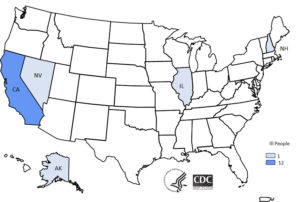

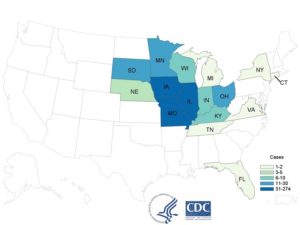 As of September 11, 2018, CDC was notified of 511 laboratory-confirmed cases of Cyclospora infections in people from 15 states and New York City who reported consuming a variety of salads from McDonald’s restaurants in the Midwest.
 Now that is a mouthful of some pathogens.
 This year marks the 25th anniversary of a massive E. coli outbreak, which hit 73 Jack in the Box restaurants in Washington, Idaho, Oregon and California; sickened 700 people; sent 171 to the hospital; and killed four. The anniversary is a somber but noteworthy milestone for accomplished food safety attorney Bill Marler ’87.
 It is said that it is always hard to get the first olive out of the jar and it is the same in settlements. It was hard fought, but the resolutions of the cases were fair and my hope is that these corporate defendants and their insurers see that it is in everyone’s best interest to take care of customers who were sickened by their product sooner rather than later.
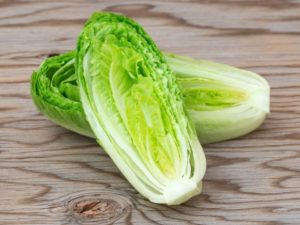 The Spring 2018 E. coli O157:H7 Romaine Lettuce Outbreak: In 2018 in the United Sates, 210 people infected with the outbreak strain of E. coli O157 were reported from 36 states. 96 people were hospitalized, including 27 people who developed a type of kidney failure called hemolytic uremic syndrome (HUS). 5 deaths were reported from Arkansas, California, Minnesota (2), and New York. In Canada, 8 cases of E. coli O157 that were genetically similar to the U.S. outbreak linked to romaine lettuce coming from the Yuma growing region in the U.S. The 8 Canadian illnesses were reported in 5 provinces: British Columbia, Alberta, Saskatchewan, Ontario and Quebec. 1 of the Canadian cases was hospitalized with HUS and no deaths were reported in Canada. Through our own traceback, we have uncovered numbers restaurant clusters which have led to processor clusters, and in some instances, farms.
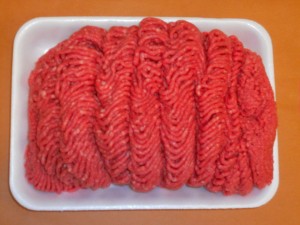 The Summer 2018 E. coli O26 Ground Beef Outbreak: As of September 19, 2018, 18 people infected with the outbreak strain of E. coli O26 were reported from 4 states. Illnesses started on dates ranging from July 5, 2018 to July 25, 2018. Ill people ranged in age from one year to 75, with a median age of 16. Sixty-seven percent of ill people were male. Of 18 people with information available, 6 (33%) were hospitalized, including one person who died in Florida. Epidemiologic, laboratory, and traceback evidence indicates that ground beef from Cargill Meat Solutions was a likely source of this outbreak.
 The Summer 2018 Salmonella Adelaide Cut Fruit Outbreak: As of July 24, 2018, 77 people infected with the outbreak strain of Salmonella Adelaide were reported from nine states – Arkansas 1, Florida 1, Illinois 7, Indiana 14, Kentucky 1, Michigan 39, Missouri 11, Ohio 2, Tennessee 1. Illnesses started on dates ranging from April 30, 2018, to July 2, 2018. Ill people ranged in age from less than 1 year to 97, with a median age of 67. Among ill people, 67% were female. Out of 70 people with information available, 36 (51%) were hospitalized. No deaths were reported. Epidemiologic and traceback evidence indicated that pre-cut melon supplied by the Caito Foods, LLC of Indianapolis, Indiana was the likely source of this multistate outbreak.
 The
The  Summary