
This fellowship was created in Dave’s honor after his sudden passing in 2017. It is a special opportunity for a young food scientist to work closely with Stop Foodborne Illness and learn from members who have experienced the consequences of failures in food safety firsthand. The Dave Theno Food Safety Fellowship is a partnership between Stop Foodborne Illness and Michigan State University Online Food Safety Program. The Fellow will work full-time for Stop Foodborne Illness and complete a 12-credit Online Food Safety Certificate with Michigan State University.

Salary for the Fellowship is $25,000. Start Date: August 24, 2020 | End Date: August 13, 2021

This is what I wrote about Dave before his untimely death:

In 2013, I wrote a piece on my blog about “Why I Love my Job.”  Its ironic how much of my job and my life over they last 25 years has been intertwined with Dave Theno.  I will miss the occasions we shared a good meal – Dave with a rare steak and mine well-done – with always a very good bottle of wine.  We will all miss his humanity and leadership.

Here is the piece I wrote:

A few months ago I was asked to write something by WSBA about my practice and life as a lawyer.  The ask was something like this:

Mr. Marler, I noted that you are a (“the” – I must admit I added that) preeminent litigator in food poisoning cases in our state (well, actually the “world” – I must admit I added that too). Our members would love an article from you describing a significant case or client that resonated with you, or a description of what it is like to practice in your area of law.

I thought a lot about the ask and my 20 plus years of practice, and the fact that I may well be at the downslope of a job that I truly love.  In a not so often-quite moment, I thought about the beginning of what became both my passion and my job.  Honestly, it has had very little to do with being a lawyer.

I had just turned 35-years-old and was only five years out of Law School, I was a young lawyer in a job that seemed quite dead-end, and then my world changed.
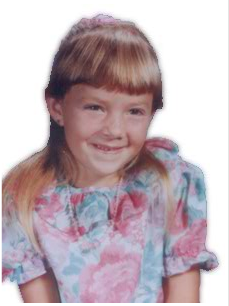
Lauren Beth Rudolph died on December 28, 1992 in her mother’s arms due to complications of an E. coli O157:H7 infection – Hemolytic Uremic Syndrome – also know as acute kidney failure.  She was only 6 years, 10 months, and 10 days old when she died. The autopsy described her perforated bowel as being the consistency of “jelly.”  Her death, the deaths of three other children, and the sicknesses of 600 others, were eventually linked to E. coli O157:H7 tainted hamburger produced by Von’s and served undercooked at Jack in the Box restaurants on the West Coast during late 1992 and January 1993.  I pushed myself to the front of the pack of lawyers.  Roni Rudolph, Lauren’s mom, I have known for nearly 20 years.

Dave Theno became head of Jack in the Box’s food safety shortly after the 1992-1993 outbreak. I too have known Dave for 20 years, mostly because I spent several days deposing (he would say – grilling/torturing) him over the course of the multi-year, multi-state litigation.  However, a decade after spending such quality time (for me anyway) with him, I only recently learned a significant fact about Dave – one that made me admire him even more – one that I think, that all leaders in corporate food safety, or any position of authority, should emulate.

Last year Dave and I shared the stage at the Nation Meat Association (NMA) annual “Meating” in Tampa as an odd pair of keynote speakers. The NMA is an association representing meat processors, suppliers, and exporters.  Dave, spoke just before I did and was rightly lauded as someone who takes food safety to heart.  However, it was his story about Lauren Rudolph and his relationship with Roni that struck me in a physical way.

Dave told the quiet audience about Lauren’s death. He too knew the same autopsy report.  Dave told the audience that the death of Lauren and his friendship with Roni had changed him also in a physical way. He told us all that he had carried a picture of Lauren in his briefcase everyday since he had taken the job at Jack in the Box. He told us that every time he needed to make a food safety decision – who to pick as a supplier, what certain specifications should be – he took out Lauren’s picture and asked, “What would Lauren want me to do?”

I thought how powerful that image was. The thought of a senior executive of any corporation holding the picture of a dead child seeking guidance to avoid the next possible illness or death is stunning, but completely appropriate.

I hugged Dave and we promised to get together again – sometime, someday.

Shortly after leaving Tampa, I spent time with a family in South Carolina whose 4 year old ate cookie dough tainted with E. coli O157:H7 and suffered months of hospitalizations, weeks of dialysis and seizures. She faces a lifetime of complications despite oversight by the Food and Drug Administration of the food she consumed.

After leaving South Carolina I headed to Cleveland, Ohio where I sat across the kitchen table with a family who lost their only daughter, Abby, because she died from an E. coli O157:H7 infection from meat inspected by the United States Department of Agriculture Food Safety Inspection Services.

Neither head of either agency, nor the president of either corporation, whose product took the life of one and nearly the life of the other, ever visited either family, and, that is a shame.

In 20 years of litigation, in 20 years of spending time with Lauren’s or Abby’s family, I am changed.  I see the world far differently than most do now.

If I had any advice to offer to corporate or governmental leaders – run your departments like Dave ran food safety at Jack in the Box. Go meet the families that Dave and I have met.  Sit across their kitchen tables. Go to their child’s hospital room and see more tubes and wires than you can count. Understand what these people have lived though. Take their stories into your heart.

It is hard, very hard, but it will give you a real reason to do your jobs and to love it.

This is what I wrote on the day I spoke at his memorial:

I’m not sure I will get through what I plan on saying today at Dave’s Memorial, so I thought I would put it here:

Funerals are painful, and our hearts go out to Jill and the entire Theno clan. We all share just a small part of your grief.

Funerals are also uncomfortable, because they remind us all of life’s fragile nature and of all the things we should have said too so many.  Especially as we grow older, we think of all the deeds that we have not done, and the ever – decreasing time to do them.

However, we are here today to honor our friend Dave, who unlike most of us, left nothing undone and leaves this life a hero.  Dave was honored by so many.  Here are just a few:

  • NSF Lifetime achievement award
  • American Association of Food Hygiene Veterinarians
  • American Meat Science Association
  • International Association of Food Protection
  • International Meat & Poultry HACCP Alliance
  • Institute of Food Technologists
  • National Advisory Committee on Meat & Poultry Inspection
  • National Advisory Committee for Microbiological Criteria for Foods
  • National Cattlemen’s Beef Association’s Beef Industry Food Safety Council
  • National Meat Association
  • Black Pearl Award by the International Association of Food Protection
  • Innovator of the Year Award from Nation’s Restaurant News
  • California Environmental Health Association’s Mark Nottingham Award
  • Nation’s Restaurant News “Top 50 Players”
  • STOP’s Hero Award and Scholarship

And, this coming year Dave was due for even more deserved recognitions.

Of course, many in the food safety community’s most poignant visual, and most vivid memory, is of Dave asking a picture of Lauren what was the right thing to do.  However, Dave always knew what the right thing to do was, and Lauren was always beside him to confirm it.

In the end, Dave’s profile will not be etched into Mount Rushmore or on the Washington D.C. Mall – but it should be.  Why?  Because Dave’s life’s work saved countless lives and will continue to do so long after all of us have attended our own funerals.

Dave is and will be missed, but he will always be a hero remembered.

Here is Dave and I speaking together in 2012:
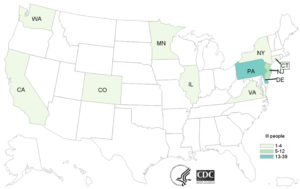
Ninety-six people infected with the outbreak strain of Salmonella Javiana have been reported from 11 states – California 1, Colorado 1, Connecticut 1, Delaware 39, Illinois 1, Minnesota 1, New Jersey 12, New York, 4, Pennsylvania 34, Virginia 1 and Washington 1.

Illnesses were reported from states where Tailor Cut Produce distributes, including Pennsylvania, New York City, New Jersey, and Delaware. Ill people from other states reported traveling to these states in the week before their illness started.

Twenty-seven hospitalizations have been reported. No deaths have been reported.

Since the last update on December 11, 85 additional ill people have been reported from 11 states.

These illnesses started during the same time period as the illnesses reported on December 11, but were not confirmed as part of the outbreak at that time.

Epidemiologic and traceback evidence indicate that cut fruit, including honeydew melon, cantaloupe, pineapple, and grapes, produced by Tailor Cut Produce of North Brunswick, New Jersey, is a likely source of this outbreak.

According to the FDA, Sprouts Unlimited of Marion Iowa is recalling clover spouts in 4 oz packages because it may be contaminated with Escherichia coli O103 bacteria (E. coli O103).

The affected batches of clover sprouts were distributed to Hy Vee Food stores, Fareway Food Stores and Jimmy John’s restaurants in Iowa.

The sprouts available at retail were packaged in in pint containers from Sprouts Unlimited Inc. with a blue label on the lid. The UPC code 7 32684 00013 6 is stamped on the bottom right side of the label.

Sprouts Unlimited Inc. became aware of the potential contamination after receiving information from the Iowa Department of Inspections and Appeals, Des Moines, IA that a cluster of E. coli O103 illnesses epidemiologically linked to clover sprouts from Sprouts Unlimited Inc. An investigation and further tests are being conducted to determine the source.

Sprouts have long been a problem as my friend Doug has repeatedly warned on Barfblog:

Kate Bernot of The Take Out wrote, “If you ask anyone in food safety, ‘What is the one food you will not eat?’ Raw sprouts tops the list, always.”

That’s one of the first sentences out of the mouth of Doug Powell, a former professor of food safety and the publisher of barfblog, a frequently updated site that publishes evidence-based opinions on food safety.

I’ve asked him whether food-safety fears about sprouts—those tiny, crunchy squiggles in your salad or sandwich—are well-founded. He tells me the public isn’t concerned enough about them.

“Risk is inherent in the nature of the product which is why Walmart and Costco got rid of them,” he says. (Kroger also stopped selling sprouts in 2012.) “This is not a new problem. It’s been going on for decades.”

According to a paper he and three colleagues published in the journal Food Control in 2012, sprouts have been responsible for at least 55 documented foodborne outbreaks affecting more than 15,000 people globally in the past two decades. The Food And Drug Administration tallies 46 reported outbreaks of foodborne illness in the United States linked to sprouts between 1996 and 2016, accounting for for 2,474 illnesses, 187 hospitalizations, and three deaths. In an effort to reduce these outbreaks, the FDA in 2017 collected 825 samples of sprouts from across the U.S.; 14 of those tested positive for E. coli, listeria, or Salmonella.

Here’s a table of over 75 sprout-related outbreaks going back to 1973.

One dose of single-antigen hepatitis A vaccine has been shown to control outbreaks of hepatitis A and provides up to 95% seroprotection in healthy individuals for up to 11 years.

Please get one and do not become a statistic – especially, if you are a food service worker.

States with Hepatitis A cases.

A Farm is under investigation: 

The FDA continues to actively investigate the cause of this outbreak. An investigation team consisting of staff from FDA, CDC, the California Department of Public Health and the California Department of Food and Agriculture are attempting to identify any factors that could have led to contamination at a common farm identified by traceback. This investigation involves assessing and sampling soil, animal droppings, compost, water, and other potential environmental sources at the ranches of this grower. The samples and information collected during the farm investigations will be analyzed.

Positive Products and Recalls:

  • The Wisconsin Department of Health Services recently reported that they identified the outbreak strain of E. coli O157:H7 in an unopened bag of Fresh Express brand Leafy Green Romaine collected from an ill person’s home. The source of the romaine identified in the bag was Salinas, California. It was determined that one of the growers of this product also supplied romaine linked to other E. coli outbreaks that FDA is investigating.
  • On Nov. 21, 2019, the U.S. Department of Agriculture’s Food Safety and Inspection Service (FSIS) announced a recall by Missa Bay, LLC, a Swedesboro, N.J. establishment, of approximately 75,233 pounds of salad products that contain meat or poultry because the lettuce ingredient may be contaminated with E. coli 0157:H7. Products in this recall were produced with the same lot of lettuce that was used to produce the packaged salad that the Maryland Department of Health found to contain E. coli 0157:H7.
  • The Maryland Department of Health identified E. coli O157:H7 in an unopened package of Ready Pac Bistro® Chicken Caesar Salad collected from an ill person’s home in Maryland. Analysis of this salad, through Whole Genome Sequencing (WGS), has linked strain E. coli O157:H7 to three Maryland cases and the multi-state outbreak.

All current outbreaks linked:

These outbreaks are each caused by strains that are different from each other and different from the larger outbreak. One of the outbreaks is in Washington state, is potentially linked to romaine lettuce served at Evergreens restaurants (13 sick). Another outbreak, with cases in the U.S. and Canada, is linked to Fresh Express Sunflower Crisp Chopped Salad Kits (26 sick in US and Canada).  And, the third outbreak:

Total Illnesses: 138

Hospitalizations: 72

Acute Kidney Failure: 13

First illness onset: September 20, 2019

Last illness onset: December 1, 2019

States with Cases:

AZ (3)

CA (4)

CO (6)

FL (2)

IA (1)

ID (3)

IL (10)

MD (5)

MI (1)

MN (5)

MT (1)

NE (2)

NJ (9)

NC (2)

NM (2)

OH (12)

OR (1)

PA (17)

SC (1)

SD (1)

TN (1)

TX (6)

VA (6)

WA (4)

WI (33)

And, let’s not forget this outbreak that was announced October 30, 2019 – long after it ended:

CDC notified the FDA of this illness cluster in mid-September 2019 and the agency promptly initiated a traceback investigation. The FDA, CDC, along with state and local partners, investigated the illnesses associated with the outbreak. A total of 23 people infected with the outbreak strain of E. coli O157:H7 were reported from 12 states: Arizona (3), California (8), Florida (1), Georgia (1), Illinois (2), Maryland (1), North Carolina (1), Nevada (1), New York (1), Oregon (1), Pennsylvania (2) and South Carolina (1). Eleven people were hospitalized and no deaths were reported. Illnesses started on dates ranging from July 12, 2019 to Sept. 8, 2019. No illnesses were reported after CDC began investigating the outbreak on Sept. 17, 2019.

Investigators were sent to visit farms located in California’s central coast region which were identified through the traceback investigation. They collected and tested many environmental samples, and the outbreak strain was not identified. While romaine lettuce is the likely cause of the outbreak, the investigation did not identify a common source or point where contamination occurred.

Almark Foods  and the FDA need to explain why positive product tests and illnesses in 2017 did not stop positive product tests and illnesses in 2019.

As of December 17, 2019, a total of seven people infected with the outbreak strain of Listeria monocytogenes have been reported from five states – Texas, Florida, South Carolina, Pennsylvania and Maine.

Listeria specimens from ill people were collected from April 10, 2017, to November 12, 2019. Ill people range in age from less than 1 to 82 years, with a median age of 75. Seventy-one percent of ill people are male. Of six ill people with information available, four hospitalizations have been reported. One death has been reported from Texas. One illness was reported in a newborn who was infected with Listeria while the mother was pregnant, but the newborn survived.

Epidemiologic and laboratory evidence indicates that bulk hard-boiled eggs produced by Almark Foods of Gainesville, Georgia, are a likely source of this outbreak.

Additionally, based on whole-genome sequencing, the Listeria monocytogenes found in environmental samples collected at the firm’s processing facility during an FDA inspection conducted in February 2019 is a genetic match to the outbreak strain.  FDA laboratory analysis of the environmental sample collected February 6, 2019, confirmed that two (2) environmental swabs were positive for L. monocytogenes.  The two swabs were collected from the peeling room in the following locations:

  • One (1) environmental swab was collected from the peeling room floor drain near (b)(4).
  • One (1) environmental swab was collected from the egg counter entrance and stainless-steel area at the end of the conveyor belt. This location is a food contact surface.

Whole Genome Sequencing (WGS) analysis was conducted on the two (2) L. monocytogenes isolates obtained from the FDA environmental sample collected on February 6, 2019.  WGS analysis of food-borne pathogens provides high-resolution data, which can be used to infer the evolutionary relationship (or phylogeny) within a given set of isolates as it measures each DNA position in a bacterial genome, enabling direct links to be established between clinical isolates and food or environmental sources of bacterial contamination and illness.  The WGS phylogenetic analysis established that there is at least one (1) strain of L. monocytogenes present in your facility and that strain contains both of the referenced isolates.  Specifically, WGS analysis of the strain revealed that the two (2) isolates, collected from two (2) different zone locations, are genetically identical to each other, which suggests possible cross-contamination between the locations.  Further, the WGS analysis of the strain also showed that the isolates are genetically identical to 2 cases of human illness dating back to 2017.

According to the FDA, this outbreak strain was found during environmental sampling in 2017 of one other Almark food facility. That facility is not currently handling food and ceased operation in 2018.

On December 20, 2019, Almark Foods recalled and suspended production of hard-boiled and peeled eggs in pails due to the potential for contamination with Listeria monocytogenes. These hard-boiled and peeled eggs were sold in pails under the following names: Rainbow Select Hard-cooked Eggs, Rainbow Select Hard-cooked Eggs in Vinegar, Nic’s Salad Hard-boiled Eggs, Almark Hard-cooked Eggs, and Sutherland Select Hard-cooked Eggs.

Note:  According to the FDA – “The FDA, CDC and our state partners have identified a common grower between each of the outbreaks, which is a notable development.”

According to the FDA, there are presently three outbreaks under investigation.  These outbreaks are each caused by strains that are different from each other and different. One of the outbreaks in Washington state (13 sick), is potentially linked to lettuce. Another outbreak, with cases in the U.S. and Canada, is linked to Fresh Express Sunflower Crisp Chopped Salad Kits (8 sick in US and 25 sick in Canada). And, the largest outbreak according to the CDC, has a total of 138 people infected with the outbreak strain of E. coli O157:H7 have been reported from 25 states.  States with Cases: AZ (3), CA (4), CO (6), FL (2), IA (1), ID (3), IL (10), MD (5), MI (1), MN (5), MT (1), NE (2), NJ (9), NC (2), NM (2), OH (12), OR (1), PA (17), SC (1), SD (1), TN (1), TX (6), VA (6), WA (4), WI (33).  Two illnesses have been reported in Canada.

I have filed lawsuits in each of the three cases above, and eventually, likely within 90 days, the Court process will out that “common grower.”  However, certainly federal, state and county officials know, as do others in private industry.

If someone either announces the name or calls me with it in the next 24 hours, I will donate $25,000 – half to the Arizona Leafy Green Marketing Agreement and half to the California Leafy Green Marketing Agreement.

According to the FDA, there are presently three outbreaks under investigation.  These outbreaks are each caused by strains that are different from each other and different. One of the additional outbreaks, in Washington state (13 sick), is potentially linked to romaine lettuce. The other outbreak, with cases in the U.S. and Canada, is linked to Fresh Express Sunflower Crisp Chopped Salad Kits (8 sick in US and 25 sick in Canada).

Note:  According to the FDA“The FDA, CDC and our state partners have identified a common grower between each of the outbreaks, which is a notable development.”

According to the CDC, since the previous update on December 4, an additional 36 ill people have been reported. As of December 17, 2019, a total of 138 people infected with the outbreak strain of E. coli O157:H7 have been reported from 25 states.  States with Cases: AZ (3), CA (4), CO (6), FL (2), IA (1), ID (3), IL (10), MD (5), MI (1), MN (5), MT (1), NE (2), NJ (9), NC (2), NM (2), OH (12), OR (1), PA (17), SC (1), SD (1), TN (1), TX (6), VA (6), WA (4), WI (33).  Two have been reported in Canada.

Note: According to the CDC, as there are an estimated 26 unreported illnesses for every STEC O157 case reported to PulseNet, the true size of this outbreak is likely much larger than the 140 illnesses reported through PulseNet to date, suggesting that thousands of people (3,640) have been actually sickened in this outbreak thus far.

Illnesses started on dates ranging from September 20, 2019, to December 1, 2019. Ill people range in age from less than 1 to 89 years, with a median age of 26. Sixty-two percent of ill people are female. Of 136 ill people with information available, 72 hospitalizations have been reported, including 13 people who developed hemolytic uremic syndrome (HUS), a type of kidney failure. No deaths have been reported.

Epidemiologic, laboratory, and traceback evidence indicate that romaine lettuce from the Salinas, California, growing region is the likely source of this outbreak.

The Wisconsin Department of Health Services recently reported that they identified the outbreak strain of E. coli O157:H7 in an unopened bag of Fresh Express ® brand Leafy Green Romaine collected from an ill person’s home. Salinas, California was the source of the romaine identified in the bag.

FDA and states continue to trace the source of the romaine lettuce eaten by ill people. FDA posted an update on on their investigation on December 12, 2019. The investigation is ongoing to determine the source of contamination and if additional products are linked to illness.

CDC continues to advise that consumers not eat and retailers not sell any romaine lettuce grown in Salinas, California. CDC will provide more information as it becomes available.

This outbreak is caused by the same strain of E. coli O157:H7 that caused outbreaks linked to leafy greens in 2017 and to romaine lettuce in 2018.

E. coli O157:H7 outbreaks associated with lettuce and other leafy greens are by no means a new phenomenon. Outlined below is a list of E. coli outbreaks involving contaminated lettuce or leafy greens in the past decade:

Date Vehicle Etiology Confirmed Cases States/Provinces
Sept. 2009 Lettuce: Romaine or Iceberg E. coli O157:H7 29 Multistate
Sept. 2009 Lettuce E. coli O157:H7 10 Multistate
April 2010 Romaine E. coli O145 33 5:MI, NY, OH, PA, TN
Oct. 2011 Romaine E. coli O157:H7 60 Multistate
April 2012 Romaine E. coli O157:H7 28

1:CA

Canada

June 2012 Romaine E. coli O157:H7 52 Multistate
Sept. 2012 Romaine E. coli O157:H7 9 1:PA
Oct. 2012 Spinach and Spring Mix Blend E. coli O157:H7 33 Multistate
Apr. 2013 Leafy Greens E. coli O157:H7 14 Multistate
Aug. 2013 Leafy Greens E. coli O157:H7 15 1:PA
Oct. 2013 Ready-To-Eat Salads E. coli O157:H7 33 Multistate
Apr. 2014 Romaine E. coli O126 4 1:MN
Apr. 2015 Leafy Greens E. coli O145 7 3:MD, SC, VA
June 2016 Mesclun Mix E. coli O157:H7 11 3:IL, MI, WI
Nov. 2017 Leafy Greens E. coli O157:H7 67 Multistate and Canada
Mar. 2018 Romaine E. coli O157:H7 219 Multistate and Canada
Nov. 2018 Romaine E. coli O157:H7 88 Multistate and Canada
Sept. 2019 Romaine E. coli O157:H7 23 Multistate
Nov. 2019 Romaine E. coli O157:H7 140 Multistate and Canada


I posted this on Food Safety News yesterday.
For those of you who read these fine pages of Food Safety News produced by Dan, Coral, Joe, Jonan, Cookson, and our many contributors on a daily basis for the last ten years, I try not – well, at least – not too often, to interject my legal side with my publisher side.

Here is an exception – Marler Clark needs help.

Well, more precisely, consumers of food around the world need help.

Since 2017 there been over 500 people in the U.S. and Canada who have suffered E. coli O157:H7 illnesses linked to leafy greens grown in the U.S.  Of these, nearly 200 have been hospitalized with 50 suffering hemolytic uremic syndrome (acute kidney failure).  There have been seven reported deaths.

Setting aside why outbreaks (no more “romaining” calm) are happening at frightening frequency and why so many of the illnesses seem so particularly brutal, the fact is that people, many children and the vulnerable, need legal advocacy.

So, here is my pitch:  If you have been out of law school 2-5 years, send your cover letter, resume and writing sample to bmarler@marlerclark.com or bclark@marlerclark.com before the end of the year.  You must be willing to relocate to Seattle.

I am not looking for someone who wants just a job.  I am looking for someone who is willing to think of this not as a job, but more of a calling.  I want someone who will happily work besides some of the finest lawyers, doctors, nurses, epidemiologists, paralegals, experts and staff in the food safety business.  We are dedicated to our clients 24/7/365 and I expect applicants to feel the same.  This is NOT a 9-5 gig.

I recently was asked to write a Forward to a book on food safety for someone I greatly admire.  I think if these words do not inspire you, you do not need to send an application.

Forward

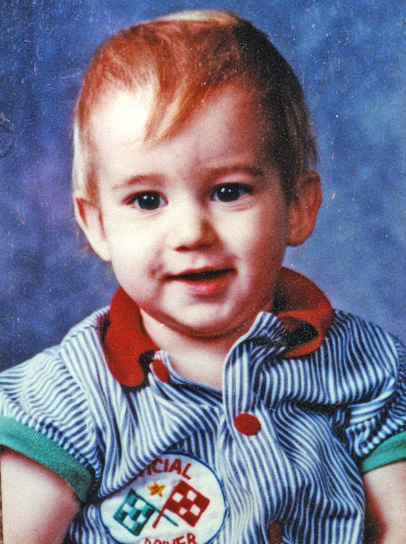
I never met Riley.  However, I have a vivid memory after almost twenty-seven years of his tiny white casket flashing across the front page of the Seattle papers and the evening news.  I remember the picture of Riley that Darin carries – a smiling toddler about to do mischief.

Riley’s life was a life cut short by a deadly pathogen that had been too long ignored by government and industry, and virtually unknown to consumers.  In 1993 we all thought hamburgers were the all-American meal, not a recipe for death.

Riley and my daughter, Morgan, would have graduated from High School in 2010 and both been twenty-eight this year.  For Darin, instead of twenty-eight years of memories and a future with a grown child, he has photos and videos of a forever young Riley and faded clippings of the public’s view of Riley’s agonizing death and the pain on his parent’s faces.

It is not without an anguished honor that I realize that the beginning of my life’s work is forever linked to Riley’s death and the deaths of Lauren Rudolph, Michael Nole and Celina Shribbs, and the devastating life-long illnesses of so many others caused by E. coli O157:H7, including Brianne Kiner, who was hospitalized for several months after Riley died a few hospital rooms away.

In the intervening years there have sadly been  too many other Riley’s and Brianne’s.  I have done what I could to help those families impacted by E. coli, Salmonella, Listeria and other foodborne pathogens.  I have done what I could to change government and industry behavior by using the levers of the legal system.  However, regardless how passionate I might be at times to be “put out of business,” it pales to what Darin Detwiler has done in the memory of his son.

As a lawyer, I have seen what can happen to a parent of a child that dies or has life-long complications caused be a pathogen like E. coli.   Understandably, many never recover or simply cope by ignoring the pain.  Few, like Darin, stare directly at the pain, embrace it, learn from it and teach us from it.  Every word of this book written by Riley’s father carries a bit of Riley in every sentence, page and chapter.  This book is important.  Thank you Darin for writing it and thank you Riley for inspiring it.

No more to be said.

As of December 17, 2019, a total of seven people infected with the outbreak strain of Listeria monocytogenes have been reported from five states.

Listeria specimens from ill people were collected from April 10, 2017, to November 12, 2019. Ill people range in age from less than 1 to 82 years, with a median age of 75. Seventy-one percent of ill people are male. Of six ill people with information available, four hospitalizations have been reported. One death has been reported from Texas. One illness was reported in a newborn who was infected with Listeria while the mother was pregnant, but the newborn survived.

Epidemiologic and laboratory evidence indicates that bulk hard-boiled eggs produced by Almark Foods of Gainesville, Georgia, are a likely source of this outbreak.

In interviews, ill people answered questions about the foods they ate and other exposures in the month before they became ill. Of the five people for whom information was available, four (80%) reported eating products containing eggs. Three of these people reported eating hard-boiled eggs in deli salads purchased from grocery stores and in salads eaten at restaurants.

In the PulseNet database, CDC noted two environmental samples from February 2019 that are closely related genetically to bacteria from ill people in this outbreak. FDA reports that these samples were taken during a routine inspection of the Almark Foods facility. These results provide additional evidence that people in this outbreak got sick from eating hard-boiled eggs produced by Almark Foods.

Investigators are continuing to collect records from grocery stores and restaurants where ill people reported eating hard-boiled eggs. Investigations are ongoing to determine and document the distribution and production chain, as well as the source of hard-boiled eggs to the locations reported by ill people.

CDC is concerned that bulk, fresh hard-boiled eggs produced by Almark Foods of Gainesville, Georgia, are contaminated with Listeria and have made people sick. These products were packaged in plastic pails for use nationwide by food service operators.

The investigation is ongoing to determine the source of contamination and if additional products are linked to illness. CDC will provide updates when more information is available.