“Bill Marler, the Seattle lawyer who represented hundreds of victims in the Jack in the Box food poisoning case in the 1990s, was outraged by the avoidable tragedy that sickened 700 and claimed the lives of four children. He courted the media to get the E. coli bacteria on the agenda of policymakers — and played a key role in getting the U.S. Department of Agriculture to outlaw the most virulent strains of the pathogen in meat. Now, Marler, 62, is at it again. This time he is taking aim at salmonella, which over the past decade has become the most dangerous bacteria in meat.”

“I’ve been involved in every food-borne illness outbreak, small and large, since 1993,” said Bill Marler, a Seattle-based lawyer who specializes in representing victims of food-borne illnesses.”

“During the past twenty years, Marler has become the most prominent and powerful food-safety attorney in the country.”

“Bill Marler, a Seattle-based food safety lawyer who has been involved in food-borne illness lawsuits for decades.”

“William Marler, a Seattle lawyer who is a leading plaintiff’s attorney in food-borne illness cases.”

“William Marler, a prominent Seattle-based food safety attorney whose work began with the 1993 Jack in the Box E. coli outbreak that sickened hundreds and killed four. Since then, he has represented thousands of victims and families in major outbreaks linked to hamburger, peanut butter, spinach and cantaloupe.”

“Marler Clark, the Seattle-based group known for being the nation’s leading law firm for victims of food-borne illness.”

Its a long flight from the “other Washington” for my 5 minutes of testimony before the Reagan-Udall Foundation for the FDA’s Independent Expert Panel, but here it is:

In the nearly 30 years that I have been coming to Washington D.C. on food safety issues, there has always been a discussion about how best to effectively accomplish food safety regulation and oversight.  

I was here then with the parents of Brianne Kiner, a child that survived the 1992/1993 Jack in the Box E. coli outbreak after six months in the hospital, months on dialysis, the removal of her large intestine and leaving her with brain damage and diabetes.  

I was here in 2006, 2007 and 2008 in the run-up to the passage of the Food Safety Modernization Act (FSMA), bringing dozens of clients in to put a human face on E. coli outbreaks linked to leafy greens and Salmonella outbreaks linked to peanut butter.

From the Clinton, Bush, Obama, and Trump administrations, from nearly every Congress over those three decades, and from multiple government, industry and consumer reports, the refrain still echoes for a single food safety agency.  

As one administration aptly said, it is past time to address the “fragmented and illogical division of federal oversight” of food safety.  

For decades multiple experts have cited the need to revamp the safety and quality of the U.S. food supply as it is now “governed by a highly complex system stemming from at least 30 federal laws that are administered by 16 federal agencies.”

Yes, I understand that we are not here to revisit this decades long discussion.  I point it out only to underscore that the discussion of the organization, reorganization and culture of the agencies predates many of us here. 

Over the last decades, the discussion has been how to make food safety perfect.  I am here to ask that we not make perfect the enemy of the good.  However, it is past time for us to in fact do good.

In thinking about the charge that the commissioner gave the Reagan-Udall Foundation and this august group of experts, I recalled a seminal decision made in 1994 by the then administrator of the Food Safety and Inspection Service (FSIS) deeming E. coli O157:H7 an adulterant in ground beef.  

A perfect decision, no. Should all pathogens in all meat be considered adulterants?  To me that would be perfect.  But, that 1994 decision was good enough that, slowly, over the following decade, E. coli cases linked to beef fell, and fell so far, that what had been the staple of my firm’s work almost completely evaporated.  The government and industry essentially put me out of the E. coli in beef business.

I believe that the 1994 decision worked for two reasons, one, the Jack in the Box disaster was perhaps too significant to ignore and two, the organization of the USDA placed clear authority over both food safety policy and inspections in the hands of the agency administrator. This allowed for the decision and implementation to occur swiftly, not perfectly, but good enough to have a significant impact on public health.

In the decade after Jack in the Box, before the decision to deem additional strains of E. coli adulterants solidified, I could count nearly like clockwork E. coli cases occurring in beef in the Spring and the Summer.  That stopped in 2003, and for a moment I gladly conceded that I chose the wrong profession.  

But, then many of the food items regulated by the FDA – especially leafy greens – filled that void.

The spinach E. coli outbreak of 2006, with 205 sickened, dozens with kidney failure and 5 deaths, the industry termed “its Jack in the Box.”  This outbreak, along with multiple other E. coli outbreaks linked to romaine lettuce and Salmonella outbreaks linked to peanut butter, moved the FDA and Congress forward on FSMA.

The idea behind FSMA was to make the FDA and the industries it oversees, more proactive, not reactive.  However, you only need to look at the 2018 E. coli outbreak linked to romaine (again) with over 240 sickened in the U.S. and Canada, dozens with kidney failure and 5 deaths, that the hope of FSMA is not yet reality.

Is FSMA perfect, likely not.  Has its implementation since 2010 been too slow and uneven, yes.  However, I believe that FSMA’s failures are not due to the legislation itself, but to the lack of sustained, consistent, effective, and accountable leadership at the FDA due to the culture and fragmentation of the essential food safety functions between the four main Centers – CFSAN, ORA, CVM and OFPR.

In closing, my advice is to create separate commissioners – one for food and one for drugs.  Both should be direct reports to the HHS secretary. The food side should be led by a proven food safety expert tasked with all aspects of food and the entire organization should be coordinated and accountable for the safety of the 80% of the food supply that is its purview.

Would this be perfect, likely not.  Would it be good enough? I would hope it would be good enough to do what FSIS did to E. coli and beef.  It is time to put me out to pasture.

What we all do not need is another 4-year-old Lucas Parker, who because of the consumption of E. coli tainted romaine lettuce in 2019, will never walk, never talk, and never feed himself. 

It is time for all of us to do good.

Arcade Snacks of Auburn, MA is recalling its 15 ounce packages of Candy Corn because they may contain undeclared egg. People who have allergies to egg run the risk of serious or life-threatening allergic reaction if they consume these products.

Candy Corn was distributed in Massachusetts and Connecticut at the following locations:

  • Johnson Roadside Farm Market in Swansea, Massachusetts
  • Donelan’s Supermarkets in Massachusetts
  • Fieldstone Farm Market in Marion, Massachusetts
  • Foodies in Massachusetts
  • Windfall Market in Falmouth, Massachusetts
  • Highland Park Market in Glastonbury, Connecticut

The product comes in a 15 ounce, clear plastic container marked with UPC #0 18586 00114 4 and a best by date of 3/8/2023 on the label on the back panel.

No illnesses have been reported to date in connection with this problem.

The recall was initiated after it was discovered that the egg-containing product was distributed in packaging that did not reveal the presence of egg.

Public Meeting Registration and Online Stakeholder Portal Now Open

The Reagan-Udall Foundation has opened a Stakeholder Portal to collect perspectives and experiences with FDA’s human foods program. In addition, the Foundation announced a public meeting of its food-focused Independent Expert Panel. 

The Expert Panel wants to hear directly from stakeholders,” said Jane E. Henney, MD, Chair of the foods Independent Expert Panel. “We want to hear firsthand observations about both the strengths and challenges the program faces as well as ideas on how to best prepare for the regulatory landscape of the future.”  

The portal allows all stakeholders to share their insights about what is working in FDA’s human foods program, the challenges it faces, and suggestions to improve program operations. Comments received through the Stakeholder Portal will be shared with the Independent Expert Panel charged with generating the recommendations for FDA. 

On September 29-30, the Reagan-Udall Foundation will facilitate a public meeting of the Independent Expert Panel on food. Invited stakeholders will provide feedback on critical topics such as Nutrition Initiatives, Food Safety, Intra-Federal Relations, Federal-State Relationships, Resources, and Positioning FDA for the Future. A limited number of seats are available to stakeholders who wish to observe the in-person meeting to be held in Washington, DC. To expand access, audio streaming will also be available.  

The operational evaluation focuses on the structure/leadership, authority, resources, and culture of FDA’s human foods program. The 60-business-day review will culminate in recommendations that will be submitted on December 6, 2022, to Dr. Robert Califf, Commissioner of Food and Drugs, at FDA

new outbreak of infections from Listeria monocytogenes has been reported by the FDA, bringing the agency’s number of open investigations to 10.

The Food and Drug Administration reports that it has begun on-site inspection and sample testing, but it has not found a specific source for the Listeria. It has not initiated traceback efforts. The agency reports there are six confirmed patients in the outbreak, but has not revealed their ages or the states where they live.

In other outbreak news, the patient count in an outbreak caused by Salmonella Mississippi has increased to 102 from the 100 patients reported a week ago.  The agency has not made public where the patients live or their ages. The FDA has not identified a source of the pathogen but has initiated traceback efforts. The agency has not reported what food or foods are being traced.

Other outbreaks with active FDA investigations

  • For a Salmonella Senftenberg outbreak from a not yet identified food, the patient count is steady at 27. Traceback has begun but FDA has not reported what is being traced.
  • For a Salmonella Typhimurium outbreak from a not yet identified food, the patient count is steady at 78. Traceback, on-site inspection and sample analysis has been initiated, but the FDA has not reported what is being traced or tested or where the inspection is taking place.
  • For a Cyclospora outbreak the patient count remains steady 79. Traceback has begun but the FDA has not reported what is being traced.
  • For another Cyclospora outbreak the patient count has remained steady at 42. Traceback has begun but the FDA has not reported what is being traced. Similarily, sample testing has begun but the agency has not reported what is being tested. 
  • An investigation related to adverse effects associated with Daily Harvest brand frozen Leeks & Lentils Crumbles is ongoing. The company has received more than 470 complaints of illnesses and as of its most recent report on July 29 the FDA had received 329 complaints. Some of the patients have gone into liver failure and at least 25 have had to have their gallbladders removed. The FDA is working on traceback efforts and has begun on-site inspection and product testing. Some testing has revealed that tara flour is an ingredient unique to the Daily Harvest crumbles product and could be related to the illnesses.
  • In an ongoing outbreak of infections caused by E. coli O157:H7 the FDA has initiated sample collection and analysis. The outbreak, reported by the CDC as being linked to lettuce on Wendy’s sandwiches, has sickened at least 84 people. The four-state outbreak has sickened more people according to the state counts, but all of the reports have not reached the CDC. Wendy’s has stopped serving the romaine-iceberg lettuce hybrid on sandwiches in several states, according to a statement from the company.
  • The FDA is conducting an on-site inspection at Big Olaf Creamery in Florida, which has been deemed to be behind an 11-state outbreak of Listeria infections. The state of Florida closed the business several weeks ago after tests found multiple places of contamination with Listeria monocytogenes in the plant. Testing also showed Listeria in 16 of 17 flavors of the company’s ice cream. At last count the outbreak had sickened 25 patients with one having died. A pregnant woman also miscarried. Twenty-four of the patients have required hospitalization.
  • An outbreak of infections from Cronobacter in four infants, two of whom died. The outbreak has been determined to be over by the CDC but is it still under investigation. The babies consumed infant formula made by Abbott Nutrition’s plant in Sturgis, MI.

The December 2017 Cluster 

In late 2017, three cases of E. coli O157:H7 were reported in Wisconsin. These Wisconsin cases were found to have genetic fingerprints that matched each other, which was an essentially definitive signal to investigating epidemiologists that the cases of illness had a common source. Wisconsin state health officials determined that this cluster was likely sickened by a contaminated mixed green salad served at an unidentified school. 

The three Wisconsin cases were classified as part of a CDC cluster (CDC Cluster Code: 1801MLEXH-1). This cluster soon grew to definitively include numerous cases from other states (Arizona, California, Maine, Michigan, New Jersey, Nevada, New York, Utah, Washington, and Wisconsin). Ultimately, the cluster included approximately 17 cases from ten states, all of whom had experienced an onset of symptoms from November 6, 2017, to January 9, 2018. 

Genetic analysis conducted by the CDC on the “isolate” (i.e., the E. coli O157:H7 bacteria isolated from her stool sample) showed that her illness was a genetic match to the cluster that originated in Wisconsin. The client was, therefore, definitively included as a confirmed case in this ten-state cluster of E. coli O157:H7 illnesses, as is set forth in the CDC’s official “line list” (i.e., chart of all confirmed cases in a cluster), which is reproduced below: 

The Spring 2018 E. coli O157:H7 Cluster 

Not long after the 1801MLEXH-1 cluster occurred, 240 E. coli O157:H7 cases from 37 states were identified in one of the largest ever E. coli outbreaks linked to the consumption of contaminated romaine lettuce. Due to its sheer size, this outbreak investigation demanded significant federal resources, including thorough epidemiologic and environmental investigations by CDC and FDA. Almost all the confirmed cases in this outbreak, known by CDC Cluster Code 1804 MLEXH-1, occurred from March 13 through early May 2018. 

The critical findings from the 2018 cluster were as follows: 

·  The 2018 cluster involved an identical strain, by genetic analysis, to the late 2017 cluster; 

·  CDC’s epidemiologic investigation conclusively identified romaine lettuce grown in the Yuma, Arizona growing region as the source of the outbreak; 

·  The E. coli strain involved in the 2018 cluster originated at an extremely large Centralized Animal Feeding Operation (CAFO) located in Wellton, Arizona (cattle are overwhelmingly the predominant animal source of E. coli O157:H7); 

·  The E. coli strain involved in the 2018 cluster was found in three different water samples from an irrigation canal that flows along the border of the CAFO in Wellton, Arizona. 

The Yuma, Arizona Growing Region 

In the past, lettuce from the Yuma growing region has been the source of several E. coli outbreaks.

Not surprisingly, the FDA, in its complete “Environmental Assessment of Factors Potentially Contributing to the Contamination of Romaine Lettuce Implicated in a Multi-State Outbreak of E. coli O157:H7” concluded that the risk of environmental contamination associated with the 1804MLEXH-1 outbreak was, in fact, a persistent risk likely associated with past outbreaks, as well: 

Food safety problems related to raw whole and fresh-cut (e.g., bagged salad) leafy greens are a longstanding issue. As far back as 2004, FDA issued letters to the leafy greens industry to express concerns about continuing outbreaks associated with these commodities. FDA and our partners at CDC identified 28 foodborne illness outbreaks of Shiga-toxin producing E. coli (STEC) with a confirmed or suspected link to leafy greens in the United States between 2009 and 2017. This is a time frame that followed industry implementation of measures to address safety concerns after a large 2006 outbreak of E. coli O157:H7 caused by bagged spinach. 

STEC contamination of leafy greens has been identified by traceback to most likely occur in the farm environment. 

Contamination occurring in the farm environment may be amplified during fresh- cut produce manufacturing/processing if appropriate preventive controls are not in place. Unlike other foodborne pathogens, STEC, including E. coli O157:H7, is not considered to be an environmental contaminant in fresh-cut produce manufacturing/processing plants. 

In its summary of its environmental findings, the “FDA (in part) identified the following factors and findings as those that most likely contributed to the contamination of romaine lettuce from the Yuma growing region with E. coli O157:H7 that caused [the 1804MLEXH-1 outbreak]”: 

• FDA has concluded that the water from the irrigation canal where the outbreak strain was found most likely led to contamination of the romaine lettuce consumed during this outbreak. 

• There are several ways that irrigation canal water may have come in contact with the implicated romaine lettuce, including direct application to the crop and/or use of irrigation canal water to dilute crop protection chemicals applied to the lettuce crop, either through aerial or ground-based spray applications. 

• How and when the irrigation canal became contaminated with the outbreak strain is unknown. A large animal feeding operation is nearby, but no obvious route for contamination from this facility to the irrigation canal was identified. Other explanations are possible, although the EA team found no evidence to support them. 

Some might have heard that the FDA Commissioner has instituted a review on how the FDA, and it’s Food Safety arms or organized. Setting aside that it might be a good idea to create a single food safety agency with all the parts of USDA and FDA, etc., in one place, perhaps we can at least go back to the way things were in the Obama Administration.

Any brilliant ideas? Here is the 2022 organization chart of the FDA:

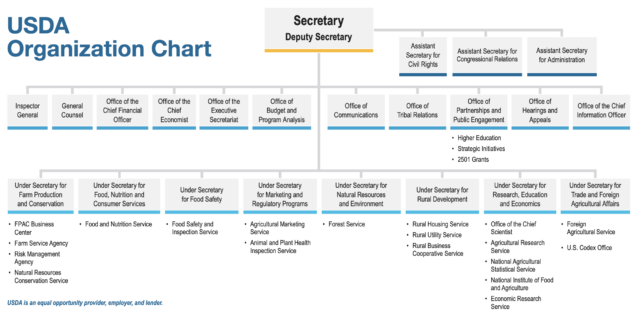
By the way, here is the 2022 organization chart of the USDA:

In the first 10 years of my practice, 90% of the cases I did were E. coli cases linked to ground beef. Hemolytic Uremic Syndrome (HUS) was called the “Hamburger Disease.” It took several years after deeming E. coli O157:H7 an adulterant in ground beef for industry, government, retailers and consumers to bend the curve.

I just hope we have not gotten too confident.

The U.S. Department of Agriculture’s Food Safety and Inspection Service (FSIS) is issuing a public health alert due to concerns that ground beef products in HelloFresh meal kits may be associated with Escherichia coli (E. coli) O157:H7 illness. A recall was not requested because the products are no longer available for purchase.

The meal kits containing ground beef for this public health alert were shipped to consumers from July 2-21, 2022. The following products are subject to the public health alert:     

  • 10-oz. plastic vacuum-packed packages containing “GROUND BEEF 85% LEAN/15% FAT” with codes “EST#46481 L1 22 155” or “EST#46481 L5 22 155” on the side of the packaging.

 The ground beef packages bear “EST.46841” inside the USDA mark of inspection and on the plastic ground beef package.

FSIS, the Centers for Disease Control and Prevention, and state public health partners are investigating an outbreak of E. coli O157:H7 and raw ground beef is the probable source of the reported illnesses. Traceback information identified that multiple case-patients received ground beef produced at establishment M46841 and distributed by HelloFresh in meal kits from July 2-21, 2022. Traceback of materials used to produce the ground beef is ongoing and FSIS continues to work with suppliers and public health partners on the investigation.

FSIS is concerned that some product may be in consumers’ freezers. Consumers who have purchased these products are urged not to consume them. These products should be thrown away.

Perhaps the FSIS Outbreak Response will move from suspect to confirmed.

Buitoni affair: new testimonies overwhelm management

The testimonies of several employees of the Buitoni factory in Caudry shed light on the health deficiencies observed in their factory. They denounce a reduction in cleaning time imposed in 2015 and a change of flour in 2021. Investigation by Laetitia Cherel, investigation unit of Radio France.

Employees of the Buitoni site in Caudry denounce serious health deficiencies in their factory.

First, there is a sense of guilt. “ We think, we no longer sleep. We wonder how we got here. What did we do wrong?” The features drawn, Pierre * (an employee of the Caudry factory (North) where the Fraîch’Up pizzas of the Buitoni brand contaminated with Escherichia coli were manufactured) today feels the need to indulge. Since the scandal broke, he feels “responsible somewhere” for what happened. A feeling shared by several of his colleagues, including Patrick*: “ These pizzas were our life, our pride, he explains in a strangled voice . Our pride has turned into shame.”

Then there is the shock of the closure of the factory in which they and other employees have sometimes worked for several decades. On April 1, an order from the Nord prefecture ordered production to be halted “until compliance with hygiene regulations”. Patrick, Pierre and their colleagues then go around in circles. They continue to receive their remuneration but worry about their future.

Finally, there is the need to give their version of the facts on the “serious shortcomings” pointed out in the decree of the Nord prefecture to justify the closure of the factory. These shortcomings, the employees do not dispute. But they want to explain themselves. It is for all these reasons that, along with other colleagues, they agreed to speak to the Cellule investigation de Radio France.

Excerpts from the prefectural decree dated April 1, 2022.

Minimize non-production time

They specify from the outset that they have no information on the origin of the contamination. A judicial inquiry is underway to help understand the causes of the poisoning which claimed 56 victims, including 55 children aged 1 to 15, and which caused the death of two of them.

The investigation nevertheless revealed shortcomings in the management of the plant. These had already been pointed out by the DGCCRF (General Directorate for Competition, Consumer Affairs and Fraud Prevention) in three reports dating from 2012 , 2014 and 2020 (as revealed by the online investigative media Disclose ). We then discovered the presence of mold, rust and flaking paint in the factory, as well as food moths on the production line of Fraîch’Up pizzas.

The accounts of the employees shed light on these abuses. “In 2012, Nestlé implemented a new way of managing the site. This is called the Lean method, explains Maryse Tréton of the CGT agrifood federation. The objective is to reduce as much as possible all the time that is not dedicated to production. We reduce cleaning times and preventive maintenance times to maximize production.”

Three years later, in 2015, this reduction in cleaning time will be included in a so-called “competitiveness” plan. “Until 2015, the factory operated with 16 hours of production and 8 hours of cleaning per day, specify Patrick and Pierre. After 2015, we almost double the production time to reach 27 hours a day (in three shifts of 9 hours) and we almost halve the cleaning time, which goes from 8 hours to 4 hours 45 minutes.”

“The general condition has deteriorated”

According to them, the consequences of this reorganization are not long in coming: “ For us, that meant going faster on cleaning. So the priority was to clean the production line and the machines. But not what was around, like for example the walls and the ceilings. It was no longer possible to do everything.” Asked about this point, the management of Nestlé France confirms that the cleaning time is now less than 5 hours. But it specifies that it has “ systematic microbiological samples taken in different strategic areas of the site”.

This reduction in cleaning time would have had other consequences. According to the employees whom the Cellule investigation of Radio France met, certain zones of the factory which were cleaned at least once a year before 2015, would not be any more. “Before, explains one of them, we closed the factory for three weeks in August. During this time, the cleaning company that had a contract with the factory could do deep cleaning. Since then, Nestlé only wants to stop the factory for a single week in the summer. So the general condition has deteriorated.”

27 degrees due to clogged air conditioning

In the bakery workshop where the dough for the Fraîch’Up pizzas is made, “ before 2015, the air conditioning ducts were cleaned every six months to a year, explains Pierre. Now, it is no longer done and it is clogged. When it is 40 degrees outside, as there is sheet metal on the roofs, the temperature rises very high in the workshop, it is very hot, it can go up to 27 degrees.” Gilles Salvat, Deputy Director General of the Research and Reference Center of ANSES, the National Agency for Food Safety, specifies:“Products such as flour that come in powder form create dust in the factory environment which then clogs these filtration sleeves. They have to be taken apart and cleaned much more regularly. Otherwise, the operation of the air conditioning and ventilation systems is impaired. The consequence of this alteration can be, according to the scientist, a rise in temperature which leads to a risk of rapid development of Escherichia coli bacteria, even if there is nothing to confirm that this is what happened in the Buitoni factory.” Asked specifically about this point, the management of Nestlé France did not respond.

Flour silos not cleaned for seven years

Sanitation in other areas of the factory apparently left something to be desired. These are the silos, these four giant factory towers that are very visible from afar, and which each store 25 tonnes of flour. “Before, they were cleaned once a year, in August when the factory was closed. Since 2015, they have not been so to my knowledge,” says Patrick. However, according to the European guide to good hygiene practices for the storage of cereals, which we consulted, storage areas should be cleaned at least once a year.

Extract from the European Guide to Good Hygiene Practice, page 34, July 2015.

Another breach noted in the closure order issued by the prefecture: the presence of rodents in the bakery workshop. Patrick says he observed a possible crossing point for the rats: “Right next to the Fraîch’Up pizza production line , he says, there is a room where we put the raw materials. The driver [the delivery man, Editor’s note] does not close the door each time he takes a pallet off the truck. So the door stays open and rodents can get in.” Yet here again, according to Gilles Salvat, the presence of rodents is“obviously to be absolutely avoided in the food industry, because they are particularly important sources of bacterial infections, including potentially the bacterium Escherichia coli, even if it is rarely the main source” . When questioned, the management of Nestlé told us that it has made the fight against rodents a priority for several years. She specifies that she is committed to strengthening this fight with a view to restarting her factory.

A change of flour that raises questions

The track of contamination inside the factory is one of the hypotheses put forward by scientists, but it is not the only one. It is not excluded that the flour could have been contaminated before being delivered to the factory. This possibility was put forward by Christophe Cornu, the CEO of Nestlé France, in an interview with Le Figaro last July. And it is taken seriously by Éric Oswald, professor of bacteriology at the Faculty of Medicine of Toulouse Purpan. “ It wouldn’t be usual but the flour may have been contaminated with wheat soiled by spreading or manure in the fields. The bacterium is thus latent in the flour, explains the professor.And it is when this flour is going to be remixed with water and brought to temperature, that we risk having a development of the bacteria.

To deal with this eventuality, there is a type of flour that is heat-treated, that is, heated to kill bacteria. It is regularly used for the manufacture of raw pasta, more conducive to the presence of bacteria. And Buitoni, according to employees, used this type of flour until 2021 to make the dough for its Fraîch’Up range. But they claim that after this date, another non-thermally treated flour would have been used. “ At the beginning of 2021, there was a change of flour when we had been making Fraîch’Up with the same one for 20 years , we were told. We had never had a problem with this pasteurized flour. And we were told: now you are going to use a classic dough that is not pasteurized. We don’t understand why.”Asked about this point, the management of Nestlé confirmed to us that it had changed the recipe for Fraîch’Up pizzas, but without giving any details on the nature of the flour it now uses.

An alert, already at Nestlé, in the United States in 2009

And yet… In 2009 in the United States, contamination with unheated flour poisoned nearly 80 people. “The victims had eaten raw cookie dough from Nestlé’s Toll Cookie Dough brand which contained the bacterium Escherichia coli , explains Ilana Korchia, a French lawyer from the firm Marler Clark, specializing in food-borne illnesses. This firm defended 40 victims who had to be hospitalized, 10 of them developed haemolytic uremic syndrome (HUS). Ilana Korchia sees similarities in this affair with the Buitoni scandal in France: “It is the same brand, the same type of raw dough and the flour was already in question.”Following this contamination, in 2010 the American authorities classified the flour in the category of products “presenting a danger” and capable of causing epidemics of Escherichia coli. Since then, in the United States, products to be eaten raw have been made with heat-treated flour. And the mention “Safe” (“without danger”) is clearly indicated on the packaging.

*Names have been changed.