

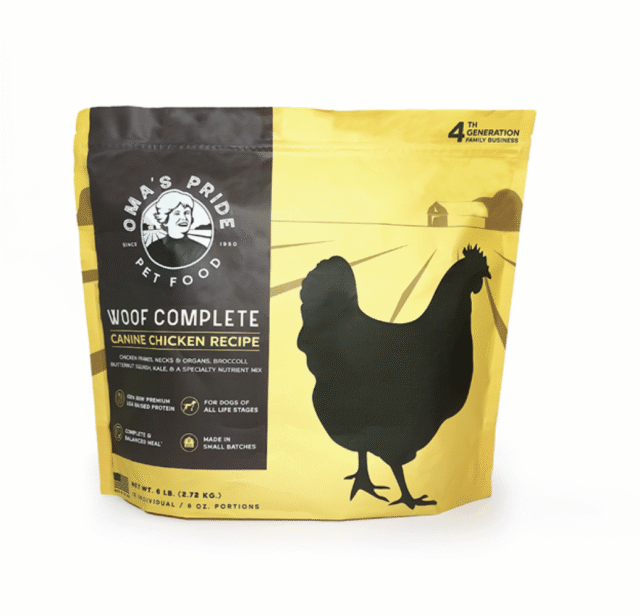
The Oma’s Pride recall notice has been rewritten, and the new version says something the first one did not. FDA has re-posted the company announcement with a line at the top explaining that the firm updated its press release “to include the reason for recall, illness information, and dates of distribution.” Here is the reason for recall: FDA received a consumer complaint, then collected and analyzed a sample of the product, and it tested positive for Salmonella. And here is the illness information, in its entirety: “Three illnesses have been reported to date in association with the complaint.”
That is the whole disclosure. Three illnesses. The notice does not say whether they were people or dogs.
It also does not say whether any of the three were culture-confirmed, whether a clinical isolate was whole-genome sequenced, or whether any of those sequences matched the Salmonella that FDA grew out of the bag. It does not give a serotype, a state, an age, or an onset date. It does not say whether anyone was hospitalized. Read carefully, the sentence does not even claim the three illnesses were caused by this food — they are “in association with the complaint,” which is a phrase describing where the report came from, not what made anyone sick.
The distinction between people and dogs is not a detail. If those three are human, then somewhere there are stool cultures, a PulseNet upload and a cluster, and this is not a routine sample-positive recall at all — it is an outbreak, and it ought to be announced as one. If those three are dogs, then they are outside every disease surveillance system this country has. There is no PulseNet for canine salmonellosis. There is no national database of sick pets. A dog’s illness gets counted only if the owner notices, calls the veterinarian, pays for a culture the veterinarian may not think to run, and then thinks to report it to the manufacturer or to FDA’s Safety Reporting Portal. Every one of those steps is voluntary, and most of them do not happen. Three reported illnesses in the pet food world is not a small number. It is the tip of something no one is measuring.
The recalled lot is BB012729: 639 bags of Woof Complete Canine Chicken Recipe in the 6-pound bag, item F-WOOFC-6, UPC 8 7938400145 9, manufactured January 27, 2026, with a best-by date of January 27, 2029. The updated notice now adds the distribution window — February 12 through May 15, 2026 — to retail and wholesale accounts and directly to consumers through online orders, shipped frozen, in Arizona, California, Indiana, Kentucky, Louisiana, Maryland, Nevada, New Jersey, New York, Pennsylvania and Virginia. Read that best-by date twice. Bags that shipped in February are sitting in home freezers right now with two and a half years of shelf life on the label telling the owner they are fine.
Notice too the distance between FDA’s headline and the announcement underneath it. The headline still says “Possible Salmonella Health Risk.” The company’s own first sentence says the product is contaminated with Salmonella. Not possible. Is. Somebody cultured this food and grew the bug, three illnesses are now on the page, and the headline a pet owner reads in four seconds while scrolling a recall list still says “possible.”
The dogs are only half of it. The people who get hurt in raw pet food cases are very often the ones who never ate a bite — the owner who thaws the portion, scoops the bowl, rinses it in the kitchen sink, wipes the counter with a sponge and then makes a sandwich. Salmonella does not care that the package said “dog.” It produces nausea, vomiting, diarrhea or bloody diarrhea, cramps and fever, and in a minority of people it goes further — bloodstream and arterial infections, endocarditis, reactive arthritis that can last for years. The children in the house are the ones on the floor with the dog, and an infected dog that never looks sick a day in its life can shed the organism for weeks.
None of this is new to FDA. The agency’s own Center for Veterinary Medicine screened more than a thousand pet food samples over two years and found raw pet food far more likely than any other kind to carry Salmonella and Listeria monocytogenes — 38 of 196 raw samples positive for one or both. FDA’s advice ever since has been blunt: the single best way to avoid these infections is not to feed a raw diet. Freezing is not a kill step. It is a pause button.
When I wrote about this recall on Wednesday, I gave Oma’s Pride credit for moving quickly, and against the comparison at hand it still deserves some. Days earlier the Justice Department, on FDA’s behalf, walked into federal court in Seattle and asked for a permanent injunction against Arrow Reliance, Inc., d/b/a Darwin’s Natural Pet Products, and its owner — a company that, according to the government’s complaint, turned down FDA recall requests in 2022, 2023, 2024 and 2025 while twelve of the agency’s eighteen most recent samples came back positive for pathogens, and whose food matched, genome to genome, the E. coli O157:H7 that put a four-year-old boy in the hospital. A company that pulls 639 bags when asked is not that company.
But the updated notice changes the shape of the credit. This recall did not begin with the plant’s own testing catching a problem before it left the building. It began with somebody outside the company — a consumer with a complaint — and it took a government sample to confirm what that complaint suggested. The product had already been in distribution for three months and out of the plant for six. A raw product with no kill step is protected by nothing but the cleanliness of the incoming meat and the plant around it, and when the confirmation comes from a consumer complaint and a federal lab rather than from the company’s own release testing, the honest reading is that the controls did not hold and nothing inside the building caught it.
Testing also finds only what it happens to find. A positive on one lot from one production day is a sample result, not a boundary. What ran before it on that line, and after? What did the environmental swabs show? The company says it is conducting further investigation to better understand the finding, and that investigation is where the real answer lives — but so far the public has been given one lot, three unexplained illnesses and a species left blank.
If you have this bag, stop feeding it now. Do not donate it, do not sell it, do not scoop out one more meal. Bag it, throw it away, and then wash and sanitize the bowl, the scoop, the container, the counter and your hands. Oma’s Pride is taking calls at 1-800-678-OMAS, weekdays 8:00 a.m. to 5:00 p.m. Eastern, and at hello@omaspride.com, and it is offering refunds. If someone in your house has been sick, or your dog has, call the doctor or the veterinarian and say the words “raw pet food” out loud. That sentence is what turns a stool culture into a case, and a case into a recall that catches the next 639 bags. It is also, on this record, the only way anyone will ever learn whether those three illnesses walked on two legs or four.