

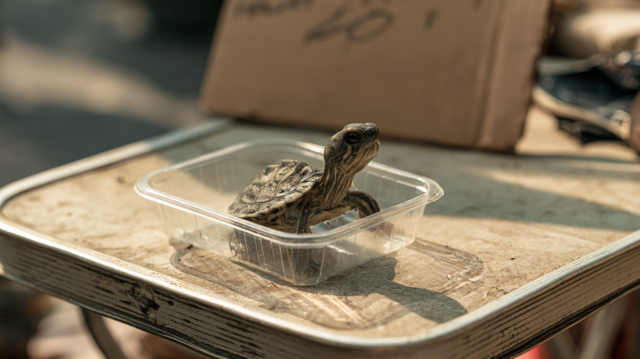
A Salmonella outbreak linked to pet turtles has more than doubled in six weeks. In its September 18, 2026 update, the Centers for Disease Control and Prevention reported 20 sick people in 12 states, up from 8 children in 6 states when the outbreak was first announced on August 5. Five people have been hospitalized. No deaths have been reported. Half of the people who got sick are children younger than 5.
The outbreak strain is Salmonella Paratyphi B variant L(+) tartrate+. CDC says any turtle can carry Salmonella, but turtles with shells less than 4 inches long are a known source of illness. Selling those turtles as pets has been against federal law since 1975.
The numbers as of September 18
CDC’s updated outbreak page lists 20 cases (12 new), 5 hospitalizations (2 new), no deaths, and 12 states (6 new). CDC notes that the true number of sick people is likely higher, because many people recover without seeing a doctor and are never tested, and because it usually takes three to four weeks to confirm that a new illness is part of an outbreak.
CDC’s case data, current as of September 17, place the sick people in Florida (6), Texas (4), and one each in Iowa, Kentucky, New Mexico, New York, North Carolina, Oklahoma, Pennsylvania, Rhode Island, Virginia and Wisconsin. Florida and Texas together account for half the cases. Illnesses began between June 6 and August 22, 2026, with the two most recent both starting on August 22. The outbreak did not end with the July cases CDC first reported; twelve of the twenty people got sick after July 4.
What investigators found in August
CDC’s first investigation notice described 8 children, counted as of July 27, who got sick between June 6 and July 4, 2026. They ranged in age from under 1 to 7 years, with a median age of 4, and a quarter of them were a year old or younger. Three of the six children with information available were hospitalized.
Parents of six of the children were interviewed, and five of them (83%) reported that their child had contact with a pet turtle before getting sick. Four parents knew the size of the turtle, and three of those four said its shell was less than 4 inches long. Parents of three children said the turtle came from a pet store, and one child received the turtle as a gift. CDC had not identified a common turtle supplier. As of this writing, CDC’s investigation-detail page still carries those August figures, so it does not yet say how many of the new patients reported turtle contact, how old they are, or where their turtles came from.
A 1975 rule that worked
On May 23, 1975, the Food and Drug Administration banned the sale and distribution of viable turtle eggs and live turtles with a shell length of less than 4 inches. The rule sits at 21 CFR 1240.62 and says those turtles “shall not be sold, held for sale, or offered” for commercial or public distribution.
The problem it addressed was enormous. According to a 2016 paper in CDC’s journal Emerging Infectious Diseases, by the early 1970s about 15 million turtle hatchlings were sold in the United States every year, 4% of households owned a pet turtle, and 14% of human salmonellosis cases were attributed to small pet turtles. The Council of State and Territorial Epidemiologists has noted that voluntary education efforts failed to fix the problem before FDA acted.
The rule worked. CDC has estimated that the ban prevents about 100,000 cases of salmonellosis among children each year.
I have seen the same thing in my own practice. I used to be in the beef business with E. coli O157:H7. Once the government set a clear rule for ground beef and enforced it, those cases largely disappeared from my firm. Clear rules, enforced, protect children. The turtle ban is proof of that from fifty years ago.
Why children are still getting sick
The rule has exceptions. It does not apply to sales for bona fide scientific, educational or exhibition purposes other than use as pets, to distribution “not in connection with a business,” or to turtles labeled for export only. In 2013, FDA also removed the procedures in the rule that called for routine destruction of turtles found held for sale, saying routine destruction was not necessary to achieve the rule’s purpose.
The larger gap is enforcement. CDC says on its outbreak page that small turtles are still sold illegally online, in stores, at flea markets and at roadside stands. The 2016 Emerging Infectious Diseases paper reached the same conclusion: despite the long-standing ban, small turtles can be readily acquired through multiple venues and remain the main source of turtle-associated salmonellosis in children. CDC keeps a menu of state turtle laws, which shows how much of the job has been left to the states.
What should happen now
The rule does not need rewriting. It needs to be enforced where the turtles are actually sold today, which increasingly means online listings, marketplaces and shipping. FDA and CDC should also tell the public where these turtles came from once a supplier is found. Parents cannot avoid a seller no one will name.
There is a larger point here too. The turtle rule was issued under Section 361 of the Public Health Service Act, the communicable-disease authority codified in 21 CFR Part 1240. That same authority is what I rely on in a citizen petition I have drafted asking FDA to sample at animal feeding operations implicated in produce outbreaks. FDA has used Part 1240 to regulate an animal at its source when that animal was making children sick. The turtle ban shows it can work.
What parents should do
CDC advises families not to buy turtles with shells less than 4 inches long, and to buy larger turtles only from a reputable pet store. Pet turtles are not recommended for children younger than 5, adults 65 and older, or people with weakened immune systems. Wash hands with soap and water right after touching a turtle or anything in its habitat, do not kiss or snuggle turtles, keep turtles and their supplies out of the kitchen, and do not let turtles roam where young children crawl and play. If a turtle is not right for your family, do not release it outdoors; call a reptile rescue, an animal shelter or a pet store about rehoming it.
Questions parents ask about turtles and Salmonella
Can a healthy-looking turtle make my child sick? Yes. CDC says turtles of any size can carry Salmonellain their droppings even when they look healthy and clean, and the germs spread easily to their bodies, their tank water and anything they touch. State epidemiologists have noted that turtles can shed the bacteria intermittently and that antibiotic treatment of turtles has not eliminated it.
Is it legal to buy a turtle with a shell under 4 inches? Not as a pet from a business. Federal law has barred that since 1975, with narrow exceptions for bona fide scientific, educational and exhibition uses, non-business distribution and export. FDA administers the rule.
When should I call a doctor? CDC says to call a health care provider right away for diarrhea with a fever higher than 102°F, diarrhea for more than two days that is not improving, bloody diarrhea, vomiting so severe that liquids cannot be kept down, or signs of dehydration. Symptoms usually start 6 hours to 6 days after exposure, and young children are among those most likely to become seriously ill.