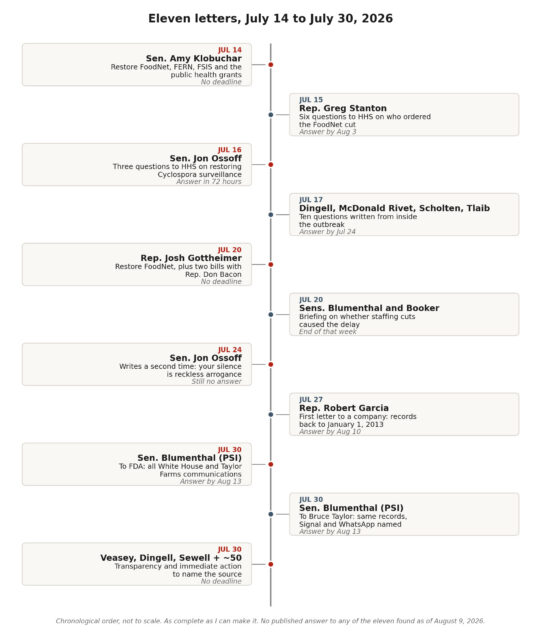
Between July 14 and July 30, members of the House and the Senate wrote eleven separate letters about the Cyclospora outbreak. Five came out of the House and six out of the Senate. They went to the acting head of CDC, to the acting commissioner of FDA, to the Secretary of Health and Human Services, and twice to the chief executive of Taylor Farms. Four of them set a deadline that has now passed. Three more come due in the next four days. As of this morning I cannot find a published answer to a single one.
Start with the credit, because it is owed. A letter from a member of Congress is not a subpoena and it is not a rule, and I have spent thirty-three years watching letters like these go into a drawer. But a letter puts a specific question in writing with a name underneath it, and it creates a date on which somebody either answered or did not. Every one of these members chose to spend staff time and political attention on a parasite that most of the country had never heard of in May. Foodborne illness does not usually get eleven letters in seventeen days. This time it did, and the people who wrote them were right to.
The first came from Senator Amy Klobuchar of Minnesota on July 14. She wrote to the acting heads of CDC and FDA asking them to restore FoodNet, the Food Emergency Response Network, the Food Safety and Inspection Service, the Public Health Infrastructure Grants and the Preventive Health and Health Services Block Grant. Her sharpest observation is that there is no longer a central place to report and compare data across state lines, which is exactly the problem every count in this outbreak has run into since. She set no deadline.
Representative Greg Stanton of Arizona wrote to Secretary Kennedy on July 15 with six questions and asked for answers by August 3. Who directed the decision to cut FoodNet’s required surveillance, and what scientific or budget analysis supported it. What funding has been reduced or redirected since January 2025. How many surveillance staff have been terminated, reassigned or left vacant. What system now performs the active laboratory outreach FoodNet used to do. How many personnel are assigned to the federal response. And what evidence supports the department’s claim that none of these changes affected this investigation. That last one is the best question anybody has asked, and August 3 came and went.
Senator Jon Ossoff of Georgia wrote to Kennedy on July 16 with three questions and gave him seventy-two hours. Has FoodNet been restored to require tracking of Cyclospora cayetanensis, and if not, why was it terminated, and what is the status of the epidemiological and food safety investigations. He wrote that the demolition of these programs puts Americans at risk, and he was working off CDC’s confirmed count of 1,645 at the time.
Eight days later he had to write again, and that second letter is the reason I am writing this one. On July 24, having received nothing, Ossoff sent a second letter telling the Secretary that seventy-two hours had passed, that his questions had not been addressed, and that silence during an outbreak of diarrheal disease is its own kind of answer. By then he was citing more than 11,000 cases across forty-one states. A United States senator asked three plain questions, got nothing, and had to spend a second letter saying so. Nobody should have to do that twice.
The best letter of the eleven came from Michigan on July 17, and it is the best one because it was written from inside the outbreak. Representatives Debbie Dingell, Kristen McDonald Rivet, Hillary Scholten and Rashida Tlaib sent ten questions to CDC and FDA and asked for answers by July 24. Do you agree with Michigan that lettuce and salad greens are the source. What barriers are preventing you from acting on the leads Michigan has developed. How many federal personnel are assigned to this compared with outbreaks of similar size in the past five years. Those are the questions of people whose constituents are the ones in the hospital beds. July 24 passed without a reply.
Representative Josh Gottheimer of New Jersey wrote to CDC on July 20 asking that FoodNet be restored to full mandatory active surveillance, and paired the letter with two bills. The Foodborne Illness Rapid Response Act, written with Representative Don Bacon of Nebraska, would bar staffing cuts in the CDC divisions responsible for foodborne illness surveillance for a year after an outbreak is detected. The second would let state and local inspectors see the same unredacted inspection information federal regulators see, which matters because state and local inspectors do roughly sixty percent of the food processing inspections in this country. Neither bill has a number yet. Bacon is the only Republican name attached to anything in this file.
Senators Richard Blumenthal and Cory Booker asked CDC for a briefing that same week, wanting to know how the outbreak was tracked and whether federal staffing cuts caused the delay, with answers by the end of the following week. I have never been able to find a copy of that letter; it exists in the reporting and not in any archive I can reach, which is its own small problem when the point is accountability.
On July 27 the letters changed character. Representative Robert Garcia of California, ranking member of the House Oversight and Government Reform Committee, wrote to Taylor Farms chief executive Bruce Taylor — the first letter in this outbreak addressed to a company rather than to the government. He asked for five categories of documents by August 10: all communications with FDA, CDC and USDA since May 1; all communications with the White House since January 21, 2025; all internal communications about the outbreak; everything concerning the July 17 recall; and every inspection, audit, risk assessment and contamination record for Taylor Farms de Mexico going back to January 1, 2013. That last date is not an accident. It reaches back to the 2013 outbreak traced to the same Mexican growing region.
Three days later Blumenthal wrote twice more, and these two are different from everything before them. Writing as ranking member of the Senate Permanent Subcommittee on Investigations, he sent one letter to the acting FDA commissioner and a second to Bruce Taylor, both dated July 30, both due August 13, both copied to Chairman Ron Johnson. Both demand all communications with the White House, expressly including the Executive Office of the President and the Domestic Policy Council, and all communications between the agency and the company. The records definition names Signal and WhatsApp by name, which tells you the subcommittee has done this before. It matters that these came from that subcommittee: it is the Senate’s standing investigative body, it has subpoena capacity, and it is the same subcommittee that held a hearing on Cyclospora in imported raspberries in July 1998. Twenty-eight years, same subcommittee, same parasite.
The eleventh is the largest by signatures and the weakest by mechanism. On July 30, Representatives Marc Veasey of Texas, Debbie Dingell of Michigan and Terri Sewell of Alabama led about fifty colleagues in a letter to CDC and FDA asking for transparency and immediate action to identify the source. Veasey’s line is that public health decisions should be guided by science and transparency and not by outside influence, which is the same accusation Blumenthal makes with names attached. Fifty-three members signed it. It sets no deadline and demands no documents, and that is the difference between a pressure letter and an investigation.
Here is the whole set on one page.
| Who wrote | Sent | Written to | Deadline | Status as of August 9 |
| Sen. Amy Klobuchar | Jul 14 | CDC and FDA | None set | No answer found |
| Rep. Greg Stanton | Jul 15 | HHS Secretary Kennedy | Aug 3 | Passed, no answer found |
| Sen. Jon Ossoff | Jul 16 | HHS Secretary Kennedy | 72 hours (Jul 19) | Passed, no answer found |
| Reps. Dingell, McDonald Rivet, Scholten, Tlaib | Jul 17 | CDC and FDA | Jul 24 | Passed, no answer found |
| Rep. Josh Gottheimer | Jul 20 | CDC | None set | No answer found; two bills, no numbers yet |
| Sens. Blumenthal and Booker | Jul 20 | CDC | End of that week | Passed, no answer found |
| Sen. Jon Ossoff (second letter) | Jul 24 | HHS Secretary Kennedy | Restates the first | No answer found |
| Rep. Robert Garcia, Oversight ranking member | Jul 27 | Taylor Farms CEO Bruce Taylor | Aug 10 | Comes due Monday |
| Sen. Blumenthal, PSI ranking member | Jul 30 | Acting FDA Commissioner Diamantas | Aug 13 | Comes due Thursday |
| Sen. Blumenthal, PSI ranking member | Jul 30 | Taylor Farms CEO Bruce Taylor | Aug 13 | Comes due Thursday |
| Reps. Veasey, Dingell, Sewell and ~50 colleagues | Jul 30 | CDC and FDA | None set | No answer found |
Two cautions about that table, and I would rather say them myself than have somebody find them for me. The first is that I believe it is every letter and I am not certain that it is. I built it from press releases, from the letter PDFs where offices posted them, and from news reporting where they did not, and a letter that went out quietly without a release is a letter I would not have seen. The second is the status column. It says no answer found, and that is exactly what it means and nothing more. An agency can respond to a member of Congress privately, and often does, and neither the agency nor the member has any obligation to publish it. What I can tell you is that I looked and found nothing published. If a member sent a letter that is not on this list, or if any of these eleven has been answered and I missed the answer, send it to me and I will correct this post and say plainly that I had it wrong. The list of answers is the part I would like to see grow.
There is something in that set that should worry every member who signed. Look at the numbers the letters themselves carry. Gottheimer’s announcement on July 20 described roughly 7,000 cases across thirty-four states. The fifty-three-member letter of July 30 described more than 4,000 cases and more than 300 hospitalizations. On July 29 the states were reporting 21,452. A letter signed by fifty-three members of Congress described an outbreak about a fifth the size of the one the states were counting. That is not a criticism of the members. They used the published federal numbers, because those are the numbers a congressional office is supposed to be able to rely on. The counting failure I have been writing about all summer has now reached the legislature itself, and the people writing the oversight letters are working from a picture the system gave them.
All eleven letters were written by Democrats. Don Bacon cosponsors a bill and Senator Bill Cassidy raised the outbreak in a hearing he was chairing, and that is the entire Republican presence in this file after eight weeks. Foodborne illness has historically been the least partisan subject in Washington, and it is worth remembering how recently that was true. Rosa DeLauro wrote FDA and CDC in August 2013 asking whether it is acceptable to identify the source of a Cyclospora outbreak and then withhold it from the public — during the outbreak traced to this same Mexican facility — and she wrote FDA again in August 2018 on the Fresh Express outbreak to say the timeline did not instill confidence. Thirteen years and eight years ago, the same questions. Nobody answered those either.
Six of the eleven aim at FoodNet, and FoodNet is the wrong instrument. It measures trends across about sixteen percent of the population; the systems that actually detect an outbreak are NNDSS and PulseNet. Restoring FoodNet is worth doing and it would not have found this outbreak a day sooner. Garcia’s letter is the only one of the eleven to name the Food Traceability Rule, which is the rule that would let anyone follow a bag of lettuce from a field in Guanajuato to a restaurant in Michigan, and which Congress has now directed FDA not to enforce before July 2028. If a member wants one thing to ask for that would change the next outbreak, that is the thing.
That brings me to the ask. A deadline with nothing behind it is a suggestion, and four suggestions have now expired. The Permanent Subcommittee on Investigations has subpoena power and a Republican chairman who has been copied on both letters. The Oversight Committee’s majority can join Garcia’s request and make it the committee’s request instead of the ranking member’s. Appropriations season is open. Any member who signed one of these letters can put the same question to the acting commissioner in a hearing, on the record, where not answering is visible. What should not happen is that August 13 goes by the way August 3 went by, and the next letter starts with the words seventy-two hours have passed.
The season closes on August 31. Taylor Farms has suspended its central Mexico iceberg sourcing until then, which means the natural end of this outbreak is going to arrive before any of these questions are answered, and an outbreak that ends is an outbreak that stops making news. Two people are dead in Michigan. The states have counted 26,755 sick. The federal government counts 6,358 in fifteen states, which is the number that will end up in the history of this thing unless somebody makes the agencies explain the gap. Eleven letters is not nothing. Eleven letters and no answers is a lesson, and the people who wrote them are the only ones in a position to make sure it is not the lesson that sticks. Thank you for writing. Please do not let it end there. I am watching, and so are twenty-six thousand seven hundred and fifty-five other people, and not one of us chose to be part of this.