

FDA published its final Guide to Minimize Biological Hazards in Ready-to-Eat Fresh-Cut Produce on August 11, a day ahead of its Federal Register date, and I have Marion Nestle to thank for the heads up[1]. Eighty pages, eight years from draft to final, nonbinding, and aimed only at registered processors — not at farms, and by FDA’s own footnote not at restaurants or retail. It reads like housekeeping until page thirty-eight, where the agency writes that it is not currently aware of any antimicrobial that would significantly minimize or prevent Cyclospora cross-contamination and be suitable for use on fresh-cut produce. Elsewhere it adds that a wash water process control is not a kill step at all, and that antimicrobials do not reach pathogens that have attached to the produce or been internalized in the tissue.
There is no way to wash this parasite off a bag of lettuce. I have been saying it since July. The government has now written it down.
Two other things in the document matter as much. FDA states that Cyclospora cayetanensis is a known or reasonably foreseeable biological hazard in berries, fresh basil, fresh cilantro, and fresh salad mixes, including salad mixes that contain lettuce and carrots — which is not an abstraction, it is a product description. And it states that fecally contaminated agricultural water, and fecal deposits from infected field workers on or near harvested product, are currently considered reasonable routes of transfer, citing the 2023 NACMCF report on the parasite in produce — the federal report co-chaired by the man who is now chief science officer of the International Fresh Produce Association. Human waste in the water and human waste in the field, in the agency’s own voice.
What FDA tells processors to do about it is the part with teeth. Validate the wash against a bacterium, it says, and address what the antimicrobial cannot control through supply-chain controls. It then lists Cyclospora alongside pathogenic E. coli, Salmonella and Listeria among the hazards that can cause serious adverse health consequences or death, for which the appropriate supplier verification is an onsite audit by a qualified auditor before first use and at least annually after. In the contract-harvester example it recommends reviewing the harvester’s records of required worker training on the hazard posed by Cyclospora for people who hand harvest ready-to-eat lettuce.
That is a standard of care in four steps, with a date on it. The parasite is foreseeable in salad mix. No wash controls it. Control it in the supply chain. Verify by qualified annual audit. And an obligation follows that nobody is talking about: the preventive controls rule requires a facility to reanalyze its food safety plan whenever it becomes aware of new information about potential hazards in its food. This guidance is that new information. There is no phase-in, because guidance is the agency’s current thinking the day it posts. Which leaves a question worth asking every fresh-cut processor in the country from here forward. What did your reanalysis say about this organism after August 2026, and if you did not run one, why not.
Which brings me to what is missing, and it is the whole ballgame. If the wash cannot control it, and the answer has to come from upstream, what does eighty pages say about testing the water?
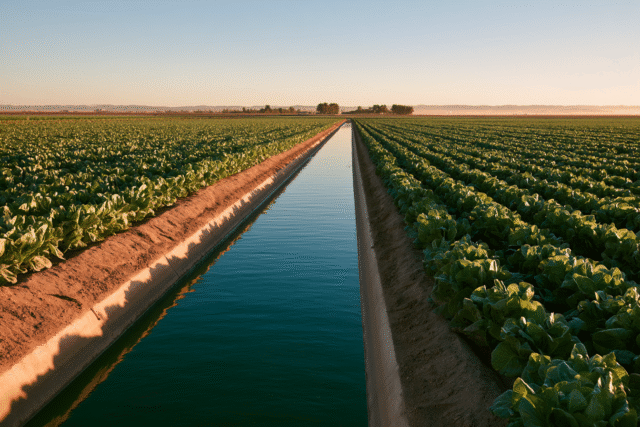
The water inside the plant gets one paragraph: make it potable, and a footnote pointing to EPA’s drinking water rules as adequate. Those rules do regulate parasites — a contaminant level goal of zero for Cryptosporidium, 99.9 percent removal for Giardia lamblia. This one is not among them. The wash water gets forty pages of genuinely exacting instruction — sensor placement, organic load by chemical oxygen demand, ten parts per million of free chlorine as the critical limit, pH below 7.5, titration twice a shift, records that must show 22 ppm and not the word OK. Read every one of those measurements and not one of them looks for an organism. All of it measures the chemistry of a treatment the same document says does not work on this parasite. Upstream, water appears exactly once, as a certificate that the harvest water came from a public system. A certificate of source, not a result. Irrigation water is not addressed at all, because irrigation water belongs to the Produce Safety Rule, whose only numeric microbial criterion is generic E. coli, which FDA’s own fact sheet says will not identify this organism.
The loop closes on itself. The antimicrobial cannot control the parasite, so FDA sends it to the supply chain. The supply-chain control is an audit against the produce rule. The produce rule measures a bacterial indicator. Nowhere in that chain is anyone looking for Cyclospora. The agency drew a careful map from the hazard to the control, and the last box on the map is empty.
It did not have to be. FDA has had a validated method for detecting the parasite in fresh produce, romaine included, since 2017, and a validated method for agricultural water since 2020 that found roughly six oocysts in ten litres. Chapters 19b and 19c of its own Bacteriological Analytical Manual. I could not find either one cited anywhere in eighty pages and fifty references.
Credit where it is owed. For bacteria this is a real improvement, and the improvement is the second worked example — peracetic acid on diced onions, dosed by hand and titrated every thirty minutes, which describes the industry as it actually exists rather than as an automated ideal. A mid-size processor has a template today it did not have on Monday. But FDA is explicit that the wash is a cross-contamination control and not a lethality step, and its job is to keep one contaminated head from seeding the batch. Yuma in 2018 and Salinas in 2019 and 2020 walk through a flawless flume untouched. Keeping the wash from making things worse is worth doing. It is smaller than the page count suggests.
The same logic reaches the peppers. Antimicrobials do not reach what is internalized in the tissue, which is the entire answer to why no chlorine wash was ever going to save the jalapeños behind this summer’s Salmonella recalls. The wash is not the control. The supplier is. And nobody is testing the supplier’s water.
Guidance dockets never close. Comments on FDA-2018-D-3583 can be filed at any time, and there is one worth filing: name Chapters 19b and 19c in this document, and recommend testing supplier water and the growing environment as a verification activity. Not as a release criterion, because a negative can never clear a lot. As proof that somebody is looking. It took eight years to write down the hard half of the truth. The other half is that we have known how to find this thing in ten litres of irrigation water since 2020, and the guidance that admits the first half never mentions the second.
[1] Marion Nestle is the Paulette Goddard Professor of Nutrition, Food Studies, and Public Health, Emerita, at New York University, where she chaired the department from 1988 to 2003, and a visiting professor of nutritional sciences at Cornell. She was senior nutrition policy advisor at the Department of Health and Human Services from 1986 to 1988 and edited the 1988 Surgeon General’s Report on Nutrition and Health. She has written or edited fifteen books, among them Food Politics, Safe Food and Unsavory Truth, and she blogs at foodpolitics.com.