

On November 19, Alice Callahan of the New York Times published “5 Foods That Food Safety Experts Avoid.” I liked it enough to write a tip of the pen the same morning. I still like it. Go read it, then come back.
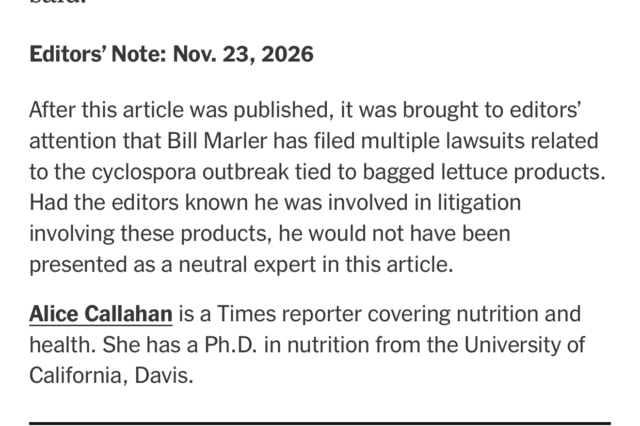
On November 23, the Times added an Editors’ Note. It reports that, after publication, the editors learned I have filed multiple lawsuits over the Cyclospora outbreak tied to bagged lettuce, and that had they known, “he would not have been presented as a neutral expert in this article.”
I intend to cooperate fully. In that spirit, and to spare the editors a second note, here are some further disclosures.
Further disclosures, offered voluntarily
I am a lawyer. I have been one for more than 30 years. I have never been accused of neutrality before, and I would like the record to reflect that I did not start it.
My firm is Marler Clark. We call it “The Food Safety Law Firm.” It is on the website, the letterhead and the door. In hindsight, we could have made the font bigger.
I have represented people sickened by every food on Ms. Callahan’s list. Sprouts, deli meat, bagged salad, raw oysters and melon. That is not a coincidence. That is how I know what is on the list.
I published my own list nearly eleven years ago. In January 2016, I wrote about six foods I do not eat. Four of the Times’ five were on it: raw sprouts, prewashed and precut produce (which covers both the bagged salad and the precut melon) and raw shellfish. I have been on the record as not neutral about bagged salad for a decade.
There is a book. There is also a Netflix documentary. Both are called Poisoned. I appear in them. I am not presented as neutral in those either.
I disclosed it myself. My November 19 post said, in so many words, that I was the one who gave her the bagged salad answer, and that I have been suing lettuce and leafy greens companies for a very long time.
I am biased against food poisoning. Strongly. I have been for my entire career, and I do not expect to recover.
Which way does the conflict run?
A conflict of interest usually means the source makes money if you take his advice. Consider mine. If I am right about bagged salad, and you buy a whole head of lettuce and wash it yourself, fewer people get sick. Fewer sick people means fewer people calling a food poisoning lawyer. As a business plan, it is one of the worst in American law.
I have been pursuing that plan in public since 2002, when I wrote an op-ed after the ConAgra ground beef recall asking the industry to put me out of business. The beef industry largely did. The hamburger E. coli cases that built my firm are nearly gone, and that is the best thing to happen in food safety in my lifetime. I would be delighted if lettuce were next.
The editors have a point
Here is the part where I stop joking. Readers should know who is talking and what stake that person has in the subject. I have filed petitions asking FDA to tell the public more about outbreaks, not less. I can hardly object when the standard is applied to me.
The article now tells readers that I am a lawyer with lawsuits pending over this outbreak. That is accurate. Weigh what I said accordingly.
I would add only this. I am not sure a neutral expert on foodborne illness exists, and I am not sure you would want one. Barbara Kowalcyk, who opens the article, lost her 2-year-old son to an E. coli infection in 2001 and has spent the years since making food safer. Sandra Eskin runs Stop Foodborne Illness. The scientists quoted have built careers studying Salmonella, Listeria and norovirus. None of us is neutral about whether people should get sick from dinner. That is the qualification, not the defect.
What Alice Callahan got right
None of this takes anything away from the reporting. Ms. Callahan, who covers nutrition and health for the Times and holds a Ph.D. in nutrition from the University of California, Davis, did what most “foods to avoid” stories do not. She explained the why. Each of her five foods comes with the mechanism that makes it risky, and with something a reader can do about it. The advice is also nearly free: buy the whole head, buy the whole melon, wash it, and cook the sprouts.
It is short, it is accurate, and it is worth five minutes of your Thanksgiving weekend. Read it, note included.
I am thankful this year for reporters who cover food safety well, for editors who care about disclosure, and for having it confirmed in the paper of record that I am not neutral about food poisoning. I never have been.
Editors’ Note: After this post was published, it was brought to the author’s attention that he is still a lawyer. Had he known, he would have written it anyway.