Employees at two local Louisville, Kentucky businesses have been diagnosed with Hepatitis A.

That has been a similar and common headline in newspapers across the country over the last several months.

One worker at Sarino (1030 Goss Avenue) was diagnosed. Customers who dined at the establishment from February 24 through March 15 may have been exposed to the virus. One worker from Kroger (520 N 35th Street) was diagnosed. Customers who shopped at the store from March 2 through March 19 may have been exposed to the virus.

Kentucky

Since Jan. 1, 2017, the Kentucky Department for Public Health (KDPH) has identified 198 confirmed cases of acute hepatitis A, a liver disease caused by hepatitis A virus. An increase in cases since Aug. 1, 2017, primarily among the homeless and drug users, prompted declaration of a statewide outbreak in Nov. 2017. Viral sequencing has linked several outbreak-associated cases in Kentucky with outbreaks in California and Utah.

KDPH is working closely with the Centers for Disease Control and Prevention and local health departments to provide guidance and education to health professionals and at-risk populations. Treatment for acute hepatitis A generally involves supportive care, with specific complications treated as appropriate. Hepatitis A is a vaccine-preventable disease.

Counts as of Mar. 17, 2018

  • Total Outbreak: 198
  • Hospitalizations: 142
  • Deaths: 1

Utah

Since January 1, 2017, Utah public health has identified 226 confirmed cases of hepatitis A virus (HAV) infection; many among persons who are homeless and/or using illicit drugs. Several cases have been linked by investigation and/or viral sequencing to a national outbreak of hepatitis A involving cases in California and Arizona. Hospitalization rates of less than 40% have been described in previous hepatitis A outbreaks; however, other jurisdictions associated with this outbreak are reporting case hospitalization rates approaching 70%.

California

On Jan. 23, 2018, the San Diego County ended the local health emergency, declared on September 1, 2017, in response to the local hepatitis A outbreak. The action does not mean the outbreak is over, and the County will continue efforts it has taken to control the spread of the disease.  There has been a total of 586 illnesses, 401 hospitalizations and 20 deaths.

Arizona

Arizona officials believe the local outbreak was mainly confined to homeless people in Maricopa County. The county recorded only 15 known cases and no deaths, and officials have detected no new Arizona cases since the end of May 2017.  The illnesses in Arizona were linked to a person who traveled from San Diego.

Michigan

Since the beginning of the outbreak in August 2016, the Michigan public health response has included increased healthcare awareness efforts, public notification and education, and outreach with vaccination clinics for high-risk populations. No common sources of food, beverages, or drugs have been identified as a potential source of infection. Transmission appears to be through direct person-to-person spread and illicit drug use. Those with history of injection and non-injection drug use, homelessness or transient housing, and incarceration are thought to be at greater risk in this outbreak setting. Notably, this outbreak has had a high hospitalization rate.  There has been a total of 789 illnesses, 635 hospitalizations and 25 deaths.

What about all the rest of the states?  What is the cause?  What is the source?  What can we do – in addition to vaccinations – to stop this?

My friends at CIDRAP did a great job of pouring over the recent FoodNet report (Mar 23 MMWR report) on the incidence of a variety of pathogens.  I will steal a bit from their work.

Good news: Salmonella Typhimurium and Heidelberg illnesses down which mirrors decrease in positives in chicken and a decreased incidence of hemolytic uremic syndrome from 2006 to 2016 which mirrors an STEC O157 decline in ground beef over the same timeframe.

A team from the US Centers for Disease Control and Prevention (CDC) and partners in 10 states that are part of the FoodNet surveillance network reported its findings today in the latest issue of Morbidity and Mortality Weekly Report (MMWR).

The group publishes an annual FoodNet report in early spring, and this year’s report sums up lab-confirmed infections from nine pathogens for 2017, detailing changes since 2006. The pathogens are Campylobacter, Cryptosporidium, Cyclospora, Listeria, Salmonella, Shiga toxin-producing E coli (STEC), Shigella, Vibrio, and Yersinia.

For 2017, the FoodNet system identified 24,484 foodborne illnesses, 5,677 hospitalizations, and 122 deaths. Highest incidences per 100,000 population were for CampylobacterSalmonella, and Shigella.

Growing use of culture-independent diagnostic tests (CIDTs) at public health labs is a useful tool for quickly identifying illnesses that might be missed by other lab tests, leading to more accurate incidence estimates, the authors write. They note, however, that their use can complicate the interpretation of estimates and that culturing isolates is still needed to reveal subtype information and test for antimicrobial susceptibility.

Regarding the infections only found on CIDT testing, percentages were highest for Yersinia (51%), Campylobacter (36%), Shigella (31%), Vibrio (29%), STEC (27%), Salmonella (9%), and Listeria (1%). Compared with findings from 2014 to 2016, incidence for 2017 was significantly higher for CyclosporaYersiniaVibrio, STEC, Listeria, and Campylobacter.

Given that the use of CIDT panels are rising, tests more often routinely detect CyclosporaYersiniaVibrio, and non-O157 STEC, the group said. “The increased incidence of these infections in 2017 was most likely driven by the increased use of CIDTs,” they wrote.

Of subtyped Salmonella isolates in 2017, the five most common were Enteritidis, Typhimurium, Newport, Javiana, and I 4,[5],12:i:-, a variant of Typhimurium. For 2017, the incidence of Heidelberg was 65% lower than from 2006 to 2008, with a similar decrease for Typhimurium over the same period.

When the scientists looked at STEC isolates, they found that the incidence of non-O157 STEC increased significantly in 2017 compared with 2014 to 2016. Though O157 STEC held steady, the incidence decreased 35% compared with 2006 to 2008.

According to the CDC, as of March 20, 2018, 13 people infected with the outbreak strain of Salmonella Typhimurium have been reported from 8 states. WGS performed on bacteria isolated from ill people showed that they were closely relatedly genetically. This means that people in this outbreak are more likely to share a common source of infection.

Illnesses started on dates ranging from September 22, 2017 to February 26, 2018. Ill people range in age from 1 to 73 years, with a median age of 40. Sixty-seven percent are female. Three hospitalizations have been reported. No deaths have been reported.

Epidemiologic, laboratory, and traceback evidence indicates that dried coconut is the likely source of this multistate outbreak.

In interviews, ill people answered questions about the foods they ate and other exposures in the week before they became ill. Seven (88%) of eight people interviewed reported eating dried coconut from grocery stores. Of the seven people who reported eating dried coconut, four people purchased the product at different Natural Grocers store locations. Public health officials continue to interview ill people to learn more about what they ate in the week before becoming sick.

FDA and state health and regulatory officials collected leftover dried coconut from ill people’s homes, as well as dried coconut from Natural Grocers store locations where ill people shopped and from the Natural Grocers’ Distribution Center. FDA testing identified the outbreak strain of Salmonella Typhimurium in an unopened sample of Natural Grocers Coconut Smiles Organic collected from Natural Grocers. The outbreak strain was also identified in an opened, leftover sample of Natural Grocers Coconut Smiles Organic collected from an ill person’s home.

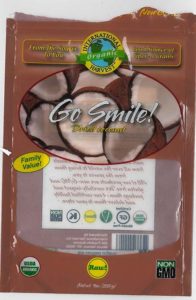
FDA also collected dried coconut from International Harvest, Inc. The outbreak strain of Salmonella Typhimurium was identified in samples of International Harvest Brand Organic Go Smile! Dried Coconut Raw and Go Smiles Dried Coconut Raw.

On March 16, 2018, International Harvest, Inc. recalled bags of Organic Go Smile! Raw Coconut and bulk packages of Go Smiles Dried Coconut Raw. The recalled Organic Go Smile! Raw Coconut was sold online and in stores in 9-ounce bags with sell-by dates from January 1, 2018 through March 1, 2019. Recalled bulk Go Smiles Dried Coconut Raw was sold in a 25-pound case labeled with batch/lot numbers OCSM-0010, OCSM-0011, and OCSM-0014. These products were sold in various grocery stores. Regulatory officials are working to determine where else Organic Go Smile! Raw Coconut and Go Smiles Dried Coconut Raw were sold.

On March 19, 2018, Vitamin Cottage Natural Food Markets, Inc. recalled packages of Natural Grocers Coconut Smiles Organic labeled with barcode 8034810 and packed-on numbers lower than 18-075. Recalled Natural Grocers Coconut Smiles Organic were sold in 10-ounce clear plastic bags with the Natural Grocers label. The packed-on number can be found in the bottom left-hand corner of the label.

Federal and state health officials are investigating a multistate Salmonella outbreak connected with a potentially contaminated organic packaged coconut that was sold at Natural Grocers stores, a product that was the subject of a recall posted by the US Food and Drug Administration (FDA) yesterday.

In the recall notice, Vitamin Cottage Natural Food Market, Inc., based in Lakewood, Colo., said it was recalling its Natural Grocers brand 10-ounce Coconut Smiles Organic due to potential Salmonella contamination. It said six illnesses have been reported, the company’s own routine tests found Salmonella in some packages, and a sample taken by the FDA was also positive for Salmonella.

The product is packaged in clear plastic 10-ounce bags bearing the Natural Grocers label. All packages with packed-on dates before 18-075 (Mar 16, 2018) are subject to the recall. The products were distributed to 145 Natural Grocers stores in 19 states: Arkansas, Arizona, Colorado, Iowa, Idaho, Kansas, Minnesota, Missouri, Montana, Nebraska, Nevada, New Mexico, North Dakota, Oklahoma, Oregon, Texas, Utah, Washington, and Wyoming.

The below is the latest recall list of meat products that have tested positive for Listeria.  NOT all have been linked to the Listeria Outbreak that has sickened nearly 1,000 and killed nearly 200.

Pick and Pay

PNP Fresh Black pepper Chicken Roll (4X2.5kg =10kg)
PNP Fresh Garden Herb Chicken Roll (4X2.5kg =10kg)
PNP Fresh Plain Chicken Roll (4X2.5kg =10kg)
PNP Fresh Sweet Chilli Roll (4X2.5kg =10kg)
PNP Fresh Cheese Chicken Roll (4X2.5kg =10kg)
NO NAME IQF PORK BANGER 375GR
NO NAME IQF PORK BANGER 750GR

Rainbow

Fresh Polony 1kg
Simply Chicken Chakalaka Polony 1kg
Simply Cheese Polony 700g
Simply Chicken Original 1kg
Simply Chicken Peri Peri Polony 1kg
Rainbow Simply Chicken Original 750g
Rainbow Simply Chicken Polony Polony 400g
Rainbow IQF Chilli Russians 1kg
Rainbow IQF cheese Russians 850g
Rainbow IQF original Russian 1kg
Farmer Brown cabinet Loaves
Farmer Brown Roast Chicken Loaf 500g
Farmer Brown  Capsicum pepper loaf 500g
Farmer Brown Garlic & herb loaf 500g
Framer Brown Deli loaves
Farmer Brown Capscum Pepper Loaf (4X2.5kg =10kg)
Farmer Brown B Roast Chicken Loaf (4X2.5kg =10kg)
Farmer Brown B Garlic & Herb Chicken Loaf (4X2.5kg =10kg)
Rainbow Simply Chicken Mini Cheese Viennas 240g
Rainbow Simply Chicken Mini Viennas 240g
Rainbow Simply Chicken Viennas assorted 1kg
Rainbow Simply Chicken Viennas 500g

Enterprise 

All ready-to eat-processed meat products under the following brands:

Bokkie
Renown
Enterprise Lifestyle Range
Mieliekip

Woolworths 

Wafer thin Chargrilled Ham 125g
Waferthin Roasted Chicken 125g
Waferthin Smoked Ham 125g
Waferthin Cooked Ham 125g
Waferthin Smoked Chicken 125g
500g Smoked Viennas
1kg Smoked Viennas
500g Red Viennas
1kg Red Viennas
375g Cocktail Viennas
125g Smoked Cheesy Viennas 400g
Bulk Salami Sticks 150g
Salami Sticks 85g
Plain Salami Sticks 85g
Spicy Salami Sticks 60g
Plain Salami Bites 150g
Spicy Salami Sticks 85g
Coriander Salami 60g
Spicy Salami Bites 250g
Smoked and Roasted Gammon
Sliced Lean Ham 125g
Sliced Cooked Ham 250g
Sliced Cooked Ham 125g
250g Ham Selection
Assorted Cold Meat 200g
Sliced Salami 100g
Salami 100g
German Salami
100g Sliced Peppered Salami
100g Spicy Salami
125g Country Ham

Shoprite

Farmer’s Deli red viennas, 500g and 1kg and Farmer’s Deli smoked viennas, 500g and 1kg

Snax

All ready-to eat-processed meat products.

Imagine that the phone call comes or an email pops into your inbox – “Sir, we have been contacted by the health authorities and they say our product (polony) has been linked to illnesses and deaths. What do we do?”

So, what do you do?  Lawrence MacDougall received that call.  Now, what has he done and what will he do?

After being involved in every major (and a few minor) food poisoning outbreaks since the Jack in the Box E. coli Outbreak of 1993, I have seen it all. I have seen good CEOs act badly and make their and their company’s problems worse and I have seen bad CEOs handle the outbreak with such aplomb that they become associated with both food safety and good PR.

So, what do you do?

Of course, it is always best to avoid the outbreak to begin with. When I have spoken to CEOs or their Boards–generally, pre-outbreak and pre-lawsuit–I always pitch them on “why it is a bad idea to poison your customers.” Putting safe food as the primary goal–yes, alas, even before profits–will (absent an error) give you a very, very good chance of never seeing me on the other side of a courtroom.

But, what if despite your best efforts, or what if you simply did not care, and an outbreak happens.

So, what do you do?

First, have a pre-existing relationship with the folks that regulate you. If someone holds your business in the palm of his or her hand, you should at least be on a first name basis. No, I am not suggesting that you can influence your way out of the outbreak but knowing who is telling you that your company has a problem allows you the ability to get and understand the facts. Do regulators and their investigators make mistakes? Perhaps, but not very often and not often enough to waste time arguing that your company did not poison customers.

Second, stop production of the implicated product and initiate a recall of all products at risk immediately. This procedure should have been practiced, and practiced, and practiced before. All possibly implicated suppliers should be alerted and all retailers should be offered assistance. Consumers need to be engaged too.  The goal now is to get poisoned product out of the marketplace and certainly out of the homes of consumers.

Third, launch your own investigation with two approaches, and at the same time. Are the regulators correct? And, what went wrong? Tell everyone to save all documents and electronic data. The goal here is to get things right. If it really is not your product, what has happened is bad, but survivable. If it really was your product, then learning what happened helps make sure it is likely to never happen again. More than anything, be transparent. Tell everyone what you find–good or bad.

According to the South African Minister of Public Health, Minister of Health Dr. Aaron Motsoaledi:

Listeria monocytogenes was isolated from stool collected from one of the ill children, and from both of the polony specimens collected from the crèche. These isolates were sent to the NICD Centre for Enteric Diseases and underwent whole genome sequencing and genomic analysis. The ST6 sequence type was confirmed on all three isolates on Saturday 27th January. Remember that in the last press conference I informed you that from clinical isolates obtained from patients (patient blood), 9 sequence types of Listeria monocytogenes were isolated and 91% were of sequence type 6 (ST6). We had then concluded that time that this outbreak is driven by ST6.

Following the lead from the tests performed on these children from Soweto and the food they had ingested, the EHPs (Environmental Health Practitioners), together with the NICD and DAFF representatives, accompanied by 3 technical advisors from the World Health Organization in Geneva, visited a food-production site in Polokwane and conducted an extensive food product and environmental sampling.

Listeria monocytogenes was isolated from over 30% of the environmental samples collected from this site, which happens to be the Enterprise factory in Polokwane.

To conclude the investigation, whole genome sequencing analysis was performed from this Enterprise factory and the results became available midnight or last night. The outbreak strain, ST6, was confirmed in at least 16 environmental samples collected from this Enterprise facility.

THE CONCLUSION FROM THIS IS THAT THE SOURCE OF THE PRESENT OUTBREAK CAN BE CONFIRMED TO BE THE ENTERPRISE FOOD-PRODUCTION FACILITY IN POLOKWANE

As of the March 14, 2018 update of Listeria monocytogenes Outbreak from the Centre for Enteric Diseases (CED) and Division of Public Health Surveillance and Response, Outbreak Response Unit (ORU), National Institute for Communicable Diseases (NICD)/National Health Laboratory Service (NHLS), a total of 978 cases has been reported since 2017. Since the last situational update (8 March 2018), 11 additional cases have been reported to the NICD. The death total remained at 183.Given the above work by NICD and the fact that the number of ill is failing post-recall, Tiger Brands – Enterprise has nothing to argue about the source of the outbreak.

Fourth, assuming that the outbreak is in fact your fault, publicly admit it. If it is not your fault, then fight it. However, pretending that you are innocent when you are actually at fault will get you nowhere. Asking for forgiveness is not a bad thing when you have something to be forgiven for. Saying you are sorry is not wrong when you are in fact wrong.

Mr. MacDougall, given the facts saying this was both heartless and stupid: “There is no direct link with the deaths to our products that we are aware of at this point. Nothing.”

Fifth, do not blame your customers.  If your food has a pathogen it is not your customers responsibility to handle it like it will likely kill them or a member of their family.  Hoping that the consumer will fix your mistake takes your eye off of avoiding the mistake in the first place.

Sixth, reach out to your customers and consumers who have been harmed. Offering to pay legitimate losses will save money and your company’s reputation in the long run.  The public with give you credit and it will be a reduction from the future award during litigation.

Seventh, teach all what you have learned. Do not hide what you have learned. Make your knowledge freely available so we all limit the risk that something similar will happen again.

Mr. MacDougall, I will match you personally 1,000,000 Rand to donate to an Organization or University in South Africa to lead a review of both food processing standards and governmental regulations and oversight.  I will help find experts from around the world to assist.

Yes, you can do all of the above and still get sued. And, I might be the one to sue you, and in Mr. MacDougall’s case I am. Yet, companies who have followed the above find their passage through an outbreak, recall, and litigation temporary. The companies that struggle for unfounded reasons will seldom exist in the long run, or they will simply pay my clients more money.

Bill Marler is trial lawyer who spends a great deal of time trying to convince companies around the world why it is a bad idea to poison customers. Twitter @bmarler and Blog at www.marlerblog.com

As of March 8, 2018, 967 laboratory-confirmed listeriosis cases have been reported to NICD from all provinces since January 1, 2017. To date, 749 cases were reported in 2017, and 218 cases in 2018.

Females account for 56% (525/933) cases where gender is reported. Where age was reported (n=930), ages range from birth to 92 years (median 18 years) and 42% (390/930) are neonates aged ≤28 days. Of neonatal cases, 96% (373/390) had early-onset disease (birth to ≤6 days).

Most cases have been reported from Gauteng Province (59%, 572/967) followed by Western Cape (12%, 115/967) and KwaZulu-Natal (7%, 68/967) provinces. Cases have been diagnosed in both public (65%, 630/967) and private (35%, 337/967) healthcare sectors.

Amongst 967 cases, 709 (73%) specimens that were positive for Listeria monocytogenes on blood culture, while 208 (22%) were positive on cerebrospinal fluid. 70/967 (7%) specimens were positive from a variety of other sites (stool, pus, abscess or other fluid). Four public sector patients had positive PCR test for Listeria monocytogenes, but these patients also had a positive culture.  Additional data on a limited number of cases is available where completed case investigation forms have been submitted or provincial investigations have been conducted. Race distribution amongst 308 cases is black (261, 85%), colored (21, 7%), white (25, 7%) and Asian (1, <1%). Outcome is known for 669/967 (69%) patients of whom 183 (27%) have died.

Tiger Brands said Enterprise Foods had received a report from the Department of Health on Thursday confirming the presence of Listeria monocytogenes ST6 (LST6) strain in its Polokwane factory. On Sunday‚ the department announced that the source of the current outbreak of listeriosis was Enterprise Foods’ Polokwane facility.

Marler Clark has filed several lawsuits and represents three dozen victims.

The CDC reports as of March 6, 2018, 170 people infected with the outbreak strains of Salmonella Typhimurium have been reported from 7 states. Illness Count Iowa (149), Illinois (9), Nebraska (5), Minnesota (3), South Dakota (2) Indiana (1), Texas (1).

Illnesses started on dates ranging from January 8, 2018, to February 18, 2018. Ill people range in age from 7 to 89 years, with a median age of 59. Sixty-six percent of ill people are female. 62 hospitalizations and no deaths have been reported.

Illnesses that occurred after February 12, 2018, might not yet be reported due to the time it takes between when a person becomes ill and when the illness is reported. This takes an average of two to four weeks.

WGS analysis did not identify predicted antibiotic resistance in 67 of 72 isolates (70 ill people and 2 food samples). Five isolates from ill people contained genes for resistance to all or some of the following antibiotics: amoxicillin-clavulanic acid, ampicillin, cefoxitin, ceftriaxone, gentamicin, streptomycin, sulfamethoxazole, and tetracycline. This resistance is unlikely to affect the treatment of most people, but some infections might be difficult to treat with antibiotics usually prescribed and may require a different antibiotic. Testing of outbreak isolates using standard antibiotic susceptibility testing methods is currently underway in CDC’s National Antimicrobial Resistance Monitoring System (NARMS)laboratory.

State and local health officials continue to interview ill people to ask about the foods they ate and other exposures in the week before they became ill. Of 159 people interviewed, 131 (82%) reported eating chicken salad from Fareway stores. Triple T Specialty Meats, Inc. produced the chicken salad that ill people reported eating.

It takes an average of two to four weeks from when a person becomes ill with Salmonella to when the illness is reported to CDC or health officials. Because of this reporting lag, the additional 105 people added to this investigation likely became ill from eating chicken salad recalled by Triple T Specialty Meats, Inc. which is no longer available for purchase. The last reported illness began on February 18, 2018.

Black First Land First, which laid murder charges against the corporations at the Hillbrow Police Station, said heads had to roll.

Leader of Black First Land First Andile Mngxitama (BLF) believes the listeriosis outbreak that has claimed as many as 180 lives amid about 1,000 confirmed infections can be categorized as “murder”.

He tweeted on Monday morning that his organization would lay murder charges against Tiger Brands, Enterprise Foods and Rainbow Chicken, which he says has links to business magnate Johann Rupert.

He claims Enterprise was complicit in a corporate cover-up and should be treated as party to murder. He described their alleged actions as “premeditated murder for profits”.

Sounds somewhat familiar?


South Africa’s biggest consumer foods maker, Tiger Brands, has recalled products produced by its Enterprise unit after the government traced the source of a listeria outbreak that has killed almost 180 people and sickened nearly 1,000 to its Enterprise manufacturing facility. Tiger Brands said it has suspended operations at both Enterprise manufacturing facilities in Polokwane and Germiston.

South Africa’s laws governing products liability closely parallel those found in many US jurisdictions. While the country has long-recognized that a manufacturer of unfit food can be held civilly liable in negligence, legislation introduced almost decade ago codified strict products liability principles applicable to every entity in a product’s supply chain. Further, South Africa also holds entities in a supply chain criminally liable for making contaminated or unfit food available to consumers.

Prior to enacting legislation in the early 2000’s, South African manufacturers of food could be held civilly liable under principles similar to those common in US tort law. Specifically, claimants alleging injury caused by unfit food could demonstrate that an entity was negligent in its manufacture of the product. The Muzik v. Cansone Del Mare case is a well-known example of a food-poisoning litigation where the court found in favor of a victim claiming a restaurant’s negligent preparation and service of seafood caused his serious injuries. The restaurant, Cansone Del Mare, served Muzik contaminated mussels which made him severely ill and led to his hospitalization. He subsequently sued the restaurant, and was awarded damages including his medical bills, lost wages, and loss of enjoyment of life because his fear of being poisoned again prevented him from enjoying a previously-loved food.

A few years after Muzik, South Africa provided foodborne illness claimants a powerful avenue of recovery when it enacted the Consumer Protection Act No. 68 of 2006 (CPA). Section 61 of the CPA establishes broad strict liability principles, specifically holding everyone in the supply chain of a product—manufacturers, importers, distributors, and retailers—liable for any harm their product causes, irrespective of whether or not they behaved negligently. The elements of strict products liability in South Africa is near-identical to the burden in the US: a claimant need only prove that their injury or illness was caused by (1) the supply of an unsafe product, (2) a product failure, defect, or hazard in the product, or (3) inadequate instructions or warnings. 61(1)(a)—(c).[1]

If a claimant prevails in demonstrating her burden, the responsible parties are held jointly and severally liable for, “the death of, or injury to, any natural person; an illness of any natural person…and any economic loss that results from,” that death, injury, or illness. 61(5)(a)—(d). While initially appearing to be broad-sweeping legislation, Section 61 may also limit the liability of so-called “passive retailers”—entities who merely obtain pre-prepared food to sell to consumers. The relevant language bars liability if, “it is unreasonable to expect the distributor or retailer to have discovered that the unsafe product characteristic, failure, defect or hazard, having regard to that person’s role in marketing the goods to consumers.” 61(4)(c).

Finally, despite its many similarities to US product liability laws, South Africa also holds entities criminally liable for making contaminated or unfit food available to the public. The Food, Cosmetics and Disinfectants Act 54 of 1972 makes it a criminal offense for any person to, “sell[], manufacture[] or import for sale, any foodstuff which is contaminated, impure or decayed, or is, in terms of any regulation deemed to be harmful or injurious to human health.” (2)(1)(b)(i). If the criminal offense is committed by an employee of a food service establishment, such liability attaches to the employer unless he can demonstrate that he took all reasonable measures to prevent the act or omission that led to the offense. (8)(1).[2]

__________

[1]           Section 53 of the CPA defines a “defect” as, “(i) any material imperfection in the manufacture of the goods or components, or in performance of the services, that renders the goods or results of the service less acceptable than persons generally would be reasonably entitled to expect in the circumstances; or (ii) any characteristic of the goods or components that renders the goods or components less useful, practicable or safe than persons generally would be reasonably entitled to expect in the circumstances.”

[2]           Simply forbidding the particular act or omission is insufficient to avoid liability. (8)(2).