

 Rose Acre Farms – FDA 483 Investigation Report
Observation 1: When your monitoring indicated unacceptable rodent activity within a poultry house, appropriate methods were not used to achieve satisfactory rodent control.
Specifically, a review of your pest control records from September 2017 to present indicate an ongoing rodent infestation. The corrective actions taken by your firm have not been effective at reducing the rodent levels within your poultry houses to an acceptable level that is below the threshold established in your SE Prevention Plan.
Observation 2: There were insanitary conditions and poor employee practices observed in the egg processing facility that create an environment that allows for the harborage, proliferation and spread of filth and pathogens throughout the facility that could cause the contamination of egg processing equipment and eggs.
On 03/28118, during a review of the firm’s cleaning procedures and a walkthrough of the cleaning procedures we observed that the firm did not have in their procedures or use a sanitizing step following the wash step.
Throughout the inspection we observed condensation dripping from the ceiling, pipes, and down walls, onto production equipment (i.e. crack detector, egg grader) and pooling on floors in foot traffic and forklift pathways.
On 03/28/18, we observed maintenance and sanitation employees placing buffers (food contact) and metal covers to the egg packer with buffers (non-food contact) onto floor, pa11ets, and equipment that was visibly dirty with accumulated grime and food debris, before placing the equipment into service. Additionally, throughout the inspection several production and maintenance employees were observed touching non-food contact surfaces (i.e. face, hair, intergluteal cleft, production equipment with accumulated grime and food debris, floor, boxes, trash cans, inedible transport cans) and then touch shell eggs and food contact surfaces (i.e. buffers, rollers, etc.) without changing gloves or washing hands. We also observed maintenance employees dragging non-food contact equipment (i.e. black electrical conduit with accumulated grime and dried food debris) on top of food contact surfaces (i.e. conveyors and rollers).
Throughout the inspection we observed equipment (i.e. conveyor belts, chains, rail guards, buffers, egg transport arms, egg clappers, production computers and exterior of production equipment surfaces) with accumulated food debris (i.e. dried egg and shells) and grime, post sanitation. The same areas of accumulated food debris were observed uncleaned on multiple days during the inspection pre-and post-sanitation.

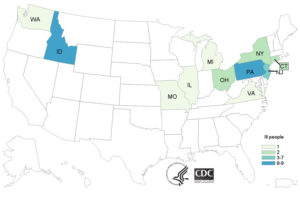 On Friday, according to the CDC, as of April 12, 2018, 35 people infected with the outbreak strain of E. coli O157:H7 have been reported from 11 states. Connecticut 2, Idaho 8, Illinois 1, Michigan 1, Missouri 1, New Jersey 7, New York 2, Ohio 2, Pennsylvania 9, Virginia 1 and Washington 1. Illnesses started on dates ranging from March 22, 2018 to March 31, 2018. Ill people range in age from 12 to 84 years, with a median age of 29. Sixty-nine percent of ill people are female. Twenty-two ill people have been hospitalized, including three people who developed hemolytic uremic syndrome, a type of kidney failure.
 The Arizona Department of Health Services (ADHS) is advising residents to not eat and dispose of store-bought chopped romaine lettuce, including salads and salad mixes containing chopped romaine lettuce. The Centers for Disease Control and Prevention and the Food and Drug Administration indicated a multi-state outbreak of E. coli O157 is likely associated with chopped romaine lettuce from the Yuma, Arizona growing region. Three cases of E. coli in Arizona have been linked to this multistate outbreak.
 Advisory from the
  Rose Acre Farms of Seymour, Indiana is voluntarily recalling 206,749,248 eggs because they have the potential to be contaminated with Salmonella Braenderup, an organism which can cause serious and sometimes fatal infections in young children, frail or elderly people, and others with weakened immune systems. Healthy individuals infected with Salmonella Braenderup can experience fever, diarrhea, nausea, vomiting and abdominal pain. In rare circumstances, infection with Salmonella Braenderup can result in the organism getting into the bloodstream and producing more severe illnesses such as arterial infections (i.e., infected aneurysms), endocarditis and arthritis.
 To put the dispute in context: According to the CDC, a total of 265 people infected with the outbreak strains of
 Fareway Stores, Inc. Statement:
 As of April 12, 2018, 35 people infected with the outbreak strain of E. coli O157:H7 have been reported from 11 states. Connecticut 2, Idaho 8, Illinois 1, Michigan 1, Missouri 1, New Jersey 7, New York 2, Ohio 2, Pennsylvania 9, Virginia 1 and Washington 1. (
 A vaccine for all employees is good for customers and good for business.


 The
The