The Ottawa County Department of Public Health is alerting the public to increasing cases of shiga-toxin producing E. coli (STEC) infections in the community. The Department is currently monitoring 9 cases of STEC, which is significantly higher than the typical number of cases reported at this time of the year. The Department is working with the Michigan Department of Agriculture and Rural Development (MDARD) and the Michigan Department of Health and Human Services (MDHHS) to investigate possible links between the cases. Four of the 9 cases have been hospitalized for their symptoms.

Jan Larson McLaughlin of the BG Independent News reports that the Wood County Health Department has recorded three years’ worth of E. coli cases in the past week.

Health Commissioner Ben Robison reported to the Wood County Board of Health Thursday evening that 15 known cases of E. coli have been identified in the last week. That compares to 27 cases in the last five and a half years in the county, he said.

“We are in the very front stages of an investigation,” Robison said.

Tests are being conducted by the Ohio Department of Health to see if there is a link between the cases. The results are expected back next Tuesday.

Robison cautioned that the 15 known cases are likely just the beginning.

“This number we expect will grow,” he said.

Of the 15 cases reported so far, five people were hospitalized, ranging in age from 21 to 60, Robison said. 

The Wood County Health Department is partnering with other agencies to try and solve the puzzle of the origin of the E. coli. Those partners include the Ohio Department of Health and other county health departments. It could be expanded to the Ohio Department of Agriculture if a link is identified to food products in the early stages of growing or processing.
Understandably, my nearly 350 clients sickened by Daily Harvest French Lentil + Leek Crumbles (and possibly additional products) are frightened and angered by the lack of information about the contaminant in the tara, that according the the FDA, has hospitalized over 100 with symptoms consistent with acute liver failure. Dozens of people have had their gall bladders removed, as well as several with liver biopsies. Hundreds have suffered through over two months of illness with unbearable pain, jaundice, multiple procedures, including extensive blood draws, MRI’s, CT scans – and the list goes on. Because they do not know what has sickened them, they fear the future complications that may or may not appear. Medical bills are now pouring in that risk credit score damage and bankruptcy for some.

And, what did they do – they thought they were eating something healthy.

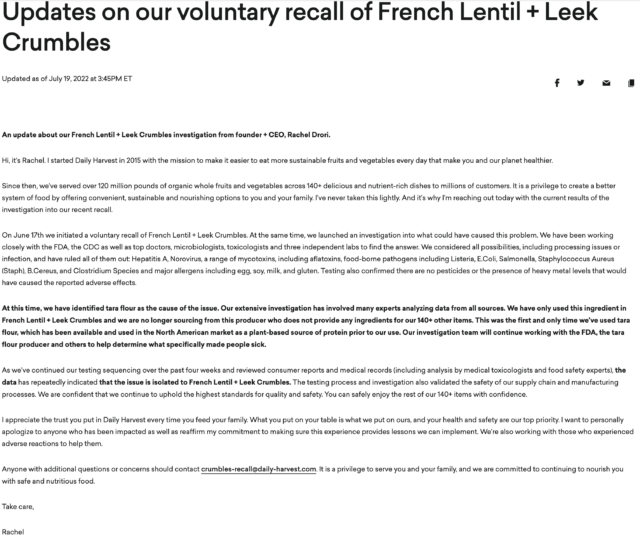
The below is the last official update from Daily Harvest ( nearly 1 month ago) as they now go about their way on other social media sites touting their food safety protocols and marketing additional products. I think customers deserve more.

We have asked privately that Daily Harvest and its manufacturer, Stone Gate, to consider three things – 1) to provide us samples of tara to independently test, 2) to name the tara supply chain so that can be brought into the pending litigation so all responsible parties are in the same Courtroom, and 3) to consider helping victims financially now to avoid making their suffering even worse.

So far – silence. They can delay the above, but eventually the Court will force compliance with each of the three.

In an effort to get to the root cause of the contamination, I have shared with Daily Harvest, Stone Gate AND THE FDA, redacted information about hundreds of peoples’ symptoms and test results. We have also provided all three with product test results in real time.

The goal of all should be to find out what happened and what is causing the suffering and to stop it – isn’t it?

And, Stone Gate has said nothing.

Watch this space and court filings.

At some point in the not too distant future through the process of litigation, Daily Harvest, Stone Gate and Revive will be forced to both tell me the source of the Tara (and why they used it) and to provide samples to test. It does beg the question as to why they will not willingly provide the information and the samples now?

Through a private lab, we have been testing dozens of French Lentil + Leek Crumbles and Pineapple and Mango Smoothie samples – as has the FDA and presumably Daily Harvest and Revive. To date, we have not determined what in the Tara is causing all the illnesses. The hunt continues.

For those who have been following my blog the last two months, there is little surprise that Tara is the link to some or all the illnesses from Daily Harvest French Lentil + Leek Crumbles (and possibly other Daily Harvest products) and Revive smoothies – specifically, the Pineapple and Mango (which is not longer for sale).

To date we have been retained by over 350 acute liver failure survivors (some 30 left without a gallbladder) of Daily Harvest Crumbles (containing Tara), and we are investigating nearly another 30 Daily Harvest illnesses linked to other products. We have also been retained by nearly 30 people sickened by Revive Pineapple and Mango smoothies that also contained Tara.

Much more to be uncovered. I feel a field trip to Peru?

Early morning in wonderful Machu Picchu

Last week we filed two lawsuits against Revive (a Canadian company) in New York Federal Court. We have filed three lawsuits against Daily Harvest – one on behalf of a woman who lost her gallbladder and on behalf of two minor children – one an infant and one an 11-year-old.

Three lawsuits (two in New York Federal Court and one in New York State Court) have been filed against Daily Harvest and the company that manufactured the French Lentil + Leek Crumbles, Second Bite Foods d.b.a, Stone Gate Foods, that have been linked to nearly 300 cases of acute liver failure.

The first lawsuit filed by a Tulsa woman that purchased the Daily Harvest product on May 3 and consumed it on May 7. Later the same day, she began experiencing abdominal pain and gastrointestinal discomfort. She also suffered from right shoulder pain. The next day, she experienced more significant pain accompanied by nausea and headache. On May 9 her husband took her to the emergency room at St. John’s Ascension Medical Center.

At the Medical Center, she received pain medicine and had blood and urine tests along with ultrasound and CT scans. She was discharged with advice to pursue a bland diet. She again purchased the “French Lentil + Leek Crumbles.” from Defendant on May 17 and had them for lunch on May 28. By 7 a.m. the next day, she was again experiencing abdominal and shoulder pain. The pain was so severe by the next that she again required hospitalization.

Her hospitalization lasted four days, and it found that she was experiencing liver and gallbladder dysfunction. After consulting with her primary care doctor, she underwent surgery to have her gallbladder removed on June 24, 2022.

We did voluntarily dismiss this lawsuit to avoid – for now – an unnecessary fight over Daily Harvest’s “Terms of Service” where it is trying to force its customers to arbitrate vs litigate. More on this in the coming weeks.

The second lawsuit was filed on behalf of a 4-month-old baby and her mother became ill and were hospitalized after the mother ate the lentil-based product at the end of May and beginning of June, according to a lawsuit filed in the Supreme Court of the State of New York, County of New York. Beginning May 25, the infant experienced vomiting, diarrhea, screaming and dark urine after her mother consumed the product and breastfed her, the lawsuit said. 

After consuming the product again in June, the baby’s mother was hospitalized with extreme abdominal pain and gastrointestinal distress from June 8 to 15, the suit said. At the time, the infant also began having symptoms including fever, vomiting and gastrointestinal distress, the suit said, adding the mother continued to breastfeed during her hospitalization on the advice of her doctors, who did not know the cause of her illness.

The infant was seen by a physician on June 24, where tests showed high liver enzymes and she was hospitalized on June 25 before being released the next day with ongoing testing and monitoring from experts, the lawsuit said. 

In a third lawsuit filed this week on behalf of a child, a father alleges his daughter became ill with symptoms including abdominal pain and elevated thyroid and liver enzyme levels. The lawsuit said a gastrointestinal and liver specialist told the girl the elevated liver enzymes could indicate a “potential lifelong, life-threatening illness” and that she could no longer participate in her soccer, the girl’s passion, because “an inflamed liver could lacerate while playing and be fatal.” The child’s liver function is being monitored, according to the lawsuit, which was filed in federal court for the Southern District of New York.

Complaints:

https://www.foodpoisonjournal.com/files/2022/07/155840_2022_John_Looby_v_Daily_Harvest_Inc_et_al_COMPLAINT__AMENDED__2.pdf

https://www.foodpoisonjournal.com/files/2022/07/First-Amended-Complaint-filed-07152022-2.pdf

https://www.foodpoisonjournal.com/files/2022/07/Ltr-motion-to-file-2nd-Am-Comp-07152022.pdf

As I said the other day, for nearly a month we have known about the likely link between Revive Mango & Pineapple smoothies and an ingredient known as Tara. To date, in addition to the over 350 Daily Harvest cases (also with an ingredient known as Tara), we are representing over 30 people that have suffered acute liver failure linked to the Mango & Pineapple smoothies.  We are testing a variety of Daily Harvest and Revive products and have shared the results with both the FDA and Daily Harvest.

Monday we filed two lawsuits against Revive (a Canadian company) in New York Federal Court. We have filed three lawsuits against Daily Harvest – one on behalf of a woman who lost her gallbladder and on behalf of two minor children – one an infant and one an 11-year-old.

On Monday I posted that I had just gotten off the phone with a Revive Mango & Pineapple smoothie customer who had her gallbladder removed the day before and learned about the link between her illness and the product by Yahoo News. I then had the identical call with another woman two days ago. She was about to have another smoothie as she recovered at home after having her gallbladder removed the day before when she read an article in the Washington Post about the growing outbreak.  

And guess what, another conversation this morning with a young woman who ate the Revive Mango & Pineapple smoothie in mid-July and is now suffering acute liver failure.  Someone sent her one of the above articles and she called me somewhat relived that she was not going to die from liver cancer.

As I said before, to date, Revive has NOT recalled the product – which may well be frozen in customer’s freezers.  Not recalling a product that is clearly sickening your customers is both legally and morally suspect. 

The number of reported cases of domestically acquired cyclosporiasis illnesses has increased by 323 cases since the last update on June 30, 2022. Cases continue to be reported.

As of July 26, 2022, 384 laboratory-confirmed cases of cyclosporiasis in people who had no history of international travel during the 14-day period before illness onset have been reported to CDC by 23 jurisdictions, including 22 states and New York City, since May 1, 2022.

The median illness onset date is June 20, 2022 (range: May 3, 2022–July 18, 2022).

At least 30 people have been hospitalized; 0 deaths have been reported.

The FDA is investigating a new outbreak of dozens of infections caused by the Cyclospora parasite.

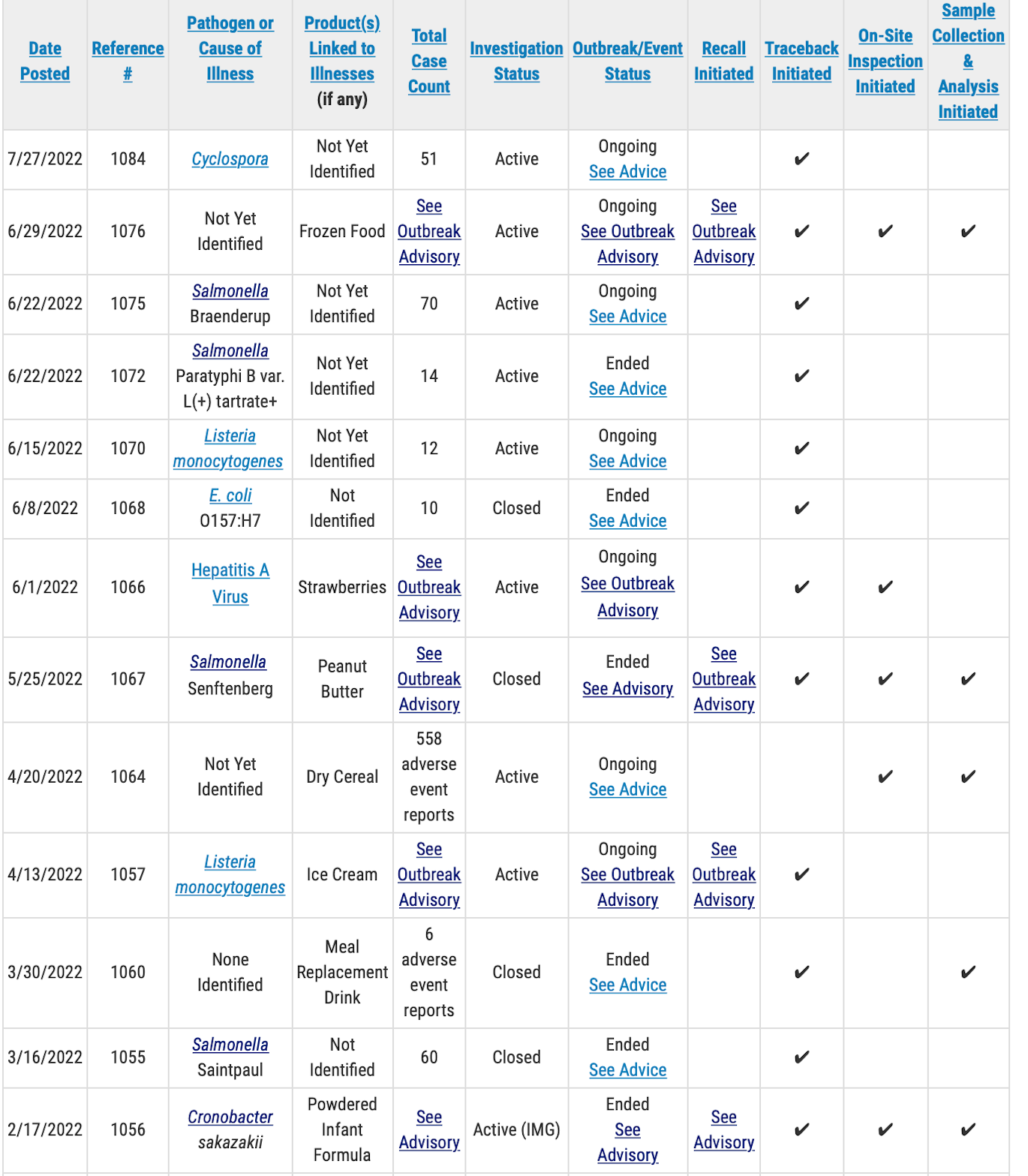
Little information has been released, but the Food and Drug Administration is reporting that 51 people have been confirmed infected. The agency has not released any specific information about the patients such as their ages or where they live.

The FDA’s outbreak information indicated that a traceback investigation has begun, but it has not reported what food or foods are being traced. The agency has not initiated any on-site inspections or testing. 

In another outbreak for which the cause remains undetermined, the FDA reports that the Salmonella Paratyphi B var. L(+) tartrate+ source has not been found. The outbreak status is listed as ended with 14 people having been confirmed infected. The FDA’s investigation in ongoing and traceback efforts are under way for unspecified food or foods.

There are seven other FDA outbreak investigations underway as of July 27. They include:

  • An investigation related to adverse effects associated with Daily Harvest brand frozen Leeks & Lentils Crumbles. The company has received more than 470 complaints of illnesses and as of July 14 the FDA had received 277 complaints. Some of the patients have gone into liver failure and at least 25 have had to have their gallbladders removed. The FDA is working on traceback efforts, has begun on-site inspection and product testing.
  • An outbreak of Salmonella Braenderup infections in 70 confirmed patients. The cause is unknown but the FDA has begun traceback efforts. The agency has not revealed what food or foods are being traced.
  • An outbreak of Listeria monocytogenes infections that has sickened 12 people. The FDA has initiated traceback efforts but has not yet reported what food or foods are being traced.
  • An outbreak of hepatitis A infections traced to fresh strawberries that has sickened at least 19 people with 13 having been hospitalized. These potentially contaminated strawberries were imported from Baja California, a state in northern Mexico, and branded as FreshKampo and HEB and distributed nationwide. The FDA and the Centers for Disease Control and Prevention continue to investigate the outbreak. There have also been reports of sick people in Canada.
  • An outbreak of “adverse events” involving 558 patients who ate Lucky Charms cereal. The investigation is ongoing and the FDA is conducting on-site inspections and testing.
  • An outbreak of infections from Listeria monocytogenes traced to Big Olaf ice cream produced in Florida. A total of 23 confirmed patients have been reported with one death and one fetal loss. The patients are spread across 10 states and many of the sick people reported travel to Florida before becoming ill. Testing has shown Listeria in the manufacturing plant and in 16 of 17 flavors of Big Olaf ice cream. The company has been closed down by the state until further notice.
  • An outbreak of infections from Cronobacter in four infants, one of whom died. The outbreak has been determined to be over by the CDC, but is it still under investigation. The babies consumed infant formula made by Abbott Nutrition’s plant in Sturgis, MI. 
Click on chart to enlarge. Use link at bottom to go to the FDA page with links to specific outbreak information.

Peanut Butter:

As of July 27, 2022, a total of 21 people infected with the outbreak strain of Salmonella Senftenberg were reported from 17 states. Illnesses started on dates ranging from February 20, 2022, through May 24, 2022.

Sick people ranged in age from less than one to 85 years, with a median age of 59, and 75% were female. Of 13 people with information available, 4 were hospitalized. No deaths were reported.

State and local public health officials interviewed people about the foods they ate in the week before they got sick. Of the 13 people interviewed, 13 (100%) reported eating peanut butter in the week before they got sick. This percentage was significantly higher than results from a survey of healthy people, in which 57% of respondents reported eating any peanut butter in the week before they were interviewed. This suggests that people in this outbreak got sick from eating peanut butter. All 13 people reported eating Jif brand peanut butter specifically.

Public health investigators used the PulseNet system to identify illnesses that were part of this outbreak. CDC PulseNet manages a national database of DNA fingerprints of bacteria that cause foodborne illnesses. DNA fingerprinting is performed on bacteria using a method called whole genome sequencing (WGS). WGS showed that bacteria from sick people’s samples were closely related genetically. This means that people in this outbreak likely got sick from the same food.

FDA conducted WGS analysis on an environmental sample collected at the Lexington, Kentucky, J.M. Smucker Company facility in 2010. The analysis shows that this 2010 environmental sample was closely related genetically to the outbreak strain.

On May 20, 2022, J.M. Smucker Company recalled multiple Jif brand peanut butter types made at the Lexington, Kentucky, facility. Additional companies recalled foods made with Jif brand peanut butter.

As of August 2, 2022, a total of 18 outbreak-associated cases of hepatitis A have been reported from 3 states.

Strawberries:

Illnesses started on dates ranging from March 28, 2022, to May 6, 2022. Ill people range in age from 9 to 73 years, with a median age of 57.5 years. Sixty-seven percent of ill people are female. Of 18 people with available information, 13 (72%) have been hospitalized. No deaths have been reported.

In total, there were 10 laboratory-confirmed cases of hepatitis A illness reported in two provinces: Alberta (4) and Saskatchewan (6). Individuals became ill between early and mid-April 2022. Individuals who became ill were between 10 to 75 years of age. Four individuals were hospitalized. No deaths were reported.

The CFIA conducted a food safety investigation into the FreshKampo brand fresh organic strawberries purchased between March 5 and 9, 2022 at Co-op stores in Alberta and Saskatchewan. There were no food recall warnings associated with this outbreak.

Epidemiologic and traceback evidence indicate that fresh organic strawberries, imported from Baja California, Mexico, are the likely source of this outbreak. The potentially affected FreshKampo and HEB products are past shelf life and no longer available for purchase in the United States. People who purchased FreshKampo or HEB fresh organic strawberries during March 5, 2022, through April 15, 2022, and then froze those strawberries for later consumption should not eat them. These products may have been sold at the following retailers, including, but not limited to: HEB, Kroger, Safeway, Sprouts Farmers Market, Trader Joe’s, Walmart, Weis Markets, and WinCo Foods.

The downstream recall previously reported (Urban Remedy Organic Revitalizing Tea Tonic Strawberry Hibiscus Rose) is now considered a market withdrawal. It has been determined that the product was not made using implicated strawberries.

In interviews, ill people answered questions about the foods they ate and other exposures in the 2 to 7 weeks before they became ill. Of people who were interviewed, 11/15 (73%) reported eating fresh organic strawberries. This proportion was significantly higher than results from a survey of healthy people in which 50% reported eating fresh strawberries in the week before they were interviewed.

Outbreak update:

Total Illnesses: 25

Hospitalizations: 24

Deaths: 1

Fetal Loss: 1

States with Cases: Colorado (1), Florida (13), Georgia (1), Illinois (1), Kansas (1), Nebraska (1), Massachusetts  (2), Minnesota (1), New Jersey (1), New York (2), and Pennsylvania (1).

Product Distribution: FL, OH Distribution has been confirmed for states listed, but product could have been distributed further, reaching additional states.

The CDC and FDA report since the last update on July 13, 2022, two more illnesses have been reported. As of August 2, 2022, a total of 25 people infected with the outbreak strain of Listeria monocytogenes have been reported from 11 states. Thirteen sick people are residents of Florida and ten reported traveling to Florida before getting sick. Illnesses started on dates ranging from January 24, 2021, to June 24, 2022.

Sick people range in age from less than one to 92 years, with a median age of 72, and 56% are male. Of 25 people with information available, 24 have been hospitalized. One death in a person who was not pregnant has been reported from Illinois. Five people got sick during their pregnancy, and one person’s illness resulted in a fetal loss.

The true number of sick people in an outbreak is likely higher than the number reported, and the outbreak may not be limited to the states with known illnesses. This is because some people recover without medical care and are not tested for Listeria. In addition, recent illnesses may not yet be reported as it usually takes 3 to 4 weeks to determine if a sick person is part of an outbreak.

Public health officials continue to interview people about the foods they ate before they got sick. Of the 21 people interviewed, all (100%) reported eating ice cream. Among 17 people who remembered details about the type of ice cream they ate, 12 reported eating Big Olaf Creamery brand ice cream or eating ice cream at locations that might have been supplied by Big Olaf Creamery. Eight sick people were identified as part of three illness clusters in this outbreak. An illness cluster is defined as two or more people who do not live in the same household who report eating food from the same retail location before getting sick. If several unrelated sick people ate food from the same retail location, it suggests that the contaminated food item was served or sold there. All three illness clusters were at retail locations that sell Big Olaf Creamery ice cream.

The Florida Department of Agriculture and Consumer Services (FDACS) collected samples of ice cream and environmental samples from the ice cream production area at the Big Olaf Creamery facility in Sarasota, Florida. FDACS also performed whole genome sequencing on these samples and the Florida Department of Health identified the outbreak strain in the samples collected from the ice cream and the environment.

This Listeria outbreak is a mess. Illnesses began in January 2021 and are likely to be continuing. Listeria has been found on equipment in the ice cream processing facility and in 16 of 17 flavors. Big Olaf first refused to recognize that it was the cause of the outbreak and refused to stop production and stop ice cream sales. According to the Florida Department of Agriculture and Consumer Services (FDACS):

“The results from product sampling taken from the Big Olaf production facility last week by FDACS found that 16 of the 17 flavors tested were positive for Listeria monocytogenes (L. mono). This includes Blueberry Cheesecake, Butter Pecan, Cherry Cordial, Chocolate, Chocolate Chip, Coconut, Coconut Almond Joy, Cookie Dough, Cookies & Cream, Kahlua Krunch, Mint Chip, Pistachio, Plantation Praline, Superman, Vanilla, and White Chocolate Raspberry. With these results, FDACS is currently issuing formal stop sales on the 16 products where L. mono was found, which were previously part of a voluntary recall. Our department continues to work closely with our state and federal partners on this investigation and enforcement of the stop sale.”

Please find linked here [dropbox.com] the results for the product samples that represent the 16 positive flavors. The one outstanding environmental sample [dropbox.com] noted previously has also come back positive, bringing the total positive environmental samples to 10, and I’m linking here [dropbox.com] to those results.

Listeria:  Marler Clark, The Food Safety Law Firm, is the nation’s leading law firm representing victims of Listeriaoutbreaks. The Listeria lawyers of Marler Clark have represented thousands of victims of Listeria and other foodborne illness outbreaks and have recovered over $800 million for clients.  Marler Clark is the only law firm in the nation with a practice focused exclusively on foodborne illness litigation.  Our Listeria lawyers have litigated Listeria cases stemming from outbreaks traced to a variety of foods, such as lettuce, polony, deli meat, cantaloupe, cheese, celery and milk.   

If you or a family member became ill with a Listeria infection after consuming food and you’re interested in pursuing a legal claim, contact the Marler Clark Listeria attorneys for a free case evaluation.

Update on May 4, 2022 on the grouped cases of hemolytic uremic syndrome and E. coli infections producing shiga-toxin and the consumption of frozen pizzas from the Nestlé Fraîch’Up range of the Buitoni® brand. Note – only a bout 5 to 10 percent of those diagnosed with E. coli infections develop a potentially life-threatening kidney failure complication, known as a hemolytic uremic syndrome (HUS). So, the number of actually sickened is significantly higher. Jack in the Box accounted for 732 sick, 178 seriously with four deaths.

Public Health France and the National Reference Center (CNR) E. coli and its associated laboratory (Institut Pasteur, Paris, and Microbiology Laboratory of the Robert Debré Hospital, Paris), in conjunction with the Directorate General for Food, the Directorate General for Competition, Consumer Affairs and Fraud Prevention, and in coordination with the Directorate General for Health, have been investigating since 02/10/2022 an increase in the number of cases of haemolytic uremic syndrome (HUS) pediatric infections and Shiga toxin-producing Escherichia coli (STEC) infections.

The epidemiological, microbiological and traceability investigations carried out since that date have confirmed a link between the occurrence of these grouped cases and the consumption of frozen pizzas from the Buitoni brand Fraîch’Up range contaminated with STEC bacteria. On 03/18/2022, the company proceeded with the withdrawal-recall of all the pizzas in the Fraîch’Up range, marketed since June 2021 and the authorities asked the people who hold these pizzas not to consume them and to destroy them.

The total number of HUS cases linked to the consumption of these pizzas has stabilized since the withdrawal-recall. Other reports of STEC infection are investigated as part of routine surveillance. To date, these reports are not linked to grouped cases or consumption of Fraîch’Up pizzas.

Case of SHU in France: update on 04/05/22

As of 04/05/2022, 56 confirmed cases have been identified, of which 54 are linked to STEC O26 strains, and 2 to STEC O103 strains.

These 56 cases occurred in 55 children and 1 adult, who presented symptoms between 18/01/2022 (week 3) and 05/04/2022 (week 14) (Figure 1). The epidemic peak is in week 7 (14/02 to 20/02) and week 9 (28/02 to 06/03), with 10 cases each of these weeks.

These 56 cases occurred in 12 regions of metropolitan France: Hauts-de-France (12 cases), Ile-de-France (9 cases), New Aquitaine (8 cases), Pays de la Loire (7 cases), Brittany ( 6 cases), Grand Est (3 cases), Provence-Alpes-Côte d’Azur (3 cases), Auvergne-Rhône-Alpes (2 cases), Occitanie (2 cases), Center Val-de-Loire (2 cases) , Bourgogne Franche-Comté (1 case) and Normandy (1 case) (Figure 2).

The 55 sick children are aged from 1 to 17 years with a median age of 6 years; 25 (45%) are female; 48 (87%) presented with HUS, 7 (13%) with STEC gastroenteritis. Two children died. The adult did not present with HUS.

Figure 1: Epidemic curve: number of confirmed cases of HUS and STEC infections, by week of onset of symptoms – metropolitan France, weeks 3 to 14, 2022 (N=54: week of onset of symptoms not specified for 2 cases )

Figure 2: Geographical distribution of confirmed cases of HUS and STEC infections (N=56) linked to the consumption of Buitoni® brand Fraîch’Up pizzas, by region of residence in metropolitan France, weeks 3 to 14, 2022

The epidemiological, microbiological and traceability investigations carried out since that date have confirmed a link between the occurrence of these grouped cases and the consumption of frozen pizzas from the Buitoni brand Fraîch’Up range contaminated with STEC bacteria.

The total number of cases of HUS linked to the consumption of these pizzas seems to have stabilized since the withdrawal-recall.

French prosecutors have searched a Buitoni frozen pizza factory in northern France, the suspected source of an E. coli outbreak, as well as the headquarters of its owner Nestle France.

An investigation into involuntary manslaughter and deceitful practices was opened on 1 April.

The search at the Caudry factory operated by Buitoni, which is owned by the Swiss food conglomerate Nestle, was confirmed by a police source and the Paris prosecutor’s office, which is leading the investigation.

Nestle France, whose headquarters outside Paris were also raided, announced a recall of the affected Fraich’UP pizzas on March 18, and authorities ordered a halt of their production at Caudry after carrying out two hygiene inspections. The inspections “revealed a deterioration of food hygiene controls”, the presence of “rodents” and “insufficient measures to prevent pests from contaminating a food production site.”

Marler Clark, The Food Safety Law Firm, is the nation’s leading law firm representing victims of E. coli outbreaks and hemolytic uremic syndrome (HUS). The E. coli lawyers of Marler Clark have represented thousands of victims of E. coli and other foodborne illness infections and have recovered over $800 million for clients. Marler Clark is the only law firm in the nation with a practice focused exclusively on foodborne illness litigation.  Our E. coli lawyers have litigated E. coli and HUS cases stemming from outbreaks traced to ground beef, raw milk, lettuce, spinach, sprouts, and other food products.  The law firm has brought E. coli lawsuits against such companies as Jack in the Box, Dole, ConAgra, Cargill, and Jimmy John’s.  We have proudly represented such victims as Brianne KinerStephanie Smith and Linda Rivera.

If you or a family member became ill with an E. coli infection or HUS after consuming food and you’re interested in pursuing a legal claim, contact the Marler Clark E. coli attorneys for a free case evaluation.

Additional Resources:

The U.S. Department of Agriculture’s (USDA) Food Safety and Inspection Service (FSIS) is announcing that it will be declaring Salmonella an adulterant in breaded and stuffed raw chicken products.

“Food safety is at the heart of everything FSIS does,” said Agriculture Secretary Tom Vilsack. “That mission will guide us as this important first step launches a broader initiative to reduce Salmonellaillnesses associated with poultry in the U.S.”

“Today’s announcement is an important moment in U.S. food safety because we are declaring Salmonella an adulterant in a raw poultry product,” said Sandra Eskin, USDA Deputy Under Secretary for Food Safety. “This is just the beginning of our efforts to improve public health.”

By declaring Salmonella an adulterant in these products, FSIS will be able to ensure that highly contaminated products that could make people sick are not sold to consumers. Since 1998, breaded and stuffed raw chicken products have been associated with up to 14 outbreaks and approximately 200 illnesses. Products in this category are found in the freezer section and include some chicken cordon bleu or chicken Kiev products. These products appear cooked, but they are heat-treated only to set the batter or breading and the product contains raw poultry. Continual efforts to improve the product labeling have not been effective at reducing consumer illnesses.

Breaded and stuffed raw chicken products will be considered adulterated when they exceed a very low level of Salmonella contamination and would be subject to regulatory action. FSIS will be proposing to set the limit at 1 colony forming unit (CFU) of Salmonella per gram for these products, a level that the agency believes will significantly reduce the risk of illness from consuming these products. The agency will also seek comment on whether a different standard for adulteration – such as zero tolerance or one based on specific serotypes – would be more appropriate.

The notice is expected to publish in the Federal Register in the fall and FSIS will be seeking public comments that address what the standard should be as well as to inform a final implementation plan, including a verification testing program. Once published, the notice will be posted in FSIS’ Federal Register & Rulemaking page for review and comment. When the proposal is finalized, FSIS will announce its final implementation plans and the date it will begin routine testing for Salmonella in these products.

This action is part of FSIS’ broader efforts to reduce Salmonella illnesses associated with poultry. In October 2021, USDA announced it was reevaluating its strategy for controlling Salmonella in poultry, including whether Salmonella should be considered an adulterant in specific raw poultry products. Since launching this effort, USDA has been focusing on gathering information by meeting with stakeholders to hear their ideas, asking for recommendations from food safety experts, and soliciting ideas for pilot projects from industry to test drive different control strategies in poultry establishments. USDA plans to present a proposed framework for a new comprehensive strategy to reduce Salmonella illnesses attributable to poultry in October and convene a public meeting to discuss it in November.

As I said in a post a few months ago, calling the obvious the obvious is not a bad thing.

If Salmonella is deemed an adulterant – at least those that sicken and kill us – the sky will not fall – history as a guide.

On Jan. 19, 2020, we filed a petition with USDA’s Food Safety and Inspection Service (FSIS), on behalf of Rick Schiller, Steven Romes, the Porter family, Food & Water Watch, Consumer Federation of America, and Consumer Reports. 20-01-marler-011920 The petition asked FSIS to declare the following Salmonella “outbreak serotypes” as per se contaminants (adulterants) in meat and poultry products:

Salmonella Agona, Anatum, Berta, Blockely, Braenderup, Derby, Dublin, Enteritidis, Hadar, Heidelberg, I 4,[5],12:i:-, Infantis, Javiana, Litchfield, Mbandaka, Mississippi, Montevideo, Muenchen, Newport, Oranienburg, Panama, Poona, Reading, Saintpaul, Sandiego, Schwarzengrund, Senftenberg, Stanley, Thompson, Typhi, and Typhimurium.

I said at the time, reducing salmonellosis from meat and poultry “demands bold action” beyond that yet taken by FSIS. Salmonella is a leading cause of foodborne illness in the United States, causing 1.35 million illnesses, 26,500 hospitalizations, 130 outbreaks, and 420 deaths each year.

Presently, government regulators are somewhat silent with what they intend to do.  The poultry industry, as expected, sees any additional regulation as unnecessary, burdensome and costly.

This is nothing new.   Here is a historical piece written by Helena Bottemiller, then at Food Safety News:

It was Sept. 29, 1994. Mike Taylor took the podium in San Francisco at the American Meat Institute’s annual convention to make his first, and most significant, speechas the top food safety official at the U.S. Department of Agriculture.

“I am here to talk about change,” began Taylor, who had just become administrator for the USDA’s Food Safety Inspection Service, as he looked out over his all-industry audience. “Change in what the public expects when it comes to food safety, change in how we at the Food Safety and Inspection Service (FSIS) are approaching our job, and change in the demands being placed on all those who produce, process and market meat and poultry for American consumers.”

Taylor explained his belief that the meat industry had an opportunity to move beyond the politics of food safety and find real solutions on the heels of the massive E. coli O157:H7 outbreak in the Pacific Northwest.

“You know from your daily experience that improving food safety serves us all.”

And then, Taylor uttered a few lines the industry may not have wanted to hear:

“In one critical respect, our inspection program at FSIS does not currently meet the public expectation. There is a gap in our system…”

“The fact is we do not deal directly enough and scientifically enough with the microbial pathogens that can make people sick,” he continued, before outlining some sweeping public health goals. And then he got very specific.

“To clarify an important legal point, we consider raw ground beef that is contaminated with E. coli O157:H7 to be adulterated within the meaning of the Federal Meat Inspection Act,” he added, explaining that he wanted to make USDA’s E. coli policy “crystal clear.”

“We are prepared to use the Act’s enforcement tools, as necessary, to exclude adulterated products from commerce.”

In September 2011, FSIS banned the “the Big Six” as reported by Helena Bottemiller, still then at Food Safety News:

Six dangerous strains of E. coli — dubbed “the Big Six” — will soon be banned from the beef supply, U.S. Department of Agriculture officials said Monday.

“This is one of the biggest steps forward in the protection of the beef supply in some time,” Under Secretary for Food Safety at USDA, Dr. Elisabeth Hagen, told the New York Times. “We’re doing this to prevent illness and to save lives.”

The proposal, which will be outlined in more detail by top USDA officials Tuesday morning, will declare six additional strains of Shiga toxin-producing E. coli (STECs), beyond well-known E. coli O157:H7, as adulterants in beef, making product contaminated with these pathogens illegal to sell in commerce. USDA’s Food Safety and Inspection Service will soon test ground beef, beef trim that goes into ground beef, and machine-tenderized steaks for these pathogens.

E. coli O157:H7 has been illegal in beef products since 1994, a policy that was put in place in response to the historic outbreak that sickened hundreds and killed four children in the Pacific Northwest. The new policy, which will extend to E coli O26, O45, O103, O111, O121, and O145, is expected to kick in in March.

The meat industry did not react warmly to the announcement, while consumer groups unanimously praised the move.

“USDA’s announcement today that it will soon be ‘illegal’ to have six strains of naturally occurring non-O157 E. coli in ground beef is premised upon the notion that the government can make products safe by banning a pathogen,” said James H. Hodges, executive vice president of the American Meat Institute, the group representing the vast majority of the meat industry. “That view is not supported by science.”

AMI believes the interventions currently used to eliminate E. coli O157:H7 will work for the non-O157 strains and slammed USDA for adding costs that it said will eventually be passed along to consumers.

 “USDA will spend millions of dollars testing for these strains instead of using those limited resources toward preventive strategies that are far more effective in ensuring food safety,” added Hodges, in a statement to reporters. “Imposing this new regulatory program on ground beef will cost tens of millions of federal and industry dollars – costs that likely will be borne by taxpayers and consumers.  It is neither likely to yield a significant public health benefit nor is it good public policy.”

Food safety advocates, many of whom have been lobbying USDA to take action on non-O157 E. coli strains for years, lauded the announcement and argued that the policy may well help the meat industry by preventing costly recalls.

“This is a huge step,” said Dr. Barbara Kowalcyk, CEO of the Center for Food Borne Illness Research and Prevention, who became a tireless advocate after her son lost his life from an E.coli O157:H7-contaminated hamburger. “We think this is going to have a significant impact on public health — fewer recalls, fewer illnesses, fewer deaths.”

Kowalcyk believes the policy is actually a bargain, when you weigh the costs and benefits. USDA estimates that the new rule could cost the meat industry as much as $10 million annually, not just for testing but also for cooking meat that tests positive before it hits store shelves.

“The average cost of a recall is $4-5 million plus the loss in consumer confidence,” added Kowalyck. “Preventing just two recalls could make up for the cost. And that’s not even taking into account the human costs.”

According to the Centers for Disease Control and Prevention, the six strains addressed under the new regulation cause approximately 113,000 illnesses and 300 hospitalizations annually in the United States.

Nancy Donley, co-founder of STOP Foodborne Illness, whose son died in 1993 from an E. coli O157:H7 infection, was also very pleased with the announcement.

“All of us at STOP Foodborne Illness are absolutely thrilled to have the big six declared adulterants,” said Donley in an email. “It’s something that we have been advocating for years now.  We’re pleased to see the USDA act progressively in putting forward an initiative that should greatly enhance public health and safety rather than waiting for another major foodborne illness outbreak to spur them to action.”

USDA’s announcement comes two years after Bill Marler, managing partner at Marler Clark, the nation’s leading food safety law firm (and publisher of Food Safety News), petitioned the department to declare all non-O157 STECs as adulterants. Petition(with Attachments)

“I’m really pleased,” said Marler. “This is going to go a long way towards making our food supply safer.”
 
Congresswoman Rosa DeLauro (D-CT), a staunch supporter of tougher food safety laws, echoed the praise, saying she was “thrilled” by the decision.
 
“It is a critical step forward in bettering our food safety system,” said DeLauro in a statement. “When a similar action was taken on E. coli O157:H7, its prevalence decreased by nearly fourfold, and I hope to see a similar result with these six strains. I applaud this new rule, and hope to continue enhancing the USDA’s ability to protect American consumers from unsafe food.”

If Salmonella is deemed an adulterant – at least those that sicken and kill us – the sky will not fall – history as a guide.

From the Jack in the Box E. coli outbreak in 1993 to the ConAgra E. coli outbreak in 2002, about 90% of my law firm revenue was E. coli O157:H7 cases linked to hamburger.  Deeming E. coli O157:H7 an adulterant did not change things overnight, but the government, industry and consumers over that decade worked hard to “Put me out of Business, Please.”

Today, and for the last 20 years, E. coli cases – O157 and/or “the Big Six”- linked to hamburger has been a small and diminishing factor in my practice.  It works – ask my accountant.