The above picture is the Marler Clark office on Bainbridge Island (opened during the pandemic to get me out of the house). We still have our Seattle office, but since March 2020, Marler Clark has gone virtual. We now have staff and attorneys spread out in several states. We are not missing a beat.

I am so thankful for all the lawyers and staff at Marler Clark and the writers at Food Safety News. I am honored and humbled by the tens of thousands of clients who put their trust in us over the last 30 years.

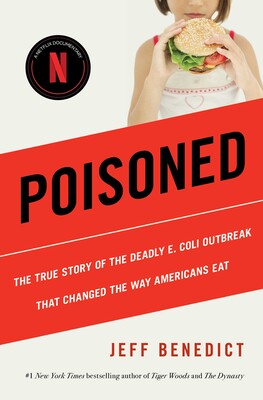
I am looking forward to the re-release of the book “Poisoned” and the Netflix documentary coming out in January. I am hopeful that it has an impact. However, watching the below Frontline Documentary from 2015 make me realize how much time it take to accomplish food safety and how much more we have to do.

I am thankful for all of those that work towards moving the food safety needle in the right direction, regardless of how small and how long it takes.

Cheers to all.

With Netflix’s adaptation of the book “Poisoned” coming soon, I poked around on the “inner tubes” to find a bit more documentary video.

Here is one we did for the Marler Clark website.

An E. coli Outbreak at Wendy’s.

An E. coli Outbreak at Odwalla and a bit of history from Jack in the Box.

A Salmonella Outbreak linked to Peanut Butter.

The Trouble with Chicken – Salmonella.

I need to poke around a bit more.

You can find a number of videos here – https://www.youtube.com/@marlerclark/videos

And, here – https://vimeo.com/user10145854

Honestly, when it come to Salmonella in poultry, little has changed since Frontline did this groundbreaking documentary nearly 10 years ago. Although the focus was on chicken, the same issues surround turkey too.

Here is an interesting piece that puts the dangers of the holiday in perspective.

Volume 28, Number 1—January 2022
Dispatch
Salmonella Serotypes Associated with Illnesses after Thanksgiving Holiday, United States, 1998–2018

Here is the CDC’s conclusion:

Salmonella Reading was the serotype most strongly associated with illness during the Thanksgiving holiday. Given the dramatic increase in turkey consumption around Thanksgiving, one might expect that serotypes we identified are primarily associated with turkey consumption, and indeed, Reading caused a multistate outbreak with a raw turkey source during 2017–2019, and a new clone of this serotype has emerged since 2014 in commercial turkey production. Other serotypes significantly associated with Thanksgiving in our study (i.e., Hadar, Schwarzengrund, and Heidelberg) have also been associated with turkey.

Other significantly associated serotypes are not among those most commonly identified in turkey (e.g., Heidelberg and 4,[5],12:i- are more commonly identified in chicken; Derby, Brandenburg, and 4,[5],12:i- in swine and pork; and 4,[5],12:i- in cattle). However, all these serotypes have been found in turkeys and in retail samples of turkey or have been associated with outbreaks attributed to turkey. Some of the serotypes significantly increased after Thanksgiving, such as, Baildon and Ohio, were rare, causing <200 illnesses annually, and were not reported among food animals, retail products, or outbreaks during 2015‒2020. Although our study may have identified serotypes associated with other foods eaten during the Thanksgiving holiday, particular attention probably should be paid to evidence of these serotypes emerging in turkey production.

So, again, why is Salmonella NOT an adulterant?

With Listeria outbreaks being reported across the United States linked to Deli Meat , Cheeses and Mushrooms, it is a good idea to remember how deadly this pathogen is.

Listeria is a bacterium that causes a serious infection called listeriosis. Around 300 deaths in the United States are caused by Listeria infection each year, according to estimates from a 2011 CDC report. 

Listeria bacteria are most found in raw foods. Vegetables can be contaminated by soil and water carrying bacteria. Listeria is also found in raw animal products, such as meat and cheese. 

Babies can be born with Listeria if the mother eats contaminated food during pregnancy. The death rate among newborns with Listeria is 25 to 50 percent. 

Who is most likely to get seriously ill from Listeria bacteria?

Healthy adults and children hardly ever become seriously ill from Listeria. However, people at increased risk of illness from Listeria bacteria include:

  • Pregnant women – Pregnant women are 20 times more likely to get listeriosis than the average healthy adult
  • Newborns
  • People with weak immune systems
  • People with cancer, diabetes, or kidney disease
  • People with AIDS – People with AIDS are 300 times more likely to get sick from Listeria than people with normal immune systems
  • People who take gluticocorticosteroids, such as cortisone
  • Elderly people

Symptoms of Listeria

Listeria symptoms appear anywhere between 3 and 70 days after infection, but usually around 21 days later. Typical symptoms include:

  • Fever
  • Muscle aches
  • Nausea or diarrhea (less common)

If infection spreads to the central nervous system, symptoms can include:

  • Headache
  • Stiff neck
  • Confusion
  • Loss of balance
  • Convulsions

Symptoms for those with Weakened Immune Systems

If a patient has a weak immune system, Listeria bacteria can invade the central nervous system and cause meningitis or a brain infection. 

Symptoms for Pregnant Women and Newborns

Infected pregnant woman experience mild, flu-like symptoms. However, infection during pregnancy can lead to miscarriage, infection of the newborn, or stillbirth. Symptoms usually appear in newborns in the first week of life but can also occur later on. A newborn’s Listeria symptoms are often subtle, and include irritability, fever, and poor feeding.

Diagnosis of Listeria

Doctors can determine whether patients have listeriosis by taking a blood or spinal fluid sample.

Treatment of Listeria

Patients who present with symptoms of listeriosis can be treated with antibiotics.

Pregnant Women

If a pregnant woman takes antibiotics promptly after contracting Listeria, she can usually prevent the spread of the Listeria bacteria to her child. Babies who have listeriosis usually take the same antibiotics as adults. 

How to Prevent Listeria

People with Normal Immune Systems

  • Thoroughly cook raw food from animal sources, such as beef, pork, or poultry
  • Wash raw vegetables before eating them
  • Keep uncooked meats separate from vegetables and cooked foods 
  • Avoid products made with unpasteurized milk
  • Wash hands and cooking utensils after handling uncooked foods
  • Consume perishable and read-to-eat foods as soon as possible

People at High Risk (Pregnant women and people with weak immune systems)

  • Do not eat hot dogs or lunch meats unless they are heated to a temperature sufficient to kill Listeria bacteria
  • Avoid getting liquid from hot dog packages on other food
  • Wash hands after handling hot dogs and lunch and deli meats
  • Do not eat soft cheeses (e.g., feta, Brie, Camembert, blue cheese, and queso blanco) unless the label clearly states that they are pasteurized
  • Do not eat refrigerated pâté or meat spread, only canned or shelf-stable ones
  • Do not eat refrigerated smoked seafood, sometimes labeled as “nova-style,” “lox,” “kippered,” or “jerky.” Canned or shelf-stable smoked seafood is ok

Additional Resources:

Marler Clark, The Food Safety Law Firm, is the nation’s leading law firm representing victims of Listeria outbreaks. The Listeria lawyers of Marler Clark have represented thousands of victims of Listeria and other foodborne illness outbreaks and have recovered over $850 million for clients.  Marler Clark is the only law firm in the nation with a practice focused exclusively on foodborne illness litigation.  Our Listeria lawyers have litigated Listeria cases stemming from outbreaks traced to a variety of foods, such as lettuce, polony, deli meat, cantaloupe, cheese, celery and milk.  

If you or a family member became ill with a Listeria infection after consuming food and you’re interested in pursuing a legal claim, contact the Marler Clark Listeria attorneys for a free case evaluation.

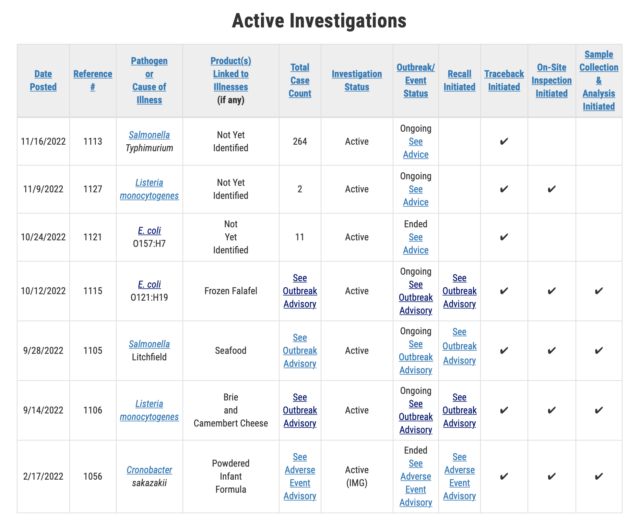
One mystery Salmonella Typhimurium Outbreak has sickened 254.

And, FDA (and state health departments and the CDC), I still am not sure why you closed the investigation with nearly 400 sick (100 hospitalized) into the Investigation of “Adverse Event Reports: French Lentil & Leek Crumbles (June 2022)” linked to Daily Harvest other than to say “Check your freezers for and do not eat, sell, or serve recalled French Lentil & Leek Crumbles from Daily Harvest.”

It is good that FDA and FSIS has been being more transparent on what is “cooking” in outbreak investigation. It is concerning, however, that many significant outbreaks – especially the resent Salmonella Typhimurium that has sickened 254 still has the product unidentified.

Here are the FDA Reports – Salmonella, Listeria, E. coli and Cronobacter:

Here are the FSIS reports – E. coli and Salmonella:

Interesting that neither seems to be investigating (or listing) these two Listeria outbreaks?

Deli Meats and Cheeses Listeria Outbreak: As of November 9, 2022, 16 people infected with the outbreak strain of Listeria have been reported from 6 states – California, Illinois, New York, Maryland, Massachusetts, New Jersey. Sick people’s samples were collected from April 17, 2021, to September 29, 2022. 

Public health officials collect information about the age, ethnicity, and other demographics of sick people, and the types of foods they have eaten, to provide clues that can help identify the source of the outbreak. Sick people range in age from 38 to 92 years, with a median age of 74, and 62% are male. Of 13 people with ethnicity information available, 11 are of Eastern European background or speak Russian. Of 14 people with information available, 13 have been hospitalized. One person got sick during their pregnancy, resulting in pregnancy loss. Additionally, one death has been reported from Maryland.

State and local public health officials are interviewing people about the foods they ate in the month before they got sick. Of the 12 people interviewed, 11 reported eating meat or cheese from deli counters. Among seven sick people in New York, five bought sliced deli meat or cheese from at least one location of NetCost Market, a grocery store chain that sells international foods. Sick people from other states purchased deli meats or cheeses from other delis.

Investigators do not believe that NetCost Market delis are the only source of illnesses because some sick people in the outbreak did not shop at a NetCost Market. A contaminated food likely introduced the outbreak strain of Listeria into delis in multiple states.

In 2021, health officials in New York state and New York City found the outbreak strain of Listeria in several environmental and food samples:
• Environmental samples from a NetCost Market deli in Brooklyn
• Several open packages of mortadella and ham that were sliced at the same NetCost Market deli in Brooklyn
• Sliced salami that a sick person bought from a NetCost Market deli in Staten Island

NetCost Market voluntarily closed the deli temporarily in Brooklyn after New York officials notified them about the sampling results. NetCost Market performed a deep cleaning and then reopened the deli in Brooklyn after further environmental testing did not identify Listeria.

In September 2022, the outbreak strain was found at the same Brooklyn NetCost Market deli; however, the most recent illness with NetCost Market exposure was in October 2021. After a deep cleaning, additional environmental testing did not identify Listeria in the deli.

Old Europe Cheeses Listeria Outbreak: As of September 28, 2022, six people infected with the outbreak strain of Listeria have been reported from six states. Sick people’s samples were collected from August 6, 2017, to August 5, 2022. Sick people range in age from 56 to 83 years, with a median age of 78, and 67% are female. Five people have been hospitalized, and no deaths have been reported.

State and local public health officials are interviewing people about the foods they ate in the month before they got sick. Of the five people interviewed, four (80%) reported eating brie or camembert cheese. Most people did not remember the brand of the cheese they ate, but one person reported eating Lidl Premium Brand Brie. Old Europe Cheese is the only manufacturer of Lidl Premium Brand Brie.

FDA, with assistance from the Michigan Department of Agriculture and Rural Development, inspected the Old Europe Cheese facility in Michigan and collected samples for testing. WGS showed that the Listeria found in the cooling room is closely related genetically to Listeria from sick people’s samples. This provides more evidence that people likely got sick from eating cheese made by Old Europe Cheese.

On September 30, 2022, Old Europe Cheese, Inc. recalled their brie and camembert cheese. The company has also temporarily stopped producing these cheeses.

And, My view of 30 Years of largest and most unforgettable Foodborne Illness Outbreaks in the United States

NOW A NETFLIX DOCUMENTARY
From Jeff Benedict, the #1 New York Times bestselling author of Tiger Woods and The DynastyPoisoned chronicles the events surrounding the worst food-poisoning epidemic in US history: the deadly Jack in the Box E. coli infections in 1993.

On December 24, 1992, six-year-old Lauren Rudolph was hospitalized with excruciating stomach pain. Less than a week later she was dead. Doctors were baffled: How could a healthy child become so sick so quickly? After a frenzied investigation, public-health officials announced that the cause was E. coli O157:H7, and the source was hamburger meat served at a Jack in the Box restaurant. During this unprecedented crisis, four children died and over seven hundred others became gravely ill.

In Poisoned, award-winning investigative journalist and #1 New York Times bestselling author Jeff Benedict delivers a jarringly candid narrative of the fast-moving disaster, drawing on access to confidential documents and exclusive interviews with the real-life characters at the center of the drama—the families whose children were infected, the Jack in the Box executives forced to answer for the tragedy, the physicians and scientists who identified E. coli as the culprit, and the legal teams on both sides of the historic lawsuits that ensued. Fast Food Nation meets A Civil Action in this riveting account of how we learned the hard way to truly watch what we eat.

My view of 30 Years of largest and most unforgettable Foodborne Illness Outbreaks in the United States

Over the last 30 years, I have had a front seat to most every large Foodborne Illness Outbreak in the United States.  Years ago, I could quickly recall each of them.  Perhaps as I have grown a bit older, or perhaps there are now just too many to count?  I thank the work my team has done to create www.outbreakdatabase.com to help us all remember and to perhaps, not forget.

Here are some of the larger from each year, and some just unforgettable, outbreaks:

Jack in the Box Hamburger E. coli Outbreak 1993 – Over 700 sickened across five states with four children dead and over 100 with hemolytic uremic syndrome due to undercooked E. coli-tainted hamburger.  We had the honor to represent Brianne Kiner.

Schwan’s Ice Cream Salmonella Outbreak 1994 – Estimated 224,000 sickened across United States due to cross-contamination of raw eggs.

Salmonella Outbreak linked to Beef Jerky 1995 – At least 95 people in New Mexico sicken with two types of Salmonella from locally produced beef jerky.

Norovirus Outbreak linked to Raw Oysters 1996 – 493 sickened in at least five states from oysters harvested in Louisiana waterways.

Odwalla Apple Juice E. coli Outbreak 1996 – At least 70 sickened in three states and Canada with one death and several hemolytic uremic syndrome cases linked to commercially sold unpasteurized apple juice. A $1,400,000 criminal misdemeanor charge was levied against the company. We had the honor to represent Michael Beverly.

Vibrio Outbreak linked to Raw Oysters 1997 – Over 200 sickened with one death linked to eating raw oysters harvested in California, Oregon, Washington, and Canada.

White Water Park E. coli Outbreak 1998 – 26 culture confirmed cases linked to exposure in a wading pool with one death and six with hemolytic uremic syndrome. We had the honor to represent Jordan Shook.

Malt-O-Meal Cereal Salmonella Outbreak 1998 – This multi-state outbreak sickened over 200, with nearly 50 hospitalizations in 10 states.

E. coli Outbreak linked to Water at Washington County Fair 1999 – 921 people who attended the fair were sickened by either E. coli or Campylobacter with several developing hemolytic uremic syndrome with two deaths due to consuming unchlorinated water.

Sizzler E. coli Outbreak 2000 – There were at least 550 probable cases and 125 possible cases with one death linked to cross-contamination between raw meat and watermelon at two Wisconsin Sizzler restaurants.

Raw Milk Butter E. coli Outbreak 2001 – Nearly 20 kids were sickened by homemade raw milk butter contaminated with E. coli.

ConAgra Beef E. coli Outbreak 2002 – At least 34 cases, including several with hemolytic uremic syndrome and one death in several states linked to contaminated ground beef. We had the honor to represent Thomas Kruc.

Chi-Chis Hepatitis A Outbreak 2003 – Over 650 confirmed cases with five deaths in Pennsylvania linked to the consumption of Hepatitis A-tainted green onions.  We had the honor to represent Richard Miller.

Sheetz Tomato Salmonella Outbreak 2004 – Nearly 300 Salmonella cases in five states linked to the consumption of tomatoes at Sheetz convenience stores.

Cryptosporidium Outbreak linked to Water 2005 – Over 2,000 people from 20 New York counties were linked to illnesses from water at the Seneca Lake spray park.

Peter Pan Peanut Butter Salmonella Outbreak 2006 – Over 600 people in 47 states were linked to the consumption of Salmonella-tainted peanut butter sold under the Peter Pan and Great Value brands. A $11,200,000 criminal misdemeanor charge was levied against the company. We had the honor to represent Mora Lou Marshall.

Dole Baby Spinach E. coli Outbreak 2006 – Over 200 were sickened, several with hemolytic uremic syndrome with five deaths linked to E. coli-tainted baby spinach grown in California. We had the honor to represent Ashley Armstrong.

Topps Beef E. coli Outbreak 2007 – Nearly 50 cases in eight states with 20 hospitalized and two with hemolytic uremic syndrome linked to frozen beef patties.

Cargill Beef E. coli Outbreak 2007 – We had the honor to represent Stephanie Smith.

Peanut Corporation of America Salmonella Outbreak 2007 – Over 700 people were sickened with hundreds hospitalized and nine deaths in 46 states and Canada due to Salmonella-tainted peanut butter.  Felony criminal charges were filed against the president and several employees of the company.  Two executives were sentenced to over 20 years in prison.

ConAgra Pot Pie Salmonella Outbreak 2007 – Over 400 people were sickened in 41 states after consuming ready to cook pot pies.

Nebraska Beef E. coli Outbreak 2008 – At least 50 people were sickened in eight states with 27 hospitalized due to E. coli-tainted ground beef.

Nestle Tollhouse Cookie Dough E. coli Outbreak 2009 – Nearly 75 people with 32 hospitalized and 10 with hemolytic uremic syndrome in 30 states linked to the consumption of E. coli-tainted cookie dough. We had the honor to represent Linda Rivera.

Wright County Egg Salmonella Outbreak 2010 – Over 2,000 sickened across the United States linked to Salmonella-tainted eggs.  A $7,000,000 criminal misdemeanor penalty was assessed and included three months in jail for two executives. We had the honor to represent Sarah Lewis.

Cargill Ground Turkey Salmonella Outbreak 2011 – At least 136 people with 37 hospitalized and one death were linked to Salmonella-tainted turkey on 34 states.

Jensen Farms Cantaloupe Listeria Outbreak 2011 – 33 deaths with 147 illnesses were linked in 28 states to Listeria-tainted cantaloupe from Colorado.  The owners pleaded guilty to five misdemeanor charges.  We had the honor to represent Paul Schwarz.

Tuna Scrape Salmonella Outbreak 2012 – At least 425 people with 55 hospitalized in 28 states linked to two strains of Salmonella ties to raw Tuna scrape.

Foster Farms Chicken Salmonella Outbreak 2013 – At lease 650 people were sickened with hundreds hospitalized due to Salmonella-tainted chicken.

Townsend Farms Berry Hepatitis A Outbreak 2013 – Nearly 200 people were sickened in 10 states linked to Hepatitis A-tainted berries, some imported from Turkey.

Salmonella Outbreak linked to Cucumbers 2014 – Almost 300 people were sickened with dozens hospitalized in 29 states.

Chipotle E. coli Outbreak 2015 – Approximately 60 people were sickened with over 20 hospitalized in 12 states. A $25,000,000 criminal misdemeanor charge was levied against the company.

Blue Bell Ice Cream Listeria Outbreak 2015 – Only 10 were sickened in four states.  A $19,500,000 criminal misdemeanor was charged.

Salmonella Outbreak linked to Cucumbers 2015 – Over 900 were sickened with 200 hospitalized in 40 states linked to Salmonella-tainted cucumbers.

Costco Chicken Salad E. coli Outbreak 2015 – Only 19 people were sickened, some with several hemolytic uremic syndrome on seven states. We had the honor to represent Chloe Rodgerson.

Hepatitis A Outbreak linked to Strawberries 2016 – Nearly 150 people were sickened by Hepatitis A-tainted strawberries imported from Egypt.

Hepatitis A Outbreak linked to Scallops 2016 – Nearly 300 were sickened with 75 hospitalized and one death in Hawaii tied to imported scallops. We had the honor to represent Shirlee Yuu.

I.M. Healthy Soy Nut Butter E. coli Outbreak 2017 – Over 30 sickened with a dozen hospitalized linked to Salmonella-tainted Soy Nut Butter.

Cyclospora Outbreak linked to unknown cause 2017 – Over 1,000 Cyclospora cases likely linked to a food product in 36 states.

Fareway Chicken Salad Salmonella Outbreak 2018 – Nearly 300 were sickened by Salmonella-tainted chicken salad in eight states.

JBS Meat Salmonella Outbreak 2018 – Over 400 sickened with over 150 hospitalized from Salmonella-tainted ground beef in 30 states.

Caito Foods Fruit Salmonella Outbreak 2019 – 137 linked to Salmonella-tainted cut fruit with 38 hospitalized in 10 states.

Thomson Onion Salmonella Outbreak 2020 – Over 1,000 sickened with 150 hospitalized in 48 states tied to Salmonella-tainted onions.

Salmonella Outbreak linked to Onions 2021 – Over 1,000 sickened with 260 hospitalized in 39 states tied to Salmonella-tainted onions.

Wendy’s Leafy Green E. coli Outbreak 2022 – Over 100 sickened with 52 hospitalized with 13 with hemolytic uremic syndrome likely linked to romaine lettuce.

Big Olaf’s Ice Cream Listeria Outbreak 2022 – 28 sickened, 27 hospitalized with one death tied to Listeria-tainted ice cream.

If only government and the beef industry had paid more attention to Dr. Riley, you likely would not be reading this blog.

According to the UC Berkeley School of Public Health, Lee W. Riley, a leader in the decolonization of global health and pioneer in molecular epidemiology, died October 19, 2022, at the age of 73 in Berkeley, California, following a brief illness.

At the time of his death, Riley was professor of epidemiology and infectious diseases and chair of the Infectious Diseases and Vaccinology Division at the UC Berkeley School of Public Health, as well as director of the Global Health Equity Scholars Program.

Riley’s expansive research interests ranged from “slum” health to tuberculosis and from food borne pathogens—including seminal work on E. coli— to parasitic diseases. However, his true legacy is his generous mentorship of thousands of aspiring scientists and public health experts in the United States and around the globe. Their ongoing work serves as a testiment to Riley’s ability to inspire and influence his students and collaborators.

After completing a residency in internal medicine at Columbia Presbyterian Hospital, Riley joined the Centers for Disease Control and Prevention (CDC) in Atlanta in 1981 on a two year fellowship as an investigator in the Epidemic Intelligence Service. While there, he met Dr. Arthur Reingold, his long-time collaborator and future colleague at UC Berkeley School of Public Health and traveled to study disease outbreaks in several countries, including Brazil.

Tasked to do epidemiological fieldwork on enteric disease outbreaks—such as listeria, salmonella, and E. coli—Riley became interested in taking a molecular approach to epidemiology.  He authored a seminal study, published in the New England Journal of Medicine, showing for the first time that a specific kind of bloody diarrhea that appeared in Oregon and Michigan in 1982 was caused by a novel bacterium. The major foodborne pathogen, called E. coli O157:H7, sickens and can kill people who eat undercooked beef.  Riley traced the source of the outbreak through “Food Chain A”: McDonald’s restaurants in both states.

“His work really changed the whole approach to preventing this infection by not allowing the sale of undercooked hamburgers,” said Reingold. “This really made Lee’s career.”

I met Dr. Riley in early 1993 while first learning about E. coli O157:H7 during the early days of the Jack in the Box E. coli Outbreak that sickened over 650, many developing acute kidney failure and killing 4 children. I had stumbled across the article “Hemorrhagic Colitis Associated with a Rare Escherichia coli Serotype,” and reached out to Dr. Riley convinced that Jack in the Box was in fact the “Food Chain A.” He was kind enough to set me straight – “Food Chain A” – was in fact McDonald’s. We talked about the likely origins of E. coli O157:H7 in the CAFOs in the US and the failure of the government and meat industry to take E. coli’s risk in ground meat seriously enough to avoid the 1992/1993 catastrophe.

I am reminded of the the food industries and governments failures to head warnings in nearly every outbreak that I hear about nearly every day. Losing great scientists like Dr. Riley is a loss for us all.

E. coli on Seattle: Seattle-King County Public Health is investigated an outbreak of Shiga toxin-producing E. coli(also known as STEC) associated with diarrhea and abdominal pain at Torero’s Mexican Restaurant in Renton.

We did not identify how STEC was spread within the restaurant. This is not uncommon for STEC outbreaks, because the bacteria can spread through contaminated food items, environmental surfaces, and from person to person. All of the cases had confirmatory testing indicating infections with Shiga toxin-producing E. coli (STEC) via culture. All confirmed cases had the same strain of STEC, based on genetic fingerprinting (whole genome sequencing or WGS) at the Washington State Public Health Laboratory.

Since September 5, 2022, 3 people from 3 separate meal parties reported becoming ill after eating food from Torero’s Mexican Restaurant in Renton on September 3, 2022 and September 7, 2022. All of the people developed one or more symptoms consistent with STEC, including diarrhea (often bloody), abdominal cramping, nausea, and vomiting. We did not identify any ill employees.

Public Health conducted interviews with the people ill with STEC to identify potential common exposures. On September 29, 2022, Public Health identified Torero’s as a common food source for all three individuals. 

Environmental Health Investigators visited the restaurant on September 30, 2022. Investigators identified inadequate handwashing facilities and improper storage of raw meats as potential risk factors for this outbreak. All critical violations were corrected during the inspection. On October 3, 2022, Environmental Health Investigators revisited the facility and ensured proper compliance with food handling practices. 

No ill employees were identified at the time of the inspection. Investigators reviewed with restaurant management the requirement that ill staff are not allowed to work until they are symptom-free for at least 24 hours. Investigators provided education about preventing the spread of STEC — including proper handwashing, preventing bare hand contact with ready-to-eat foods, and preventing cross contamination during food preparation. 

Listeria in New York: As of November 9, 2022, 16 people infected with the outbreak strain of Listeria have been reported from 6 states – California, Illinois, New York, Maryland, Massachusetts, New Jersey. Sick people’s samples were collected from April 17, 2021, to September 29, 2022. 

Public health officials collect information about the age, ethnicity, and other demographics of sick people, and the types of foods they have eaten, to provide clues that can help identify the source of the outbreak. Sick people range in age from 38 to 92 years, with a median age of 74, and 62% are male. Of 13 people with ethnicity information available, 11 are of Eastern European background or speak Russian. Of 14 people with information available, 13 have been hospitalized. One person got sick during their pregnancy, resulting in pregnancy loss. Additionally, one death has been reported from Maryland.

State and local public health officials are interviewing people about the foods they ate in the month before they got sick. Of the 12 people interviewed, 11 reported eating meat or cheese from deli counters. Among seven sick people in New York, five bought sliced deli meat or cheese from at least one location of NetCost Market, a grocery store chain that sells international foods. Sick people from other states purchased deli meats or cheeses from other delis. Investigators do not believe that NetCost Market delis are the only source of illnesses because some sick people in the outbreak did not shop at a NetCost Market. A contaminated food likely introduced the outbreak strain of Listeria into delis in multiple states.

Public health investigators are using the PulseNet system to identify illnesses that may be part of this outbreak. CDC PulseNet manages a national database of DNA fingerprints of bacteria that cause foodborne illnesses. DNA fingerprinting is performed on bacteria using a method called whole genome sequencing (WGS). WGS showed that bacteria from sick people’s samples are closely related genetically. This suggests that people in this outbreak got sick from the same food.

In 2021, health officials in New York state and New York City found the outbreak strain of Listeria in several environmental and food samples:
• Environmental samples from a NetCost Market deli in Brooklyn
• Several open packages of mortadella and ham that were sliced at the same NetCost Market deli in Brooklyn
• Sliced salami that a sick person bought from a NetCost Market deli in Staten Island

NetCost Market voluntarily closed the deli temporarily in Brooklyn after New York officials notified them about the sampling results. NetCost Market performed a deep cleaning and then reopened the deli in Brooklyn after further environmental testing did not identify Listeria.

In September 2022, the outbreak strain was found at the same Brooklyn NetCost Market deli; however, the most recent illness with NetCost Market exposure was in October 2021. After a deep cleaning, additional environmental testing did not identify Listeria in the deli.

This sad news just popped into my inbox. Jim and I seldom saw eye to eye on most things. But he was always respectful, witty, good humored and brilliant. He will be missed.

Boca Raton, FL – We are deeply saddened to report that Jim Prevor has suddenly passed away from heart failure after being stricken by a heart attack and stroke. On this earth for merely 61 years, Jim was a force of boundless energy and enthusiasm for the perishable food and fresh produce industry in which he was born and carried a rich family legacy.  Jim is survived by his wife Debbie, sons William and Matthew, and loving extended family and friends.

The upcoming New York Produce Show and Conference will continue as scheduled in Manhattan this coming November 29 – December 2, with a special tribute to Jim’s tremendous contributions to the industry.

Founder of PRODUCE BUSINESS magazine in 1985, just a couple years after his education at Cornell University, Jim saw the need for a publication to inform and educate the buying segments of the fruit and vegetable industry. As a national debate champion, political scientist and 4th-generation produce industry veteran, Jim immediately made his mark as a journalist who applied a keen intellect and analytical mind to the daily workings of the buying end of the trade.

His “Fruits of Thought” column garnered more than 100 awards in business journalism, including the Timothy White Award for Editorial Integrity, which recognized Jim’s commanding presence and leadership during the Great Spinach Crisis of 2006. His PerishablePundit.com website became the platform searched by news outlets outside of the industry, and Jim was asked to appear on national television news stations, as well as to keynote and speak at industry events and within boardrooms around the world.

His words about the fresh produce industry were featured in The New York Times, Wall Street Journal and Weekly Standard, to name a few.

Jim’s entrepreneurial spirit carried forward with other buyer-oriented publications created in the fresh food arena — Deli Business, Cheese Connoisseur, Floral Business, and PerishableNews.com — and in 2010, Jim launched the New York Produce Show and Conference as the first recurring produce industry event to take place in America’s hub of international trade. Along with the partnership of the Eastern Produce Council, the event is now the largest fixed-site fresh produce trade show in North America.

Jim took the success of the New York Produce Show and utilized his vast international network of industry friends to create the London Produce Show and the Amsterdam Produce Show. Most recently, Jim gathered an international audience of grape breeders, growers, wholesalers, and retailers at the Global Grape Summit.

“The staff of PRODUCE BUSINESS, our company, Phoenix Media Network, and the global perishable food industry, will feel a tremendous void in his absence,” said Ken Whitacre, executive vice president and publisher. “Jim was larger-than-life and, as such, his spirit will forever be with us, and we will honor his legacy by carrying on his passion and mission to ‘initiate industry improvement’.”

If you wish to share your thoughts, memories, and condolences, simply email us at rememberingjim@producebusiness.com.