The Seattle Times | By Sandy Doughton | Feb. 24, 2023

https://www.seattletimes.com/pacific-nw-magazine/seattle-food-safety-attorney-bill-marler-does-not-eat-these-foods-do-you/

People in the food industry used to call attorney Bill Marler a blood-sucking ambulance chaser. Now they honor him for 30 years spent fighting to improve food safety. (Daniel Kim / The Seattle Times)

IN JULY 1990, I wrote a story for The News Tribune in Tacoma that was headlined: “There may be a bug in that burger.”

The state epidemiologist and a pediatrician at Seattle Children’s Hospital had warned that a dangerous strain of E. coli might infect humans through undercooked hamburger, and that it was particularly dangerous to children.

Talk about foreshadowing.

THE MAINSTORY      30 years after the deadly E. coli outbreak, a Seattle attorney still fights for food safety

As the Jack in the Box outbreak began unfolding in early 1993, I helped my colleague Elaine Porterfield cover the story.

I’ve been extremely careful about food safety ever since. I thoroughly wash my hands and cutting boards and utensils. I never rinse raw chicken, which can send salmonella-laden droplets flying through the air. And yes; I’m that obnoxious person who sends back pink-in-the-middle hamburgers.

But I hadn’t ruled out many types of food until I asked food safety attorney Bill Marler what he won’t eat.

Understandably, hamburgers were on his family’s “no way” list for years. Now, he’ll occasionally order one — well-done, of course — because the odds of dangerous contamination have been lowered dramatically.

But these things still never pass his lips:


● Unpasteurized milk or juice. One of Marler’s first post-Jack in the Box cases was against Odwalla, whose unpasteurized apple juice triggered an E. coli outbreak in 1996 that killed a 16-month-old girl and sickened at least 70 people. The CDC says unpasteurized milk contaminated with bacteria and viruses caused 75 outbreaks between 2013 and 2018.

● Raw sprouts. “The warm, humid conditions needed to grow sprouts are also ideal for germs to grow,” says the CDC. All types — alfalfa, mung bean, clover and radish — can harbor dangerous bacteria in their seeds, Marler explains.

● Meat that isn’t well-done. Marler orders steaks well-done, despite nasty looks from chefs and waiters. Thorough cooking is especially important for ground and tenderized meat, where pathogens can be mixed in.

● Bagged salads, precut or prewashed fruits and vegetables. “Convenience is great, but sometimes I think it isn’t worth the risk,” says Marler. The risk of contamination rises with the degree of processing — and packaged vegetables are highly processed and highly risky if eaten raw.

● Raw or undercooked eggs. Regulations adopted more than a decade ago have lowered the risk of salmonella in raw eggs — but contamination can still happen, says Marler, who continues to eat his eggs well-cooked.

● Raw oysters and other raw shellfish. The incidence of foodborne illness linked to raw oysters seems to be increasing, Marler says, possibly due to warming waters. As filter feeders, oysters can easily pick up dangerous microbes. “It’s simply not worth the risk.”

Sandi Doughton: 206-464-2491 or sdoughton@seattletimes.com; on Twitter: @SandiDoughton.
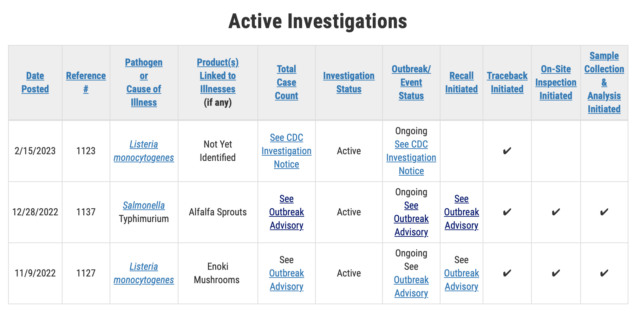
Mystery Listeria: As of February 14, 2023, a total of 11 people infected with the outbreak strain of Listeria have been reported from 10 states – Arkansas, California, Colorado, Michigan, Missouri, New York, North Carolina, Pennsylvania, South Dakota and Washington. Sick people’s samples were collected from July 3, 2018, to January 31, 2023.

Sick people range in age from 47 to 88 years, with a median age of 73, and 73% are female. Race or ethnicity information is available for ten sick people. One sick person reported Hispanic ethnicity. Of nine people that did not report Hispanic ethnicity, eight are White and one is African American/Black. Of ten people with information available, all have been hospitalized. No deaths have been reported. State and local public health officials are interviewing people to find out what foods they ate in the month before they got sick.

Public health investigators are using the PulseNet system to identify illnesses that may be part of this outbreak. CDC PulseNet manages a national database of DNA fingerprints of bacteria that cause foodborne illnesses. DNA fingerprinting is performed on bacteria using a method called whole genome sequencing (WGS). WGS showed that bacteria from sick people’s samples are closely related genetically. This suggests that people in this outbreak got sick from the same food.

Listeria Enoki Mushrooms: Epidemiologic and laboratory data show that enoki mushrooms are contaminated with Listeria and are making people sick. FDA found two strains of Listeria in an import sample of Utopia Foods brand enoki mushrooms. One strain is linked to the two illnesses that were already included in this outbreak, and the other strain is linked to one additional illness. Both strains are now included in this outbreak investigation.

Since the last update on November 22, 2022, one more illness has been linked to this outbreak. As of January 18, 2023, three people infected with the outbreak strains of Listeria have been reported from three states – California, Nevada and Michigan. Sick people’s samples were collected from October 3, 2022, to October 8, 2022. Sick people range in age from 30 to 56 years, with a median of 42 years, and 66% are male. Two people are Hispanic, and one person is Asian. All three have been hospitalized, and no deaths have been reported.

FDA found the outbreak strains of Listeria in an import sample of Utopia Foods brand enoki mushrooms. Previously, in December 2022, Missouri state officials conducted routine sampling and found Listeria in a sample of Utopia Foods brand enoki mushrooms. The Listeria found in this sample was not the outbreak strains, and it was not linked to any reported Listeria illness in the United States. On December 13, 2022, Utopia Foods recalled these enoki mushrooms. On January 13, 2023, Utopia Foods expanded their recall of enoki mushrooms.

Salmonella “Sproutbreak”: As of December 29, 2022, a total of 15 people infected with the outbreak strain of Salmonella have been reported from three states – South Dakota, Nebraska and Oklahoma. Illnesses started on dates ranging from December 2, 2022, to December 13, 2022.

Sick people range in age from 19 to 78 years, with a median age of 39, and 67% are female. Of 14 people with information available, two have been hospitalized.

FDA’s preliminary traceback evidence indicates that the restaurants and grocery stores identified in this outbreak received alfalfa sprouts from SunSprout Enterprises. Additionally, two of the individuals identified in this outbreak confirmed they had purchased Sun Sprouts brand alfalfa sprouts from their local grocery store.

Summary

Public Health is investigating an outbreak of Shigellosis associated with Tamarind Tree Restaurant in Seattle. Symptoms reported include diarrhea, cramps, nausea, fever, chills, and vomiting.

Illnesses

As of February 8, 2023, 32 people reported becoming ill after eating food from the Tamarind Tree Restaurant. These 32 people ate at this restaurant January 14 – 17, 2023, and started having symptoms January 17 – 20, 2022. 

Public Health actions

Environmental Health investigators visited the restaurant on January 24, 2023. They observed improper food handling practices, including blocked access to handwashing facilities, improper storage of wiping cloths, risk of cross contamination, and lack of maintenance, cleaning, and sanitizing of food equipment and physical facilities. 

Environmental Health investigators did a routine inspection on January 18, 2023. They observed several risk factors that could contribute to foodborne outbreaks, including bare hand contact with ready-to-eat foods.

Investigators closed the restaurant during their visit on January 24, 2023. The restaurant was required to complete a thorough cleaning and disinfection. On February 7, Environmental Health investigators revisited the restaurant to confirm proper cleaning and disinfection, and the restaurant reopened that day.

Investigators provided education about preventing the spread of gastrointestinal illness — including proper handwashing and preventing bare hand contact with ready-to-eat foods. Investigators have also reviewed with restaurant management the requirement that people with a gastrointestinal illness who work in food handling should not work while ill, and those with diagnosed Shigella infections who work in food handling must be cleared by Public Health before returning to work to make sure they are no longer contagious.

Public Health has not identified any ill employees. Public Health worked with the restaurant to complete testing for all employees because some people infected with Shigella do not have symptoms and investigators observed several risk factors that could contribute to the spread of Shigella. At this time, no employees have tested positive for Shigella

Laboratory testing

Ten of the 32 people who became ill tested positive for Shigella. Six cases have confirmatory testing indicating Shigella sonnei, a species of Shigella. Symptoms among those who did not get tested are suggestive of a Shigella infection.

Shigella

Shigella is the bacterium that causes the disease shigellosis, also known as bacillary dysentery. Shigella is one of the most easily transmitted bacterial diarrheas, since it can occur after fewer than 100 bacteria are ingested. While reported cases of Shigella range between 14,000 and 20,000 annually, with the majority of these cases occurring between July and October. Shigella Sonnei is the most common type of Shigella. It accounts for over two-thirds of cases of shigellosis in the United States.

Shigella bacteria are generally transmitted through a fecal-oral route. Foods that come into contact with human or animal waste can transmit Shigella. Thus, handling toddlers’ diapers, eating vegetables from a field contaminated with sewage, or drinking pool water are all activities that can lead to shigellosis.

Symptoms of Shigella Food Poisoning

Symptoms of Shigella poisoning most commonly develop one to three days after exposure to Shigella bacteria, and usually go away within five to seven days. It is also possible to get Shigella but experience no symptoms, and still be contagious to others, a condition known as being asymptomatic.

Common Shigella Food Poisoning Symptoms

  • Diarrhea: Diarrhea ranges from mild to severe. It is bloody in 25 to 50 percent of cases and usually contains mucus
  • Fever
  • Stomach cramps
  • Rectal spasms
Complications from Shigella

Complications from shigellosis can include severe dehydration, seizures in small children, rectal bleeding, and invasion of the blood stream by the bacteria. Young children and the elderly are at the highest risk of death. The following is a list of specific complications caused by Shigella.

Proctitis and Rectal Prolapse: The bacteria that causes shingellosis can also cause inflammation of the lining of the rectum or rectal prolapse.

Reactive Arthritis: Approximately 3 percent of patients with Shigella infection, most often those with Shigella flexneri, develop Reactive Arthritis. It occurs when the immune system attempts to combat Shigella but instead attacks the body. Symptoms of Reactive Arthritis include inflammation of the joints, eyes, or reproductive or urinary organs. On average, symptoms appear 18 days after infection.

Toxic Megacolon: In this rare complication, the colon is paralyzed and unable to pass bowel movements or gas. Symptoms of Toxic Megacolon include abdominal pain and swelling, fever, weakness, and disorientation. If this complication goes untreated and the colon ruptures, the patient’s condition can be life-threatening.

Hemolytic Uremic Syndrome, or HUS: Shigella rarely results in HUS, which is more commonly a complication of Shiga toxin-producing E. coli infections. HUS can lead to kidney failure.

Diagnosis of Shigella

Shigella infection is diagnosed through laboratory testing of a stool sample.

Shigella Food Poisoning Treatment

Shigella infection usually goes away on its own in five to seven days, although bowel movements may continue to be abnormal for up to a month following infection. Antibiotics, however, can shorten the course of the illness. A doctor can prescribe antibiotics after testing a stool sample for the presence of Shigella bacteria.

Some strains of shigellosis are resistant to antibiotics, meaning that antibiotics might not always be an effective treatment. Antidiarrheal medication should be avoided, as it can actually make the illness worse.

Preventing a Shigella Infection

Frequent hand washing is key to preventing Shigella, since individuals can carry Shigella without noticing symptoms, and Shigella bacteria can remain active for weeks after illness.

Steps for Preventing the Spread of Shigella Infection

  • If a child in diapers has shigellosis, wash your hands after changing their diaper and wipe down the changing area with disinfectant
  • People with Shigella should not prepare food for others for at least two days after diarrhea has stopped
  • Drink only treated or boiled water while traveling and only eat fruits you peel yourself.
  • Only swim in pools maintaining a chlorine level of 0.5 parts per million and stay clear of pools where children not yet toilet trained are swimming
Additional Resources for Shigella

About-Shigella.com is a comprehensive site with in-depth information about Shigella bacteria and Shigella infection.

Shigella Blog provides up-to-date news related to Shigella outbreaks, research, and more.

 Marler Clark, The Food Safety Law Firm, is the nation’s leading law firm representing victims of Shigella outbreaks. The Shigella lawyers of Marler Clark have represented thousands of victims of Shigella and other foodborne illness outbreaks and have recovered over $850 million for clients.  Marler Clark is the only law firm in the nation with a practice focused exclusively on foodborne illness litigation.  Our Shigella lawyers have litigated Shigella cases stemming from outbreaks traced to a variety of sources, such as tomatoes, airplane and restaurant food.  

If you or a family member became ill with a Shigella infection after consuming food and you’re interested in pursuing a legal claim, contact the Marler Clark Shigella attorneys for a free case evaluation.

Food Safety Magazine February 2023

The story of the 1992–1993 Jack in the Box outbreak is well documented, but how E. coli O157:H7 first showed up on the radar is less known

By Andrew Kesler, Corporate Director of Supplier Compliance 

Thirty years ago in January saw the beginning of what became known as “The Crisis” at Jack in the Box restaurants, when hundreds of customers became seriously ill after eating hamburgers containing Escherichia coli O157:H7. This illness outbreak—at the time, the largest in U.S. history—would claim four young lives, leave many others with lifelong health impairments, sicken over 700 people, and nearly ruin Foodmaker Inc., the parent company of Jack in the Box.

Two years prior to this outbreak, in 1991, I spent my first Thanksgiving away from home at a Jack in the Box restaurant in Lompoc, California. At the time, I had no idea that Jack in the Box would become a defining part of my career in food safety or that I would even have a career in “food safety.” I would later join the quality assurance team at Jack in the Box, led by the late Dr. David Theno, a prominent food safety and process control consultant who was hired by Foodmaker to figure out why the outbreak occurred and to put systems in place to prevent another one from happening.

The story of this seminal illness outbreak is well documented, but how E. coli O157:H7, the deadly organism responsible for the 1992–1993 Jack in the Box outbreak, first showed up on the radar is less known. The story begins a decade earlier, in 1982, with another, much larger, fast food restaurant chain. It is important to examine this earlier outbreak (which was technically two outbreaks) to understand why the aftermath of the Jack in the Box outbreak was much different, as well as how it propelled huge changes in the meat industry and within large restaurant chains. The entire food industry became much stronger because of Dave Theno’s fundamental philosophy that there should be no competitive advantage in ensuring food safety.

The Centers for Disease Control and Prevention’s “We Were There” series offers a segment on E. coli O157:H7. It briefly discusses the 1982 outbreaks and the scientific work that followed, and it reviews the Jack in the Box outbreak and its impact at length. It is told from the perspective of the regulators and their conclusions on how this outbreak changed the industry. This article summarizes my personal observations based on over a decade of working at Jack in the Box and almost three decades of experience in the industry. Many of the projects I have worked on came about as a direct result of corrective actions and regulations borne from our collective journey with pathogenic E. coli.

Forty Years Ago

The 1982 E. coli outbreaks are not well known or discussed in nearly any historical account of E. coli O157:H7. The name of the restaurant chain involved is rarely associated with the outbreaks in the same way that Jack in the Box is forever linked to the 1992–1993 outbreak. In 2012, Bill Marler, the attorney who represented many of the victims of the Jack in the Box outbreak asked (rhetorically) on his blog: “What if, in 1982, McDonald’s had been named as the source of the 47 sickened by E. coli O157:H7-tainted hamburger in two states?”1 Would the Jack in the Box outbreak have occurred ten years later?” That is a nearly impossible question to answer, but the 1982 outbreaks did not make the national news, nor did they prompt the collective changes in food safety spurred by the Jack in the Box outbreak, in which four young children died.

On March 24, 1983, the New England Journal of Medicine published the article, “Hemorrhagic Colitis Associated with a Rare Escherichia Coli Serotype.”2 The article summarizes the investigation results from two outbreaks, one in Michigan and one in Oregon, which sickened “at least” 47 people in early 1982. The common food in the outbreaks was hamburger with three common ingredients from a single fast-food chain—beef patty, pickles, and rehydrated onions. While the report did not name the restaurant associated with the outbreak, only one fast-food chain at the time had restaurants in both Michigan and Oregon, cooked hamburger patties on flat grills, and used rehydrated onions.

One brief news article about the outbreaks, probably buried on the back pages of The Washington Post, was published on October 9, 1982. It linked McDonald’s to what was then a “rare intestinal illness… which may be linked to undercooked hamburgers.” Cristine Russell, writing for The Washington Post, remarked that the McDonald’s home office in Oak Brook, Illinois “…contended that the link with its hamburgers might be a statistical anomaly and said that the company’s required cooking procedures ‘ensure product safety.'”3 In defense, McDonald’s Vice Chairman, Edward Schmitt, made remarks about the small number of illnesses as “isolated incidents.” He further remarked that the chain had served almost two billion burgers since the illnesses occurred. In this context, with little known about E. coli‘s ability to make humans sick (and kill them), it is understandable to characterize this event as an “anomaly.”

Although McDonald’s publicly declared the outbreaks to be an anomaly, the company took action to investigate the microorganism and new cooking technologies to combat it—a very early example of large foodservice companies sponsoring and promoting significant food safety research in partnership with government and industry. After the 1982 outbreaks, McDonald’s hired then-University of Wisconsin microbiology professor Dr. Michael Doyle, who recommended new clamshell grills (among other actions) that would cook patties simultaneously on both sides and not open until the cook time was completed. The cook times and temperatures were researched thoroughly to ensure that harmful microorganisms were destroyed during the cooking process. Side note: I was an assistant manager at a McDonald’s restaurant in the late 1980s and helped install the new clamshell grills. It would be more than 30 years before I connected the dots behind why we switched to this equipment. At the time, I assumed it was to cook the patties faster and increase “speed of service.”

Still, the 1982 incident remained an obscure, back-page news article, and the controls implemented to ensure product safety were intended to solve the problem primarily through control steps in the restaurants. It would be an entirely different outcome ten years later, after four children died from undercooked hamburgers served by the nation’s fifth-largest fast-food chain. The news went national with the Jack in the Box logo all over it, which got the attention of the public, the industry, the regulators, and, most importantly, Washington, D.C. There was no keeping the Jack inside this box. 

Thirty Years Ago

Dave Theno told the story many times. To remind him of whom he actually worked for, regardless of the company logo on his paycheck, he carried in his wallet a picture of six-year-old Lauren Rudolph. He often showed the picture to people when explaining why he recommended a particular course of action to protect public health. “Lauren is who we are protecting. Lauren, and the children she represents, is who I report to,” he would say. She was the first victim of the Jack in the Box outbreak, and Dave got to know her family well through the ordeal.

The story of “The Crisis,” as it came to be known at Foodmaker, was expertly researched and told by Jeff Benedict in his 2011 book, Poisoned.4 The major parts of the outbreak had been explained before, but what the uncomfortable narrative teaches is how hemolytic uremic syndrome (HUS), an infection of the digestive tract caused by E. coli O157:H7, destroys the red blood cells in the body, causing extreme pain in the kidneys and other organs as they begin to fail. That such young children could die such painful deaths—just from eating a hamburger—was unimaginable to me. Riley Detwiler, one of the four young victims, did not even eat a hamburger. He merely came into contact with another child at a daycare center who had eaten contaminated beef—a testament to how virulent E. coli O157:H7 can be, even spreading through cross-contact among people.

By early 1993, the outbreak had become national news, with a newly elected president calling the parents of the victims and promising to do more to ensure safe food. Regulators and industry had become more willing to accept changes in how food was inspected. The relentless national media attention, combined with civil litigation resulting in multimillion-dollar settlements for the victims, created an environment that demanded significant change—on the part of industry and regulators.

The course of action Dave embarked on when he arrived at Foodmaker—first as a consultant, and then full-time as a Vice President—was to determine where in the process, from farm to fork, controls could be implemented and measured to ensure safe hamburgers. His goal was to give the leadership team specific metrics to monitor as an indicator of the health of their food safety program, so that they could take immediate action if the system went out of control.

Dave realized that fully cooking the hamburgers solved only half the problem. Knowing that the pathogenic organism can be transferred through bare-hand contact required an additional mitigation step to solve the other half of the problem. He implemented a “no bare-hand contact” rule with raw hamburger patties, which was unheard of at the time for any large restaurant chain. Training grill employees to use tongs, rather than their hands, to separate the frozen patties and then place them on the grill was no small feat, especially when it was common to place up to 12 patties on the grill at the same time.

In the restaurants, Dave implemented a mandatory “final flip and visual check” of each patty before pulling it off the grill to make sure the patty was not pink after the scheduled cooking time. (Unlike McDonald’s, which had plenty of cash to invest in clamshell grills, Foodmaker did not have such capital available at the time. It was uncertain if the company would even survive.) The combination of checking each patty and monitoring the temperatures of the grill surface and the internal patty several times each day ensured the cooking process was continuously in control.

“No bare-hand contact” and the “final flip and visual check” became the fundamental critical control points in what was the first HACCP program created for a restaurant; and these two steps were observed and documented by the restaurant’s management several times throughout the day. Procedures were also implemented to verify the cooking processes by measuring the temperature of the cooked patties several times per day. This became another critical control point in the restaurant HACCP program. Compliance with these steps in the process, along with many others, was now measured and became a metric for Jack in the Box’s operations teams to monitor the health of their restaurant chain’s food safety system.

Dave just as quickly turned his attention to the supply of hamburger patties, taking a methodical approach to implementing HACCP from feedlots and slaughter to the ground beef operations that produced the hamburger patties. Few “grinding operations” at the time were willing to implement a new microbial monitoring program to test both the incoming meat and the raw ground hamburger patties for E. coli O157:H7. However, Texas American and CTI Foods both signed on to adopt the new system; and by implementing the program, the industry as a whole learned much more about how pathogenic E. coli enters the supply and production system.

Over time, additional slaughter and fabrication mitigation steps were employed to reduce microbial loads. While testing was used to exclude contaminated supply, the intention of the testing program was to learn and make continuous improvements to the controls within the process. Fundamental to the success of the testing program was defining and tracking “lots” within the process to allow for traceability and proper rotation. Microbial testing results of the beef supply became a defining metric for Jack in the Box’s leadership team.

One of the most meaningful actions Dave took was to openly share the testing program and controls with anyone in industry who was interested, including competing restaurant chains. He firmly believed that there was no competitive advantage in food safety. We have learned over time that an illness outbreak from one company can have negative impacts on an entire food industry segment—peanut butter, tomatoes, cantaloupes, and lettuce, to name a few.

Quality and Process Control through HACCP

Before joining Jack in the Box, Dave Theno had already pioneered the use of HACCP and its concepts to achieve microbial reduction through “process control.” Before Jack in the Box, Dave had built a very successful consulting business working with clients who wanted to implement process control through HACCP in their organizations. At the start of his career, he demonstrated that by identifying and monitoring key steps within the poultry slaughter process, the rate of Salmonella contamination in chilled carcasses could be reduced from 35 percent to around 1–2 percent. Even for processes where there is no “kill step,” such as slaughter, identifying the key steps within the process that can be controlled and measured, and then measuring them, helps achieve microbial reduction through data visibility and continuous process improvement. This is exactly what happened as a result of the microbial testing that was implemented for Jack in the Box’s ground beef supply. The data allowed for examination of processes further back in the supply chain and identified areas where additional microbiological control technologies would help reduce the overall level of E. coli. Consequently, over the three decades since the program was implemented, the U.S. ground beef supply has far less exposure to pathogenic E. coli, and illnesses associated with ground beef have been substantially reduced.

In the 1980s and early 1990s, not everyone at the U.S. Department of Agriculture (USDA) or in the industry was a proponent of controlling processes through the use of HACCP, even though the National Aeronautics and Space Administration (NASA) had successfully used it to ensure safe food for their astronauts in space. The traditional process of government inspectors visually inspecting and stamping every animal carcass to declare safety was entrenched and viewed by many in the meat industry and government as successful. After all, the HACCP detractors reasoned, the consumer was surely responsible enough to know to cook raw meat thoroughly before eating it. The HACCP proponents would correctly point out, however, that pathogenic microbial contamination cannot be observed through traditional visual inspection. A new system of controls during the slaughter and manufacturing processes was needed to enhance visual inspection. The Jack in the Box outbreak softened attitudes toward HACCP, creating a window of opportunity for change, and in July 1996, a final rule—Pathogen Reduction; Hazard Analysis and Critical Control Points (HACCP) Systems—was published in the Federal Register.5 It became known as USDA’s “Mega Reg.” Timothy Lytton’s 2019 book, Outbreak, provides additional insight into the history behind the development of this regulation.6

In 1996, I had just started my career in the food manufacturing industry as Quality and Process Control Engineer for Hormel Foods. At the time, Hormel used a Total Quality Control program in its manufacturing plants to ensure that its processes were in control and producing safe, consistent product. Each step of the process was clearly defined, and the program outlined how each step in the process was to be monitored, and by whom. Each page of the 60-plus-page document was approved and stamped by USDA’s Food Safety and Inspection Service (FSIS). Any changes, no matter how minor, needed to be reviewed and approved by USDA. Thus, USDA approved the program under which the plant operated, and routinely inspected the approved individual activities required by the program, essentially serving as quality control. If the program required pulling 60 cans of chili after the cooking process and incubating them, the USDA inspector would create a Process Deficiency Report (the predecessor of today’s Noncompliance Reports) if they counted only 59 in the incubator. The role of Quality and Process Control Engineers at Hormel was to ensure that the processes were continuously in control and to bring them back into control when necessary. The USDA inspector’s role was to inspect the plant and its processes and notify plant management when deficiencies in approved processes were observed.

The implementation of HACCP largely turned the development and monitoring of process control systems over to the manufacturing plants, theoretically reducing the burden on regulators. The plants developed their control programs using the principles of HACCP, and USDA’s new role was to ensure that the plant was executing its HACCP system—which was more of a quality assurance vs. quality control approach. At the time, I was tasked with writing the new plans and implementing them at the plant level. For the companies that employed Total Quality Control plans, the switch to HACCP was relatively easy since the controls in the process were already defined. For many smaller companies, however, implementing HACCP was a long and difficult journey.

The Jack in the Box outbreak propelled an entire industry into a new way of monitoring process controls within manufacturing plants and shifted USDA’s role in food manufacturing from control to oversight, a system that continues today.

Thirty Years Later

The story of E. coli O157:H7 cannot be told without discussing Dr. Dave Theno and his contributions to the safety of our nation’s food supply.

The root causes of the Jack in the Box outbreak largely shaped many of Dave’s philosophies about food safety. Manage risk as far back in the supply chain as possible, implement microbiological testing programs when the data can be meaningful in driving continuous process improvement, design solid processes, and ensure they are in control from “farm to fork.” The learnings from his early career work in process control measurement remain universal. Every process, even processes without steps to reduce or eliminate harmful bacteria, can be measured at key steps. That measurement data can be used to monitor process control and continuous process improvement.

Lastly, “you get what you demonstrate you want.” This means that, as a leader, your employees will deliver on what is important to you—not necessarily what you say, but what you demonstrate is important through your actions, what you measure, and how you publicly acknowledge and reward employee performance. Those actions are important concepts in today’s ongoing discussion about creating food safety cultures within organizations. As an operations vice president, if your first question to your plant management team is about order fill rates, production line efficiencies, or labor costs, then you have clearly established what is first and foremost on your mind. If your first question is about environmental monitoring results, critical control point compliance, or reported customer complaints, then you are demonstrating that food safety is your top priority. Plant management is able to keep track of all these metrics, of course, but the order in which you ask about them communicates your priorities as leader. Those priorities will become your team’s priorities.

At a memorial service for Dave Theno in 2016, Bill Marler, the attorney who sued Foodmaker and won substantial settlements on behalf of his clients, spoke about Dave and his legacy. For any other person, it might have been odd to have the attorney who sued the company you worked for attend your memorial service, but not so for Dave. In the years following the outbreak, he maintained open communication with Bill Marler. Not in the sense of “keep your enemies close,” but because their collective goal, even working on opposite sides of the fence, was the same: make the food supply as safe as it can be. Dave truly lived by his words that he was working for Lauren Rudolph and everyone she represented.

Dave was a well-respected thought leader in food safety, known by regulators, industry, and litigation attorneys alike. He trained a generation of food safety leaders to continue working toward a safer food supply by applying science and common sense to process control and decision-making through data analysis. His larger-than-life personality also helped elevate the role and visibility of food safety as a profession. When I began my career in food manufacturing in the 1990s, it was in the quality control department; food safety departments did not yet exist. Today, we continue to see more food manufacturers with a dedicated, experienced executive to lead an independent food safety function. The most progressive companies have this position on the top line of their organizational chart—along with sales, marketing, operations, research and development, supply chain, human resources, legal, and finance. The role is not buried beneath someone else’s responsibilities, such as operations or supply chain.

For those of us in the business of making and serving food for human consumption (and especially those of us with “food safety” in our job titles), we should all carry a picture of Lauren Rudolph as a reminder of whom we ultimately work for and represent. Had she not eaten a hamburger, Lauren would have turned 37 this year; and Riley Detwiler, who did not eat a hamburger but died anyway, would have turned 32.

References

1.   Marler, Bill. “What if in 1982 McDonalds had been named as the source of forty-seven sickened by E. coli O157:H7-tainted hamburger in two states?” Marler Blog. February 8, 2012. https://www.marlerblog.com/lawyer-oped/what-if-in-1982-mcdonalds-had-been-named-as-the-source-of-forty-seven-sickened-by-e-coli-o157h7-tain/.

2.   Riley, L. W., R. S. Remis, S. D. Helgerson, et al. “Hemorrhagic colitis associated with a rare Escherichia coli serotype.” New England Journal of Medicine 308, no. 12 (March 24, 1983): 681–685. https://pubmed.ncbi.nlm.nih.gov/6338386/.

3.   Russell, Cristine. “Underdone Burgers Probed in Outbreak Of Intestinal Illness.” The Washington Post. October 9, 1982. https://www.washingtonpost.com/archive/politics/1982/10/09/underdone-burgers-probed-in-outbreak-of-intestinal-illness/1aa3d75e-17d6-414f-be4c-5c6f9e9d762a/.

4.   Benedict, Jeff. Poisoned: The True Story of the Deadly E. Coli Outbreak That Changed the Way Americans Eat. Inspire Books: May 1, 2011.

5.   Office of the Federal Register. Pathogen Reduction; Hazard Analysis and Critical Control Point (HACCP) Systems. 61 FR 38806. FederalRegister.gov. July 25, 1996. https://www.federalregister.gov/documents/1996/07/25/96-17837/pathogen-reduction-hazard-analysis-and-critical-control-point-haccp-systems.

6.   Lytton, Timothy. Outbreak: Foodborne Illness and the Struggle for Food Safety. Chicago, Illinois: University of Chicago Press (April 16, 2019).

Andrew Kesler worked for Dr. David Theno at Jack in the Box, and later as part of Dave’s food safety consulting company, Gray Dog Partners, which he founded with his wife, Jill, after retiring from Jack in the Box as Chief Food Safety Officer. Dave’s life work was food safety, which he expertly pursued to the very end. Andrew Kesler serves as Corporate Director of Supplier Compliance for America’s leading producer of salads and fresh, healthy foods. Previously, he managed supplier food safety programs for McDonald’s, Jack in the Box, and Qdoba restaurants. He also provided supplier management support to Subway and other clients as part of Dave Theno’s Gray Dog Partners food safety consulting team. Mr. Kesler began his career in food manufacturing at Hormel Foods after serving in the U.S. Air Force.

The key points of this warning letter are in BOLD below:

WARNING LETTER 638042

Dear Mr. Smucker:

The U.S. Food and Drug Administration (FDA) and the Kentucky Cabinet for Health and Family Services Food Safety Branch (CHFS-FSB) jointly inspected your manufacturing facility located at 767 Winchester Road, Lexington, KY 40505-3728 from May 19, 2022, through June 9, 2022. The inspection was initiated as part of a multistate foodborne outbreak investigation of Salmonella Senftenberg (S. Senftenberg) illnesses linked to your ready-to-eat (RTE) peanut butter. According to the Centers for Disease Control and Prevention (CDC), 21 people from 17 states were infected with the outbreak strain of S. Senftenberg. On May 20, 2022, your firm recalled all peanut butter manufactured at this facility from October 1, 2021, to May 20, 2022, due to potential contamination with Salmonella.

CDC and FDA have determined, based upon the epidemiologic, laboratory, and traceback evidence, that peanut butter manufactured at your facility was the source of this multistate S. Senftenberg outbreak. Further, the evidence establishes that you introduced adulterated peanut butter into interstate commerce as prohibited by section 301(a) of the Federal Food, Drug, and Cosmetic Act (the Act) [21 U.S.C. § 331(a)].

During the joint inspection, FDA and CHFS-FSB investigators found serious violations of the Current Good Manufacturing Practice, Hazard Analysis, and Risk-Based Preventive Controls for Human Food regulation (CGMP & PC rule), Title 21, Code of Federal Regulations, Part 117 (21 CFR Part 117). Based on our inspectional findings, we have determined that the RTE peanut butter manufactured in your facility is adulterated within the meaning of section 402(a)(4) of the Act [21 U.S.C. § 342(a)(4)], in that it was prepared, packed or held under insanitary conditions whereby it may have been contaminated with filth or rendered injurious to health. In addition, failure of the owner, operator, or agent in charge of a covered facility to comply with the preventive controls provisions of the CGMP & PC rule (located in Subparts A, C, D, E, F, and G of Part 117) is prohibited by section 301(uu) of the Act [21 U.S.C. § 331(uu)]. You may find the Act and further information about the CGMP & PC rule through links in FDA’s home page at http://www.fda.gov.

At the conclusion of the inspection, FDA (hereinafter, we) issued a Form FDA 483 (FDA 483), Inspectional Observations. We received your responses to the FDA 483 dated July 1, 2022, August 1, 2022, August 16, 2022, and October 4, 2022, describing the corrective actions taken and planned by your firm, including training records associated with your implemented corrective actions. After reviewing the inspectional findings and your responses, we are issuing this letter to advise you of FDA’s continuing concerns and provide detailed information describing the findings at your facility.

Multistate Outbreak of Salmonella Senftenberg linked to Jif Brand Peanut Butter:

During routine monitoring of the whole genome sequencing (WGS) National Center for Bioinformatics database, FDA identified five recent 2022 clinical isolates (samples collected from ill people) which matched over one hundred third-party peanut butter and environmental isolates from Kentucky collected from 2014 to 2017. Shortly thereafter, FDA and CDC began investigating a multistate outbreak of Salmonella infections. On May 19, 2022, five out of five patients who were interviewed, reported peanut butter exposure with four specifically reporting consuming Jif brand peanut butter. FDA reviewed information from inspections and identified a 2010 FDA environmental sample of S. Senftenberg collected from your facility. WGS was conducted on the 2010 environmental sample, and it was found to match the growing cluster of S. Senftenberg clinical isolates from the outbreak of Salmonella infections and the peanut butter and environmental isolates from Kentucky. The presence of the same S. Senftenberg strain in your facility since 2010, which matched the clinical cluster, is indicative of a resident strain. On May 19, 2022, we notified you of these findings via teleconference. On May 20, 2022, you initiated a voluntary recall of Jif brand peanut butter. In addition, CDC deployed a supplemental peanut butter focused questionnaire to identify possible clinical exposures. In total, this outbreak included 21 cases from 17 states. Of 13 cases with information, all reported Jif brand peanut butter exposure (100%).

Epidemiological, laboratory and traceback data show that you introduced adulterated peanut butter into interstate commerce as prohibited by section 301(a) of the Act (21 U.S.C. § 331(a)). Specifically, the evidence supports that the peanut butter responsible for this outbreak was manufactured in your Lexington, KY facility.

Your finished product testing records from January 1, 2021, to February 23, 2022, indicate that you detected Salmonella in your RTE peanut butter on numerous occasions, i.e., October 22 and December 15, 2021; and February 4, 9, 10, 20, and 21, 2022, and that your corrective actions were not sufficient to address the root cause of the contamination.

For example, on February 17-18, 2022, you identified a leak in the air intake vent of the cooling chamber of Roaster (b)(4), as a source of water entering your equipment, and stated you immediately repaired the vent. However, on February 20, 2022, after the repair was completed, you detected Salmonella in (b)(4) of the (b)(4) lots on Line (b)(4) ((b)(4), and (b)(4)) using your standard (b)(4) samples per lot sampling program. Subsequently, per your practice, you “collect[ed] [and tested] (b)(4) samples ((b)(4)sample composites) from the lot[s] produced immediately prior to and after the product that tested positive.” After testing (b)(4) lots that initially tested negative for Salmonella, you identified two additional positive lots:

  • (b)(4), Salmonella detected in 2 of (b)(4)-sample composites
  • (b)(4), Salmonella detected in 2 of (b)(4) sample composites

The next day, on February 21, 2022, you detected Salmonella in a (b)(4) lot on Line (b)(4) using your standard (b)(4) samples per lot sampling program. Similar to February 20, after testing (b)(4) lots that initially tested negative for Salmonella you identified additional positive lots:

  • (b)(4), Salmonella detected in 5 of (b)(4)-sample composites
  • (b)(4), Salmonella detected in 4 of (b)(4)-sample composites
  • (b)(4), Salmonella detected in 5 of (b)(4)-sample composites
  • (b)(4), Salmonella detected in 4 of (b)(4)-sample composites

You indicated that “[e]ven when the additional samples test negative, we destroy all (b)(4) production lots to provide further assurance we have bracketed and eliminated any potential contamination.” However, your positive test results for lots for which Salmonella was previously not detected show the limitations of reliance on your testing program to identify contamination as a way to prevent contaminated products from reaching consumers. Further, the S. Senftenberg outbreak shows that neither your corrective actions nor your finished product testing was adequate to prevent contaminated product from reaching consumers and causing illnesses.

In your letter dated May 27, 2022, you stated that the outbreak of S. Senftenberg was likely due in part to Salmonella introduced to your production process through cooling air supply vents that were installed incorrectly on Roaster (b)(4) on December 10, 2021, allowing unfiltered air and a small amount of rainwater to enter the cooling section of the roaster where the peanuts are RTE. Preventing water in dry processing environments for low moisture foods is essential to control environmental pathogens such as Salmonella.

In your response dated July 1, 2022, you stated that you updated your finished product testing procedures to include a “(b)(4) Hold” in the event a single positive result is detected in your RTE peanut butter. This (b)(4) Hold includes holding “(b)(4) Lots” produced (b)(4) hours before and (b)(4) hours after the affected (i.e., positive) lot and performing further testing using (b)(4) samples from only the (b)(4) lots on “each extreme of the bracketed window” (i.e., only the (b)(4) or (b)(4) lot on either end of the held product). You stated that “this conservative approach provides a safety factor to ensure any potential contamination is included [in the held product].”

We are concerned that your use of this approach in response to a contamination event would not ensure all affected product would be identified and prevented from entering commerce. We are not aware of any data or scientific rationale to support how your (b)(4)Hold would be an effective approach to identify all product affected by a contamination event in your continuous production of RTE peanut butter. As part of your response to this letter, we ask that you provide support for your approach.

Hazard Analysis and Risk-Based Preventive Controls (21 CFR Part 117, Subpart C):

1. You did not identify and evaluate the hazard of contamination with environmental pathogens, such as Salmonella spp. at certain post-roasting processing steps, as a known or reasonably foreseeable hazard to determine whether it requires a preventive control, to comply with 21 CFR 117.130(c)(1)(ii).

Specifically, your hazard analysis, “Hazard Analysis – Process for the ‘Jif Lexington’” plant, dated March 2022, for your RTE peanut butter, did not consider the hazard of recontamination with environmental pathogens, such as Salmonella spp., at post-roasting processing steps from blanching to sorting and milling (including (b)(4)). In-process RTE peanuts are exposed to the environment at these steps, and the food does not receive further treatment or otherwise include a control measure (such as a formulation lethal to the pathogen) that would significantly minimize the pathogen.

Your July 1, 2022, response discussed actions your facility has taken to address the deficiencies with your food safety plan, including adding environmental recontamination with Salmonella as a hazard requiring a sanitation preventive control at all steps where RTE product is exposed to the environment and will not receive an additional kill-step. However, you did not provide a revised hazard analysis or food safety plan for our evaluation. As part of your response to this letter, we request that you provide your current food safety plan (including your hazard analysis).

2. Your corrective action procedures did not ensure appropriate action was taken, when necessary, to reduce the likelihood that environmental contamination will recur, as required by 21 CFR 117.150(a)(2)(ii), when you detected Salmonella in your facility’s environment.

During FDA’s February 2018 inspection, you indicated that your environmental monitoring program included collecting (b)(4) environmental samples from zones (b)(4), and (b)(4) located throughout the manufacturing and packaging areas of the facility. All samples were sent to your third-party testing laboratory and analyzed for Listeria monocytogenes, E. coli, and Salmonella. You stated that your corrective actions for positive samples included increased cleaning and sanitizing to the subject area until (b)(4) negatives are obtained.

Your environmental monitoring records from July 24, 2018, November 26, 2018, October 9, 2019, and November 4, 2019, revealed four Salmonella positive environmental swabs located at roaster (b)(4), stairs leading to platform “(b)(4)”, floor of the entrance to the blanch nut tank rooms (b)(4) and (b)(4), and the floor broom in the roaster (b)(4). You determined that the root causes for each Salmonella positive environmental swab were roof leaks or increased foot traffic during repairs in response to roof leaks, and you took immediate action to repair roof leaks and to correct foot traffic issues. Your records indicate that you suspended production until you could clean and sanitize the areas and take other corrective actions, such as adding (b)(4) and replacing utensils, as appropriate.

Your environmental monitoring records from 2021 revealed five Salmonella positive environmental swabs in your facility on July 6, July 8, July 12, September 3, and November 16, 2021. These Salmonella positive swabs were found on the floors near your blanch nut tank rooms, roaster booth (b)(4), the stairs at the top level of the nut house (b)(4), and the stairs leading to platform “(b)(4)”. The detection of Salmonella in your facility in 5 locations in 2021, many of which were similar to locations where you detected Salmonella in 2018 and 2019, show that your corrective action procedures in response to environmental contamination in 2018 and 2019 were not sufficient to reduce the likelihood that environmental contamination would recur, as required by 21 CFR 117.150(a)(2)(ii).

In your response dated July 1, 2022, you indicated that you conducted root cause investigations on the 2021 Salmonella findings in your facility, and you implemented corrective actions consistent with your environmental monitoring procedures. However, the outcomes of these investigations (e.g., your root cause determinations) were not provided in your response.

This letter is not intended to be an all-inclusive statement of violations that may exist in connection with your products. You are responsible for investigating and determining the causes of any violations and for preventing their recurrence or the occurrence of other violations. It is your responsibility to ensure that your firm complies with all requirements of federal law, including FDA regulations.

This letter notifies you of our concerns and provides you an opportunity to address them. Failure to adequately address this matter may result in legal action including, without limitation, seizure, and injunction.

In addition, we have the following comments:

We are concerned that the history of contamination events associated with water in your facility and results from the WGS database suggest that Salmonella may be resident within your production facility. As an example of the continuing problems with water in the facility, we note that on February 17-18, 2022, you found a puddle of water, measuring approximately 4 feet by 8 feet in the bottom of cooling zone (b)(4) in Roaster (b)(4) and a puddle of water measuring approximately 4 inches by 4 inches in the bottom of cooling zone (b)(4) in Roaster (b)(4). After you found the puddles of water, you collected environmental swabs from Roaster (b)(4), which were found to be indicative of microbial growth. Your investigation found a defective flange on the zone (b)(4) cooler inlet of Roaster (b)(4), which allowed rainwater and unfiltered air to enter the roaster’s cooling zones and contact the roasted peanuts after the roasting/kill step. Your corrective actions included repairing the defective flange and cleaning and sanitizing the roasters.

In your July 1, 2022 response, you stated that you will verify that there are no conditions conducive for bacteria growth on equipment due to the presence of water/moisture before beginning a production run. Specifically, you provided your “Right to Run (b)(4)Inspection” procedure which you state is a supplement to the overall Plant Food Safety program to ensure the plant does not continue production with critical food safety risks present (i.e., “external conducive conditions related to water penetration and other adverse environmental factors that could yield product contamination”). You also implemented (b)(4) inspections and sanitation of the roofs and ceilings according to your Master Sanitation Schedule.

While these procedures may help to identify events which would introduce water into your processing environment, constant vigilance is needed to ensure water does not become a source or route of cross-contamination in your dry processing environment. Further, to prevent Salmonella from spreading in your facility and adulterating your products, it is essential to identify the areas in your food manufacturing plant where Salmonella survive and take corrective actions as necessary to eradicate the organism.

In addition, we recommend that you consider incorporating WGS as a tool to investigate pathogen isolates obtained in your environmental monitoring program and/or your finished product testing program. The use of WGS to analyze and investigate any pathogen isolated from your production environment or RTE peanut butter will provide the most complete information available to identify and implement appropriate and effective corrective actions, including steps to prevent the contamination from recurring and steps to ensure contaminated product does not enter commerce.

Furthermore, we note that during the inspection and in your response dated July 1, 2022, you stated that on “very rare instances you find Salmonella in finished product when a Salmonella organism survives our validated thermal process.” Specifically, you stated this in reference to the detection of Salmonella in your peanut butter produced on October 22, 2021, and December 15, 2021. You added that you have a “robust finished product testing program specifically because of this possibility, as even a validated kill step, such as the roasters that are validated to deliver over a (b)(4) kill, does not eliminate the potential that Salmonella could survive the roasting process on rare occasion.” We evaluated your roasting process parameters during the inspection and disagree with your position that a properly validated and implemented process control at your peanut roasting step would allow for the survival of Salmonella such that the pathogen would be detected in your finished product because it survived the roasting step.

In addition, you stated in your July 1, 2022, response that after detecting Salmonella in your RTE peanut butter on February 4, 9, and 10, 2022, you used a (b)(4) to remove peanut butter from the lines between the (b)(4) to the (b)(4). (b)(4) piping and other equipment used to process peanut butter contaminated with Salmonella, although effective at removing large amounts of peanut butter from the equipment, are not an effective means of eliminating possible Salmonella contamination from that equipment.

Please respond in writing, within 15 working days of receipt of this letter, of the specific steps you have taken to address any violations. Include an explanation of each step being taken to prevent the recurrence of violations, as well as copies of related documentation. If you cannot complete corrective actions within 15 working days, state the reason for the delay and the time within which you will do so. If you believe that your products are not in violation of the Act, include your reasoning and any supporting information for our consideration.

Your written response should be sent to United States Food & Drug Administration; Attn: Allison Hunter, Compliance Officer via email at ORAHAFEAST5FirmResponses@fda.hhs.gov or 550 Main Street, Suite 4-930, Cincinnati, Ohio 45202. If you have questions regarding this letter, please contact CO Hunter by telephone at (513) 322-0629, or via email at allison.hunter@fda.hhs.gov.

Sincerely,
/S/

Steven B. Barber Director, Division V
Office of Human & Animal Food Operations-East

Congress passed the Federal Food, Drug, and Cosmetic Act in 1938 in reaction to growing public safety demands.  The primary goal of the Act was to protect the health and safety of the public by preventing deleterious, adulterated or misbranded articles from entering interstate commerce.  Under section 402(a)(4) of the Act, a food product is deemed “adulterated” if the food was “prepared, packed, or held under insanitary conditions whereby it may have become contaminated with filth, or whereby it may have been rendered injurious to health.” A food product is also considered “adulterated” if it bears or contains any poisonous or deleterious substance, which may render it injurious to health.  The 1938 Act, and the recently signed Food Safety Modernization Act, stand today as the primary means by which the federal government enforces food safety standards.

Chapter III of the Act addresses prohibited acts, subjecting violators to both civil and criminal liability. Provisions for criminal sanctions are clear:

Felony violations include adulterating or misbranding a food, drug, or device, and putting an adulterated or misbranded food, drug, or device into interstate commerce.  Any person who commits a prohibited act violates the FDCA.  A person committing a prohibited act “with the intent to defraud or mislead” is guilty of a felony punishable by years in jail and millions in fines or both.

A misdemeanor conviction under the FDCA, unlike a felony conviction, does not require proof of fraudulent intent, or even of knowing or willful conduct.  Rather, a person may be convicted if he or she held a position of responsibility or authority in a firm such that the person could have prevented the violation.  Convictions under the misdemeanor provisions are punishable by not more than one year or fined not more than $250,000, or both.

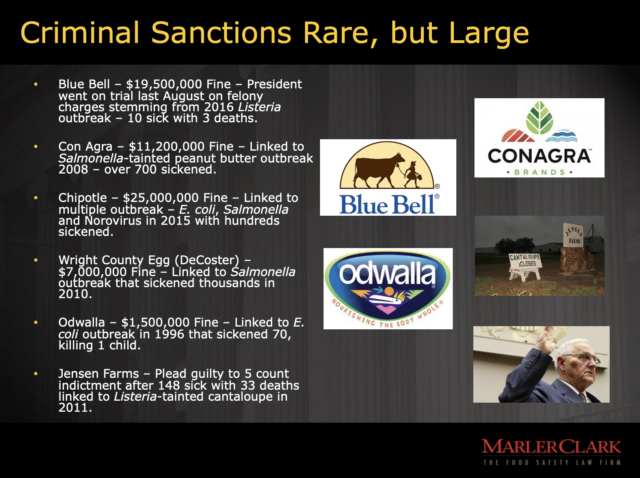
The legal jargon aside, if you are a producer of food and knowingly or not manufacturer and sell adulterated food, you can (and should) face fines and jail time.

Kerry Inc. Pleads Guilty and Agrees to Pay $19.228 Million in Connection with Insanitary Plant Conditions Linked to 2018 Salmonella Poisoning Outbreak

I need to update my slide deck:

Food and ingredient manufacturing company Kerry Inc. pleaded guilty today to a charge that it manufactured breakfast cereal under insanitary conditions at a facility in Gridley, Illinois, that was linked to a 2018 salmonellosis outbreak.

Pursuant to a plea agreement filed with a criminal information in federal court in Peoria, Illinois, Kerry pleaded guilty to a misdemeanor count of distributing adulterated cereal marketed as Kellogg’s Honey Smacks. The company also agreed to pay a criminal fine and forfeiture amount totaling $19.228 million. If the guilty plea is accepted by the court, the $19.228 million fine and forfeiture will constitute the largest-ever criminal penalty following a criminal conviction in a food safety case.

“Consumers depend on food manufacturers to take appropriate steps to ensure food safety,” said Principal Deputy Assistant Attorney General Brian Boynton, head of the Justice Department’s Civil Division. “The Department is committed to holding accountable those who fail to meet this obligation.” 

“Today’s announcement should serve as a reminder that food manufacturers have a critical responsibility to produce and sell food that is safe for American consumers to eat,” said Assistant Commissioner Justin D. Green for the Food and Drug Administration’s (FDA) Office of Criminal Investigations. “We will continue to pursue and bring to justice those who put the public health at risk by allowing contaminated foods to enter the U.S. marketplace.” 

The criminal information unsealed today alleges that Kerry manufactured Kellogg’s Honey Smacks cereal under insanitary conditions and distributed it in violation of the Food, Drug, and Cosmetic Act. According to the plea agreement, tests performed as part of Kerry’s environmental monitoring program found numerous instances of Salmonella in the environment at the Gridley facility. During the time period June 2016 to June 2018, routine environmental tests detected Salmonella in the plant approximately 81 times, including at least one positive Salmonella sample each month. According to the plea agreement, employees at the Gridley facility routinely failed to implement corrective and preventative actions (CAPAs) to address positive Salmonella tests.

In June 2018, the FDA and the Centers for Disease Control and Prevention (CDC) announced that an ongoing outbreak of salmonellosis cases in the United States could be traced to Kellogg’s Honey Smacks cereal produced at Kerry’s Gridley facility. In response, Kellogg’s voluntarily recalled all Honey Smacks manufactured at the plant since June 2017. The CDC eventually identified more than 130 cases of salmonellosis linked to the outbreak, with illness onset dates beginning in March 2018. The CDC did not identify any deaths related to the outbreak.

Salmonellosis can cause symptoms such as diarrhea, fever, and abdominal cramps that last several days in healthy adults. Absent prompt treatment, salmonellosis can cause severe dehydration and even death in infants, young children, the elderly, transplant recipients, pregnant women, and individuals with weakened immune systems.

In a related case, Ravi K. Chermala, Kerry’s Director of Quality Assurance until September 2018, previously pleaded guilty to three misdemeanor counts of causing the introduction of adulterated food into interstate commerce. Chermala oversaw the sanitation programs at various Kerry manufacturing plants, including the Gridley facility. In pleading guilty, Chermala admitted that between June 2016 and June 2018, he directed subordinates not to report certain information to Kellogg’s about conditions at the Gridley facility. In addition, Chermala admitted that he directed subordinates at the Gridley facility to alter the plant’s program for monitoring for the presence of pathogens in the plant, limiting the facility’s ability to accurately detect insanitary conditions. Chermala is scheduled to be sentenced on Feb. 16.

The court set a March 14 sentencing date for Kerry. Further information about the Kerry and Chermala cases will be posted to the Department’s Information for Victims in Large Cases website at https://www.justice.gov/largecases.

FDA’s Office of Criminal Investigations is investigating the matter.

Senior Trial Attorney James T. Nelson of the Civil Division’s Consumer Protection Branch is prosecuting the case. Former Trial Attorney Cody Matthew Herche and Associate Chief Counsel Jason Hadges of FDA’s Office of Chief Counsel provided substantial assistance.

For more information about the enforcement efforts of the Consumer Protection Branch, visit the Branch’s website at http://www.justice.gov/civil/consumer-protection-branch

Look what’s in the Federal Register – https://www.federalregister.gov/documents/2022/11/18/2022-25140/expansion-of-fsis-shiga-toxin-producing-escherichia-coli-stec-testing-to-additional-raw-beef

Not sure why this is not in a press release – but as my friends “down under”say: “Good on ya mate.”

AGENCY:

Food Safety and Inspection Service, USDA.

ACTION:

Notice.

SUMMARY:

The Food Safety and Inspection Service (FSIS) is announcing that on February 1, 2023, the Agency will expand its routine verification testing for six Shiga toxin-producing Escherichia coli that are adulterants (non-O157 STEC; O26, O45, O103, O111, O121, or O145), in addition to the adulterant Escherichia coli ( E. coli) O157:H7, to ground beef, bench trim, and other raw ground beef components in addition to raw beef manufacturing trimmings in official establishments. The raw ground beef components to be tested for these six non-O157 STEC, hereafter “other raw ground beef components,” are: head meat, cheek meat, weasand (esophagus) meat, product from advanced meat recovery (AMR) systems, partially defatted chopped beef and partially defatted beef fatty tissue, low temperature rendered lean finely textured beef, and heart meat. Currently, FSIS tests only its beef manufacturing trimmings samples for these six non-O157 STEC and E. coli O157:H7. Otherwise, all other raw beef products are tested only for E. coli O157:H7 and Salmonella.FSIS also will begin testing for these non-O157 STEC in ground beef samples that it collects at retail stores and in applicable samples it collects of imported raw beef products. Additionally, FSIS is responding to comments regarding the STEC testing expansion and the costs and benefits analysis (CBA), as well as its updated STEC laboratory testing criteria for determining whether a result is positive.

DATES:

Beginning February 1, 2023, FSIS will implement routine verification testing for the six additional STECs discussed in this document (O26, O45, O103, O111, O121, and O145) in raw ground beef, bench trim, and other raw ground beef components. At this time, FSIS also will implement testing for these non-O157 STEC in ground beef samples that it collects at retail stores and in applicable samples it collects of imported raw beef products.

FOR FURTHER INFORMATION CONTACT:

Rachel Edelstein, Assistant Administrator, Office of Policy and Program Development by telephone at (202) 205-0495.

SUPPLEMENTARY INFORMATION:

Background

On June 4, 2020, FSIS announced in the Federal Register its plans to expand its routine verification testing for six non-O157 STEC (O26, O45, O103, O111, O121, or O145) that are adulterants in applicable raw beef products, in addition to the adulterant E. coli O157:H7, to ground beef, bench trim, and other raw ground beef components for samples collected at official establishments (85 FR 34397). FSIS also announced that it would test for these non-O157 STEC in ground beef samples that it collects at retail stores and in applicable samples it collects of imported raw beef products. FSIS stated that it would announce the date for implementation of the new testing in a subsequent Federal Register notice. Additionally, FSIS responded to comments on the November 19, 2014, Federal Register notice titled, “Shiga Toxin-Producing Escherichia coli (STEC) in Certain Raw Beef Products (79 FR 68843).” FSIS also made available its updated CBA on the implementation of its non-O157 STEC testing on raw beef manufacturing trimmings and the costs and benefits associated with the expansion of its non-O157 STEC testing to ground beef, bench trim, and other raw ground beef components.[1

Recent Changes to FSIS’ Laboratory Testing Criteria for Determining Positives

On April 16, 2021, FSIS announced in the Constituent Update changes to the laboratory testing criteria for E. coliO157:H7.[2FSIS explained that it had fully aligned the testing criteria for E. coli O157:H7 with that for non-O157 STEC. FSIS also explained that identifying specific bacterial genes associated with human illness is important for detecting STECs in food. Under the updated method, consistent with laboratory testing for non-O157 STEC, an E. coliO157:H7 isolate is confirmed positive if it has a stx gene, an eae gene, and is identified by the laboratory as O157. Further, under the new method, FSIS no longer performs H7 gene testing for certain O157:H7 isolates. Harmonizing STEC laboratory testing creates a more efficient FSIS laboratory workflow where all regulated STECs are treated the same from initial laboratory screening to full isolate characterization. This update did not affect current FSIS laboratory protocols leading to the reporting of potential and presumptive positive results. To implement this change, FSIS updated the Microbiology Laboratory Guidebook (MLG) Chapter 5C, “ Detection, Isolation, and Identification of Top Seven Shiga Toxin-Producing Escherichia coli (STECs) from Meat Products and Carcass and Environmental Sponges,”  [3and began using the updated STEC method on samples received on or after May 17, 2021.

Aligning the criteria for identifying positives for the top seven STECs of public health interest does not affect FSIS’ public health priorities, will not require establishments, or public health partners, or equivalent countries that ship beef to the United States to change their existing STEC laboratory methods that met the previous two separate STEC definitions, and may facilitate commercial test kit technology development.

Implementation

Currently, the only raw beef products FSIS routinely tests for non-O157 STEC are beef manufacturing trimmings. On February 1, 2023, FSIS plans to implement its expansion of its routine verification testing for the six non-O157 STEC that are adulterants to ground beef, bench trim, and other raw ground beef components for samples collected at official establishments. Once FSIS expands its non-O157 sampling to all raw beef products, for any positive results during routine verification testing, FSIS will conduct follow-up testing. FSIS will analyze all follow-up samples for all seven adulterant STEC and Salmonella.

Responses to Comments

In response to a request from multiple industry associations for more time to submit comments on the June 4, 2020 Federal Register notice, FSIS extended the comment period by an additional 30 days to September 3, 2020.[4FSIS received 10 comments. Specifically, FSIS received comments from a small establishment owner and an industry organization opposed to the expanded testing; while a food industry group, a consumer group coalition, and a college organization supported the expansion of testing. A foreign country and a laboratory testing representative also commented on the proposal. Two comments were outside the scope of this document.

In response to comments, FSIS added clarification on the new laboratory method, and a new table showing the additional cost of the expansion; but made no fundamental changes to the CBA. The Agency still plans to expand STEC testing to ground beef, bench trim, and other raw ground beef components. A summary of the issues raised by commenters and the Agency’s responses follows.

Cost and Benefits Analysis

Comment: An industry organization stated that the Agency did not adequately explain how it calculated an annual savings of $51.6 million from reduced non-O157 STEC outbreak-related recalls. Also, the commenter stated that the Agency did not provide data to support that the proposal will prevent two outbreak-related recalls per year because, according to the commenter, there were only a few non-O157 STEC outbreak-related recalls before 2012 and they are still rare.

The industry organization argued that FSIS’ contention in the CBA that detection can prevent recalls does not include supporting data. According to the commenter, the Agency started testing beef manufacturing trimmings for non-O157 STECs in 2012; therefore, FSIS should compare the number of non-O157 STEC outbreak related recalls before and after implementing this testing program to determine whether the theory has merit.

Response: In the 2020 CBA, FSIS explained how it determined that the proposed policy was likely to prevent, on average, two recalls per year at an estimated cost of $25.6 million per recall. It described the reasoning in detail in section 3.b “Benefits from reduced outbreak-related recalls” and section 4 “Net benefit” (pp. 19-23). FSIS clarified that the estimate was based on Public Health Information System (PHIS) data related to non-O157 STEC contamination and prevalence (i.e., Agency sampling data), not solely on the historical number of non-O157 STEC outbreak-related recalls.

Before 2012, FSIS did not routinely test raw beef products for non-O157 STEC, so it is not possible to make the proposed comparison between the number of recalls associated with beef products contaminated with non-O157 STEC versus recalls caused by E. coli O157:H7. The first non-O157 STEC investigation that led to a recall of ground beef product in the U.S. occurred in 2010. Once the Agency began testing for non-O157 STEC in raw beef manufacturing trimmings, the Agency prevented contaminated raw beef products from entering commerce. Beginning February 8, 2013, FSIS began to withhold its determination as to whether meat and poultry products are not adulterated, and thus eligible to enter commerce, until all test results that bear on the determination have been received (77 FR 73401). A substantial number of recalls (93 recalls) of raw beef products adulterated with STEC occurred between August 2012 and December 2020. Of these recalls approximately 20.0 percent (19 recalls) were caused by non-O157 STEC. Six of the 19 recalls were a result of outbreak investigations and seven were from routine FSIS verification testing. The remaining six recalls were results of: establishment-product testing (four), Agricultural Marketing Service (AMS) testing (one), and a notification from U.S. Food and Drug Administration (FDA) about contaminated flour used to produce a USDA regulated product (one).

As is stated above, currently, the only raw beef products FSIS routinely tests for non-O157 STEC are beef manufacturing trimmings. However, of the 19 non-O157 STEC recalls, 15 of them involved raw non-intact and ground beef products containing non-O157 STEC. Five of the 15 beef products recalled occurred as a result of FSIS routine and follow-up sampling of beef manufacturing trimmings and follow-up sampling verification programs. FSIS may have detected the other ten if FSIS had sampled the product through a routine verification sampling project. Analysis of the Agency’s historical testing data indicates that the number of beef manufacturing trimming samples positive for non-O157 STEC (0.71 percent) exceeded samples positive for E. coli O157:H7 (0.23 percent). Therefore, other beef samples subject to FSIS testing for E. coli O157:H7 may contain non-O157 STEC. As such, we believe it is reasonable to derive the estimate of prevented outbreak-related recalls from the detected prevalence of the pathogen.

Comment: An industry organization commented that the proposed expansion would not contribute to overall lower numbers of positive non-O157 test results. The commenter stated that there have been only two outbreaks of non-O157 STEC attributed to raw beef products since 2006 that resulted in recalls. In the same timeframe, the commenter stated that there have been eight E. coli O157:H7 outbreaks. In addition, the commenter stated that from 2006 to present, there have been 129 recalls for O157, compared to 20 for non-O157 STEC. Finally, the commenter stated that the vast majority of recalls for STEC are not associated with illnesses, because the presence of the pathogen is only part of the equation. Virulence, consumer health, handling, and preparation all play a part.

Response: The STEC pathogen must be present for an individual to show symptoms of the disease caused by that pathogen. FSIS has previously determined that raw, non-intact beef products or raw, intact beef products that are intended for use in raw, non-intact product, that are contaminated with STEC are adulterated within the meaning of 21 U.S.C. 601(m)(1) (76 FR 58157; Sep. 20, 2011). Virulence, consumer health, handling, and preparation may play a part in causing illness, but the key point is that the pathogen must be present.

Between August 2012 and December 2020 approximately 45 million pounds of contaminated raw beef products were prevented from entering commerce by FSIS because of STEC adulteration. Over this timeframe, FSIS tested a total of 167,073 raw beef samples for E. coli O157:H7 and 220 (0.13 percent) of these samples were positive. Analysis of the data tested for O157:H7 and non-O157 STEC by FSIS between August 2012 and December 2020 showed that non-O157 STEC were more frequently recovered from verification beef manufacturing trimming samples.

Specifically, FSIS tested 44,457 samples over the same timeframe as above. See table 1 below for the percent of positive samples for the different STEC.

SerogroupPercent of positive samples
Non-O157.71
O103.42
O157:H7.23
O26.15
O111.11
O145.022
O45.020
O121.016

FSIS raw beef verification testing has been effective in helping to protect the public by detecting E. coli O157:H7 and non-O157 STEC adulterants and preventing these products from entering commerce.

As mentioned, in response to a previous comment, between August 2012 and December 2020, there were 19 recalls of FSIS regulated products that were caused by adulteration of product by non-O157 STEC serogroups. These recalls show that non-O157 STEC can be present in products intended for commerce and represents a threat to public health.

According to the CDC, the number of culture-confirmed illnesses caused by non-O157 STEC have increased, and outpaced illnesses caused by O157:H7 STEC.[5Surveillance data presented by the CDC revealed that the percentage change in incidence of STEC infections in 2019 compared with the annual average incidence from 2016 to 2018 showed that O157:H7 decreased by 20 percent and non-O157 STEC increased by 35 percent.

Comment: An industry organization commented that the CBA relies on the outdated 2013 Pathogen Controls in Beef Operations Survey to evaluate the potential costs from expanded industry sampling in response to the proposal. According to the commenter, this survey may not accurately represent industry sampling practices, and, therefore, costs to industry may be underestimated due to outdated data. The commenter stated that the Agency should conduct an updated survey, with specific questions related to the proposal, and update the CBA before finalizing any changes to its STEC sampling program.

Response: FSIS does not require industry testing for STEC. Under the Hazard Analysis and Critical Control Point (HACCP) regulations, the establishment is required to identify the intended use of the product (9 CFR 417.2(a)(2)), conduct the hazard analysis (9 CFR 417.2(a)), determine the hazard(s) reasonably likely to occur (9 CFR 417.2(a)(1)), and support the decision(s)made (9 CFR 417.5(a)(1)). Also, all establishments are required to conduct on-going verification activities to ensure that their HACCP plans are effectively implemented (9 CFR 417.4(a)(2)). Establishments are required to conduct ongoing verification activities to ensure that any critical control point (CCP) is adequately addressing STEC, or that purchase specifications continue to prevent the pathogen from entering the facility. FSIS recommends that establishments’ verification activities include testing for STEC (67 FR 6232562331).

Lastly, the HACCP regulations in 9 CFR part 417 require that establishments validate the HACCP plan’s adequacy to control the food safety hazards identified by the hazard analysis (9 CFR 417.4(a)). These regulations prescribe requirements for the initial validation of an establishment’s HACCP plan and require that establishments “conduct activities designed to determine that the HACCP plan is functioning as intended.” Validation under 9 CFR 417.4(a)(1)requires that establishments assemble two types of data: (1) The scientific or technical support for the judgments made in designing the HACCP system, and (2) evidence derived from the HACCP plan in operation to demonstrate that the establishment is able to implement the critical operational parameters necessary to achieve the results documented in the scientific or technical support. Thus, validation of the HACCP system involves validation of the critical control points in the HACCP plan, as well as of any interventions or processes used to support decisions in the hazard analysis (80 FR 27557).

In 2012, FSIS explained in a Federal Register notice (77 FR 31979) how E. coli O157:H7 results can be used for non-O157 STEC HACCP decision-making. FSIS considers controls for E. coli O157:H7 to be effective against non-O157 STEC when implemented appropriately (85 FR 34397). How each establishment designs and supports their unique HACCP system can vary, and in-plant testing may or may not be conducted. When employed, testing can be conducted for different reasons, including to establish microbiological independence between lots, fulfill customer purchase specifications for specific products, validate HACCP controls, verify the HACCP system is functioning as intended, or other reasons. The frequency of sampling, products sampled, lot size, sampling method used, and laboratory testing methodology can vary from establishment to establishment based on the purpose sampling serves in each establishment’s HACCP system.

In 2013, FSIS conducted a survey of industry practices of STEC controls to evaluate the potential costs to industry of expanding sampling in response to the 2012 change. Since that survey in 2013, the above HACCP requirements have not changed, the Agency’s method of verification has not changed, and the Agency’s policy regarding the use of E. coliO157:H7 as an indicator for STEC has not changed. Though an establishment may conduct STEC testing for a variety of reasons as noted above, FSIS does not have reason to believe the data obtained in the 2013 survey is no longer reliable nor indicative (on the aggregate) of industry practices. Further, innovations in testing methodology have since occurred that can reduce the costs of STEC analysis (see Section of Recent Changes to FSIS’ Laboratory Method (85 FR 3439734399)). If FSIS assumes establishments do not adopt these cost-saving innovations, the results of the 2013 survey remain valid for cost estimations.

In response to the comments regarding the use of E. coli O157:H7 testing results for non-O157 STEC decision-making, under HACCP, establishments may be able to support using a single STEC serogroup ( e.g., E. coli O157:H7) as an “indicator” of all STEC as one component for demonstrating overall process control over STEC. If this approach is used, the decision-making for how E. coli O157:H7 results indicate control over non-O157 STEC is to be included in the hazard analysis and appropriately supported. Testing for E. coli O157:H7 as an indicator of STEC control may be acceptable for validation, verification, and process control because often the same controls address all STEC.

However, as explained in the Federal Register notice referenced above, both E. coli O157:H7 and non-O157 STECs occur in raw beef at low levels and at low prevalence, and positive tests for these pathogens are not likely to be highly correlated. For this reason, testing for a single STEC serogroup alone cannot serve as an “index” organism for any other STEC, meaning an E. coli O157:H7 result alone does not provide direct evidence about the actual presence or absence of any other STEC serogroups in a specific lot. If an establishment produces 2 lots of product from the same source material and if one lot is positive for a non-O157 STEC serogroup, then an E. coli O157:H7 negative test in the second lot of product would not be sufficient to show microbiological independence even with additional process control information. Such microbiological independence determination would include consideration of numerous other factors, including commonalities in the source materials used, sanitation practices employed, antimicrobial interventions applied, any process control information, other sample results, and illness reports. E. coli O157:H7 testing results alone are not sufficient evidence for microbiological independence following a non-O157 positive.

In addressing corrective actions after a positive STEC result, FSIS personnel are to consider the impact one or more non-O157 STEC positives may have on the adequacy of the HACCP system to control STEC but should not automatically expect establishments to begin non-O157 STEC testing. When a product tests positive for non-O157 STEC, it is important for the establishment to recognize that even though the E. coli O157:H7 results and other processing CCP records may indicate process control was maintained, identification of non-O157 STEC contamination in the production process questions whether design or implementation of the establishment’s unique food safety system is sufficient to control STEC. In response to one or more non-O157 STEC positives, establishments must ensure any additional testing conducted includes non-O157 as part of the validation, verification, and reassessment requirements of 9 CFR 417.4 and supporting documentation requirements of 9 CFR 417.5(a)(1), until the establishment is able to demonstrate control over STEC in their unique HACCP system, or the HACCP system may be deemed inadequate (9 CFR 417.6). For example, it is particularly important in veal establishments to demonstrate control over STEC because FSIS data and other peer-reviewed research shows a higher incidence of non-O157 STEC as compared to E. coli O157:H7.[6

Comment: An industry organization stated that after FSIS starts testing for non-O157 STEC in additional raw beef products, AMS will likely similarly expand its purchase program requirements as it has done in the past in response to FSIS sampling programs, which could increase industry costs.

Response: AMS has a Federal Purchase Program and vendors that choose to participate in that program must comply with AMS’s requirements, including any testing requirements. The requirements of AMS’s Federal Purchase Program are outside the scope of this Federal Register notice about FSIS’ non-O157 STEC testing program.

Response to Positive Test Result

Comment: An industry organization commented that the proposal should not affect practices that have proven successful in the industry’s continued improvement on STEC control. These practices have predominantly applied to beef manufacturing trimmings but should be accepted for any additional products that FSIS samples and tests when it implements expanded testing.

Response: If an establishment uses the same controls for STEC on beef manufacturing trimmings as it does on its other raw beef products, even if the other raw beef products were not slaughtered on-site, it should be able to support the decisions made in the use of such controls. How each establishment designs and supports their HACCP system may vary depending on the establishment and its hazard analysis, HACCP plan and the decisions made to support them.

Comment: A consumer group and a college organization commented that they did not support the use of E. coli O157:H7 testing results for non-O157 STEC decision-making and encouraged FSIS to amend its instructions to inspection personnel to require establishment non-O157 STEC testing to the same degree as E. coli O157:H7 testing. However, an industry organization’s comments did support using E. coli O157:H7 testing results for non-O157 STEC process control decision-making.

Additionally, an industry organization commented that the Agency and industry must appropriately understand and respond to positive STEC results, regardless of the serovar.

Response: FSIS does not require industry testing for STEC. Under the Hazard Analysis and Critical Control Point (HACCP) regulations, the establishment is required to identify the intended use (9 CFR 417.2(a)(2)), conduct the hazard analysis (9 CFR 417.2(a)), determine the hazard(s) reasonably likely to occur (9 CFR 417.2(a)(1)), and support the decision(s)-made (9 CFR 417.5(a)(1)). To be clear: this notice announces the expansion of non-O157 STEC testing by FSIS when it conducts routine verification testing. It does not impose testing requirements on industry.

As is stated above, FSIS considers controls for E. coli O157:H7 to be effective against non-O157 STEC when implemented appropriately (85 FR 34397). As mentioned above, in 2012, FSIS explained in a Federal Register notice (77 FR 31979) how E. coli O157:H7 results can be used for non-O157 STEC HACCP decision-making.

International

Comment: A foreign government questioned whether FSIS would provide a reasonable interval between the publication of the final Federal Register notice and when foreign countries would be required to implement new testing for non-O157 STEC.

Response: After FSIS expands its non-O157 STEC verification sampling and testing, FSIS will require foreign countries that ship beef product to the United States to implement equivalent government verification testing for non-O157 STEC in the same products included in FSIS’ new expanded verification testing program. FSIS acknowledges that foreign countries will need additional time to implement changes to their testing requirements and to provide applicable supporting documentation. FSIS will continue to use the existing equivalence process [7to ensure that foreign countries implement a government microbiological sampling and testing program equivalent to FSIS’ verification testing program for raw beef products within a reasonable time period. In addition, FSIS will begin testing imported ground beef, bench trim, and other raw ground beef components for non-O157 STEC at the same time as FSIS implements its domestic non-O157 STEC testing program ( i.e., on this notice’s effective date).

Test Only for Other Raw Ground Beef Components at Slaughter

Comment: Two industry organizations commented that FSIS should only expand testing to other raw ground beef components produced in slaughter establishments because STEC are introduced, and therefore most effectively controlled, at slaughter. Also, conducting the testing at slaughter establishments allows establishments to identify positive product before it enters commerce. The commenters argued that testing other raw ground beef components for non-O157 STEC at slaughter would prevent recalls and allow establishments to address the underlying cause at the source.

The commenters also stated that sampling and testing at further processing establishments makes it more difficult to identify the cause of the positive result and may increase the amount of product implicated in a recall. Also, according to the commenters, sampling ground beef does not provide feedback to either the processing establishments or slaughter establishments on process control. The commenters stated that the Agency should not include ground beef in the Agency’s expanded non-O157 STEC testing.

Also, one commenter disagreed with the Agency’s argument that by sampling bench trim, the Agency is verifying the product is not adulterated before it is ground. The commenter argued that instead of sampling for non-O157 STEC, FSIS should consider verification tasks at grinding establishments to ensure they maintain effective programs, such as purchase specifications or validated antimicrobial interventions.

Response: FSIS agrees that slaughter establishments are in the best position to prevent non-O157 STEC contamination because the introduction of the contaminant to the exterior surface of beef products can occur during the slaughter and dressing operation. However, processing establishments that receive product for grinding also have an important role in addressing non-O157 STEC. As explained above, the HACCP regulations require establishments to conduct a hazard analysis to determine the food safety hazards that are reasonably likely to occur in their processes and to identify the preventive measures they can apply to control those hazards in the production of particular products (see 9 CFR 417.2(a)). Consistent with the HACCP regulations, processing establishments can control or reduce non-O157 STEC to below detectable levels by using preventive measures, including validated antimicrobial interventions. Processing establishments can also establish as a preventive measure a purchase specification that requires suppliers to provide source materials with no detectable STEC. Processing establishments can then verify that these control measures are working as intended through their own product testing ( see67 FR 62325).

As stated earlier in the document, currently, the only raw beef products routinely tested for non-O157 STEC by the Agency are beef manufacturing trimmings, and beef manufacturing trimmings are produced at the slaughter establishment. However, of the 19 non-O157 STEC recalls, 15 of them were a result of raw non-intact and ground beef products containing non-O157 STEC. These 15 recalls support that expansion of routine non-O157 testing to other raw beef products, such as ground beef and other raw ground beef components, is necessary so that adulterated products do not reach the consumer.

Testing Based on Production Volume

Comment: An industry organization commented that FSIS should conduct sampling and testing for non-O157 STEC in applicable product in all establishments, regardless of production volume, for at least one year, and then FSIS should evaluate the data to determine whether continued sampling is warranted. This approach would allow additional components to be tested for non-O157 STECs at all establishment sizes for all products used as components for ground beef.

Response: Currently, per FSIS Directive 10,010.1, all establishments that produce raw beef products are subject to FSIS sampling and testing for STEC and Salmonella, regardless of establishment size. Consistent with the sampling frequency set in the directive, FSIS will sample each establishment that produces raw ground beef products at least three times per year. FSIS also samples establishments that produce bench trim, other raw ground beef components, or beef manufacturing trimmings at least once per year for each product. FSIS will continue to assess results and make necessary changes to its sampling and testing program. However, FSIS anticipates that it will continue this sampling and testing on an ongoing basis beyond one year of sampling and testing.

Testing Methods

Comment: One individual commented that STEC testing is much more sensitive than E. coli O157:H7 testing. The commenter stated that the STEC test is a presence or absence test that will show positive results with just a couple of cells. The commenter also stated that test results showing low numbers for Aerobic Plate Count (APC) and generic E. coliwould also test positive for STEC.

Response: As discussed earlier in the document, FSIS updated its laboratory method in 2019 to use a single, combined workflow to screen samples for the presence of E. coli O157:H7 and the six non-O157 STEC that FSIS considers adulterants (O26, O45, O103, O111, O121, or O145). The technology used for screening samples allows all seven STEC serogroups to be screened identically. FSIS utilizes the following performance criteria and definitions when evaluating the suitability of an alternative laboratory method for a given analyte and sampling matrix pair: [8

  • Sensitivity of 90 percent or greater,
  • Specificity of 90 percent or greater,
  • Accuracy of 90 percent or greater,
  • Positive Predictive Value of 90 percent or greater, and

• Negative Predictive Value of 90 percent or greater. FSIS’ internal verification work during the selection of new technologies in 2018 found a sensitivity of 92 percent in STEC samples inoculated with approximately 1 CFU in a 325g sample for that technology.[9The manufacturer determined the average limit of detection (LOD50 ) of the iQ-Check STEC VIrX and SerO II method was 0.7 (range: 0.4-1.2) CFU/sample for O157 and other adulterant STEC.[10There is no difference in sensitivity for E. coli O157 and other non-O157 adulterant STEC serogroups. Additional information for using this method may be found in Chapter 5C of the MLG and associated appendices.[11

Testing Results

Comment: An industry organization commented that follow-up sampling conducted by the Agency in response to an E. coli O157:H7 positive in products only subject to E. coli O157:H7 testing should continue to be tested for all STEC, but the results should not be included in baseline and routine verification data (prevalence). According to the commenter, the Agency also incorrectly included follow-up sampling as part of the aggregated prevalence data in the proposed expansion of products tested for STEC. The commenter noted that FSIS previously reported follow-up sampling independently from routine sampling data and, according to the commenter, should consistently do so moving forward. According to the commenter, follow-up samples should never be included in overall prevalence calculations of O157 or non-O157 STEC. According to the commenter, follow-up sampling is conducted in response to a positive sampling result, which may indicate issues with process control at that establishment and can therefore skew the data.

Response: FSIS collects follow-up samples as a result of a positive from a routine verification sample. The purpose of scheduling these follow-up samples is to determine whether the establishment effectively addresses STEC. As mentioned above, once FSIS expands its non-O157 sampling to all raw beef products, FSIS will analyze all follow-up samples for all 7 adulterant STEC and Salmonella. FSIS posts the follow-up sampling results separately on its website.

When calculating prevalence, FSIS does not use follow-up sampling in its prevalence calculations. Also, FSIS does not typically use follow-up samples in its baseline studies.

Reallocating Resources

Comment: Two organizations commented that the Agency should explain its reasoning for changing its allocation of resources for sampling STECs. According to the commenters, the Agency intends to sample once per week in higher volume establishments, a slight increase from four samples per month, by reallocating resources from lower-volume establishments. The commenters argued that the slight increase will likely not cause significant issues in high volume establishments, but there is not enough information about the reallocation to understand the potential impact of decreased sampling at lower volume establishments. The commenters argued that the shift in sampling may represent a significant reduction or elimination of sampling in lower volume establishments. According to the commenters, the data should be analyzed by volume to determine whether a decrease in sampling frequency at lower volume establishments will inhibit the Agency from identifying establishments that may have issues with STEC control.

A college organization noted that diverting current testing resources from lower-volume establishments will result in extending the time required for determining establishment performance, potentially increasing the risk of contaminated products entering the marketplace. According to the commenter, until FSIS has demonstrated that reallocating samples among beef processors will not negatively impact public health, the Agency should focus on requesting additional resources from Congress for sampling and laboratory testing. The commenter encouraged FSIS to consider how microbial distribution within a product and/or false-positive test results may affect Agency verification results.

Response: FSIS may address allocating resources for sampling in a future Federal Register document, but FSIS believes the Agency has sufficient resources to conduct sampling and testing for STEC, ensuring that the nation’s commercial supply of raw beef products, whether domestic or imported, is safe, wholesome and unadulterated.

After implementation, the Agency may adjust the numbers of samples collected and tested +/− by approximately 10 percent. FSIS has a set minimum sampling frequency for each establishment. FSIS will sample each establishment that produces raw ground beef products at least three times per year. FSIS also samples establishments that produce bench trim, other raw ground beef components, or beef manufacturing trimmings at least once per year for each product.

Sampling Methodology

Comment: An industry organization noted that FSIS is evaluating alternatives to its sampling procedures ( e.g., assessing sampling using a surface swabbing with a cloth vs. N60 incision sampling). According to the commenter, methodology often has a significant impact on baseline results, which are used to inform the public health decisions of local, state, and federal bodies and other private entities, and support Agency decisions. The commenter argued that the Agency should conduct a short-term, targeted baseline sampling program after a change in methodology and make the new information public with explanations. According to the commenter, this approach will help provide context to preclude public uncertainty if prevalence seemingly increases because the new methodology increases sensitivity and detectability.

Additionally, the same commenter argued that potential changes to sampling methodology for pathogen sampling should be available for public comment. According to the commenter, the industry and other interested parties need time to consider impacts of the new methodology and provide information to the Agency to inform its decision-making. Also, an industry association and an individual commented that FSIS should continue to explore rapid and accurate methods to test for all pathogens of concern. One commenter encouraged FSIS to continue to work with industry and academia to develop rapid tests using the latest technology available to identify STEC and other pathogens in FSIS regulated products.

Response: FSIS continues to update its laboratory criteria and posts changes to its laboratory method in the MLG Chapter 5C titled “ Detection, Isolation, and Identification of Top Seven Shiga Toxin-Producing Escherichia coli (STECs) from Meat Products and Carcass and Environmental.” FSIS also usually announces these changes in the Constituent Update.

FSIS recognizes the importance of keeping abreast of the latest scientific endeavors as well as its role in promoting research in areas important to the FSIS mission. FSIS food safety research priorities [12are presented as suggestions for researchers interested in pursuing food safety objectives that are relevant to FSIS regulated products. This list of research areas of interest may be useful to researchers who are preparing grants for submission to agencies that fund food safety research ( e.g., USDA National Institute of Food and Agriculture ( https://www.nifa.usda.gov), National Institutes of Health ( https://www.nih.gov/​), Grants.gov ( https://www.grants.gov), or researchers with resources to conduct such research. In 2021 FSIS added a study titled, “Develop a method to detect Shiga toxin-producing Escherichia coli (STEC) based on virulence factors,” to the Food Safety Research Priority list.

As mentioned in its June 4, 2020 Federal Register notice (85 FR 34397), FSIS is conducting an in-field surface sampling study to determine the feasibility of a non-destructive surface sample collection method to collect raw beef manufacturing trimmings verification samples. FSIS will announce any changes to the sample collection method for the beef manufacturing trimmings project in a future Federal Register notice.

Data for Agency Policy

Comment: An industry organization commented that FSIS should use relevant scientific data for Agency policy. Specifically, the aggregated data by calendar year publicly available on FSIS’ website incorrectly includes sample results from multiple slaughter classes of cattle, different sampling categories, and is not appropriately stratified. In the aggregated data, the commenter stated that the Agency does not separate samples attributed to different slaughter classes of cattle, such as veal. The commenter stated that different slaughter classes of cattle have varying risks of O157 and non-O157 STEC contamination, and FSIS should evaluate the risk of these different slaughter classes separately.

Response: In the discussion regarding aggregated data, FSIS stated the sampling results from FSIS verification testing programs includes data from veal establishments and follow-up sampling results.[13Using aggregated sampling results is appropriate because FSIS is not proposing any changes to sampling allocations by slaughter class as part of the lab testing change. Therefore, the portion of samples collected from each slaughter class and the overall aggregate sampling is expected to remain consistent. The information showed that FSIS was finding non-O157 positive results in its verification sampling programs across all slaughter classes.

USDA’s Non-Discrimination Statement

In accordance with Federal civil rights law and U.S. Department of Agriculture (USDA) civil rights regulations and policies, USDA, its Mission Areas, agencies, staff offices, employees, and institutions participating in or administering USDA programs are prohibited from discriminating based on race, color, national origin, religion, sex, gender identity (including gender expression), sexual orientation, disability, age, marital status, family/parental status, income derived from a public assistance program, political beliefs, or reprisal or retaliation for prior civil rights activity, in any program or activity conducted or funded by USDA (not all bases apply to all programs). Remedies and complaint filing deadlines vary by program or incident.

Program information may be made available in languages other than English. Persons with disabilities who require alternative means of communication to obtain program information ( e.g., Braille, large print, audiotape, American Sign Language) should contact the responsible Mission Area, agency, or staff office; the USDA TARGET Center at (202) 720-2600 (voice and TTY); or the Federal Relay Service at (800) 877-8339.

To file a program discrimination complaint, a complainant should complete a Form AD-3027, USDA Program Discrimination Complaint Form, which can be obtained online at https://www.ocio.usda.gov/​document/​ad-3027, from any USDA office, by calling (866) 632-9992, or by writing a letter addressed to USDA. The letter must contain the complainant’s name, address, telephone number, and a written description of the alleged discriminatory action in sufficient detail to inform the Assistant Secretary for Civil Rights (ASCR) about the nature and date of an alleged civil rights violation. The completed AD-3027 form or letter must be submitted to USDA by:

(1) Mail: U.S. Department of Agriculture, Office of the Assistant Secretary for Civil Rights, 1400 Independence Avenue SW, Washington, DC 20250-9410; or

(2) Fax: (833) 256-1665 or (202) 690-7442; or

(3) Email: program.intake@usda.gov.

USDA is an equal opportunity provider, employer, and lender.

Additional Public Notification

Public awareness of all segments of rulemaking and policy development is important. Consequently, FSIS will announce this Federal Register publication on-line through the FSIS web page located at: https://www.fsis.usda.gov/​federal-register.

FSIS will also announce and provide a link to it through the FSIS Constituent Update, which is used to provide information regarding FSIS policies, procedures, regulations, Federal Register notices, FSIS public meetings, and other types of information that could affect or would be of interest to our constituents and stakeholders. The Constituent Updateis available on the FSIS web page. Through the web page, FSIS is able to provide information to a much broader, more diverse audience. In addition, FSIS offers an email subscription service which provides automatic and customized access to selected food safety news and information. This service is available at: https://www.fsis.usda.gov/​subscribe. Options range from recalls to export information, regulations, directives, and notices. Customers can add or delete subscriptions themselves and have the option to password protect their accounts.

Done at Washington, DC.

Paul Kiecker,

Administrator.

Footnotes

1.  The CBA is available at: https://www.fsis.usda.gov/​sites/​default/​files/​media_​file/​2020-07/​FSIS-Non-0157-STEC-Testing-CBA-June-2020.pdf.Back to Citation

2.   https://www.fsis.usda.gov/​news-events/​news-press-releases/​constituent-update-april-16-2021.Back to Citation

3.   https://www.fsis.usda.gov/​sites/​default/​files/​media_​file/​2021-04/​MLG-5C.01.pdf.Back to Citation

4.   https://www.fsis.usda.gov/​news-events/​news-press-releases/​constituent-update-june-19-2020.Back to Citation

5.  Ibid.Back to Citation

6.   https://ask.usda.gov/​s/​article/​When-an-establishment-only-conducts-product-testing-for-E-coli-what-factors-does-the-establi.Back to Citation

7.   https://www.fsis.usda.gov/​inspection/​import-export/​equivalence.Back to Citation

8.  MLG 1.01- https://www.fsis.usda.gov/​sites/​default/​files/​media_​file/​2021-03/​MLG-1.01_​0.pdf.Back to Citation

9.   https://www.fsis.usda.gov/​sites/​default/​files/​media_​file/​2021-09/​Molecular-Screen-Evaluation-2018-White-Paper.pdf.Back to Citation

10.   https://www.bio-rad.com/​sites/​default/​files/​2021-08/​Bulletin_​3213.pdf.Back to Citation

11.   https://www.fsis.usda.gov/​sites/​default/​files/​media_​file/​2021-04/​MLG-5C.01.pdf.Back to Citation

12.   https://www.fsis.usda.gov/​science-data/​research-priorities.Back to Citation

13.   https://www.fsis.usda.gov/​science-data/​data-sets-visualizations/​microbiology/​microbiological-testing-program-escherichia-coli.Back to Citation

[FR Doc. 2022-25140 Filed 11-17-22; 8:45 am]

Statement of Jerold Mande, CEO, Nourish Science

FDA Proposed Redesign of Human Foods Program

I congratulate Dr. Califf and FDA for making a serious effort to address FDA’s many food failings. Unfortunately, they failed to use this hard work to produce a plan that solves the fundamental problems.

The #1 problem is inadequate resources including budget. This plan doesn’t propose them.

#2 we must make at least an equal effort to combat acute and chronic food illness. This plan will take nutrition, which is currently listed equally with food safety, and relegate it to what seems to be a small, unfunded, and separate center.

FDA was created to ensure processed food doesn’t make us sick, acutely or chronically. This plan will do virtually nothing to reduce the 1,600 deaths a day due to chronic food illness.

It’s time to move the F in FDA to a “Department of Food and Agriculture” that would elevate food & nutrition policy to the Cabinet level where it needs to be.

It is past time for Congress and the Administration to step in and solve the FDA organizational problems that seems to elude the FDA bureaucracy.

Safe food should not be a political issue.

Perhaps, because after 30 years in the food poison trenches, I had a good idea what was going to happen (or not), or perhaps I too got the embargoed FDA Statement on “FDA Proposes Redesign of Human Foods Program to Enhance Coordinated Prevention and Response Activities.”

Embargoed FDA statements, like confidential Presidential documents, seem to be everyplace all at once.

Sources aside, Drs. Califf’s and Woodcock’s “plan” announced this morning is nothing more than a well-crafted (embargoed to increase the feeling of exclusivity) press release that rearranges the deck chairs on the USS FDA – food safety iceberg be damned.

The FDA essentially ignored the people selected by the Reagan-Udall Foundation to give the FDA suggestions on how to fix both the structure of the food side of the FDA and to move towards a more proactive culture of food safety writ large. Here is the present FDA Organization Chart (highlights by me of the Centers that need to be unified under either an empowered Deputy Commissioner for Foods or a separate Commissioner of Foods who reports to the HHS Secretary).

Xavier, Hakeem, Kevin, Mitch, Chuck and Joe, do you know that 48,000,000 of us get poisoned yearly by the “safest food supply in the world”?  And, that is just bacteria and viruses.  If you consider the food with too much salt, sugar and fat, that the FDA also does an inadequate job of regulating, millions of all of us become ill and die needlessly from this “safe food.”

Xavier, Hakeem, Kevin, Mitch, Chuck and Joe, before yet another food crisis like infant formula or E. coli-tainted romaine happens again – DO SOMETHING!

Xavier, Hakeem, Kevin, Mitch, Chuck and Joe, read the Reagan-Udall report. Hold hearings. Ask hard questions. Seek input from consumers and food processors on how best to organize the FDA to meet its Mission Statement: “The Food and Drug Administration is responsible for protecting the public health … by ensuring the safety of our nation’s food supply, … .”

This can be done. Government can work. Please step up and be the leaders that we need.

Tomorrow is the long-anticipated day that Dr. Califf is set to announce his intentions on how or if to implement the recommendations of the Reagan-Udall Foundation panel’s review of the FDA’s human foods program.

On behalf of the 48,000,000 Americans sickened by a foodborne illness yearly in the U.S. and the millions who die of diseases brought on by too much salt, sugar and fat, I hope is that it is more that “rearranging the deck chairs on the USS FDA.

I have said too often that my vision of a more empowered food-side (food poisoning and nutrition) of the FDA would have been to create two Senate appointed commissioners – one with a portfolio of all aspects of food and one with a portfolio of drugs and medical devices. 

Here are many who I admire that have hope as well.

American Frozen Food Institute, Association of Food and Drug Officials, Consumer Brands Association, Consumer Reports, Environmental Working Group, International Fresh Produce Association, STOP Foodborne Illness, Western GrowersDiverse coalition calls on FDA to outline meaningful reforms in announcement on foods program

WASHINGTON, D.C. – A diverse coalition of food policy stakeholders representing consumers, industry, and state and local regulators reiterated its call for significant structural reform of FDA’s foods program ahead of the agency’s anticipated January 31 announcement on how it intends to implement recommendations from a report by the Reagan-Udall Foundation.

The coalition commended the report when it was released in December of last year, noting that the expert panel accurately captured problems related to the structure, leadership, culture, transparency, and accountability within FDA’s foods program. Importantly, the report reinforces the coalition’s call for an expert, empowered deputy commissioner for food who could unify the program and elevate its stature within FDA.

The coalition reiterated the need for bold reforms that incorporate the following elements:

Full Unification of the Human and Animal Foods Program under an Expert Leader

Establishing an empowered deputy commissioner position with direct line authority over all components of FDA’s human and animal foods program is foundational to its operational success and essential culture change. In practice, this means unifying into a cohesive organizational structure — headed by the deputy commissioner — the Center for Food Safety and Applied Nutrition (CFSAN), the food and feed-related activities of the Center for Veterinary Medicine (CVM), and all the food-related components of the Office of Regulatory Affairs (ORA), including inspection and compliance, food-related laboratories, import oversight, state partnerships, training, and information technology.

Candidates for the empowered deputy commissioner role should possess the attributes recommended in the report, including expertise and knowledge in food safety and/or nutrition; demonstrated strong leadership, management, and communications skills; and the ability to lead and make timely decisions in a complex regulatory environment.

An Elevated, More Prominent Foods Program

The empowered deputy commissioner should be viewed internally and externally as the commissioner’s surrogate for all FDA food activities and as the agency’s leader, spokesperson and decision-maker for the foods program. The position should have the authority and standing within FDA and HHS, to represent FDA on foods program issues and funding before Congress, within the executive branch, as well as with stakeholders and foreign partners.

Culture Change and Modernization

Reframing the culture within the foods program is a prerequisite to the success of its structural reform. The current fragmented structure and lack of central authority and leadership contributes to a culture of silos, indecision, inaction, and delay in implementing the prevention mindset called for in the Food Safety Modernization Act (FSMA). The deputy commissioner should also be mandated to modernize the program in a way that facilitates transparency, timeliness, and meaningful stakeholder engagement as part of its decision-making process.

The FDA’s foods program is a distinctive part of the agency and deserves a structure and leadership model that is appropriately customized to fit its mission. We look forward to FDA Commissioner Califf’s pending announcement and remain committed to working with the agency as changes are implemented.

And, one would think the head of the FDA, would pay attention to those with the purse strings.

DURBIN, DELAURO URGE FDA COMMISSIONER CALIFF TO IMPLEMENT REFORMS AT THE AGENCY’S HUMAN FOODS PROGRAM

The letter follows the Reagan-Udall Foundation’s report which outlined significant flaws within FDA’s Human Food Program

WASHINGTON – U.S. Senate Majority Whip Dick Durbin (D-IL) and U.S. Representative Rosa DeLauro (D-CT) sent a letter to the Food and Drug Administration (FDA) Commissioner Dr. Robert Califf urging him to make critical reforms within FDA’s Human Foods Program.  This follows the Reagan-Udall Foundation’s recent external evaluation and report, which outlined various flaws at FDA including their slow response to foodborne illness outbreaks, particularly with infant formula, and lack of implementing the Food Safety Modernization Act (FSMA), which Durbin and DeLauro authored.  In response to the report, Commissioner Califf plans to release a public update on his new vision of FDA soon. 

“We are writing regarding the Reagan-Udall Foundation’s critical review of the Food and Drug Administration’s (FDA) Human Foods Program,” wrote Durbin and DeLauro.  “You previously stated that this review would help inform a ‘new vision’ for FDA that will be announced at the end of this month.  As part of this ‘new vision,’ we encourage you to embrace the significant leadership and structural reforms that the Foundation recommended in its report.  American families cannot afford for FDA to continue its inadequate food oversight, especially when we now have a comprehensive analysis of how to start to remedy the agency’s food safety failures.”

FDA is responsible for the oversight of nearly 80 percent of food in the United States.  Too often, however, FDA has failed to protect Americans from dangerous food pathogens and outbreaks.  Every year, more than 48 million Americans are sickened, 128,000 are hospitalized, and 3,000 lose their lives because of some bacteria or virus in their food.  In 2011, FMSA was signed into law to transform the United States’ approach to foodborne illnesses.  FSMA requested FDA to be more proactive, not reactive, to foodborne illnesses to prevent outbreaks in the first place.  FSMA empowered FDA with new authorities, resources, and funding to accomplish this goal.  But, as outlined in the Reagan-Udall report, FDA has not made this shift, despite FSMA’s passage more than a decade ago.  FSMA required FDA to promulgate several rules so that it would prevent rather than respondto foodborne outbreaks.  However, more than a handful of times, FDA missed congressionally mandated deadlines to implement them.  FSMA also required FDA to “increase the frequency of inspection of all [food] facilities,” to ensure companies’ compliance with safety and quality standards.  But, FDA inspections have plummeted since FSMA was signed into law.

The letter cites FDA’s failures to respond to a compliance issue at Abbott Nutrition’s Sturgis, Michigan, facility which manufactures infant formula.

“However, despite the vulnerable population that consumes the products manufactured at this facility, FDA did not follow up and inspect the facility until January 2022, upon which it found several samples to suggest the presence of Cronobacter.  Even then, FDA did not request that Abbott initiate a recall of their infant formula—nor warn consumers—until mid-February 2022.  It’s difficult to explain why FDA moved this slowly, even when this issue hospitalized at least four infants, claimed two of their lives, and had the potential to harm the health and well-being of other infants across the nation,” the letter continued.

In July, Durbin, DeLauro, and Senator Richard Blumenthal (D-CT) introduced the Food Safety Administration Act of 2022, legislation that would establish the Food Safety Administration, a single food safety agency responsible for ensuring the safety of our nation’s food supply.  This new agency would take over food safety responsibilities currently housed at FDA.  In the Reagan-Udall Foundation’s report, this proposal was included as their first option for structural reform at FDA.

The letter also urged Commissioner Califf to empower a Deputy Commissioner for Foods with authority over the Human Foods Program; separate the Center for Food Safety and Applied Nutrition (CFSAN) into a “Center for Food Safety” and a “Center for Nutrition;” and directly integrate the Office of Regulatory Affairs’ (ORA) food-related inspectional and compliance responsibilities within the Human Foods Program.

The letter concluded, “As commissioner, you have the power to turn the FDA into an organization that meets its mission and prevents foodborne illnesses and outbreaks—saving and improving lives nationwide.  Now is the time for real reform at FDA—it is not the time for half measures or more excuses.  We look forward to learning more about your ‘new vision’ for FDA’s Human Foods Program later this month.”

Full text of today’s letter is available here and below:

January 30, 2023

Dear Commissioner Califf:

            We are writing regarding the Reagan-Udall Foundation’s critical review of the Food and Drug Administration’s (FDA) Human Foods Program.  You previously stated that this review would help inform a “new vision” for FDA that will be announced at the end of this month.  As part of this “new vision,” we encourage you to embrace the significant leadership and structural reforms that the Foundation recommended in its report.  American families cannot afford for FDA to continue its inadequate food oversight, especially when we now have a comprehensive analysis of how to start to remedy the agency’s food safety failures.

            In addition to its other duties, FDA is responsible for the oversight of nearly 80 percent of food in the United States—from peanut butter, to lettuce, to infant formula.  Too often, however, the FDA has failed to protect Americans from dangerous food pathogens and outbreaks.  Every year, more than 48 million Americans are sickened, 128,000 are hospitalized, and 3,000 lose their lives because E. Coli, Norovirus, Salmonella, or some other bacteria or virus in their food.  This pain, suffering, and loss of life is unacceptable; and, even more infuriating, it can be prevented. 

            In 2011, the FDA Food Safety Modernization Act (FSMA), legislation we crafted to transform our nation’s approach to foodborne illnesses, was signed into law.  It had a simple premise:  FDA was too reactive to foodborne illness outbreaks, acting only after a problem had arisen and people had been sickened.  We worked with bipartisan Members of Congress, consumer organizations, and food companies to turn FDA into an organization that would prevent outbreaks in the first place.  The FSMA empowered the FDA with new authorities, resources, and funding to accomplish this goal.  But, as outlined in the Reagan-Udall report, FDA has not lived up to its end of the bargain, despite the FSMA’s passage more than a decade ago. 

            For example, in October 2021, FDA was alerted to significant compliance issues at Abbott Nutrition’s Sturgis, Michigan, facility—a facility responsible for manufacturing infant formula.  However, despite the vulnerable population that consumes the products manufactured at this facility, FDA did not follow up and inspect the facility until January 2022, upon which it found several samples to suggest the presence of Cronobacter.  Even then, FDA did not request that Abbott initiate a recall of their infant formula—nor warn consumers—until mid-February 2022.  It’s difficult to explain why FDA moved this slowly, even when this issue hospitalized at least four infants, claimed two of their lives, and had the potential to harm the health and well-being of other infants across the nation.

            Americans deserve better than what FDA has done to ensure food safety.  That is why we introduced a bill last Congress to create a new, independent “Food Safety Administration” responsible for taking over FDA’s food oversight responsibilities.  In the Reagan-Udall Foundation’s report, this proposal was included as their first option for structural reform at FDA.  We understand that this change would require congressional action and would be difficult to accomplish in a divided Congress.  However, FDA should take this recommendation to heart and begin undertaking meaningful steps to improve the Human Foods Program in the meantime.

As was outlined in the report, the Human Foods Program must be unified under a single leader and restructured.  To this end, we urge you to empower a Deputy Commissioner for Foods with authority over the Human Foods Program; separate the Center for Food Safety and Applied Nutrition (CFSAN) into a “Center for Food Safety” and a “Center for Nutrition;” and directly integrate the Office of Regulatory Affairs’ (ORA) food-related inspectional and compliance responsibilities within the Human Foods Program.

As commissioner, you have the power to turn the FDA into an organization that meets its mission and prevents foodborne illnesses and outbreaks—saving and improving lives nationwide.  Now is the time for real reform at FDA—it is not the time for half measures or more excuses.  We look forward to learning more about your “new vision” for FDA’s Human Foods Program later this month.

Well, we shall see. Check back tomorrow to see of the USS FDA successfully avoided the iceberg.