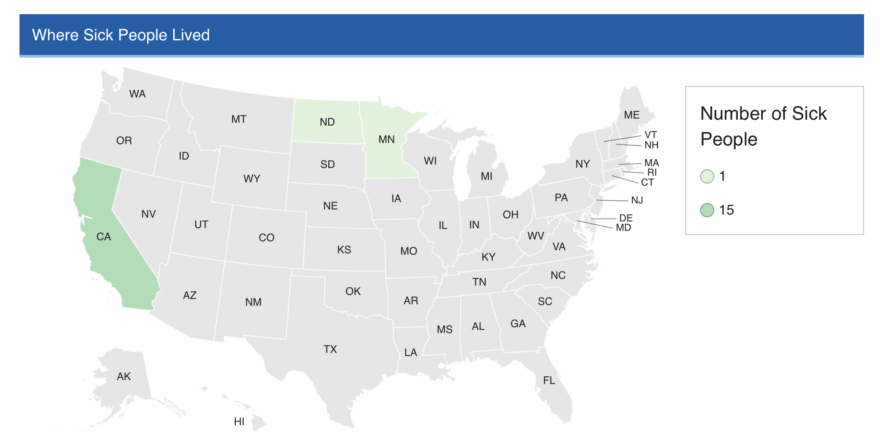
CDC, public health and regulatory officials in several states, and the U.S. Food and Drug Administration are investigating a multistate outbreak of hepatitis A potentially linked to contaminated fresh organic strawberries reportedly sold as FreshKampo or HEB, purchased in the United States between March 5, 2022, and April 25, 2022. The Public Health Agency of Canada and the Canadian Food Inspection Agency are also investigating an outbreak of hepatitis A; imported fresh organic strawberries have been identified as the likely source of that outbreak. Traceback investigations show that outbreak-associated cases in California, Minnesota, and Canada report having purchased fresh organic strawberries prior to becoming ill.

As of May 31, 2022, in the United Sates, a total of 17 outbreak-associated cases of hepatitis A have been reported from 3 states.

Illnesses started on dates ranging from March 28, 2022, to April 30, 2022. Ill people range in age from 9 to 73 years, with a median age of 58. Seventy-one percent of ill people are female. Of 17 people with available information, 12 (71%) have been hospitalized. No deaths have been reported.

Epidemiologic and traceback evidence indicate that fresh organic strawberries are a likely source of this outbreak. The potentially affected FreshKampo and HEB products are past shelf life and no longer available for purchase in the United States. People who purchased FreshKampo or HEB fresh organic strawberries between March 5, 2022, and April 25, 2022 and then froze those strawberries for later consumption should not eat them. These products may have been sold at the following retailers, including, but not limited to: HEB, Kroger, Safeway, Sprouts Farmers Market, Trader Joe’s, Walmart, Weis Markets, and WinCo Foods.

In Canada, as of June 2, 2022, there are 10 laboratory-confirmed cases of hepatitis A illness being investigated in two provinces: Alberta (4) and Saskatchewan (6). Individuals became ill between early and mid April 2022. Individuals who became ill are between 10 to 75 years of age. Four individuals have been hospitalized. No deaths have been reported.

The CFIA is conducting a food safety investigation into the FreshKampo brand fresh organic strawberries purchased between March 5 and 9, 2022 at Co-op stores in Alberta and Saskatchewan. Currently, there are no food recall warnings associated with this outbreak.

In interviews, ill people answered questions about the foods they ate and other exposures in the 2 to 7 weeks before they became ill. Of people who were interviewed, 10/13 (77%) reported eating fresh organic strawberries. This proportion was significantly higher than results from a survey of healthy people in which 50% reported eating fresh strawberries in the week before they were interviewed.

Currently, the potentially affected FreshKampo and HEB products are past shelf life. People who purchased FreshKampo and HEB fresh organic strawberries between March 5, 2022, and April 25, 2022, and then froze those strawberries for later consumption should not eat them. These products were sold at the following retailers, including, but not limited to:

Aldi

HEB

Kroger

Safeway

Sprouts Farmers Market

Trader Joe’s

Walmart

Weis Markets

WinCo Foods

Canadian Co-op stores

Contact your healthcare provider if you think you may have symptoms of a hepatitis A infection after eating these fresh organic strawberries, or if you believe that you have eaten these strawberries in the last two weeks. If you have eaten these organic strawberries, purchased fresh and later frozen, or have symptoms consistent with hepatitis A, see your health care provider immediately. Vaccination can prevent a hepatitis A infection if given within 14 days of exposure. Symptoms of hepatitis A include:

fever

dark urine

loss of appetite

fatigue (tiredness)

nausea and vomiting

stomach cramps or abdominal pain

jaundice (yellowing of the skin and eyes)

After you have been exposed to hepatitis A, symptoms typically appear 14 to 28 days later, but may occur up to 50 days later.

Symptoms usually last less than two months. Mild symptoms may last only one or two weeks, while severe symptoms can last up to nine months.

Anyone can become ill with hepatitis A infection. Most people who become ill from a hepatitis A infection will recover fully, but the risk of serious complications increases with older age and in those with underlying liver disease.

It is possible for some people to be infected with hepatitis A and to not get ill or show any symptoms, but to still be able to spread the virus to others.

Wash and sanitize any drawers, shelves, or containers where the products were stored using a kitchen sanitizer (follow the directions on the container) or prepare a bleach solution in a labelled spray bottle (you can use a ratio of 5 ml of household bleach to 750 ml of water) and rinse with water.

Wash your hands before and after preparing or eating food, and after using the washroom or changing diapers.

If you have been diagnosed with hepatitis A, do not prepare or serve food and drinks to others.

An Introduction to Listeria

Listeria (pronounced liss-STEER-ē-uh) is a gram-positive rod-shaped bacterium that can grow under either anaerobic (without oxygen) or aerobic (with oxygen) conditions. [4, 18] Of the six species of Listeria, only L. monocytogenes (pronounced maw-NO-site-aw-JUH-neez) causes disease in humans. [18] These bacteria multiply best at 86-98.6 degrees F (30-37 degrees C), but also multiply better than all other bacteria at refrigerator temperatures, something that allows temperature to be used as a means of differentiating Listeria from other contaminating bacteria. [18]

Called an “opportunistic pathogen,” Listeria is noted to cause an estimated 2,600 cases per year of severe invasive illness. [26] Perhaps not surprisingly then, “foodborne illness caused by Listeria monocytogenes has raised significant public health concern in the United States, Europe, and other areas of the world.” [3] As one noted expert observed, summarizing the history of these bacteria and their significance for public health,

Although L. monocytogenes was recognized as an animal pathogen over 80 years ago, the first outbreak confirming an indirect transmission from animals to humans was reported only in 1983, in Canada’s Maritime provinces. In that outbreak, cabbages, stored in the cold over the winter, were contaminated with Listeria through exposure to infected sheep manure. A subsequent outbreak in California in 1985 confirmed the role of food in disseminating listeriosis. Since then, Listeria has been implicated in many outbreaks of food-borne illness, most commonly from exposure to contaminated dairy products and prepared meat products, including turkey and deli meats, pâté, hot dogs and seafood and fish. [4]

Given its widespread presence in the environment and food supply, the ingestion of Listeria has been described as an “exceedingly common occurrence.” [18]

The Incidence of Listeria Infections

Listeria bacteria are found widely in the environment in soil, including in decaying vegetation and water, and may be part of the fecal flora of a large number of mammals, including healthy human adults. [4, 18] According to the FDA, “studies suggest that 1-10% of humans may be intestinal carriers of Listeria.” [14] Another authority notes that the “organism has been isolated from the stool of approximately 5% of healthy adults.” [18] Overall, seasonal trends show a notable peak in total Listeria cases and related deaths from July through October. [3]

Ingested by mouth, Listeria is among the most virulent foodborne pathogens, with up to 20% of clinical infections resulting in death. [3] These bacteria primarily cause severe illness and death in persons with immature or compromised immune systems. [13, 18] Consequently, most healthy adults can be exposed to Listeria with little to any risk of infection and illness. [4, 11]

A study published in 1995 projected Listeria infection-rates to the U.S. population, suggesting that an estimated 1,965 cases and 481 deaths occurred in 1989 compared with an estimated 1,092 cases and 248 deaths in 1993, a 44% and 48% reduction in illness and death, respectively. [25] In comparison, a USDA study published in 1996 estimated that there had been 1,795-1860 Listeria-related cases in 1993, and 445-510 deaths, with 85-95% of these attributable to the consumption of contaminated food. [28] Listeriosis-related mortality rates decreased annually by 10.7% from 1990 through 1996, and by 4.3% from 1996 through 2005. [3] 

Among adults 50 years of age and older, infection rates were estimated to have declined from 16.2 per 1 million in 1989 to 10.2 per 1 million in 1993. [25] Perinatal disease decreased from 17.4 cases per 100,000 births in 1989 to 8.6 cases per 100,000 births in 1993. [25] Neonatal infections are often severe, with a mortality rate of 25-50%. [4] 

According to the CDC’s National Center for Zoonotic, Vector-Borne, and Enteric Diseases:

Listeriosis was added to the list of nationally notifiable diseases in 2001. To improve surveillance, the Council of State and Territorial Epidemiologists has recommended that all L. monocytogenes isolates be forwarded to state public health laboratories for subtyping through the National Molecular Subtyping Network for Foodborne Disease Surveillance (PulseNet). All states have regulations requiring health care providers to report cases of listeriosis and public health officials try to interview all persons with listeriosis promptly using a standard questionnaire about high-risk foods. In addition, FoodNet conducts active laboratory- and population-based surveillance. [7]

In 2006, public health officials from 48 states reported 1,270 foodborne disease outbreaks, with a confirmed or suspect source in 884 of the outbreaks (70%). [8] Only one of the outbreaks with a confirmed source was attributed to Listeria, with this outbreak involving eleven hospitalizations and one death. [8] The next year, of 17,883 lab-confirmed infections, the CDC attributed 122 to Listeria. [9] In 2009, there were 158 confirmed Listeria infections, representing an incidence-rate of .34 cases for every 100,000 persons in the United States. [10] Such data revealed an incidence-rate of 0.27 cases per 100,000 persons, a decrease of 42% compared with 1996—1998. [10] But, according to CDC’s Technical Information website, it is estimated that there are 1,600 cases of Listeria infection annually in the United States, based on data through 2008. [7]

 The 2009 numbers represented a reported 30% decrease in the number of infections compared to the 1996—1998 rates of infection. [10] Although the nature and degree of underreporting is subject to dispute, all agree that the confirmed cases represent just the tip of the iceberg. [6, 13] Indeed, one study estimates the annual incidence rate for Listeria to be around 1,795-1,860 cases per 100,000 persons, with 445-510 of the cases ending in death. [28]   

Finally, in a study of FoodNet laboratory-confirmed invasive cases—where infection is detected in blood, cerebrospinal fluid, amniotic fluid, placenta or products of conception—the number of listeriosis cases decreased by 24% from 1996 through 2003. [33] During this same period, pregnancy-associated disease decreased by 37%, while cases among those fifty years old and older decreased by 23%. [33] 

The Prevalence of Listeria in Food and the Environment

Listeria is a common presence in nature, found widely in such places as water, soil, infected animals, human and animal feces, raw and treated sewage, leafy vegetables, effluent from poultry and meat processing facilities, decaying corn and soybeans, improperly fermented silage, and raw (unpasteurized) milk. [18, 23, 27]  Foods commonly identified as sources of Listeria infection include  improperly pasteurized fluid milk, cheeses (particularly soft-ripened varieties, such as traditional Mexican cheeses, Camembert and ricotta), ice cream, raw vegetables, fermented raw-meat sausages, raw and cooked poultry, and cooked, ready-to-eat (RTE) sliced meats—often referred to as “deli meats”. [18, 21, 23, 28] One study found that, over a five-year period of testing, in multiple processing facilities, Listeria monocytogenes was isolated from 14% of 1,080 samples of smoked finfish and smoked shellfish. [16]

Ready-to-eats foods have been found to be a notable and consistent source of Listeria. [14, 21] For example, a research-study done by the Listeria Study Group found that Listeria monocytogenes grew from at least one food specimen in the refrigerators of  64% of persons with a confirmed Listeria infection (79 of 123 patients), and in 11% of more than 2000 food specimens collected in the study. [21] Moreover, 33% of refrigerators (26 of 79) contained foods that grew the same strain with which the individual had been infected, a frequency much higher than would be expected by chance. [21] A widely cited USDA study that reviewed the available literature also summarized that:

In samples of uncooked meat and poultry from seven countries, up to 70 percent had detectable levels of Listeria [13].  Schuchat [23] found that 32 percent of the 165 culture-confirmed listeriosis cases could be attributed to eating food purchased from store delicatessen counters or soft cheeses.  In Pinner [21] microbiologic survey of refrigerated foods specimens obtained from households with listeriosis patients, 36 percent of the beef samples and 31 percent of the poultry samples were contaminated with Listeria.

The prevalence of Listeria in ready-to-eat meats has not proven difficult to explain. [26, 29] As one expert in another much-cited article has noted:

The centralized production of prepared ready-to-eat food products…increases the risk of higher levels of contamination, since it requires that foods be stored for long periods at refrigerated temperatures that favor the growth of Listeria. During the preparation, transportation and storage of prepared foods, the organism can multiply to reach a threshold needed to cause infection. [4]

The danger posed by the risk of Listeria in ready-to-eat meats has prompted the USDA to declare the bacterium an adulterant in these kinds of meat products and, as a result, to adopt a zero-tolerance policy for the presence of this deadly pathogen. [7, 29]

A USDA Baseline Data Collection Program done in 1994 documented Listeria contamination on 15.0% of broiler-chicken carcasses [30]. Subsequent USDA data-collection did not test for the prevalence of Listeria in chicken or in turkeys. [31, 32]   

Transmission and Infection 

Except for the transmission of mother to fetus, human-to-human transmission of Listeria is not known to occur. [18] Infection is caused almost exclusively by the ingestion of the bacteria, most often through the consumption of contaminated food. [18, 21, 23] The most widely accepted estimate of foodborne transmission is 85-95% of all Listeria cases. [23, 28]

The infective dose—that is, the number of bacteria that must be ingested to cause illness—is not known. [4, 18, 26] In an otherwise healthy person, an extremely large number of Listeria bacteria must be ingested to cause illness—estimated to be somewhere between 10–100 million viable bacteria (or colony forming units “CFU”) in healthy individuals, and only 0.1–10 million CFU in people at high risk of infection. [4, 18, 26] Even with such a dose, a healthy individual will suffer only a fever, diarrhea, and related gastrointestinal symptoms. [4, 18]. 

The amount of time from infection to the onset of symptoms—typically referred to as the incubation period—can vary to a significant degree.  Symptoms of Listeria infection can develop at any time from 2 to 70 days after eating contaminated food. [4, 5] According to one authoritative text, 

The incubation period for invasive illness is not well established, but evidence from a few cases related to specific ingestions points to 11 to 70 days, with a mean of 31 days. In one report, two pregnant women whose only common exposure was attendance at a party developed Listeria bacteremia with the same uncommon enzyme type; incubation periods for illness were 19 and 23 days. [18]  

Adults can get listeriosis by eating food contaminated with Listeria, but babies can be born with listeriosis if their mothers eat contaminated food during pregnancy. [4, 24] The mode of transmission of Listeria to the fetus is either transplacental via the maternal blood stream or ascending from a colonized genital tract. [24] Infections during pregnancy can cause premature delivery, miscarriage, stillbirth, or serious health problems for the newborn. [18, 24]

Incidence of Listeria infection in HIV-positive individuals is higher than in the general population. [17, 18] One study found that:

The estimated incidence of listeriosis among HIV-infected patients in metropolitan Atlanta was 52 cases per 100,000 patients per year, and among patients with AIDS it was 115 cases per 100,000 patients per year, rates 65–145 times higher than those among the general population. HIV-associated cases occurred in adults who were 29–62 years of age and in postnatal infants who were 2 and 6 months of age. [17]

Pregnant women make up around 30% of all infection cases, while accounting for 60% of cases involving the 10- to 40-year age group. [18]

Those Most Susceptible to Infection

Several segments of the population are at increased risk and need to be informed so that proper precautions can be taken. [19,20, 27] The body’s defense against Listeria is called “cell-mediated immunity” because the success of defending against infection depends on our cells (as opposed to our antibodies), especially lymphocytes called “T-cells.” [12] Therefore, individuals whose cell-mediated immunity is suppressed are more susceptible to the devastating effects of listeriosis, including especially HIV-infected individuals, who have been found to have a Listeria-related mortality of 29%. [12, 17, 18] 

Pregnant women naturally have a depressed cell-mediated immune system. [18, 24] In addition, the immune systems of fetuses and newborns are very immature and are extremely susceptible to these types of infections. [24] Other adults, especially transplant recipients and lymphoma patients, are given necessary therapies with the specific intent of depressing T-cells, and these individuals become especially susceptible to Listeria as well. [7, 18, 27] 

According to the CDC and other public health organizations, individuals at increased risk for being infected and becoming seriously ill with Listeria include the following groups: 

·      Pregnant women: They are about 20 times more likely than other healthy adults to get listeriosis. About one-third of listeriosis cases happen during pregnancy. 

·      Newborns: Newborns rather than the pregnant women themselves suffer the serious effects of infection in pregnancy. 

·      Persons with weakened immune systems 

·      Persons with cancer, diabetes, or kidney disease 

·      Persons with AIDS: They are almost 300 times more likely to get listeriosis than people with normal immune systems. 

·      Persons who take glucocorticosteroid medications (such as cortisone)  

·      The elderly [11, 20, 21]

Symptoms of Listeria infection

When a person is infected and develops symptoms of Listeria infection, the resulting illness is called listeriosis. [4, 11, 18] Only a small percentage of persons who ingest Listeria fall ill or develop symptoms. [18] For those who do develop symptoms as a result of their infection, the resulting illness is either mild or quite severe—sometimes referred to as a “bimodal distribution of severity.” [13, 28] 

On the mild end of the spectrum, listeriosis usually consists of the sudden onset of fever, chills, severe headache, vomiting, and other influenza-type symptoms. [18, 28]  Along these same lines, the CDC notes that infected individuals may develop fever, muscle aches, and sometimes gastrointestinal symptoms such as nausea or diarrhea. [11] When present, the diarrhea usually lasts 1-4 days (with 42 hours being average), with 12 bowel movements per day at its worst. [18]

Most healthy adults and children who consume contaminated food experience only mild to moderate symptoms. The infection is usually self-limited, since, in healthy hosts, exposure to Listeria stimulates the production of tumor necrosis factor and other cytokines, which activate monocytes and macrophages to eradicate the organism.  Few people with normal immune function go on to have more severe, life-threatening forms of listeriosis, characterized by septic shock, meningitis and encephalitis. [4]

As already noted, when pregnant, women have a mildly impaired immune system that makes them susceptible to Listeria infection. [19] If infected, the illness appears as an acute fever, muscle pain, backache, and headache. [18, 24] Illness usually occurs in the third trimester, which is when immunity is at its lowest. [18] Infection during pregnancy can lead to premature labor, miscarriage, infection of the newborn, or even stillbirth. [24, 28] Twenty-two percent of such infections result in stillbirth or neonatal death. [18] 

Newborns may present clinically with early-onset (less than 7 days) or late-onset forms of infection (7 or more days). [3] Those with the early-onset form are often diagnosed in the first 24 hours of life with sepsis (infection in the blood). [3, 18] Early-onset listeriosis is most often acquired through trans-placental transmission. [18, 24] Late-onset neonatal listeriosis is less common than the early-onset form. [4, 18, 24] Clinical symptoms may be subtle and include irritability, fever and poor feeding. [24] The mode of acquisition of late onset listeriosis is poorly understood. [18, 24]

Diagnosis and Treatment of Listeria Infections

Because there are few symptoms that are unique to listeriosis, doctors must consider a variety of potential causes for infection, including viral infections (like flu), and other bacterial infections that may cause sepsis or meningitis. [4, 18, 19]

Early diagnosis and treatment of listeriosis in high-risk patients is critical, since the outcome of untreated infection can be devastating. This is especially true for pregnant women because of the increased risk of spontaneous abortion and preterm delivery. Depending on the risk group, rates of death from listeriosis range from 10% to 50%, with the highest rate among newborns in the first week of life. [4]

Methods typically used to identify diarrhea-causing bacteria in stool cultures interfere or limit the growth of Listeria, making it less likely to be identified and isolated for further testing. [18] On the other hand, routine methods are effective for isolating Listeria from spinal fluid, blood, and joint fluid. [4, 18] Magnetic-resonance imaging (MRI) is used to confirm or rule out brain or brain stem involvement. [18]

Listeriosis is usually a self-limited illness—which means that a majority of infected individuals will improve without the need for medical care. [4, 11, 14, 18] But for those patients with a high fever, a stool culture and antibiotic-treatment may be justified for otherwise healthy individuals. [4, 18] Although there have been no studies done to determine what drugs or treatment duration is best, ampicillin is generally considered the “preferred agent.” [18] There is no consensus on the best approach for patients who are allergic to penicillin.[18] 

Invasive infections with Listeria can be treated with antibiotics. [18] When infection occurs during pregnancy, antibiotics given promptly to the pregnant woman can often prevent infection of the fetus or newborn. [18, 24] Babies with listeriosis receive the same antibiotics as adults, although a combination of antibiotics is often used until physicians are certain of the diagnosis. 

Complications of Listeria infection

For those persons who suffer a Listeria infection that does not resolve on its own, the complications (or sequelae) can be many. [4, 28] The most common is septicemia (bacterial pathogens in the blood, also known as bacteremia), with meningitis being the second most common. [4, 18] Other complications can include inflammation of the brain or brain stem (encephalitis), brain abscess, inflammation of the heart-membrane (endocarditis), and localized infection, either internally or of the skin. [18]

Death is the most severe consequence of listeriosis, and it is tragically common. [3] For example, based on 2009 FoodNet surveillance data, 89.2% of Listeria patients ended up in the hospital, the highest hospitalization rate for pathogenic bacterial infection. [10] In persons 50 years of age and older, there was a 17.5% fatality rate—also the highest relative to other pathogens. [10, 18]

The Prevention of Listeria infection

Given its widespread presence in the environment, and the fact that the vast majority of Listeria infections are the result of consuming contaminated food or water, preventing illness and death is necessarily (and understandably) a food safety issue. 

L. monocytogenes presents a particular concern with respect to food handling because it can grow at refrigerator temperatures (4°C to 10°C), temperatures commonly used to control pathogens in foods. Freezing also has little detrimental effect on the microbe. Although pasteurization is sufficient to kill Listeria, failure to reach the desired temperature in large packages can allow the organism to survive. Food can also be contaminated after processing by the introduction of unpasteurized material, as happens during the preparation of some cheeses. Listeria can also be spread by contact with contaminated hands, equipment and counter tops. [4]

The use of irradiation to reduce Listeria to safe levels in foods has many proponents. [26] As noted by an eminent CDC researcher, Robert V. Tauxe,

Ready-to-eat meats, such as hot dogs, have already been subjected to a pathogen-killing step when the meat is cooked at the factory, so contamination is typically the result of in-plant contamination after that step. Improved sanitation in many plants has reduced the incidence of infection by half since 1986, but the risk persists, as illustrated by a large hot dog-associated outbreak that occurred in 1999. Additional heat treatment or irradiation of meat after it is packaged would eliminate Listeria that might be present at that point. [26]

The CDC provides a comprehensive list of recommendations and precautions to avoid becoming infected with Listeria, which are as follows:

·      Thoroughly cook raw food from animal sources, such as beef, pork, or poultry to a safe internal temperature. For a list of recommended temperatures for meat and poultry, visit http://www.fsis.usda.gov/PDF/IsItDoneYet_Magnet.pdf. 

·      Rinse raw vegetables thoroughly under running tap water before eating.

·      Keep uncooked meats and poultry separate from vegetables and from cooked foods and ready-to-eat foods.

·      Do not drink raw (unpasteurized) milk, and do not eat foods that have unpasteurized milk in them.

·      Wash hands, knives, countertops, and cutting boards after handling and preparing uncooked foods.

·      Consume perishable and ready-to-eat foods as soon as possible.

Recommendations for persons at high risk, such as pregnant women and persons with weakened immune systems, in addition to the recommendations listed above, include:

·      Meats

o   Do not eat hot dogs, luncheon meats, cold cuts, other deli meats (e.g., bologna), or fermented or dry sausages unless they are heated to an internal temperature of 165°F or until steaming hot just before serving.

o   Avoid getting fluid from hot dog and lunch meat packages on other foods, utensils, and food preparation surfaces, and wash hands after handling hot dogs, luncheon meats, and deli meats.

o   Do not eat refrigerated pâté or meat spreads from a deli or meat counter or from the refrigerated section of a store. Foods that do not need refrigeration, like canned or shelf-stable pâté and meat spreads, are safe to eat. Refrigerate after opening.

·      Cheeses

o   Do not eat soft cheese such as feta, queso blanco, queso fresco, brie, Camembert, blue-veined, or panela (queso panela) unless it is labeled as made with pasteurized milk. Make sure the label says, “MADE WITH PASTEURIZED MILK.”

·      Seafood

o   Do not eat refrigerated smoked seafood, unless it is contained in a cooked dish, such as a casserole, or unless it is a canned or shelf-stable product. Refrigerated smoked seafood, such as salmon, trout, whitefish, cod, tuna, and mackerel, is most often labeled as “nova-style,” “lox,” “kippered,” “smoked,” or “jerky.” These fish are typically found in the refrigerator section or sold at seafood and deli counters of grocery stores and delicatessens. Canned and shelf stable tuna, salmon, and other fish products are safe to eat. 

Recommendations to keep food safe:

·      Be aware that Listeria monocytogenes can grow in foods in the refrigerator. Use an appliance thermometer, such as a refrigerator thermometer, to check the temperature inside your refrigerator. The refrigerator should be 40°F or lower and the freezer 0°F or lower.

·      Clean up all spills in your refrigerator right away–especially juices from hot dog and lunch meat packages, raw meat, and raw poultry.

·      Clean the inside walls and shelves of your refrigerator with hot water and liquid soap, then rinse.

·      Divide leftovers into shallow containers to promote rapid, even cooling. Cover with airtight lids or enclose in plastic wrap or aluminum foil. Use leftovers within 3 to 4 days.

·      Use precooked or ready-to-eat food as soon as you can. Do not store the product in the refrigerator beyond the use-by date; follow USDA refrigerator storage time guidelines:

o   Hot Dogs – store opened packages no longer than 1 week and unopened packages no longer than 2 weeks in the refrigerator.

o   Luncheon and Deli Meat – store factory-sealed, unopened packages no longer than 2 weeks. Store opened packages and meat sliced at a local deli no longer than 3 to 5 days in the refrigerator. [11]

Additional preventive steps and precautions can be found on the websites of most State Departments of Health, including, for example, the Minnesota Department of Health. [20] There is also excellent information to be found at the Extension Service website of the Institute of Food and Agricultural Sciences at University of Florida. [27]

References

1.      Angulo, F.J., et al., “Antimicrobial Use in Agriculture: Controlling the Transfer of Antimicrobial Resistance to Humans,” SEMINARS IN PEDIATRIC INFECTIOUS DISEASES, Vol. 15, No. 2, pp. 78-85 (April 2004).

2.      Angulo, F.J., et al., “Evidence of an Association Between Use of Anti-microbial Agents in Food Animals and Anti-microbial Resistance Among Bacteria Isolated from Humans and the Human Health Consequences of Such Resistance, JOURNAL OF VETERINARY MEDICINE, Series-B, Vol. 51, Issue 8-9, pp. 374-79 (Oct. 2004).

3.      Bennion, J.R., et al., “Decreasing Listeriosis Mortality in the United States, 1990-2005,” CLINICAL INFECTIOUS DISEASES, Vol. 47, No. 7, pp. 867-74 (2008), available online at http://cid.oxfordjournals.org/content/47/7/867.long 

4.      Bortolussi, R, “Listeriosis: A Primer,” CANADIAN MEDICAL ASSOCIAION JOURNAL, Vol. 179, No. 8, pp. 795-7 (Oct. 7, 2008), online at http://www.cmaj.ca/content/179/8/795.long

5.      Bryan, Frank, “Procedures to Investigate Foodborne Illness,” International Association for Food Protection, p. 119 (5th ed. 1999).

6.      Buzby, Jean and Roberts, Tonya, “The Economics of Enteric Infections: Human Foodborne Disease Costs, GASTROENTEROLOGY, Vol. 136, No. 6, pp. 1851-62 (May 2009).

7.      CDC, National Center for Zoonotic, Vector-Borne, and Enteric Diseases, “Listeriosis—Technical Information,” (last updated: April 6, 2011), available online at http://www.cdc.gov/nczved/divisions/dfbmd/diseases/listeriosis/technical.html 

8.      CDC, “Surveillance for Foodborne Disease Outbreaks—United States, 2006,” MORBIDITY AND MORTALITY WEEKLY REPORT, Vol. 58, No. 22, pp. 609-15 (June 12, 2007) at http://www.cdc.gov/mmwr/preview/mmwrhtml/mm5822a1.htm

9.      CDC, “Preliminary FoodNet Data on the Incidence of Infection with Pathogens Transmitted Commonly through Food—10 States, 2007,” MORBIDITY AND MORTALITY WEEKLY REPORT, Vol. 57, No. 14, pp. 366-70 (April 11, 2008), available online at http://www.cdc.gov/mmwr/preview/mmwrhtml/mm5714a2.htm

10.   CDC, “Preliminary FoodNet Data on the Incidence of Infection with Pathogens Transmitted Commonly through Food—10 States, 2009,” MORBIDITY AND MORTALITY WEEKLY REPORT, Vol. 59, No. 14, pp. 418-22 (April 16, 2010) available online at http://www.cdc.gov/mmwr/preview/mmwrhtml/mm5914a2.htm

11.   CDC, National Center for Zoonotic, Vector-Borne, and Enteric Diseases, “Listeriosis—General Information and Frequently Asked Questions,” (last updated: April 6, 2011), available at http://www.cdc.gov/nczved/divisions/dfbmd/diseases/listeriosis/

12.   Cossart, P. and Bierne, H., “The Use of Host Cell Machinery in the Pathogenesis of Listeria monocytogenes,” CURRENT OPINIONS IN IMMUNOLOGY, Vol. 13, No. 1, pp. 96-103 (Feb. 2001).

13.   Council for Agriculture, Science and Technology (CAST), “Foodborne Pathogens: Risks and Consequences: Task Force Report No.122,” pp. 1-87 (Sept. 1994) download at http://www.cast-science.org/publications/index.cfm/foodborne_pathogens_risks_and_consequences?show=product&productID=2852

14.   FDA, “Bad Bug Book: Foodborne Pathogenic Microorganisms and Natural Toxins Handbook—Listeria monocytogenes,” at http://www.cfsan.fda.gov/~mow/chap6.html (site last updated: June 18, 2009).

15.   FDA, Public Meeting, “Listeria monocytogenes Risk Assessment and Risk Management: December 4, 2003 Meeting,” Meeting Agenda and Presentations, available online at http://www.fda.gov/Food/ScienceResearch/ResearchAreas/RiskAssessmentSafetyAssessment/ucm209515.htm For Notice of Public Meeting, see 68 Fed. Reg., Vol. 68, No. 216, at 63108-09, online at http://www.fda.gov/OHRMS/DOCKETS/98fr/03-28045.pdf

16.   Heinitz, M.L. and Johnson, J.M., “The incidence of Listeria spp., Salmonella spp., and Clostridium botulinum in Smoked Fish and Shellfish,” Journal of Food Protection, Vol. 61, pp. 318-23 (March 1998).

17.   Jurado, R.L., et al., “Increased Risk of Meningitis and Bacteremia Due to Listeria monocytogenes in Patients with Human Immunodeficiency Virus Infection,” Clinical Infectious Diseases, Vol. 17, No. 2, pp. 224-7 (1993).

18.   Lorber, Bennett, “Listeria monocytogenes,” in Mandell, Douglas, And Bennett’s PRINCIPLES AND PRACTICE OF INFECTIOUS DISEASES, Fifth Edition, Chap. 195, pp. 2208-14 (2000, Mandell, Bennett, and Dolan, Editors).

19.   Mayo Clinic.  (2009). Listeria infection (listeriosis). Retrieved November 1, 2009, from Mayo Clinic website:  http://www.mayoclinic.com/health/Listeria-infection/DS00963. 

20.   Minnesota Department of Health (MDH), “Preventing Listeriosis,” available online at http://www.health.state.mn.us/divs/idepc/diseases/listeriosis/prevention.html

21.   Pinner, R.W., et al., “Role of Foods in Sporadic Listeriosis. II. Microbiologic and epidemiologic investigation, JOURNAL OF AMERICAN MEDICAL ASSOCIATION, Vol. 267, No. 15, pp. 2046-50 (April 15, 1992).

22.   Roberts, T, “Human Illness Costs of Foodborne Bacteria,” AMERICAN JOURNAL OF AGRICULTURE ECONOMICS, Vol. 71, No. 2, pp. 468-474 (1989).

23.   Schuchat, A, et al., “Role of Foods in Sporadic Listeriosis. I. Case-control Study of Dietary Risk Factors,” JOURNAL OF AMERICAN MEDICAL ASSOCIATION, Vol. 267, No. 15, pp. 2041-5 (April 15, 1992).

24.   Silver, HM, “Listeriosis during pregnancy,” OBSTETRICAL AND GYNECOLOGICAL SURVEY, Vol. 53, Issue 12, pp. 737-740 (Dec. 1998).

25.   Tappero, JW, et al., “Reduction in the Incidence of Human Listeriosis in the United States: Effectiveness of Prevention Efforts,” JOURNAL OF AMERICAN MEDICAL ASSOCIATION, Vol.  273, No. 14, pp. 1118-22 (April 12, 1995).

26.   Tauxe, Robert, CDC, “Food Safety and Irradiation: Protecting the Public from Foodborne Infections,” EMERGING INFECTIOUS DISEASES, Vol. 7, No. 3, pp. 516-21 (June 2001) at http://www.ncbi.nlm.nih.gov/pmc/articles/PMC2631852/pdf/11485644.pdf

27.   University of Florida, IFIS Extension, “Preventing Foodborne Illness: Listeriosis,” Food Science and Human Nutrition Department, Florida Cooperative Extension Service, (Jan. 2003) online at http://edis.ifas.ufl.edu/fs102

28.   USDA Economic Research Service, “Bacterial Foodborne Disease—Medical Costs and Productivity Losses,” AER-741, August 1996 (authors: Jean C. Buzby, et al.) online at http://www.ers.usda.gov/Publications/AER741/

28a. USDA Economic Research Service, S. Crutchfield and T. Roberts, “Food Safety Efforts Accelerate in the 90’s,” FOOD REVIEW, Vol. 23, No. 3, pp. 44-49 (Sept.-Dec. 2000), online at http://www.ers.usda.gov/publications/foodreview/septdec00/FRsept00h.pdf

29.   USDA Food Safety and Inspection Service (FSIS), “Assessing the Effectiveness of the 

Listeria monocytogenes Interim Final Rule, Summary Report,” (Sept. 28, 2004), available online at http://www.fsis.usda.gov/Oppde/rdad/frpubs/97-013F/LM_Assessment_Report_2004.pdf

30.   USDA FSIS, NATIONWIDE BROILER CHICKEN MICROBIOLOGICAL BASELINE DATA COLLECTION PROGRAM, July 1994—July 1995, (April 1996), full report available online at http://www.fsis.usda.gov/OPHS/baseline/broiler1.pdf 

31.   USDA FSIS, THE NATIONWIDE MICROBIOLOGICAL BASELINE DATA COLLECTION PROGRAM: YOUNG CHICKEN SURVEY, July 2007—June 2008, full report available online at http://www.fsis.usda.gov/PDF/Baseline_Data_Young_Chicken_2007-2008.pdf

32.   USDA FSIS, THE NATIONWIDE MICROBIOLOGICAL BASELINE DATA COLLECTION PROGRAM: YOUNG TURKEY SURVEY, Aug. 2008—July 2009, at http://www.fsis.usda.gov/PDF/Baseline_Data_Young_Turkey_2008-2009.pdf

33.   Voetsch, AC, et al., “Reduction in the Incidence of Invasive Listeriosis in Foodborne Diseases Active Surveillance Network Sites, 1996-2003,” CLINICAL INFECTIOUS DISEASES, Vol. 44, No. 4, pp. 513-20 (CDC Control & Prevention Emerging Infections Program, Foodborne Diseases Active Surveillance Network Working Group 2007).

34.   Wallinga, D, “Antimicrobial Use in Animal Feed:  An Ecological and Public Health Problem,” MINNESOTA MEDICINE, Vol. 85, No. 10 pp. 12-16 (Oct. 2002).

An Introduction to Salmonella Bacteria

Salmonella is a bacterium that causes one of the most common enteric (intestinal) infections in the United States – salmonellosis. [5] 

The term Salmonella refers to a group or family of bacteria that variously cause illness in humans. Salmonella serotype typhimurium and Salmonella serotype enteritidis are the most common in the United States. [5, 15, 26]  Salmonella javiana is the fifth most common serotype in the United States and accounted for 3.4% of Salmonella isolates reported to the CDC during 2002. [24] According to one study,

During the 1980s, S. Enteritidis emerged as an important cause of human illness in the United States. In 1976, the incidence of S. Enteritidis was 0.55 per 100,000 population and represented only 5% of all Salmonella isolates. By 1985, this proportion reached 10%, and the rate increased to 2.4 per 100,000 population. During the same time, total Salmonella infection rates rose from 10.7 per 100,000 in 1976 to 24.3 in 1985. The highest rates of S. Enteritidis were seen in the Northeast, although rates in the western region also increased during this time.

The number of outbreaks of S. Enteritidis infection also increased during the 1980s, particularly in the northeastern United States. Laboratory subtyping of S. Enteritidis isolates from outbreaks indicated that phage types (PT) 8 and 13a were the most common phage types in the United States. Although PT4 was common in Europe, where it coincided with a large increase in S. Enteritidis infections, it was seen in the United States only among persons with a history of foreign travel. [26]

Of the Salmonella outbreaks that occurred from 1985 through 1999, “[f]ive hundred twenty-two (62%) outbreaks of S. Enteritidis infection were associated with food prepared at commercial food establishments (restaurants, caterers, delicatessens, bakeries, cafeteria, or market).” [26]

The Incidence of Salmonella Infections

In 2009, over 40,000 cases of Salmonella (13.6 cases per 100,000 persons) were reported to the Centers for Disease Control and Prevention (CDC) by public health laboratories across the nation, representing a decrease of approximately 15% from the previous year, but a 4.2% increase since 1996. [1] Overall, the incidence of Salmonella in the United States has not significantly changed since 1996. [2, 5] 

Only a small proportion of all Salmonella infections are diagnosed and reported to health departments. [15] It is estimated that for every reported case, there are approximately 38.6 undiagnosed infections. [15] The CDC estimates that 1.4 million cases, 15,000 hospitalizations, and 400 deaths are caused by Salmonella infections in the U.S. every year. [3]

Salmonella can be grouped into more than 2,400 serotypes. [5] The two most common serotypes in the U.S. are S.Typhimurium and S. Enteritidis. S. Typhi, the serotype that causes typhoid fever, is uncommon in the U.S. [6] But, globally, typhoid fever continues to be a significant problem, with an estimated 12-33 million cases occurring annually. [5] Moreover, outbreaks in developing countries have a high death-rate, especially when caused by strains of the bacterium that are resistant to antibiotic treatment. [5]

Salmonella are found in the intestinal tract of wild and domesticated animals and humans. Some serotypes of Salmonella, such as S. Typhi and S. Paratyphi are only found in humans. [5]  For ease of discussion, it is generally useful to group Salmonellae into two broad categories: typhoidal, which includes S. Typhi and S. Paratyphi, and non-typhoidal, which includes all other serotypes.

The Prevalence of Salmonella in Food and Elsewhere

Most Salmonella infections are caused by eating contaminated food, especially food from animal origins. [23] One study found that 87% of all confirmed cases of Salmonella were foodborne, with 10 percent from person-to-person infection and 3% caused by pets. [23] As explained in a comprehensive report issued by the USDA’s Economic Research Service, 

Salmonella contamination occurs in a wide range of animal and plant products (table 3).  Poultry products and eggs are frequently contaminated with S. enteritidis, while beef products are commonly contaminated with S. typhimurium. Other food sources of Salmonella may include raw milk or other dairy products and pork.  Salmonella outbreaks also have been traced to contaminated vegetables, fruits, and marijuana. 

Another study went into even greater detail in explaining the prevalence of Salmonella and the sources of human infection, stating as follows: 

A food item was implicated in 389 (46%) outbreaks of S. Enteritidis infection from 1985 through1999; in 86 (22%) of these, more than one food item was implicated. Of the 371 outbreaks for which information was available, 298 (80%) were egg associated. This proportion ranged from 10 (71%) of 14 in 1985 to 19 (95%) of 20 in 1997. Of outbreaks caused by a single vehicle for which information was known, 243 (83%) of 294 were egg-associated, as were 55 (71%) of 77 outbreaks in which more than one food item was implicated.

Among single foods implicated in egg-associated outbreaks, 67 (28%) of 243 were foods that contained raw eggs (e.g., homemade ice cream, Caesar salad dressing, tiramisu, egg nog). Sixty-five (27%) of the outbreaks implicated traditional egg dishes such as omelets, French toast, pancakes, and foods that use egg batter, such as crab cakes, chile rellenos, egg rolls, and Monte Cristo sandwiches. Sixty-three (26%) outbreaks implicated dishes known to contain eggs, such as lasagna, ziti, and stuffing, which would have been expected to have been fully cooked but probably did not reach temperatures sufficient to kill S. Enteritidis. Thirty-six (15%) outbreaks implicated egg dishes that were “lightly cooked” (e.g., hollandaise sauce, meringue, cream pies). The food vehicles in 12 (5%) outbreaks were reported to contain eggs but could not be classified because information on how the dishes were prepared was not provided.

Seventy-three (20%) of the 371 confirmed outbreaks for which information was provided involved vehicles that did not contain eggs. Twenty (27%) of these outbreaks were associated with poultry (chicken or turkey), 8 (11%) with beef, and 6 (8%) with foods containing shrimp (3 outbreaks), bologna (1), pork (1), and pepper loaf (1). Other implicated foods included potatoes (3), beans (3), desserts (3), salad (3), macaroni and cheese (1), cheese sauce (1), goat cheese (1), chili (1), and a pureed diet (1). In 22 (30%) of the non–egg-associated outbreaks, more than one food was implicated. In four of these outbreaks, cross-contamination with raw eggs was suspected. [26]

In sum, food remains the most common vehicle for the spread of Salmonella, and eggs are the most common food implicated. [26] As one authority points out, “Studies showed that the internal contents of eggs can be contaminated with [Salmonella], and this contamination has been identified as a major risk factor in the emergence of human illness.” [26]. Part of this risk stems from the variety of ways that Salmonella can contaminate an egg. For example, the FDA has documented the following:

Bacteria can be on the outside of a shell egg. That’s because the egg exits the hen’s body through the same passageway as feces is excreted. That’s why eggs are required to be washed at the processing plant. All USDA graded eggs and most large volume processors follow the washing step with a sanitizing rinse at the processing plant. It is also possible for eggs to become infected by Salmonella Enteritidis fecal contamination through the pores of the shells after they’re laid. SE also can be inside an uncracked, whole egg. Contamination of eggs may be due to bacteria within the hen’s reproductive tract before the shell forms around the yolk and white. SE doesn’t make the hen sick. [29] 

Chicken is also a major cause of Salmonella. Beginning in 1998, the publisher of Consumer Reports magazine has conducted surveys and tested chicken at retail for Salmonella and Campylobacter. Its 2009 study found 14% of broiler chickens at grocery stores to contain Salmonella. [28] A USDA Baseline Data Collection Program report done in 1994 documented Salmonella contamination on 20.0% of broiler-chicken carcasses [16]. However, in 2009 the same USDA data collection survey showed the prevalence of Salmonella in broiler chickens at 7.5%. [17] Additionally, turkey carries a lower risk with a prevalence of 1.66%.  

While Salmonella comes from animal feces, fruits and vegetables can become contaminated. A common source is raw sprouts, which have been the subject of at least 30 reported outbreaks of foodborne illnesses since 1996. [30] The U.S. Department of Health and Human Services cautions against consuming raw sprouts under any circumstances: “Unlike other fresh produce, seeds and beans need warm and humid conditions to sprout and grow. These conditions are also ideal for the growth of bacteria, including Salmonella, Listeria, and E. coli.” [30]

Symptoms of Salmonella Infection

Salmonella infections can have a broad range of illness, from no symptoms to severe illness. The most common clinical presentation is acute gastroenteritis. Symptoms include diarrhea, and abdominal cramps, often accompanied by fever of 100°F to 102°F (38°C to 39°C). [4, 5] Other symptoms may include bloody diarrhea, vomiting, headache and body aches. The incubation period, or the time from ingestion of the bacteria until the symptoms start, is generally 6 to 72 hours; however, there is evidence that in some situations the incubation can be longer than 10 days. [6, 7]  People with salmonellosis usually recover without treatment within 3 to 7 days. [5] Nonetheless, the bacteria will continue to be present in the intestinal tract and stool for weeks after recovery of symptoms—on average, 1 month in adults and longer in children. [6] 

S. Typhi and Paratyphi generally cause a bacteremic illness—Salmonella found in the blood—of long duration. This illness is called enteric, typhoid, or paratyphoid fever. [5] Symptoms start gradually, and include fever, headache, malaise, lethargy, and abdominal pain. In children, it can present as a non-specific fever. The incubation period for S. Typhi is usually 8 to 14 days, but it can range from 3 to 60 days. [5, 6] For S. Paratyphi infections, the incubation period is similar to that of non-typhoidal Salmonella, 1 to 10 days. [5,6] 

Complications of Salmonella Infection

In approximately 5% of non-typhoidal infections, patients develop bacteremia. [5, 8]  In a small proportion of those cases, the bacteria can cause a focal infection, where it becomes localized in a tissue and causes an abscess, arthritis, endocarditis, or other severe illness. Infants, the elderly, and immune-compromised persons are at greater risk for bacteremia or invasive disease. [5, 23] Additionally, infection caused by antimicrobial-resistant non-typhoidal Salmonellaserotypes appears to be more likely to cause bloodstream infections. [9, 23]

Overall, approximately 20% of cases each year require hospitalization, 5% of cases have an invasive infection, and one-half of 1% die. Infections in infants and in people 65 years of age or older are much more likely to require hospitalization or result in death. [8] There is some evidence that Salmonella infections increase the risk of developing digestive disorders, including irritable bowel syndrome. [10]

Although most persons that become ill with diarrhea caused by Salmonella recover without any further problems, a small number of persons develop a complication often referred to as reactive arthritis. The terminology used to describe this type of complication has changed over time. The term “Reiter’s Syndrome” was used for many years, but has now fallen into disfavor. The precise proportion of persons that develop reactive arthritis following a Salmonella infection is unknown, with estimates ranging from 2 to 15%. [11]  Symptoms of reactive arthritis include inflammation (swelling, redness, heat, and pain) of the joints, the genitourinary tract (reproductive and urinary organs), or the eyes.

More specifically, symptoms of reactive arthritis include pain and swelling in the knees, ankles, feet and heels. It may also affect wrists, fingers, other joints, or the lower back. Tendonitis (inflammation of the tendons) or enthesitis (inflammation where tendons attach to the bone) can occur. Other symptoms may include prostatitis, cervicitis, urethritis (inflammation of the prostate gland, cervix or urethra), conjunctivitis (inflammation of the membrane lining the eyelid) or uveitis (inflammation of the inner eye). Ulcers and skin rashes are less common. [12]  Symptoms can range from mild to severe.

One study showed that on average, symptoms developed 18 days after infection. A small proportion of those persons (15%) had sought medical care for their symptoms, and two thirds of persons with reactive arthritis were still experiencing symptoms 6 months later. [13]  Although most cases recover within a few months, some continue to experience complications for years. Treatment focuses on relieving the symptoms.

There are a lot of gaps in our knowledge surrounding this complication. Since there is no specific test for reactive arthritis, doctors rely on signs and symptoms of the patient in order to make the diagnosis. However, there are no clearly defined criteria or set of symptoms used to diagnose this condition. The role of genetics is also unclear. It is thought that the presence of a gene called human leukocyte antigen (HLA)-B27 predisposes a person to develop reactive  arthritis, along with other autoimmune diseases; however, several studies have shown that many persons that develop reactive arthritis  lack this genetic factor. [11]  

Diagnosis of Salmonella Infections

Salmonella bacteria can be detected in stool. [5, 15] In cases of bacteremia or invasive illness, the bacteria can also be detected in the blood, urine, or on rare occasions in tissues. [5] The test consists of growing the bacteria in culture. [5, 6] A fecal, blood or other sample is placed in nutrient broth or on agar and incubated for 2-3 days. After that time, a trained microbiologist can identify the bacteria, if present, and confirm its identity by looking at biochemical reactions. Treatment with antibiotics before collecting a specimen for testing can affect bacterial growth in culture, and lead to a negative test result even when Salmonella causes the infection. [5]

Treatment for Salmonella Infection

Salmonella infections usually resolve in 3 to 7 days, and many times require no treatment. Persons with severe diarrhea may require rehydration, often with intravenous fluids. [4, 5] Antimicrobial therapy (or treatment with antibiotics) is not recommended for uncomplicated gastroenteritis. In contrast, antibiotics are recommended for persons at increased risk of invasive disease, including infants younger than 3 months of age. [4]

In situations in which antibiotics are needed, trimethoprim/sulfamethoxazole, ampicillin, or amoxicillin, are the best choices. [4, 5] Ceftriaxone, cefotaxime,  or flouroquinolones  are effective options for antimicrobial-resistant strains, although fluoroquinolones are not approved for persons less than 18 years of age. For persons with an infection in a specific organ or tissue (invasive disease), treatment with an expanded-spectrum cephalosporin is recommended, until it is known if the bacteria is susceptible to one of the more commonly used antibiotics listed above. For these rare situations, treatment with antibiotics for 4 weeks is generally recommended. For enteric fever, including S. Typhi infections, treatment for 14 days is recommended. The specific antibiotic chosen depends on the susceptibility of the bacteria and the response to treatment. [4] 

There are many steps a person can take to prevent a Salmonella infection

In general, safe cooking and preparation of food can kill existing Salmonella bacteria and prevent it from spreading. [33] Additionally, safe choices at the grocery store can greatly reduce the risk of Salmonella. [33] 

  • Always wash your hands before you start preparing food.
  • Cook poultry until it reaches an internal temperature of 165 ºF. [33]
  • Cook beef and pork until they reach 160ºF. High quality steaks (not needle or blade tenderized) can be safely cooked to 145ºF. [33]
  • Cook eggs until they reach 160ºF or until the yoke is solid. Pasteurized eggs are available in some grocery stores. [33]
  • Do not eat or drink foods containing raw eggs. Examples include homemade eggnog, hollandaise sauce, and undercooked French toast. [32]
  • Never drink raw (unpasteurized) milk. [32]
  • Avoid using the microwave for cooking raw foods of animal origin. Microwave-cooked foods do not reach a uniform internal temperature, resulting in undercooked areas and survival of Salmonella.
  • If you are served undercooked meat, poultry, or eggs in a restaurant don’t hesitate to send your food back to the kitchen for further cooking.
  • Avoid cross-contamination. That means that you should never allow foods that will not be cooked (like salads) to come into contact with raw foods of animal origin (e.g., on dirty countertops, kitchen sinks, or cutting boards). Wash hands, kitchen work surfaces, and utensils with soap and water immediately after they have been in contact with raw foods of animal origin. [33]
  • Wash hands with soap after handling reptiles, amphibians or birds, or after contact with pet feces. Infants and persons with compromised immune systems should have no direct or indirect contact with such pets.[32]
  • Reptiles, amphibians or birds, or any elements of their housing (such as water bowls) should never be allowed in the kitchen.
  • Avoid eating in animal barns, and wash your hands with soap and water after visiting petting zoos or farm settings.
  • Always wash your hands after going to the bathroom. The hands of an infected person who did not wash his or her hands adequately after using the bathroom may also contaminate food. 

References

  1. CDC, “Salmonella Annual Summary Tables 2009,” 2009, available online at
    http://www.cdc.gov/ncezid/dfwed/PDFs/SalmonellaAnnualSummaryTables2009.pdf
    2. CDC, “Preliminary FoodNet Data on the Incidence of Infection with Pathogens Transmitted Commonly through Food—10 States, 2008,” MORBIDITY AND MORTALITY WEEKLY REPORT, Vol. 58, No. 14, pp. 333-37 (April 10, 2009), online at http://www.cdc.gov/mmwr/preview/mmwrhtml/mm5813a2.htm
  2. Voetsch, Andrew, et al., “FoodNet Estimate of the Burden of Illness Caused By Non-Typhoidal Salmonella Infections in the United States,” CLINICAL INFECTIOUS DISEASES, Vol. 15, No. 38, Supplement 3, pp. S127-34 (April 15, 2004) available online at http://cid.oxfordjournals.org/content/38/Supplement_3/S127.long
  3. American Academy of Pediatrics, “Salmonella infections,” RED BOOK: 2006 Report of the Committee on Infectious Diseases, edited by L. K. Pickering, pp. 581–584 (27th ed. 2006).
  4. Miller, S. and Pegues, D., “Salmonella Species, Including Salmonella Typhi,” in Mandell, Douglas, and Bennett’s PRINCIPLES AND PRACTICE OF INFECTIOUS DISEASES, Sixth Edition, Chap. 220, pp. 2636-650 (2005). 
  5. Behravesh, C.B., et al., “Salmonellosis,” in CONTROL OF COMMUNICABLE DISEASES MANUAL, 19th Edition, published by American Public Health Association, pp. 535-540. (Heymann, D, editor 2008).
  6. Medus, C, et al., “Salmonella Outbreaks in Restaurants in Minnesota, 1995 through 2003—Evaluation of the Role of Infected Foodworkers,” JOURNAL OF FOOD PROTECTION, Vol. 69, No. 8, pp. 1870-78 (Aug. 2006), article abstract and paid-access to full-text available online at http://www.ncbi.nlm.nih.gov/pubmed/16924912
  7. Jones, Timothy F., et al, “Salmonellosis Outcomes Differ Substantially By Serotype,” JOURNAL OF INFECTIOUS DISEASES, Vol. 198, No. 1, pp. 109-14 (July 1, 2008) at http://jid.oxfordjournals.org/content/198/1/109.full
  8. Varma, Jay K., et al., “Antimicrobial-Resistant Non-typhoidal Salmonella is Associated with Excess Bloodstream Infections and Hospitalizations, JOURNAL OF INFECTIOUS DISEASES, Vol. 191, No. 4,  pp. 554-61 (Feb. 15, 2005) available online at http://jid.oxfordjournals.org/content/191/4/554.long
  9. Mearin, F, et al., “Dyspepsia and Irritable Bowel Syndrome after a Salmonella Gastroenteritis outbreak: One-year Follow-up Cohort Study,” GASTROENTEROLOGY, Vol. 129, No. 1, pp. 98-104 (July 2005) article abstract and paid-access to full-text article available online at http://www.ncbi.nlm.nih.gov/pubmed/16012939.
  10. Townes, John M., “Reactive Arthritis after Enteric Infections in the United States: The Problem of Definition,” CLINICAL INFECTIOUS DISEASES, Vol. 50, Issue 2, pp. 247-54 (2010) available online at http://cid.oxfordjournals.org/content/50/2/247.long
  11. National Institute of Arthritis and Musculoskeletal and Skin Diseases, “Reactive Arthritis—Questions and Answers,” (online publication-date: April 2009), available at
    http://www.niams.nih.gov/Health_Info/Reactive_Arthritis/default.asp#a (last accessed on July 20, 2011)
  12. Townes, John M., et al., “Reactive Arthritis Following Culture-Confirmed Infections with Bacterial Enteric Pathogens in Minnesota and Oregon: A Population-based Study,” ANNALS OF RHEUMATIC DISEASE, Vol. 67, No. 12, pp. 1689-96 (Dec. 2008) article abstract at http://www.ncbi.nlm.nih.gov/pubmed/18272671
  13. CDC, SALMONELLA SURVEILLANCE: ANNUAL SUMMARY: 2005 (2007).  http://www.cdc.gov/ncidod/dbmd/phlisdata/salmtab/2005/SalmonellaIntroduction2005.pdf
  14. Tauxe, R, “Emerging Foodborne Diseases: An Evolving Public Health Challenge.,” EMERGING INFECTIOUS DISEASES, Vol. 3, No. 4, pp. 425-34 (1997) at http://www.ncbi.nlm.nih.gov/pmc/articles/PMC2640074/pdf/9366593.pdf
  15. USDA Food Safety and Inspection Service (FSIS), NATIONWIDE BROILER CHICKEN MICROBIOLOGICAL BASELINE DATA COLLECTION PROGRAM, July 1994—July 1995, (April 1996), online at http://www.fsis.usda.gov/OPHS/baseline/broiler1.pdf
  16. USDA Food Safety and Inspection Service (FSIS), THE NATIONWIDE MICROBIOLOGICAL BASELINE DATA COLLECTION PROGRAM: YOUNG CHICKEN SURVEY, July 2007—June 2008, at http://www.fsis.usda.gov/PDF/Baseline_Data_Young_Chicken_2007-2008.pdf
  17. USDA Food Safety and Inspection Service (FSIS), THE NATIONWIDE MICROBIOLOGICAL BASELINE DATA COLLECTION PROGRAM: YOUNG TURKEY SURVEY, Aug. 2008—July 2009, at http://www.fsis.usda.gov/PDF/Baseline_Data_Young_Turkey_2008-2009.pdf
  18. Wallinga, D, “Antimicrobial Use in Animal Feed:  An Ecological and Public Health Problem,” MINNESOTA MEDICINE, Vol. 85, No. 10 pp. 12-16 (Oct. 2002).
  19. White, David, National Antimicrobial Resistance Monitoring System (NARMS), Meetings for Expert Reviews on the NARMS Program, June 23-24, 2005, Rockville, MD, TRANSCRIPT, http://www.fda.gov/AnimalVeterinary/SafetyHealth/AntimicrobialResistance/NationalAntimicrobialResistanceMonitoringSystem/ucm143994.htm
  20. Council for Agriculture, Science and Technology (CAST), “Foodborne Pathogens: Risks and Consequences: Task Force Report No.122,” pp. 1-87 (Sept. 1994) download at http://www.cast-science.org/publications/index.cfm/foodborne_pathogens_risks_and_consequences?show=product&productID=2852
  21. Buzby, Jean, et al., USDA Economic Research Service, “Bacterial Foodborne Disease—Medical Costs and Productivity Losses,” AER-741, August 1996, available online at http://www.ers.usda.gov/Publications/AER741/
  22. Buzby, Jean and Roberts, Tonya, “The Economics of Enteric Infections: Human Foodborne Disease Costs, GASTROENTEROLOGY, Vol. 136, No. 6, pp. 1851-62 (May 2009).
  23. “Outbreak of Salmonella serotype javiana infections—Orlando, Florida, June 2002,” MORBIDITY AND MORTALITY WEEKLY REPORT, Vol. 51, No. 31, pp. 683-4 (Aug.  9, 2002) at http://www.cdc.gov/mmwr/preview/mmwrhtml/mm5131a2.htm
  24. Kass, E. H., “A Brief Perspective on the Early History of American Infectious Disease Epidemiology,” Yale Journal of Biology & Medicine, vol. 60, No. 4, pp. 341-48 (1987) http://www.ncbi.nlm.nih.gov/pmc/articles/PMC2590246/pdf/yjbm00082-0043.pdf
  25. Patrick. ME, et al.  “Salmonella Enteritidis infections, United States, 1985–1999,” EMERGING INFECTIOUS DISEASES, Vol. 10, No. 1 (Jan. 2004), available online at http://www.cdc.gov/ncidod/EID/vol10no1/02-0572.htm
  26. Buzby, Jean and Roberts, Tonya, “The Economics of Enteric Infections: Human Foodborne Disease Costs, GASTROENTEROLOGY,  Vol. 136, No. 6, pp. 1851-62 (May 2009).
  27. Consumers Union, “How Safe is that Chicken?” CONSUMER REPORTS (Jan. 2010), online at http://www.consumerreports.org/cro/magazine-archive/2010/january/food/chicken-safety/overview/chicken-safety-ov.htm
  28. USDA Food Safety and Inspection Service (FSIS), FACT SHEETS, “Egg Products Preparation,” April 2011, available online at http://www.fsis.usda.gov/Factsheets/Focus_On_Shell_Eggs/index.asp
  29. Foodsafety.gov, “Sprouts: What You Should Know,” online at http://www.foodsafety.gov/keep/types/fruits/sprouts.html (last visited February 17, 2012).
  30. CDC, INVESTIGATION ANNOUNCEMENT: MULTISTATE OUTBREAK OF HUMAN SALMONELLA HEIDELBERG INFECTIONS, Aug. 2011, available online at http://www.cdc.gov/salmonella/heidelberg/080111/
  31. CDC, SALMONELLA: PREVENTION, Sep. 2010, available online at http://www.cdc.gov/salmonella/general/prevention.html
  32. USDA Food Safety and Inspection Service (FSIS), FACT SHEETS, “Salmonella Questions and Answers,” May 2011, available online at http://www.fsis.usda.gov/factsheets/salmonella_questions_&_answers/
  33. Illinois Department of Public Health, HEALTHBEAT, Salmonella, Jan. 2009, available online at http://www.idph.state.il.us/public/hb/hbsam.htm

But, no free hepatitis A vaccines to food service workers?

Public Health is currently investigating a report of a person who had hepatitis A infection while detained at Men’s Central Jail (441 Bauchet St, Los Angeles, CA 90012). Hepatitis A is very contagious, and people can even spread the virus before they feel sick. Since getting vaccinated against hepatitis A soon after exposure can help protect against developing the infection, Public Health and Correctional Health Services are offering hepatitis A vaccines to everyone in Men’s Central Jail who may have been exposed. 

The Los Angeles County Department of Public Health is also offering free vaccinations against hepatitis A to anyone who was released after being detained in Men’s Central Jail during the exposure period, May 13 to May 28, 2023. 

The hepatitis A virus, which causes a short-term liver infection, is found in the stool and blood of people who are infected. Hepatitis A is usually transmitted through eating contaminated food, or through close contact with a person while infectious. Symptoms of hepatitis include fever, nausea, vomiting, abdominal pain, diarrhea, dark urine or yellow eyes/skin. 

Public Health recommends anyone detained in Men’s Central Jail during the exposure period and who later develop symptoms of hepatitis seek medical care. Some people with severe symptoms will need medical care in a hospital. With no specific antiviral therapy for hepatitis A, vaccination is the best way to prevent disease.

Starting Saturday, June 3, Public Health is offering hepatitis A vaccine FOR FREE to anyone who was in Men’s Central Jail between May 13 to May 28, 2023.

As I say:

As the Texas Department of Health has reported, there is a Shigella Outbreak in Lavaca County that has sickened nearly 100. It appears to be linked to a local food establishment, Los Cabos San Lucas Mexican Grill, in Hallettsville, Texas.

Introduction to Shigella

Shigella is a species of enteric bacteria that causes disease in humans and other primates. [16, 20] The disease caused by the ingestion of Shigella bacteria is referred to as shigellosis, which is most typically associated with diarrhea and other gastrointestinal symptoms. [11, 16] “Shigella infection is the third most common cause of bacterial gastroenteritis in the United States, after Campylobacter infection and Salmonella infection and ahead of E. coli O157 infection.” [19]

The global burden of shigellosis has been estimated at 165 million cases per year, of which 163 million are in developing countries. [23] More than one million deaths occur in the developing world yearly due to Shigella infection. [23, 29]  By one estimate, Shigella infections are responsible for 300,000 illnesses and 600 deaths per year in the United States. [25]  By another estimate, each year 450,000 Americans are infected with Shigella, causing 6,200 hospitalizations and 70 deaths. [27]

In general, Shigella is one of the most communicable and severe forms of the bacterial-induced diarrheas. [18] No group of individuals is immune to shigellosis, but certain individuals are at increased risk. [16] Small children acquire Shigellaat the highest rate, and [24, 28] persons infected with HIV experience shigellosis much more commonly than other individuals. [4]

Shigella is easily spread person-to-person because of its relatively tiny (compared to other bacteria) infectious dose. [16, 23]  Infection can occur after ingestion of fewer than 100 bacteria. [1, 16, 17]  Another reason Shigella so easily cause infection is because the bacteria thrive in the human intestine and are commonly spread both by person-to-person contact and through the contamination of food. [11, 22, 32]

The Discovery and Naming of Shigella

The several types of Shigella bacteria have been named after the lead workers who discovered each one. [11, 16, 20]   The first bacterium to be discovered, Shigella dysentariae, was named after Kiyoshi Shiga, a Japanese scientist who discovered it in 1896 while investigating a large epidemic of dysentery in Japan. [22, 37] The bacterium was also referred to more generally as the dysentery bacillus (the term “bacillus” referring to a genus of Gram-positive, rod-shaped bacteria of which Shigella is a member). [37] 

In a summary published annually, the CDC provides an overview of the classification of various types (species) of Shigella bacteria, as follows:

There are 4 major subgroups of Shigella, designated A, B, C and D, and 44 recognized serotypes. Subgroups A, B, C and D have historically been treated as species: subgroup A for Shigella dysenteriae; subgroup B for Shigella flexneri; subgroup C for Shigella boydii and subgroup D for Shigella sonnei. These subgroups and serotypes are differentiated from one another by their biochemical traits (ability to ferment D-mannitol) and antigenic properties. The most recently recognized serotype belongs to subgroup C (S. boydii). [12]

S. sonnei, also known as Group D Shigella, accounts for over two-thirds of shigellosis in the United States. Shigella flexneri, or group B Shigella, accounts for almost all the rest. [11, 19] More specifically, according to one recent study, “From 1989 to 2002, S. flexneri accounted for 18.4% of Shigella isolates submitted to CDC. [4] From 1973 to 1999, only 49 S. flexneri-associated outbreaks of foodborne disease were reported.” [32] In contrast, in developing countries, S. flexneri is the most predominant cause of shigellosis, but S. dysinteriae type 1 is still a frequent cause of epidemic throughout the developing world. [1, 16, 23, 37] 

The Incidence of Shigella Infection

The number of shigellosis cases reported annually to the Centers for Disease Control and Prevention (CDC) has varied over the past several years, from more than 17,000 during 1978–2003, to an all-time low of 14,000 in 2004, to almost 20,000 in 2007. [11, 19] But most cases go undiagnosed or unreported. [12, 16, 37]  In one study done in Oregon, 430 confirmed Shigella cases from July 1995 through June 1998 were examined. [30] Among the several findings about those most likely to fall ill was the following:

Of 430 isolates, 410 were identified to the species level: Shigella sonnei accounted for 55% of isolates, and Shigella flexneri, for 40%. The overall annual incidence of shigellosis was 4.4 cases per 100,000 population. Children aged [less than] 5 years (annual incidence, 19.6 cases per 100,000 population) and Hispanics (annual incidence, 28.4 cases per 100,000 population) were at highest risk. [30] 

The CDC estimates that 450,000 total cases of shigellosis occur in the U.S. every year. [4, 11, 21] Shigellosis is also characterized by seasonality, with the largest percentage of reported cases occurring between July and October, and the smallest proportion occurring in January, February, and March. [19] Sporadic (or non-outbreak) infections account for the majority of cases and, in general, the exact means by which persons are infected (risk factors) are not yet well documented or understood. [21, 36]

Shigella is an especially common cause of disease among young children, in large part because it is difficult to control the spread of the bacteria in daycare settings. [16, 28] The symptoms of shigellosis vary so widely that children shedding Shigella in their stool may exhibit no symptoms of infection.  A person infected with Shigella can be asymptomatic (show no symptoms of illness), suffer from moderate to severe diarrhea, or suffer complications up to and including death. [11, 17, 26] 

More on Incidence Rates and How Shigella is Transmitted

As previously noted, Shigella species are transmitted by the fecal-oral route, and most infections are transmitted from person to person, reflecting the low infectious dose. [19] As also noted, as few as ten Shigella bacteria can result in clinical infection. [17] Where persons who are infected may be present, the risk of transmission and infection increases with poor hand hygiene, ingestion of contaminated food or water, inadequate sanitation and toileting, overcrowding, and sexual contact. [4, 14, 21, 24, 28] Shigella bacteria are present in the stools of infected persons while they are sick and for up to a week or two afterwards. [11, 16, 17] It is estimated that up 80% of all infection is the result of person-to-person transmission. [17]

Because of its quite common person-to-person spread, shigellosis has long been associated with outbreaks in daycare centers, nursing homes, institutional settings (like prison), and cruise ships. [11, 14, 17, 23, 24] Explaining the significance of daycare centers as a source of Shigella infection, one well-respected study explains as follows:

High shigellosis rates in children are attributable to several factors. Young children are unable to practice good personal hygiene and have not yet acquired immunity to S. sonnei. The infectious dose is as low as 10–200 organisms, and person-to-person transmission is highly effective. Day-care centers play an important role in the person-to-person spread of shigellosis and its subsequent dissemination in communities. Inadequate hand washing, diapering practices, and fecal contamination of water-play areas, such as kiddie pools, have been associated with S. sonnei transmission in day-care centers. [19]

Several studies have demonstrated an increased frequency of shigellosis cases in young adult men residing in urban settings who have little, if any, exposure to these traditionally recognized risk groups. [4, 36] Although some of these studies indicated that sex between men can be a risk-factor, most of these studies occurred before the HIV epidemic. [4, 23] 

Shigella infections also may be acquired from eating contaminated food. A study published in 2010 estimated more than one-third of U.S. shigellosis cases annually might be caused by the consumption of contaminated food. [21] In the United States, incidence of foodborne illness is documented through FoodNet, a reporting system used by public health agencies that captures foodborne illness in over 13% of the population. [8, 9] Of the 10 pathogens tracked by FoodNet, Salmonella,Campylobacter, and Shigella are responsible for most cases of foodborne illness. [27] An estimated 20% of the total number of cases of shigellosis involve food as the vehicle of transmission. [27]

In one oft-cited study summarizing food-related illness and death in the United States, the following synopsis is set forth at the end, summarizing Shigella.

Reported cases: Outbreak-related cases based on reports to CDC, 1983-1992. Passive surveillance estimate based on average number of cases reported annually to CDC, 1992-1997. Active surveillance estimate based on extrapolation of average 1996-1997 FoodNet rate to the 1997 U.S. population.

Total cases:  Because Shigella frequently causes bloody diarrhea, total cases assumed to be 20 times the number of reported cases, based on similarity to E. coli O157:H7.

Hospitalization rate:  Based on hospitalization rate for culture-confirmed cases reported to FoodNet, 1996-1997.

Case-fatality rate: Average case-fatality rate among cases reported to FoodNet, 1996-1997 (23,24).  Percent foodborne: Assumed to be 20%. Although most cases are due to person-to-person transmission (60),

foodborne outbreaks are responsible for a substantial number of cases [27]

According to the CDC, Shigella is the third most common pathogen transmitted through food. In FoodNet surveillance areas in 2008, the rate of Shigella was 6.6 per 100,000 population, exceeded only by Salmonella (15.2/100,000) and Campylobacter (12.7/100,000). [10] During 2006, public health officials reported a total of 1,270 foodborne-related outbreaks from 48 states in the U.S. [9] Although Shigella was responsible for only 10 (1%) of those outbreaks, 183 confirmed cases of shigellosis were nonetheless reported. [9] This reporting rate contrasts with an average of 659 cases annually in the previous five years, making it potentially an aberration or outlier.

Shigella is also responsible for a substantial portion of foodborne outbreaks on cruise ships. [16, 34] In a review of cruise ship outbreaks worldwide over several years, 16% of outbreaks were attributed to Shigella, affecting over 2,000 passengers. [34] Sanitation violations related to food handling and communicable disease have decreased substantially, however, over the past 15 years. [14]

Symptoms of Shigella Infection

Most people who are infected with Shigella develop diarrhea, fever, and stomach cramps after being exposed to the bacteria. [11, 16, 26] Symptoms may start 12 to 96 hours after exposure, usually within 1 to 3 days. [1, 16] Diarrhea may range from mild to severe, and it usually contains mucus. [16] When more severe, the diarrhea is bloody 25% to 50% of the time. [1, 16, 22] Rectal spasms, which are technically referred to as “tenesmus,” are common. [16] 

Shigellosis usually resolves in 5 to 7 days. [1, 11, 26] A severe infection with high fever may be associated with seizures in children less than two years old. [16, 19] Some persons who are infected may have no symptoms at all but may still pass the Shigella bacteria to others. [11, 17] 

Persons with shigellosis in the U.S. do not often require hospitalization, although the hospitalization rate has been estimated to be more than 50,000 per year. [27] Predictably, the hospitalization rate tends to be highest among older individuals. [9, 10, 16] Those who are immune compromised, like persons infected with HIV, are also more likely to face hospitalization because of the risk of complications. [4] 

The relationship between HIV infection and the subsequent risk for shigellosis has yet to be conclusively evaluated, although it is known that “HIV-associated immunodeficiency leads to more severe clinical manifestations of Shigellainfection.” [23] Moreover, persons infected with HIV “may develop persistent or recurrent intestinal Shigella infections, even in the presence of adequate antimicrobial therapy. They also face an increased risk of Shigella bacteraemia, which can be recurrent, severe or even fatal.” [23]

What are the serious and long-term risks of Shigella infection?

Persons with diarrhea caused by S. sonnei usually recover completely, although it may be several months before their bowel habits are entirely normal. [1, 11, 26] About 2% of persons who are infected with S. flexneri later develop pains in their joints, irritation of the eyes, and painful urination—something typically diagnosed as Reiter’s Syndrome. [1, 6] 

Reiter’s syndrome is more generally referred to as reactive arthritis, a complication that accompanies other kinds of bacterial infections as well. [27, 37] This complication occurs because the immune system, intending to fight Shigella, attacks the body instead. [6, 31]  Reactive arthritis is most common in persons with the HLA-B27 gene. [31] (About 80% of people with reactive arthritis have the HLA-B27 gene. Only 6% of people who do not have the syndrome have the HLA-B27 gene.) Reactive arthritis can last for months or years and may be difficult to treat. [6]

Once someone has suffered a Shigella infection, a certain level of immunity develops, meaning that the person is not likely to get infected with that specific type again for at least several years. [16] This temporary immunity does not, however, protect against other types of Shigella. [16, 29]

Shigella bacteria multiply in the human intestinal tract and invade the cells, which results in much tissue destruction. [29] Many strains produce a toxin called Shiga toxin, which is very potent and destructive. [16, 22] Shiga toxin is very similar to the verotoxin of E. coli O157:H7. Complications of shigellosis include severe dehydration, seizures in small children, rectal bleeding, and invasion of the blood stream by the bacteria (bacteremia or sepsis). [1, 11, 16, 26]  In some cases, the bacteria that cause shigellosis may also cause inflammation of the lining of the rectum (proctitis) or rectal prolapse. [26]

In rare cases (but more common in S. dysenteriae infection), there can also be a deadly complication called “toxic megacolon.” [1, 26] This rare complication occurs when the colon becomes paralyzed, preventing bowel movements or passing gas. [16, 26] Signs and symptoms include abdominal pain and swelling, fever, weakness, and disorientation. [26] Untreated, the colon may rupture and cause peritonitis, a life-threatening condition requiring emergency surgery. [26] 

The other relatively rare complication that can occur with a Shigella infection is the development of hemolytic uremic syndrome. This rare complication is more commonly caused by E. coli O157:H7, and it can lead to a low red blood cell count (hemolytic anemia), low platelet count (thrombocytopenia), and acute kidney failure. [26, 37]  It is more common to develop HUS after being infected with S. dysenteriae. [1]

Diagnosis and Treatment of Shigella Infections

Because the symptoms of a Shigella infection are consistent with a fairly large number of potential illnesses, including most foodborne infections, a diagnosis must be confirmed by a laboratory test. [5, 11, 26] First a stool sample must be obtained from the potentially infected person, and then the sample is placed on a medium to encourage the growth of bacteria. If and when there is growth, the bacteria are identified, usually by looking at the growth under a microscope. [20, 26] The laboratory can also do special tests to tell which species of Shigella the person has, and which antibiotics would be best to treat the infection. [16, 22, 30]  Antibiotic-sensitivity tests are important because Shigella is often resistant to multiple antibiotics. [16, 30] 

More advanced testing and surveillance methods, such as plasmid profiling and chromosomal fingerprinting, can also be used. [11, 20, 29] So-called “genetic fingerprinting” of the bacterial isolate, using pulsed-field gel electrophoresis (PFGE) is a molecular technique that can help to characterize Shigella isolates, whether obtained from human or food samples. [11, 27] Taken together, all of these tests can assist public health officials in determining whether cases (confirmed infections) are isolated or associated with common-source outbreaks. [19, 20, 27] 

Efforts to identify outbreaks of foodborne illness—whether caused by Shigella or other pathogens—are important to preventing the secondary spread of infection, especially with bacteria as highly communicable as Shigella. [1, 11, 21] One major advance in these efforts was the creation of FoodNet, an active surveillance system for foodborne illness. As described by the CDC, 

FoodNet workers regularly contact more than 300 laboratories for confirmed cases of foodborne infections in 10 states encompassing a population of more than 44 million persons. In addition to monitoring the number of Shigella infections, investigators monitor laboratory techniques for isolation of bacteria, perform studies of ill persons to determine exposures associated with illness, and administer questionnaires to people living in FoodNet sites to better understand trends in the eating habits of Americans. [11]

Although shigellosis is usually a self-limited illness, antibiotics can shorten the course, and in the most serious cases, might be lifesaving. [1, 16, 22] Historically, the antibiotics commonly used for treatment of bacterial infections, like those caused by Shigella, are ampicillin, trimethoprim/sulfamethoxazole (TMP-SMZ, also known as Bactrim or Septra), or ceftriaxone (Rocephin). [1, 11, 26]  Ciprofloxacin is also used commonly to treat adults who are infected. [11, 26, 30].  

Unfortunately, Shigella bacteria have become resistant to one or more of these antibiotics. [16, 30] This means some antibiotics might not be effective for treatment, and that using (or overusing) antibiotics to treat shigellosis can sometimes make the bacteria more resistant. [30] As noted in one recent study, 

Of 369 isolates tested, 59% were resistant to TMP-SMZ, 63% were resistant to ampicillin, 1% were resistant to cefixime, and 0.3% were resistant to nalidixic acid; none of the isolates were resistant to ciprofloxacin. Thirteen percent of the isolates had multidrug resistance to ampicillin, chloramphenicol, streptomycin, sulfisoxazole, and tetracycline. Infections due to multidrug-resistant shigellae are endemic in Oregon. [30]

This study therefore suggests that “[n]either ampicillin nor TMP-SMZ should be considered appropriate empirical therapy for shigellosis any longer; when antibiotics are indicated, a quinolone or cefixime should be used.” [30]

The Economic Impact of Shigella Infections

The USDA Economic Research Service (ERS) published its first comprehensive cost estimates for sixteen foodborne bacterial pathogens in 1989. [32]  Five years later, it was estimated that the medical costs and productivity losses that Shigella infections caused each year ran from $907 million to over $1 billion, based on an estimate of 2.1 million cases and between 120-360 deaths. [13] The average length of a related hospital stay was 4.6 days, with the cost (based on a 1990 average cost per day of $687) was $16,888. [13]

Using a different kind of economic analysis, this same 1996 study estimated that the annual cost of Shigella infections was $63 million, while the average cost of each confirmed and treated infection was $390; however, these estimates are based on significantly lower (and outdated) incidence and death rates. [13] Most recent estimates are all much higher. For example, a study published in 2010 estimated the cost per case (in 2009 dollars) for a treated Shigella infection to be $7,092, with an estimate of 96,686 cases and 1,227 deaths per year, and a total cost to U.S. residents of $686 million. [35]

Real Life Impacts of Shigella Infection

Because the illnesses caused by the ingestion of Shigella bacteria range from mild to severe, the real-life impacts of Shigella infection vary from person to person.  

While anyone can become ill with Shigella infection, very young children, the elderly, and persons with compromised immune systems are most likely to develop severe illness.  

  • About 2% of persons who are infected with one type of ShigellaShigella flexneri, later develop pains in their joints, irritation of the eyes, and painful urination. This is called post-infectious arthritis, or reactive arthritis.   The arthritis can last for months or years and can lead to chronic arthritis.  Post-infectious arthritis is caused by a reaction to Shigella infection that happens only in people who are genetically predisposed to it. [11]
  • An unknown percentage of patients with Shigella infections develop digestive disorders, including irritable bowel syndrome.

Although most patients with Shigella infections recover within a few months, some continue to experience complications for years.

One woman whose life was permanently altered by this devastating pathogen volunteered to share her story:

How to Prevent Shigella Infection

According to the World Health Organization, “Despite the continuing challenge posed by

Shigella, there is room for optimism as advances in biotechnology have enabled the development of a new generation of candidate vaccines that shows great promise for the prevention of Shigella disease.” [23] But such a vaccine has yet to be perfected. Thus, in the meantime, preventing infection is the best approach, and that means implementing proper sanitation measures. [1, 14]  Indeed, as noted in one authoritative text summarizing the research,

A safe water supply is important for the control of shigellosis and is probably the single most important factor in areas with substandard sanitation facilities. Chlorination is another factor important in decreasing the incidence of all enteric bacterial infections. Of critical importance to the establishment of a safe water supply is the general level of sanitation in the area and the establishment of an effective sewage disposal system. [16]

As previously noted, it takes but a few—far less than 100—Shigella bacteria to cause infection. [17]  Moreover, a person can be infectious even if there are no symptoms, either because he remained asymptomatic (never exhibited symptoms of shigellosis), or because the person continued to shed the bacteria in his stool for a week or two after recovering. [11, 16, 17] 

The spread of Shigella from an infected person to other persons can be avoided by frequent and careful handwashing with soap and hot water. [1, 14, 15] Handwashing among children should be frequent and supervised by an adult in daycare centers and homes with children who have not been fully toilet trained. [24, 28] 

If a child in diapers has shigellosis, everyone who changes the child’s diapers should be sure the diapers are disposed of properly in a closed-lid garbage can and should wash his or her hands and the child’s hands carefully with soap and warm water immediately after the diaper has been changed. [15, 39] After use, the diaper changing area should be wiped down with a disinfectant such as diluted household bleach, Lysol, or bactericidal wipes.  [15, 24, 39] When possible, young children with a Shigella infection who are still in diapers should not be in contact with uninfected children. [1, 11, 15]

Basic food safety precautions and disinfection of drinking water should prevent Shigella bacteria from contaminating food and water. [11, 15, 39] Nonetheless, it should go without saying that people with shigellosis should not prepare food or drinks for others until they have been confirmed (by a stool culture) to no longer be shedding Shigella bacteria in their stool. [1, 15]  At swimming beaches, there should be bathrooms and handwashing stations near the swimming area to help keep the water from becoming contaminated.  [14, 29] Daycare centers should not provide water play areas. [24]

Simple precautions taken while traveling to the developing world can prevent shigellosis. [1, 39] Drink only treated or boiled water, and eat only cooked hot foods or fruits you peel yourself. [1, 11] The same precautions prevent other types of traveler’s diarrhea. [39]

References

  1. American Public Health Association (APHA), “Shigellosis,” in CONTROL OF COMMUNICABLE DISEASES MANUAL, pp. 556-60, edited by Heymann, David L., (19th Ed. 2008).
  2. Angulo, F.J., et al., “Antimicrobial Use in Agriculture: Controlling the Transfer of Antimicrobial Resistance to Humans,” SEMINARS IN PEDIATRIC INFECTIOUS DISEASES, Vol. 15, No. 2, pp. 78-85 (April 2004).
  3. Angulo, F.J., et al., “Evidence of an Association Between Use of Anti-microbial Agents in Food Animals and Anti-microbial Resistance Among Bacteria Isolated from Humans and the Human Health Consequences of Such Resistance, JOURNAL OF VETERINARY MEDICINE, Series-B, Vol. 51, Issue 8-9, pp. 374-79 (Oct. 2004).
  4. Baer, JT, et al., “HIV Infection as a Risk Factor for Shigellosis,” EMERGING INFECTIOUS DISEASESVol. 5, No. 6, pp. 820-823 (1999).  Full text available online at http://wwwnc.cdc.gov/eid/article/5/6/99-0614_article.htm
  5. Bennett,  JV, et al., “Infectious and Parasitic Diseases,” AMERICAN JOURNAL OF PREVENTIVE MEDICINE, Vol. 3, pp. 102–14 (1987).
  6. Carter, JD and Hudson, AP, “Reactive Arthritis: Clinical Aspects and Medical Management,” RHEUMATIC DISEASE CLINICS OF NORTH AMERICA, Vol. 35, No. 1, pp. 21-44 (Feb. 2009). Abstract available online at  http://www.ncbi.nlm.nih.gov/pubmed/19480995
  1. Buzby, Jean and Roberts, Tonya, “The Economics of Enteric Infections: Human Foodborne Disease Costs,” GASTROENTEROLOGY,  Vol. 136, No. 6, pp. 1851-62 (May 2009).  Abstract available online at http://www.gastrojournal.org/article/S0016-5085(09)00341-2/abstract
  2. CDC, “Preliminary FoodNet data on the incidence of foodborne illnesses – Selected sites, United States, 1999,” MORBIDITY AND MORTALITY WEEKLY REPORT, Vol. 49, No. 10, pp. 201-03 (March 17, 2000).  Available online at http://www.cdc.gov/mmwr/preview/mmwrhtml/mm4910a1.htm
  3. CDC, “Preliminary FoodNet Data on the Incidence of Infection with Pathogens Transmitted Commonly through Food—10 States, 2006,” MORBIDITY AND MORTALITY WEEKLY REPORT, Vol. 56, No. 14, pp. 336-9 (April 13, 2007).  Available online at http://www.cdc.gov/mmwr/preview/mmwrhtml/mm5614a4.htm
  4. CDC, “Preliminary FoodNet Data on the Incidence of Infection with Pathogens Transmitted Commonly through Food—10 States, 2009,” MORBIDITY AND MORTALITY WEEKLY REPORT, Vol. 59, No. 14, pp. 418-22 (April 16, 2010).  Available online at http://www.cdc.gov/mmwr/preview/mmwrhtml/mm5914a2.htm
  5. CDC, National Center for Zoonotic, Vector-Borne, and Enteric Diseases, “Shigellosis—General Information and Frequently Asked Questions,” (updated: Nov.16, 2009).  Available online at http://www.cdc.gov/nczved/divisions/dfbmd/diseases/shigellosis/
  6. CDC, SHIGELLA SURVEILLANCE: ANNUAL SUMMARY: 2005 (2007).  Available online at http://www.cdc.gov/ncidod/dbmd/phlisdata/shigtab/2005/ShigellaIntroduction2005.pdf
  7. Council for Agriculture, Science and Technology (CAST), “Foodborne Pathogens: Risks and Consequences: Task Force Report No.122,” pp. 1-87 (Sept. 1994).   Full text available online at http://www.cast-science.org/publications/index.cfm/foodborne_pathogens_risks_and_consequences?show=product&productID=2852
  8. Cramer, EH, Blanton CJ, and Otto C., “Shipshape: Sanitation Inspections on Cruise Chips, 1990-2005,” CDC Vessel Sanitation Program, JOURNAL OF ENVIRONMENTAL HEALTH, Vol. 70, No. 7, pp. 15-21 (March 2008).  Full text available online at http://www.cdc.gov/nceh/vsp/pub/biblio/cramer08.pdf
  9. Doyle, MP, et al., “Reducing Transmission of Infectious Agents in the Home,”  DAIRY, FOOD AND ENVIRONMENTAL SANITATION, Vol. 96, No. 1, pp. 330-37 (June 2000).
  10. DuPont, HL, “Shigella species (bacillary dysentery),” in Mandell, Douglas, and Bennett’s PRINCIPLES AND PRACTICE OF INFECTIOUS DISEASES, Fifth Edition,. p. 2363-9 (2000, Mandell, Bennett, and Dolan, Editors)
  11. DuPont, HL, et al., “Inoculum Size in Shigellosis and Implications for Expected Mode of Transmission,”  THE JOURNAL OF INFECTIOUS DISEASES, Vol. 159, No. 6, pp. 1126-28 (June 1989).  Available for purchase online at http://www.jstor.org/pss/30137443
  12. Gomez HF, et al., “Lactoferrin Protects Rabbits from Shigella flexneri-Induced Inflammatory Enteritis,” INFECTION AND IMMUNITY, Vol. 70, No. 12, pp. 7050-53 (Dec. 2002). Full text at http://iai.asm.org/content/70/12/7050.full
  13. Gupta, Amita, et al., “Laboratory-confirmed Shigellosis in the United States, 1989–2002: Epidemiologic Trends and Patterns,” CLINICAL INFECTIOUS DISEASES, Vol. 38, pp. 1372–77 (May 15, 2004).  Full text available at http://cid.oxfordjournals.org/content/38/10/1372.full.pdf+html
  14. Hale, TL and Keusch, GT, “Shigella: Structure, Classification, and Antigenic Types,” in BARON’S MEDICAL MICROBIOLOGY (4th ed. 1996).
  15.  Haley, CC, et al., “Risk Factors for Sporadic Shigellosis, FoodNet 2005,” FOODBORNE PATHOGENS AND DISEASES, Vol. 7, pp. 741–47 (July 72010).  Abstract available online http://www.ncbi.nlm.nih.gov/pubmed/20113209
  16. Keusch, GT and Acheson, DW, “Shigella Infection,” in ENTERIC INFECTIONS AND IMMUNITY (1996).
  17. Kotloff, K. L., et al., “Global burden of Shigella infections: implications for vaccine development and implementation of control strategies,” BULLETIN OF THE WORLD HEALTH ORGANIZATION, Vol. 77, No. 8 (1999).  Full text available online at http://www.who.int/bulletin/archives/77(8)651.pdf
  18. Krilov, LR, et al., “Impact of an infection control program in a specialized preschool,” AMERICAN JOURNAL OF INFECTION CONTROL, Vol. 24, pp. 167-173 (1996).  Abstract available online  at http://www.ncbi.nlm.nih.gov/pubmed/8806992
  19. Lee, LA, et al., “Hyperendemic Shigellosis in the United States: A Review of Surveillance Data for 1967–1988,” JOURNAL OF INFECTIOUS DISEASES, Vol. 164, pp. 894-900 (Nov. 1991).  Full text available for purchase online at http://jid.oxfordjournals.org/content/164/5/894.full.pdf+html
  20. Mayo Clinic, “Shigella. Infection,”  Mayo Clinic Web site, information last updated April 14, 2010, at http://www.mayoclinic.com/health/shigella/DS00719.
  21. Mead, Paul M, et al., “Food-related Illness and Death in the United States,” EMERGING INFECTIOUS DISEASES, Vol. 5, No. 5, pp. 607-25 (September-October 1999).  Full text available online at  http://www.ncbi.nlm.nih.gov/pmc/articles/PMC2627714/pdf/10511517.pdf
  22. Mohle-Boetani, JC, et al., “Communitywide Shigellosis: Control of an Outbreak and Risk factors in Child Day-Care Centers,” AMERICAN JOURNAL OF PUBLIC HEALTH, Vol. 85, pp. 812-6 (1995). Full text available online at http://www.ncbi.nlm.nih.gov/pmc/articles/PMC1615492/?tool=pubmed
  23. Philpott, DJ, Edgeworth, JD, and Sansonetti, PJ, “The Pathogenesis of Shigella flexneri Infection: Lessons from in vitro and in vivo studies,” PHILOSOPHICAL TRANSACTIONS OF THE ROYAL SOCIETY—BIOLOGICAL SCIENCES,  Vol. 355,  pp. 575-586 (2000).  Full text available online at http://www.ncbi.nlm.nih.gov/pmc/articles/PMC1692768/pdf/10874731.pdf
  24. Replogle, Marilyn, et al., “Emergence of Antimicrobial-Resistant Shigellosis in Oregon,” CLINICAL INFECTIOUS DISEASE (2000) 30 (3): 515-519 (2000). Full text available online at http://cid.oxfordjournals.org/content/30/3/515.long
  25. Ringrose, JH, et al., “Influence of Infection of Cells with Bacteria Associated with Reactive Arthritis on the Peptide Repertoire Presented by HLA-B27,”  JOURNAL OF MEDICAL MICROBIOLOGY, Vol. 50, pp. 385-389 (2001). Full text available online at http://jmm.sgmjournals.org/content/50/4/385.long
  26. Reller, ME, et al., “A Large, Multiple-Restaurant Outbreak of Infection with Shigella flexneri serotype 2a Traced to Tomatoes,” CLINICAL INFECTIOUS DISEASES, Vol. 42, No. 2, pp. 163-169 (2006). Full text available online at http://cid.oxfordjournals.org/content/42/2/163.long
  27. Roberts, T, “Human Illness Costs of Foodborne Bacteria,” AMERICAN JOURNAL OF AGRICULTURE ECONOMICS, Vol. 71, No. 2, pp. 468-474 (1989).  Full text available for purchase online at http://www.jstor.org/pss/1241614
  28. Rooney, RM, et al., “A Review of Outbreaks of Foodborne Disease Associated with Passenger Ships: Evidence for Risk Management,” PUBLIC HEALTH REPORTS, Vol. 119, No. 4, pp. 427-434 (July-August 2004).  Full text available online at http://www.ncbi.nlm.nih.gov/pmc/articles/PMC1497653/pdf/15219800.pdf
  29. Scharf, Robert, “Health-Related Costs from Foodborne Illness in the United States,” The Produce Safety Project at Georgetown University (March 3, 2010).  Full text available online at http://www.producesafetyproject.org/admin/assets/files/Health-Related-Foodborne-Illness-Costs-Report.pdf-1.pdf
  30. Tauxe, RV, et al., “The Persistence of Shigella flexneri in the United States: Increasing Role of Adult Males,” AMERICAN JOURNAL OF PUBLIC HEALTH, Vol. 78, No. 11, pp. 1432-5 (Nov. 1988). Full text available online at http://www.ncbi.nlm.nih.gov/pmc/articles/PMC1350234/pdf/amjph00250-0046.pdf
  31. Trofa, Andrew, et al., “Dr. Kiyoshi Shiga: Discover of Dysentery Bacillus,” CLINICAL INFECTIOUS DISEASES, Vol. 29, pp. 1303-06 (1999).  Full available online at http://cid.oxfordjournals.org/content/29/5/1303.long
  32. USDA Economic Research Service, “Bacterial Foodborne Disease—Medical Costs and Productivity Losses,” AER-741, August 1996 (authors: Jean C. Buzby, et al.).  Full text available online at http://www.ers.usda.gov/Publications/AER741/
  33. Wallinga, D, “Antimicrobial Use in Animal Feed:  An Ecological and Public Health Problem,” MINNESOTA MEDICINE, Vol. 85, No. 10 pp. 12-16 (Oct. 2002).  Full text available online at http://www.mmaonline.net/publications/MNMed2002/October/Wallinga.html
  34. Weinberg, Winkler, NO GERMS ALLOWED! HOW TO AVOID INFECTIOUS DISEASES AT HOME AND ON THE ROAD 72 (Rutgers Univ. Press 1996). 

I am off to Tribeca next week for the showing of “Poisoned.” It is odd, and more than a bit humbling, to have a documentary that has so much of my work of the last 30 years. My hope is that viewers listen to all the great people (present company excluded) interviewed and take to heart the message that we can make even more advances in producing safe and nutritious food.

In the meantime, I will crack a broad grin with this email I received today in response to my post over at Food Safety News about vaccinating food service workers against the hepatitis A virus.

Mr. Marler,

I so appreciate the service that this newsletter provides. As the operations manager for a food manufacturer, I read your posts first thing everyday and often use your messages to inform our employees of health concerns. We had an outbreak of Hepatitis A at a Western Sizzler in Ooltewah, TN a few years back that resulted in several of their customers becoming ill and ultimately shuttered the restaurant. We started offering the shots to our workers at that time and after the incident at Famous Andy’s in VA we made it mandatory.

We have a local pharmacy that keeps the vaccine on hand for us and we pay all of the expenses.

It is amazing to us that all food establishments don’t do the same as part of their business continuity plan. Keep preaching your message and for sure keep your format for timely information going.

Thanks,

(Name redacted)

Interesting reading in Chemical Research in ToxicologyIs Baikiain in Tara Flour a Causative Agent for the Adverse Events Associated with the Recalled Frozen French Lentil & Leek Crumbles Food Product? – A Working Hypothesis

On June 17, 2022, Daily Harvest (New York, NY) issued a voluntary recall of about 28,000 units of their newly launched French Lentil & Leek Crumbles frozen food product (1 serving size, 113 g) due to gastrointestinal (GI) issues. Case counts received by the FDA total 393 adverse illness events and 133 hospitalizations related to the consumption of this product within 39 US states due to complaints of GI, liver, gallbladder, and(or) bile duct problems.

Initial testing of the frozen food product resulted in negative results for common food toxicants, microbial pathogens, mycotoxins, major allergens, heavy metals, pesticides, hepatitis A, and norovirus. Out of the 27 components in the Crumbles, Daily Harvest suspected tara flour was the potential problem since the ingredient was unique to this product (it had never been used in any other product sold by Daily Harvest). Compellingly, similar adverse health events were reported for consumption of the Revive Superfoods (Oakville, ON, Canada) Mango and Pineapple smoothies which also contain tara protein as an ingredient. 

Tara flour is a new plant-based protein ingredient manufactured from the seeds of the South American tree Tara spinosa (Feuillé ex Molina) Britton & Rose (synonym: Caesalpinia spinosa (Molina) Kuntze) which is one of the three accepted species in the genus Tara (Legumino- sae). Tara spinosa is primarily cultivated in Peru (responsible for >80% of the world supply) as a rich source of tannins based on a galloyl quinic acid structure. Tara pods (without seeds) represent approximately 65% (by mass) of the fruit and are rich in hydrolyzable tannins (between 40−60% by mass), which are used mainly for the industrial production of tannins, while the seeds are used as a source of gum. 

In summary, the results of these initial studies support a working hypothesis that the adverse events reported by individuals consuming the Daily Harvest Crumbles product originate from the tara flour ingredient and are due, at least in part, to high levels of nonprotein amino acids (e.g., baikiain). It is further hypothesized that in vivo metabolism of metabolically unstable baikiain results in a toxic metabolite(s) that depletes glutathione and/or is an irreversible enzyme inhibitor (for L- pipecolate oxidase), resulting in adverse events which are dependent on the dose consumed and potentially exacerbated for individuals that have specific genetic predispositions. 

Here is the link to the full article:

https://pubs.acs.org/doi/pdf/10.1021/acs.chemrestox.3c00100

The San Luis Obispo Tribune reports that an outbreak of norovirus stemming from a North County restaurant has sickened close to 100 people, according to the San Luis Obispo County Public Health Department. SLO County Public Health Epidemiologist Jessie Burmester said 97 people have been reported sick as part of a confirmed norovirus outbreak earlier this month. “When we perform our investigations, we’re really looking for a common source or exposure point,” she said. “Individuals have provided the name of the restaurant consistently for all the individuals that have reported on behalf of the 97 people so far.”

If I owned a restaurant in Paso Robles that was not the link in the Norovirus outbreak, I think I would be pissed.

Well, for whatever the reason the SLO County Public Heath authorities are remaining quiet as is the local media. So, here is what you need to know during an outbreak.

The Centers for Disease Control and Prevention (CDC) estimates that noroviruses cause nearly 21 million cases of acute gastroenteritis annually, making noroviruses the leading cause of gastroenteritis in adults in the United States. 

Nature has created an ingenious bug in norovirus. The round blue ball structure of norovirus is a protein surrounding the virus’s genetic material. The virus attaches to the outside of cells lining the intestine, and then transfers its genetic material into those cells. Once the genetic material has been transferred, norovirus reproduces, finally killing the human cells and releasing new copies of itself that attach to more cells of the intestine’s lining.

Humans are the only host of norovirus, and norovirus has several mechanisms that allow it to spread quickly and easily. Norovirus infects humans in a pathway like the influenza virus’ mode of infection. In addition to their similar infective pathways, norovirus and influenza also evolve to avoid the immune system in a similar way. Both viruses are driven by heavy immune selection pressure and antigenic drift, allowing evasion of the immune system, which results in outbreaks. Norovirus can survive a wide range of temperatures and in many different environments. Moreover, the viruses can spread quickly, especially in places where people are in proximity, such as cruise ships and airline flights, even those of short duration.

Norovirus causes nearly 60% of all foodborne illness outbreaks. Norovirus is transmitted primarily through the fecal-oral route, with fewer than 100 norovirus particles needed to cause infection. Transmission occurs either person-to-person or through contamination of food or water. CDC statistics show that food is the most common vehicle of transmission for noroviruses; of 232 outbreaks of norovirus between July 1997 and June 2000, 57% were foodborne, 16% were spread from person-to-person, and 3% were waterborne. When food is the vehicle of transmission, contamination occurs most often through a food handler improperly handling a food directly before it is eaten. 

Infected individuals shed the virus in large numbers in their vomit and stool, shedding the highest number of viral particles while they are ill. Aerosolized vomit has also been implicated as a mode of norovirus transmission. Previously, it was thought that viral shedding ceased approximately 100 hours after infection; however, some individuals continue to shed norovirus long after they have recovered from it, in some cases up to 28 days after experiencing symptoms. Viral shedding can also precede symptoms, which occurs in approximately 30% of cases. Often, an infected food handler may not even show symptoms. In these cases, people can carry the same viral load as those who do experience symptoms.

Norovirus illness usually develops 24 to 48 hours after ingestion of contaminated food or water. Symptoms typically last a relatively short amount of time, approximately 24 to 48 hours. These symptoms include nausea, vomiting, diarrhea, and abdominal pain.  Headache and low-grade fever may also accompany this illness. People infected with norovirus usually recover in two to three days without serious or long-term health effects.

Although symptoms usually only last one to two days in healthy individuals, norovirus infection can become quite serious in children, the elderly, and immune-compromised individuals. In some cases, severe dehydration, malnutrition, and even death can result from norovirus infection, especially among children and among older and immune-compromised adults in hospitals and nursing homes. Recently, there have been reports of some long-term effects associated with norovirus, including necrotizing entercolitis, chronic diarrhea, and post-infectious irritable bowel syndrome, but more data is needed to support these claims.

Proper hand washing is the best way to prevent the spread of norovirus.

  1. American Public Health Association (APHA), Heymann, David L., editor, “Norovirus Infection,” in CONTROL OF COMMUNICABLE DISEASES MANUAL, pp. 227-29, (18th Ed. 2008).
  2. Antonio, J, et al., “Passenger Behaviors During Norovirus Outbreaks on Cruise Ships,” INTERNATIONAL SOCIETY OF TRAVEL MAGAZINE, Vol. 15, No. 3, pp. 172-176 (May-June 2008). Abstract available online at http://www.ncbi.nlm.nih.gov/pubmed/18494694
  3. Benson, V. and Merano, M.A., “Current estimates from the National Health Interview Survey 1995,” VITAL HEALTH STATISTICS, SERIES 10 (Nat’l Center for Health Statistics 1998). Abstract available online at http://www.ncbi.nlm.nih.gov/pubmed/9914773
  4. Cáceres, VM, et al., “A viral gastroenteritis outbreak associated with person-to-person spread among hospital staff,” INFECTION CONTROL AND HOSPITAL EPIDEMIOLOGY, Vol. 19, No. 3, pp. 162-7 (March 1998). Abstract available online at http://www.ncbi.nlm.nih.gov/pubmed/9552183
  5. CDC, Norovirus:  Technical Fact Sheet, from Centers for Disease Control and Prevention Web site,http://www.cdc.gov/ncidod/dvrd/revb/gastro/norovirus-factsheet.htm (last modified on August 24, 2011) (last checked on Jan. 3, 2012). 
  6. CDC, Norovirus in Healthcare Facilities Fact Sheet, released December 21, 2006, available through Centers for Disease Control and Prevention website, at http://www.cdc.gov/ncidod/dvrd/revb/gastro/downloads/noro-hc-facilities-fs-508.pdf (last checked on January 4, 2012).
  7. CDC, Facts about Norovirus on Cruise Ships, last updated July 20, 2009, available through the Centers for Disease Control and Prevention website, at http://www.cdc.gov/nceh/vsp/pub/Norovirus/Norovirus.htm (last checked on January 4, 2012). 
  8. CDC, “Outbreaks of Gastroenteritis Associated with Noroviruses on Cruise Ships – United States, 2002,” MORBIDITY AND MORTALITY WEEKLY REPORT, Vol. 51, No. 49, pp. 1112-15 (Dec. 13, 2002). Full text available online at http://www.cdc.gov/mmwr/preview/mmwrhtml/mm5149a2.htm
  9. CDC, “Updated Norovirus Outbreak Management and Disease Prevention Guidelines,” MORBIDITY AND MORTALITY WEEKLY REPORT, Vol. 60, Recommendations and Reports No. 3, pp. 1-15 (March 4, 2011). Full text available online at http://www.cdc.gov/mmwr/preview/mmwrhtml/rr6003a1.htm
  10. CDC, “Norwalk-like viruses’—Public health consequences and outbreak management,” MORBIDITY AND MORTALITY WEEKLY REPORT, Vol. 50, Recommendations and Reports No. 9, pp. 1-18 (June 1, 2001). Full text available online at http://www.cdc.gov/mmwr/preview/mmwrhtml/rr5009a1.htm
  11. Duizer, E, et al., “Probabilities in norovirus outbreak diagnosis,” JOURNAL OF CLINICAL VIROLOGY, Vol. 40, No. 1, pp. 38-42 (Sept. 2007). Abstract available online at http://www.ncbi.nlm.nih.gov/pubmed/17631044
  12. Donaldson, E., et al., “Viral shape-shifting: norovirus evasion of the human immune system,” NATURE REVIEWS, MICROBIOLOGY, Vol. 8, No. 3, pp. 231-239 (March 2010). Abstract available online at http://www.ncbi.nlm.nih.gov/pubmed/20125087
  13. Fankhauser, RL, et al., “Epidemiologic and molecular trends of ‘Norwalk-like viruses’ associated with outbreaks of gastroenteritis in the United States,” JOURNAL OF INFECTIOUS DISEASES, Vol.186, No. 1, pp. 1-7 (July 1, 2002). Full text of article available online at http://jid.oxfordjournals.org/content/186/1/1.long
  14. Gerencher, Christine L., Reporter, “Understanding How Disease Is Transmitted via Air Travel: Summary of a Symposium,” Conference Proceedings 47, Transportation Research Board of the National Academies (2010). Full summary available online at http://onlinepubs.trb.org/onlinepubs/conf/CP47.pdf
  15. Glass, RI, et al., “The Epidemiology of Enteric Caliciviruses from Humans: A Reassessment Using New Diagnostics,” JOURNAL OF INFECTIOUS DISEASES, Vol. 181, Supplement 2, pp. S254-61 (2000). Full text available online at http://jid.oxfordjournals.org/content/181/Supplement_2/S254.long
  16. Glass, R, Parashar, U.D., and Estes, M.K., “Norovirus Gastroenteritis,” NEW ENGLAND JOURNAL OF MEDICINE, Vol. 361, No. 18, pp. 1776-1785 (Oct. 29, 2009). Full text available online at http://www.sepeap.org/archivos/pdf/11191.pdf
  17. Janneke, C, et al., “Enhanced Hygiene Measures and Norovirus Transmission during an Outbreak,” EMERGING INFECTIOUS DISEASES, Vol. 15, No., pp. 24-30 (Jan. 2009). Full text available online at http://wwwnc.cdc.gov/eid/article/15/1/08-0299_article.htm
  18. Harris, JP, et al., “Deaths from Norovirus among the Elderly, England and Wales,” EMERGING INFECTIOUS DISEASES, Vol. 14, No. 10, pp. 1548-1552 (Oct. 2008). Full text available online athttp://wwwnc.cdc.gov/eid/article/14/10/08-0188_article.htm
  19. Kirkland, KB, et al., “Steaming oysters does not prevent Norwalk-like gastroenteritis,” PUBLIC HEALTH REPORTS, Vol. 111, pp. 527-30 (1996). Full text available online at http://www.ncbi.nlm.nih.gov/pmc/articles/PMC1381901/pdf/pubhealthrep00045-0057.pdf
  20. Maunula, L, Miettinen, IT, and Bonsdorff, CH, “Norovirus Outbreaks from Drinking Water,” EMERGING INFECTIOUS DISEASES, Vol. 11, No. 11, pp. 1716-1721 (2005).  Full text available online at http://wwwnc.cdc.gov/eid/content/11/11/pdfs/v11-n11.pdf
  21. Lopman, Ben, Zambon, Maria, and Brown, David, “The Evolution of Norovirus, the ‘Gastric Flu,’” Public Library of Science: Medicine, Vol. 5, Issue 2, pp.187-189 (Feb. 2010). Full text available online at http://www.ncbi.nlm.nih.gov/pmc/articles/PMC2235896/pdf/pmed.0050042.pdf
  22. Lowther, J, Henshilwood, K, and Lees DN, “Determination of Norovirus Contamination in Oysters from Two Commercial Harvesting Areas over an Extended Period, Using Semiquantitative Real-Time Reverse Transcription PCR,” JOURNAL OF FOOD PROTECTION, Vol. 71, No. 7, pp. 1427-1433 (2008). Abstract available online at http://www.ncbi.nlm.nih.gov/pubmed/18680943
  23. Lysen, M, et al., “Genetic Diversity among Food-Borne and Waterborne Norovirus Strains Causing Outbreaks in Sweden,” JOURNAL OF CLINICAL MICROBIOLOGY, Vol. 47, No. 8, pp. 2411-2418 (2009). Full text available online at http://www.ncbi.nlm.nih.gov/pmc/articles/PMC2725682/?tool=pubmed
  24. Marks, PJ, et al., “Evidence of airborne transmission of Norwalk-like virus (NLV) in a hotel restaurant,” EPIDEMIOLOGY AND INFECTION, Vol. 124, No. 3, pp. 481-87 (June 2000). Full text available online at http://www.cdc.gov/nceh/ehs/Docs/Evidence_for_Airborne_Transmission_of_Norwalk-like_Virus.pdf
  25. Mayo Clinic, “Norovirus Infection,” Mayo Clinic Web site, information last updated April 15, 2011 (as of last checking on Jan. 3, 2012), available online at http://www.mayoclinic.com/health/norovirus/DS00942/DSECTION=1
  26. Mead, Paul M, et al., “Food-related Illness and Death in the United States,” EMERGING INFECTIOUS DISEASES, Vol. 5, No. 5, pp. 607-25 (September-October 1999). Full text available online at  http://www.ncbi.nlm.nih.gov/pmc/articles/PMC2627714/pdf/10511517.pdf
  27. Middleton, PJ, Szmanski, MT, and Petric M, “Viruses associated with acute gastroenteritis in young children,” AMERICAN JOURNAL OF DISEASES OF CHILDREN, Vol. 131, No. 7, pp. 733-37 (July 1977). Abstract available online at http://www.ncbi.nlm.nih.gov/pubmed/195461
  28. Patterson, T, Hutchin, P, and Palmer S, “Outbreak of SRSV gastroenteritis at an international conference traced to food handled by a post symptomatic caterer,” EPIDEMIOLOGY AND INFECTION,  Vol. 111, No. 1, pp. 157-162 (Aug. 1993). Available online at http://www.ncbi.nlm.nih.gov/pmc/articles/PMC2271183/?tool=pubmed
  29. Ozawa, K, et al., “Norovirus Infections in Symptomatic and Asymptomatic Food Handlers in Japan,” JOURNAL OF CLINICAL MICROBIOLOGY, Vol. 45, No. 12, pp. 3996-4005 (Oct. 2007). Abstract available online at http://jcm.asm.org/content/45/12/3996.abstract
  30. Said, Maria, Perl, Trish, and Sears Cynthia, “Gastrointestinal Flu: Norovirus in Health Care and Long-Term Care Facilities,” HEALTHCARE EPIDEMIOLOGY, vol. 47, pp. 1202-1208 (Nov. 1, 2008). Full text available online at http://cid.oxfordjournals.org/content/47/9/1202.full.pdf+html
  31. Scallan, E., et al., “Foodborne Illness Acquired in the United States—Major Pathogens,” EMERGING INFECTIOUS DISEASES, Vol. 17, No. 1, pp. 7-15 (2011). Full text available online at http://wwwnc.cdc.gov/eid/article/17/1/p1-1101_article.htm
  32. Siebenga, JJ, et al., “Norovirus Illness Is a Global Problem: Emergence and Spread of Norovirus GII.4 Variants, 2001–2007,” JOURNAL OF INFECTIOUS DISEASES, Vol. 200, No. 5, pp. 802-812 (2009). Full text available online at http://jid.oxfordjournals.org/content/200/5/802.long
  33. Treanor, John J. and Dolin, Raphael, “Norwalk Virus and Other Calciviruses,” in Mandell, Douglas, and Bennett’s PRINCIPLES AND PRACTICE OF INFECTIOUS DISEASES, Fifth Edition, Chap. 163, pp. 1949-56 (2000, Mandell, Bennett, and Dolan, Editors).
  34. Tu, E.T., et al., “Epidemics of Gastroenteritis during 2006 Were Associated with the Spread of Norovirus GII.4 Variants 2006a and 2006b,” CLINICAL INFECTIOUS DISEASES, Vol. 46, No. 3, pp. 413-420 (Feb. 1, 2008). Full text available online at http://cid.oxfordjournals.org/content/46/3/413.full
  35. Tu E.T., et al., “Norovirus excretion in an age-care setting,” JOURNAL OF CLINICAL MICROBIOLOGY, Vol. 46, pp. 2119-21 (June 2008). Full text available online at http://www.ncbi.nlm.nih.gov/pmc/articles/PMC2446857/pdf/2198-07.pdf
  36. Verhoef, L, et al., “Emergence of New Norovirus Variants on Spring Cruise Ships and Prediction of Winter Epidemics,” EMERGING INFECTIOUS DISEASES, Vol. 14, No. 2, pp. 238-243 (Feb. 2008). Full text available online at http://www.ncbi.nlm.nih.gov/pmc/articles/PMC2600213/pdf/06-1567_finalR.pdf
  37. Vinje, J, “A Norovirus Vaccine on the Horizon?” EMERGING INFECTIOUS DISEASES, Vol. 202, No. 11, pp. 1623-1625 (2010). Full text available online at http://jid.oxfordjournals.org/content/202/11/1623.full
  38. Westrell T, et al., “Norovirus outbreaks linked to oyster consumption in the United Kingdom, Norway, France, Sweden and Denmark,”  EURO-SURVEILLANCE (European Communicable Disease Bulletin), Vol. 15, No. 12 (Mar. 25, 2010). Full text available online at http://www.eurosurveillance.org/images/dynamic/EE/V15N12/art19524.pdf

Too bad the Taco Bell worker was not already vaccinated.

The Snohomish County Health Department has identified a case of hepatitis A that occurred in a food worker who worked at two Taco Bell locations: 2727 Broadway in Everett and 303 91st Ave NE in Lake Stevens.

Anyone who ate food from the Everett location on May 22 or 23 or from the Lake Stevens location on May 23 should take the following actions:

  • Check if they are vaccinated against or immune to hepatitis A. People who are vaccinated or immune do not need to take any further action as they would be considered protected against this exposure. People can check their vaccination records by contacting their healthcare provider, using the Washington Immunization Information System at https://wa.myir.net or, if available, referring to their copy of their immunization record. People who have previously been infected with hepatitis A also may be immune. If they are not sure, they should check with their healthcare provider. 

Hepatitis A vaccine should be administered as soon as possible, within 2 weeks of exposure, to all unvaccinated people aged ≥12 months who have recently been exposed to hepatitis A virus (HAV).

It is surprising the the Hepatitis A vaccines are not being offered to all exposed patrons by the Snohomish Department of Health.

The Snohomish County Health Department has identified a case of hepatitis A that occurred in a food worker who worked at two Taco Bell locations: 2727 Broadway in Everett and 303 91st Ave NE in Lake Stevens

Anyone who ate food from the Everett location on May 22 or 23 or from the Lake Stevens location on May 23 should take the following actions:

Check if they are vaccinated against or immune to hepatitis A. People who are vaccinated or immune do not need to take any further action as they would be considered protected against this exposure. People can check their vaccination records by contacting their healthcare provider, using the Washington Immunization Information System at https://wa.myir.net or, if available, referring to their copy of their immunization record. People who have previously been infected with hepatitis A also may be immune. If they are not sure, they should check with their healthcare provider.

Individuals who are not vaccinated, immune, or are unsure of their status should: 

Contact their healthcare provider or contact the Snohomish County Health Department at 425-339-3503 (then press 1) for guidance and potential post-exposure prophylaxis to prevent illness. Post-exposure prophylaxis involves receiving the hep A vaccine or immune globulin (IG), which can provide immediate and lasting protection when given within two weeks of exposure to the hepatitis A virus. Hepatitis A vaccine is available from multiple healthcare providers or pharmacies in the county. Anyone who was exposed and is having trouble finding a vaccine provider, or who is uninsured or underinsured, should contact the Health Department. 

Monitor for any symptoms of illness. Stay home and do not prepare or serve food for others if you have symptoms. It takes between 15 and 50 days to become symptomatic after being exposed.

Early signs of hepatitis A include:
• fever
• fatigue
• loss of appetite
• nausea
• vomiting
• diarrhea
• dark urine and jaundice (yellowing of eyes or skin)

If you develop any of these symptoms, be especially thorough in handwashing after using the restroom and before preparing or handling food to avoid potentially spreading the illness further. Wash hands with soap and running water. Be sure to lather and scrub all surfaces including backs of the hands, wrists, between fingers, and under fingernails. 

The confirmed case appears to have been infected during international travel. The Snohomish County Health Department is working with the business to identify other workers who were potentially exposed and connect them with prevention information as well as resources for vaccination and post-exposure prophylaxis, as needed.

Why this continues to happen is beyond me. Here is a letter I wrote not too long ago:

ACIP Secretariat
Advisory Committee on Immunization Practices 
1600 Clifton Road, N.E., Mailstop H24-8
Atlanta, GA 30329-4027
acip@cdc.gov

Re:  Letter to the CDC’s Committee on Immunization Practices – It is time to deal with Hepatitis A and Food Service Workers

Dear ACIP Secretariat:

The Advisory Committee on Immunization Practices (ACIP) provides advice and guidance to the Director of the CDC regarding use of vaccines and related agents for control of vaccine-preventable diseases in the civilian population of the United States. Recommendations made by the ACIP are reviewed by the CDC Director and, if adopted, are published as official CDC/HHS recommendations in the Morbidity and Mortality Weekly Report (MMWR).

Presently, approximately 5% of all hepatitis A outbreaks are linked to infected food-handlers.

Here is what the CDC continues to say about vaccinating food-handlers:

Why does CDC not recommend all food handlers be vaccinated if an infected food handler can spread disease during outbreaks?

CDC does not recommend vaccinating all food handlers because doing so would not prevent or stop the ongoing outbreaks primarily affecting individuals who report using or injecting drugs and people experiencing homelessness. Food handlers are not at increased risk for hepatitis A because of their occupation. During ongoing outbreaks, transmission from food handlers to restaurant patrons has been extremely rare because standard sanitation practices of food handlers help prevent the spread of the virus. Individuals who live in a household with an infected person or who participate in risk behaviors previously described are at greater risk for hepatitis A infection.

The CDC misses the point; granted, food service workers are not more at risk of getting hepatitis A because of their occupation, but they are a risk for spreading it to customers. Food service positions are typically low paying, and certainly have the likelihood of being filled by people who are immigrants from countries where hepatitis A might be endemic or by people who have been recently experienced homelessness.

Over the past several years, there has been an ongoing outbreak of hepatitis A in the United States. As of February 2, 2023, there have been a total of 44,779 cases with a 61% hospitalization rate (approximately 27,342 hospitalizations). The death toll stands at 421. Since the outbreak started in 2016, 37 states have reported cases to the CDC.

The CDC recommends to the public that the best way to prevent hepatitis A is through vaccination, but the CDC has not explicitly stated that food service workers should be administered the vaccination. While food service workers are not traditionally designated as having an increased risk of hepatitis A transmission, they are not free from risk. 

24% of hepatitis A cases are asymptomatic, which means a food-handler carrying the virus can unknowingly transmit the disease to consumers. Historically, when an outbreak occurs, local health departments start administering the vaccine for free or at a reduced cost. The funding from these vaccinations is through taxpayer dollars. 

A mandatory vaccination policy for all food service workers was shown to be effective at reducing infections and economic burden in St. Louis County, Missouri.

From 1996 to 2003, Clark Country, Nevada had 1,523 confirmed cases of hepatitis A, which was higher than the national average. Due to these alarming rates, Clark County implemented a mandatory vaccination policy for food service workers. As a result, in 2000, the hepatitis A rates significantly dropped and reached historic lows in 2010. The county removed the mandatory vaccine rule in 2012 and are now part of the ongoing hepatitis A outbreak. 

According to the CDC, the vaccinations cost anywhere from $30 to $120 to administer, compared to thousands of dollars in hospital bills, and offer a 95% efficacy rate after the first dose and a 99% efficacy after the second dose. Furthermore, the vaccine retains its efficacy for 15-20 years.  

During an outbreak, if a food service worker is found to be hepatitis A positive, a local health department will initiate post-exposure treatment plans that must be administered within a two-week period to be effective. The economic burden also affects the health department in terms of personnel and other limited resources. Sometimes, the interventions implemented by the local health department may be ineffective. 

Though there are many examples of point-source outbreaks of hepatitis A that have occurred within the past few years around the country, a particularly egregious outbreak occurred in the early fall of 2021 in Roanoke, Virginia. The health department was notified about the outbreak on September 21, 2021, after the first case was reported by a local hospital. The Roanoke Health Department, along with the Virginia Department of Health, investigated this outbreak.

Three different locations of a local restaurant, Famous Anthony’s, were ultimately determined to be associated with this outbreak. The Virginia Department of Health published a community announcement on September 24, 2021, about the outbreak and the potential exposure risk. 

For purposes of the investigation, a case was defined as a “[p]erson with (a) discrete onset of symptoms and (b) jaundice or elevated serum aminotransferase levels and (c) [who] tested positive for hepatitis A (IgM anti-HAV-positive), and frequented any of three Famous Anthony’s locations, or was a close contact to the index case patient, during the dates of August 10 through August 27, 2021.”

As of November 2021, a total of 49 primary cases (40 confirmed and 9 probable) were identified in this outbreak. Two secondary cases were also identified. Cases ranged from 30 to 82 years of age (median age of 63). In all, 57 percent of cases were male. Thirty-one cases included hospitalizations, and at least 4 case patients died. Illness onsets occurred between August 25 and October 15, 2021.

Ultimately, the outbreak investigation revealed that a cook, who also had risk factors associated with hepatitis A, had been infected with hepatitis A while working at multiple Famous Anthony’s restaurant locations. This index case’s mother and adult son also tested positive for hepatitis A. Following an inspection, the outbreak inspector noted, “due to the etiology of hepatitis A transmission, it is assumed the infectious food handler did not perform proper hand washing or follow glove use policy.” It was determined that person-to-person spread was the most likely mode of transmission in this outbreak. Environmental contamination was also considered a possible mode of transmission. 

Overwhelmed by the number of victims who pursued legal action for their injuries, Famous Anthony’s filed for bankruptcy and several of its locations have been closed.

The tragedy of this preventable hepatitis A outbreak cannot be overstated. Four people died. In one family, two of its members lost their lives. Most of the victims were hospitalized. Many risked acute liver failures. At least one person required both a liver and kidney transplants. Medical bills for the victims totaled over $6,000,000 in acute costs with millions of dollars in future expenses. And this all because one employee did not receive a $30-$120 hepatitis A vaccine.

Affordable prevention of future tragedies like the Famous Anthony’s outbreak is possible and necessary. The time has come to at least recommend vaccinations to food service workers to reduce the spread of hepatitis A.

Sincerely, 
Bill Marler
On behalf of 31 hepatitis A victims and families

1 Privately, via mail, I am providing medical summaries for 31 of the victims so there can be a clear assessment of the impacts of hepatitis A on consumers of food at the hands of one unvaccinated food service worker.