

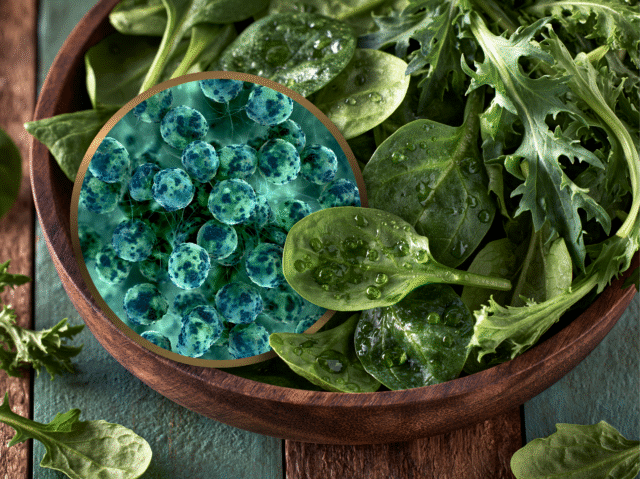
Michigan finally said the word. On Monday its Department of Health and Human Services became the first health department in the country to name a suspect in the Cyclospora outbreak tearing through the summer produce aisle: lettuce and salad greens. It named no grower, no supplier and no brand, and it did not rule other foods out — but after more than a thousand patient interviews, chief medical executive Dr. Natasha Bagdasarian said lettuce is the product that keeps surfacing. In Ohio, the other epicenter, local officials in Lorain County had already been pointing at bagged lettuce, even as the Ohio Department of Health’s official line held at “no common source identified.” Everyone else — every other state, the FDA, the CDC in Atlanta — is still staring at a blank column: no advisory, no recall, no named food.
Which brings us to the numbers, and to a warning that has to come with them. Ask three sources how many Americans have Cyclospora right now and you get three answers, none of them wrong and none of them final. NBC’s running tally, built by calling one state health department after another, passed 4,000 cases as of July 13. The CDC, which counts a case only after it is laboratory-confirmed and cleared of travel, puts the number at 843. ABC News, tallying two days earlier, landed at 2,944. Same parasite, same week — and more than three thousand cases of daylight between the low figure and the high one.
That gap is not carelessness. State health departments report on rolling counts and looser working definitions, and they do it fast, because they are the ones fielding the phone calls; the CDC confirms slowly and conservatively, case by case, which is why its number always lags. Both are doing their jobs, just answering different questions. And under all of it sits the decision, effective July 1, 2025, to drop Cyclospora from the short list of pathogens states are required to hunt for — leaving Salmonella and E. coli as the only two that still get the full treatment.
Here is where the misery actually sits, as best anyone can say this week. Michigan carries the bulk of it, with the Department of Health and Human Services counting 2,640 cases and 44 hospitalizations across 55 counties and Detroit, in a state that logs about fifty in an entire normal year. New York is at 470 statewide, with New York City alone accounting for 372. Ohio has climbed to somewhere between 361 and nearly 400 — the spread between its own official count and a local one — with 46 hospitalized and more than three hundred of those cases in the single county around Toledo. Then the shelf drops off: North Carolina at 205, Illinois at 141, Florida above 100, Indiana at 72, Texas at 48 with five hospitalized, and California somewhere between one and ten. Another eleven states — Alaska, Colorado, Connecticut, Georgia, Louisiana, Massachusetts, New Jersey, Pennsylvania, Tennessee, Virginia and Wisconsin — turn up on the CDC’s list of reporting states with no public number attached to them at all.
Take every one of those figures as true when the page loaded and maybe not by dinner. Michigan added more than a thousand cases in three days. Because the counts start on different dates and rest on different definitions, they cannot honestly be stacked into one clean national total — anyone who hands you a single exact number for the whole country is selling a precision that does not exist. Ohio proves the point inside its own borders, where the state count and a local count differ by nearly forty. What can be said is the direction, and the direction is up, faster than last year, which itself ran to roughly 2,700 cases nationally.
Even the state count depends on who is doing the counting: the CDC lists 31 states with confirmed, domestic cases, a Nexstar review found 39 as of July 13, and USA Today counted cases in all but eight — about 42. The gap is all threshold — the federal tally takes only lab-confirmed cases reported up its own chain, while a broader sweep adds probable and travel-related cases and the states still stuck in the lag, so 31 is the floor, not the ceiling.
None of these numbers agree, and the reason is not that the parasite is mysterious. Cyclospora hides in leafy greens and berries, drags on for a month of explosive, relapsing illness, and slips past the routine stool panel — all well understood. The numbers disagree because we decided, as a matter of policy, to watch less carefully, and now we act surprised that we cannot see. Michigan managed to name lettuce anyway. You cannot manage what you have chosen not to measure — and behind every mismatched tick in every one of these tallies is a real person who spent weeks in the bathroom while the agencies sorted out whether their case counted yet. I have represented enough of them since 1993 to know the count is never just a number.
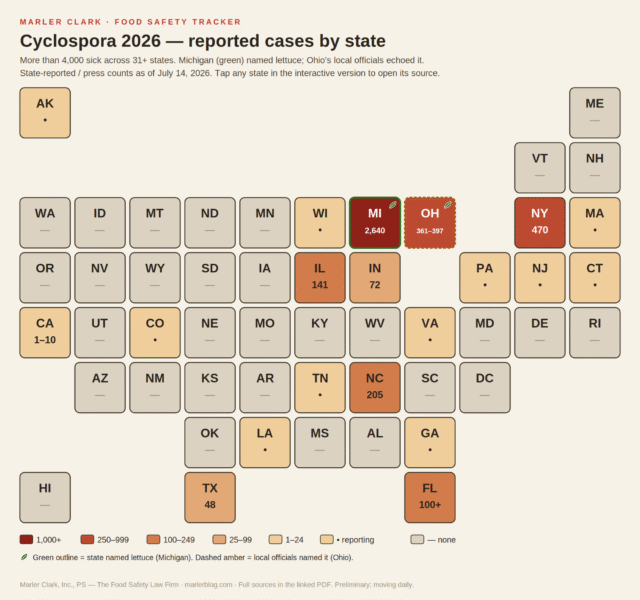
See downloadable PDF with hyperlinks to sources.
The numbers, state by state, as of July 14, 2026 — reported by health departments and the national press. Treat them as a snapshot of a moving target, not a settled ledger:
| State | Reported cases | As of | Source |
| Michigan 🥬 lettuce named | 2,640 (44 hosp.) | Jul 13 | MDHHS |
| New York | 470 statewide (NYC 372) | Jul 9 | NY State DOH / CBS NY |
| Ohio · lettuce (local officials) | 361–397 (46 hosp.; Lucas Co. 306) | Jul 13 | Ohio DOH / WOSU & CNN |
| North Carolina | 205 | Jul 10 | NC DHHS / NBC-TODAY |
| Illinois | 141 | Jul 2026 | Illinois DPH / NBC-TODAY |
| Florida | 100+ | Jul 10 | Florida DOH / ABC News |
| Indiana | 72 | Jul 2026 | Indiana DOH / NBC-TODAY |
| Texas | 48 (5 hosp.) | May 1–Jul 6 | Texas DSHS / NBC-TODAY |
| California | 1–10 | Jul 10 | CDC / ABC News tally |
| AK · CO · CT · GA · LA · MA · NJ · PA · TN · VA · WI | Reporting cases; count not individually released | 2026 season | CDC surveillance list |
| NATIONAL — state tally | 4,000+ | Jul 13 | NBC News / TODAY |
| NATIONAL — CDC confirmed | 843 (+1,500 review; 86 hosp.; 0 deaths) | Jul 9 | CDC |