


Ten people are dead. Fifty-nine were hospitalized. The plant in Jarratt, Virginia that made the liverwurst that killed them carried a documented record of filth going back years — product residue on food-contact surfaces, black mold on the walls, flies and ants and a cockroach-like insect in the coolers, water dripping over the product, blood on the floors. When ten people die from a single meal, I want to know one thing above all others: is anyone going to be held accountable, and will the public ever be told how it ends.
On June 2, 2026, I asked. I sent USDA’s Food Safety and Inspection Service a Freedom of Information Act request built around the two questions that actually matter for accountability. First, what is the current status of any law-enforcement hold or referral on the Boar’s Head records — has the Exemption 7(A) basis USDA asserted in 2024 been lifted? Second, produce any referral or transmittal records between FSIS and the Department of Justice concerning Boar’s Head, to the extent they can be released. I also asked for the records FSIS once withheld as law-enforcement material, everything about the Associated Press’s appeal, and the final enforcement actions on the Jarratt plant. Because conditions had changed — the plant reopened in February 2026 — I asked FSIS to re-evaluate whether the interference-with-enforcement rationale it invoked in 2024 still held up.
On July 2, 2026, I got my answer. It is worth reading closely, and I’ve attached all three documents below so you can read it yourself.
Seventy-eight pages, released under FOIA No. 2026-FSIS-00209-F. Much of it I had seen before — the Associated Press already pried a version loose in early 2025. There is the July 26, 2024 Notice of Suspension and the revised version four days later, laying out the whole grim arithmetic that FSIS knew from the start: 34 sick across 13 states, every hospitalized patient with available information hospitalized, two dead, whole-genome sequencing tying the liverwurst strain to the people it killed, and a positive Listeria swab on Pallet Jack SH3 in a processing room with no walls between the lines and no written plan to keep employees from carrying contamination from one line to the next. There are the lab reports. There are the “for further processing” emails, where a plant under suspension asked to keep shipping raw material out of Jarratt and FSIS blessed it “as long as it meets all applicable regulations.” There is the email where the company asked permission to dispose of recalled product and a district manager wrote back, “Yes. Just keep records.”
That is the record of a company that was warned, and warned, and warned again, and a regulator that watched it happen. It is damning. But it is not what I asked for.
| THE PAPER TRAIL FSIS ALREADY HAD Noncompliance documented at Jarratt (Est. M12612), from the released Notice of Suspension Product residue on food- & non-food-contact surfaces (pre-op): 2/3/24 · 2/29/24 · 3/14/24 · 3/22/24 · 4/19/24 · 5/20/24 · 6/28/24 · 7/6/24 · 7/19/24 Product residue from prior shifts (operational SSOP): 6/7/24 Insects — flies, ants, ladybugs, a cockroach-like insect: 2/7/24 · 2/11/24 · 3/15/24 · 6/10/24 · 6/26/24 · 7/12/24 · 7/17/24 Black mold / algal growth / insanitary conditions: 2/22/24 · 6/1/24 · 6/28/24 · 7/12/24 · 7/17/24 · 7/23/24 · 7/24/24 Water leaks over storage & product: 6/10/24 · 7/6/24 Dripping condensation on product / bags of dextrose: 7/9/24 · 7/12/24 Inedible product not denatured, mark of inspection left on: 2/8/24 · 2/21/24 · 4/8/24 · 4/24/24And this is only 2024. Federal inspectors had warned the Jarratt conditions posed an “imminent threat to public health” as early as 2022. |
In 2024, FSIS withheld these records under FOIA Exemption 7(A) — the law-enforcement exemption you invoke only when releasing records “could reasonably be expected to interfere with enforcement proceedings.” You do not invoke it over a matter that does not exist. Its use in 2024 was the strongest public confirmation we had that someone with a badge was looking hard at this company.
In the July 2, 2026 response, Exemption 7(A) is gone. FSIS now redacts only under Exemptions 4, 5, and 6 — trade secrets, deliberative process, and personal privacy. It cited no law-enforcement interference at all. That is a meaningful signal. It means that, whatever is happening, FSIS no longer believes releasing these particular records would step on an active proceeding.
Now watch the negative space, because in a FOIA response the silence is the message.
I asked for the status of any law-enforcement hold. On a June 4 clarification call, my office agreed to narrow the request and set that bullet aside to move the rest along — I’ll be straight about that. But I also asked, in a separate bullet that was never dropped, for any FSIS–DOJ referral or transmittal records. The final response recites that bullet word for word at the top of the letter. And then it does nothing with it. No records. No Vaughn-style description of records withheld. No statement that no responsive records exist. Not a single word about the Department of Justice anywhere in 78 pages.
And there is not one word about the other investigation I care about — the USDA Inspector General’s review of how its own inspectors let this plant run for years while the noncompliance reports stacked up. If the government is examining its own people, none of it is in here.
The law-enforcement exemption that once shielded these records has quietly evaporated, which tells us the interference concern has cooled. But whether that is because a criminal matter has been referred out and now lives on a docket in the Eastern District of Virginia, because it has wound down, or because it was never pursued to a charge — the response does not say, and I suspect FSIS does not intend to say. Grand-jury secrecy under Rule 6(e) covers a live investigation. It does not require the agency to pretend the DOJ bullet in my request was never written.
I have spent more than thirty years representing people whose lives were shattered by a single meal, and my stated goal has always been to put myself out of business by making food safe enough that families no longer need lawyers like me. Criminal food cases are slow — the Peanut Corporation of America prosecution that sent Stewart Parnell to prison for twenty-eight years took years to build; Chipotle’s $25 million deferred-prosecution deal followed outbreaks that began long before it. I am not demanding a charge on a schedule I happen to prefer.
I am demanding an answer to a fair and narrow question: is anyone still working this, and will the public ever be told how it ends? A 78-page release that hands back the inspection records we already had, drops the law-enforcement exemption without explanation, and never once utters the words “Department of Justice” is not an answer. It is a shrug dressed up as a determination.
Ten people are still dead. Their families are still waiting. I intend to keep asking.
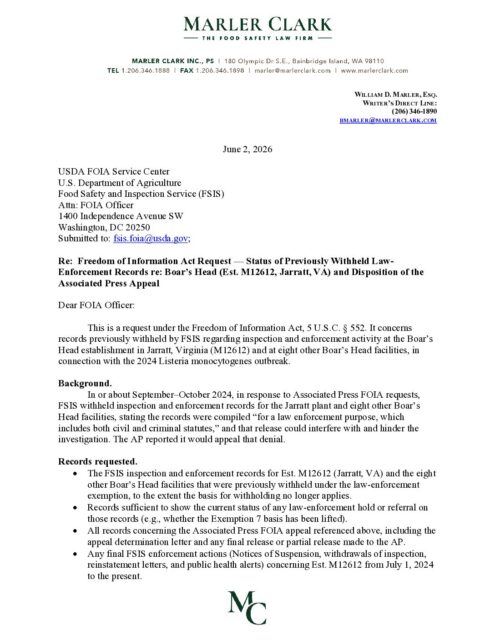
https://www.marlerblog.com/files/2026/07/FOIA_USDA_FSIS_BoarsHead2-1.pdf
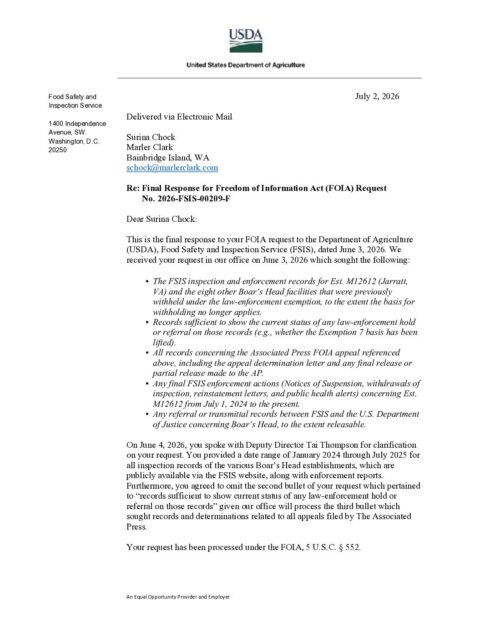
https://www.marlerblog.com/files/2026/07/FSIS-FOIA-No.-2026-FSIS-00209-F-Final-Response-Letter.pdf
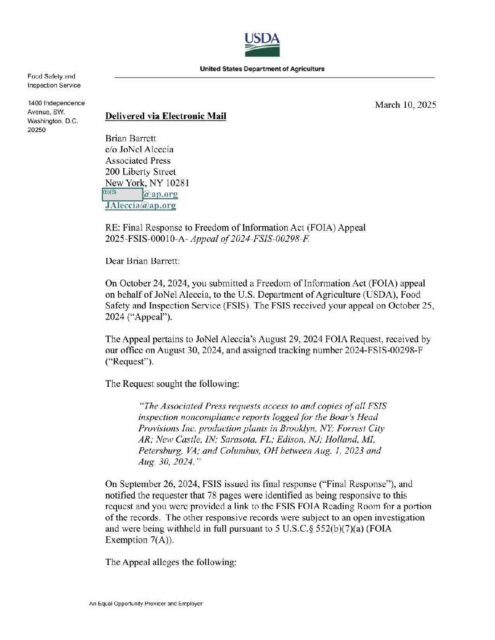
https://www.marlerblog.com/files/2026/07/2026-FSIS-00209-F-Final-Records.pdf