


The Washington Post reported at 2:21 this afternoon, Lena H. Sun and Rachel Roubein reporting, that CDC is expanding this outbreak from nine states to fifteen, adding six where illnesses have been traced to shredded iceberg lettuce from central Mexico. Three individuals familiar with the investigation are the source for the expansion itself, and they spoke anonymously because the investigation is ongoing. CDC did not immediately respond to the Post’s request for comment.
Missouri is not one of the anonymous parts. Missouri is on the record. The state health department’s spokesperson, Lisa Cox, told the Post that Missouri is one of the states being added, and that patients interviewed at length by state and local investigators said they consumed Taco Bell before getting sick. Information on the other five states was not immediately available.
That distinction matters more than it looks. A state health department putting a named spokesperson behind the statement that it is joining a federal outbreak — while no federal page yet says so — is a state getting out in front of the agency that is supposed to be counting it. Yesterday a CDC spokesperson told a Kansas City television station that the remaining thirty-two states, Missouri among them, were unrelated to this outbreak. Yesterday Missouri said it expected to be added. Today Missouri says it is being added, by name, on the record. The correction took about twenty-four hours, and it still has not reached a federal website.
I checked every federal page before writing this. None of them says fifteen. CDC’s outbreak page says nine and is titled nine. Its investigation update says nine. Its surveillance page says nine. FDA’s advisory says nine, is titled Investigation of 9-State Outbreak, and is still stamped July 24 — eleven days — with Total Illnesses 1,947, Hospitalizations 98, Deaths 0. On July 24 the same reporter had the last expansion and attributed it to an agency update already posted, with a CDC newsroom release behind it.
Now the paragraph in the Post story that I think is the most important thing published about this outbreak in two weeks, and it has nothing to do with the state count.
Taylor Farms told the Post that the recalled lettuce was distributed from June 29 through July 16, through food-service channels and retail stores in twenty-seven states. FDA’s own outbreak advisory says the illnesses in this cluster began on dates ranging from June 22 to July 20.
Read those two sentences against each other. The first person in the federal government’s own outbreak got sick seven days before the company says the recalled product started shipping. Cyclosporiasis takes about a week to make you sick, and CDC puts the range at two to fourteen days. Work it backwards: a June 22 onset means that person ate the lettuce somewhere around June 15, and no later than June 20 even on the fastest incubation the agency recognizes. That is nine to twenty-one days before the recall window opens.
There are only a few explanations. The recall window is drawn too narrowly. Or the earliest cases in the cluster ate product that shipped before June 29 and is not covered by the recall. Or the onset dates are wrong. I do not know which, and neither, apparently, does anyone who has published on it. What I do know is that the Post asked Taylor Farms how many pounds of product the recall covered and where shredded lettuce was distributed before June 29, and the company declined to provide it. That second question is the one that matters, and the refusal to answer it is the most consequential thing Taylor Farms has done since the recall.
Nine days is not a technicality in an outbreak this size. Michigan alone reports 11,508 cases. If contaminated product moved before June 29, then the recall — the only recall of this entire season — never reached it, and it was eaten, and nobody has ever gone looking for it. A recall is a boundary drawn on a calendar. Taylor Farms drew this one and will not say what is on the other side of the line.
Two more things in the story worth pulling out. The Post notes that federal investigators have publicly linked illnesses to only a portion of the states where the company said the recalled lettuce went. That has been true since July 20 and it is good to see it in print. And federal officials are investigating outbreaks and illnesses in more than two dozen additional states that have not been linked to the fifteen-state outbreak, with sources that have not been identified or tied to Taylor Farms.
Which raises the question I have been asked more than any other since the Post story went up: is this outbreak Taco Bell, or does it reach Taylor Farms’ other customers? As the federal pages are written tonight, it is Taco Bell and nothing else. FDA’s advisory says 1,947 people infected with Cyclospora and reporting exposure to Taco Bell. Its list of affected restaurants names exactly one chain. No other company appears anywhere in the case definition.
The recalled product went a great deal further than that. FDA’s own recall notice says the shredded iceberg went out between June 29 and July 16 to twenty-seven states. Consumer Reports reported that alongside Taco Bell, the recalled lettuce went to Walmart stores, Jack in the Box restaurants and major foodservice distributors including Sysco, in that same window. Jack in the Box says it learned of the problem on July 16, a day before FDA’s announcement, pulled product from restaurants served by its Texas distribution center, and has had no known illnesses. And the proportion matters: thirty-three of the thirty-five recalled items went to foodservice and only two went to Walmart retail. The overwhelming majority of this lettuce went to restaurants and distributors, and the federal count covers one restaurant chain.
Missouri is a good illustration, because it had two routes and not one. Lisa Cox says Missouri is joining on the strength of patient interviews pointing to Taco Bell. But FDA’s own advisory lists the states where recalled Marketside bags were sold at Walmart — Alabama, Arkansas, Florida, Georgia, Indiana, Kansas, Kentucky, Louisiana, Missouri, Mississippi, Oklahoma, Tennessee, Texas, Virginia and West Virginia — and Missouri is on it. The recalled bags were on Missouri shelves at the same time the recalled lettuce was in Missouri Taco Bells.
And we already have the proof that non-Taco-Bell exposure to this product makes people sick, because New Hampshire published it. Seventeen people, all at Cheshire Medical Center in Keene, all tied to recalled Taylor Farms lettuce. A hospital cafeteria, not a Taco Bell, in a state that is not among the nine. That is not a theory about what the case definition might be missing. It is a documented cluster sitting outside it.
A note on the twenty-seven. The chart at the bottom of this post counts twenty-eight states as having received the recalled lettuce, and the difference is West Virginia. Taylor Farms’ own distribution list runs to twenty-seven states and West Virginia is not on it. West Virginia is one of the nine outbreak states. It has been in the federal outbreak since the beginning, and it is not on the company’s list of places the recalled product was sent. I have flagged that since July 20, and it has never been explained.
Michigan updated this morning. MDHHS now reports 11,508 cases, up 274 from yesterday, with 193 hospitalizations as of July 30 and two deaths. The fifty-state total is now 22,957. Michigan was the only state that moved: North Carolina’s dashboard, which refreshes Tuesdays, was still stamped July 28 when I fetched it directly, and CDC’s surveillance page had not refreshed either.
When the expanded page does post, here is the test. The 1,947 is not a count of illness. It counts people who were infected and reported eating at Taco Bell, in nine named states. Widen the list to fifteen and either the number grows substantially, in which case the parasite was always in those states, and the case definition was hiding it, or six states get added and the number barely moves, in which case the definition is doing the work rather than the disease. Missouri alone reports 1,095 cases and its investigators have already tied patients to Taco Bell by interview. Watch what happens to the federal figure.
On the federal injury numbers. CDC’s surveillance page, updated July 28 with data through July 27, reports 6,707 laboratory-confirmed domestically acquired cases across forty-five states, more than 11,500 awaiting confirmation, and 423 hospitalizations. FDA’s advisory says ninety-eight. Thirteen states publish a hospitalization figure of their own and those thirteen come to 426.
| What is being counted | Hospitalizations | Deaths |
| FDA, nine-state lettuce outbreak (stamped July 24) | 98 | 0 |
| CDC national surveillance, through July 27 | 423 | 2 (acknowledged Aug 3) |
| The thirteen states that publish a figure | 426 | 2 (Michigan) |
These are not identical measures, and I am not adding 426 to 423. CDC counts hospitalizations among laboratory-confirmed domestically acquired cases; the states count among everything they have, probable cases included, across thirteen different dates, and Michigan’s 193 are certainly inside CDC’s 423. What the arithmetic establishes is direction. Thirteen states already publish more hospitalizations than the national surveillance total and more than four times what the federal outbreak advisory describes. And 426 is a floor, because the state hospitalization figures are older than the state case counts: Ohio’s ninety-six date to July 17 when Ohio had 1,316 cases, and Ohio now has 4,013 with no update since. On deaths, Michigan says two, CDC acknowledged two on August 3, and FDA still says zero.
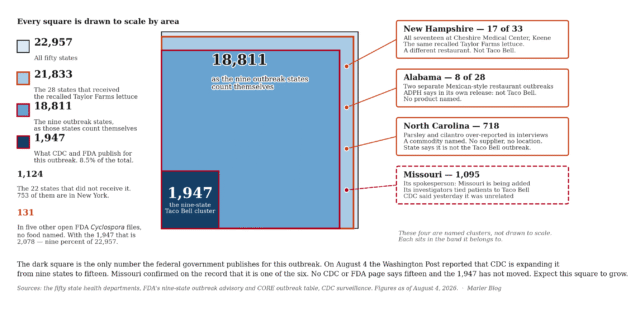
Where each state stands now, with the source for every number. Michigan is the only row that changed today.
| State | 2026 cases reported | Recalled lettuce | Where the number comes from |
| Alabama | 28 (Jul 20); 2 hosp.; 8 tied to two restaurant clusters | Yes | ADPH news release |
| Alaska | 5 (Jul 16) | No | Alaska DOH advisory |
| Arizona | 19 (Jul 17) | No | AZ DHS, via roundup |
| Arkansas | 123 (Jul 30); 75 in Benton County | Yes | ADH via KNWA |
| California | 41 provisional (Jul 14) | No | CDPH NR26-024 |
| Colorado | 150 (Jul 17); 4 hosp. | No | CDPHE, via roundup |
| Connecticut | 35 | Yes | CT DPH press release |
| Delaware | No count published | No | CDC surveillance |
| Florida | 254 since May 1 (Jul 25); 264 calendar year | Yes | FDOH via News4Jax |
| Georgia | 11-30 since May 1 (Jul 17) | Yes | GA DPH, via roundup |
| Hawaii | No count published | No | CDC surveillance |
| Idaho | No count published | No | CDC surveillance |
| Illinois | 532 (Jul 29); 23 hosp. (Jul 16) | Yes | CNN tracker |
| Indiana | 1,176 (Jul 31) | Yes | IDOH cases by county |
| Iowa | 226 in 48 counties (Jul 30); 47 travel-related | Yes | Iowa HHS weekly report |
| Kansas | 461 (Jul 29); 20 hosp. | Yes | CNN tracker / KDHE |
| Kentucky | 468 (Jul 29); 7 hosp. (Jul 20) | Yes | CNN tracker |
| Louisiana | 1-10 (Jul 17) | Yes | LA DOH, via roundup |
| Maine | No count published | No | CDC surveillance |
| Maryland | 69 (Jul 17) | Yes | MD DOH, via roundup |
| Massachusetts | 18 (Jul 17) | Yes | MA DPH, via roundup |
| Michigan | 11,508 (Aug 4); 193 hosp. (Jul 30); 2 deaths | Yes | MDHHS / CBS Detroit |
| Minnesota | 41 since May 1 (Jul 17) | No | MDH, via roundup |
| Mississippi | No count published | Yes | FDA distribution list |
| Missouri | 1,095 (Aug 2); doubled in one week; 90 in Boone County | Yes | DHSS via KCTV5 / STLPR |
| Montana | No count published | No | CDC surveillance |
| Nebraska | 49 (Jul 17) | No | NE DHHS, via roundup |
| Nevada | No count published | No | CDC surveillance |
| New Hampshire | 33 confirmed (Jul 28); 2 hosp.; 17 tied to recalled lettuce at Cheshire Medical Center | Yes | NH DHHS / NHPR |
| New Jersey | 46 (May 1-Jul 11) | Yes | NJDOH news release |
| New Mexico | No count published | No | CDC surveillance |
| New York | 753 since May 1 (Jul 27 data); 787 calendar year | No | NYSDOH |
| North Carolina | 718 since May 1 (Jul 27 data); 24 hosp.; 728 calendar year; 432 in Wake County | Yes | NCDHHS / dashboard |
| North Dakota | No count published | No | CDC surveillance |
| Ohio | 4,013 in 80 counties (Jul 31); 96 hosp. (Jul 17); ODH puts Lucas Co. at 554, the county health dept. at 1,218 (Aug 3) | Yes | ODH via WOSU / Toledo Blade |
| Oklahoma | 303 (Jul 28); 18 hosp. | Yes | OSDH via KSWO |
| Oregon | 23 in 2026 (Jul 24) | No | Oregon Health Authority |
| Pennsylvania | 82 (Jul 29); reported voluntarily | Yes | CNN tracker |
| Rhode Island | 4 since May 1 (Jul 17) | No | RI DOH, via roundup |
| South Carolina | No count published | Yes | FDA distribution list |
| South Dakota | No count published | No | CDC surveillance |
| Tennessee | 11-30 (Jul 17) | Yes | TN DOH, via roundup |
| Texas | 68 (Jul 13); 15 hosp. | Yes | Texas DSHS |
| Utah | 1-10 (Jul 17) | No | UT DHHS, via roundup |
| Vermont | No count published | No | CDC surveillance |
| Virginia | 126 total (Jul 23); 66 domestic, 31 travel, 29 pending | Yes | Virginia DH |
| Washington | 38 (May 1-Jul 17) | No | Washington DOH |
| West Virginia | 268 (Jul 31); 19 hosp. | Yes | WV OEPS |
| Wisconsin | 160 (Jul 29); 3 hosp.; 50 domestically acquired | Yes | Wisconsin DHS |
| Wyoming | No count published | No | CDC surveillance |
| Nine outbreak states | 18,811 | 9 | |
| Received the recalled lettuce | 21,833 | 28 | |
| Did not receive it | 1,124 | 22 | |
| All fifty states | 22,957 | 50 |
Thirteen states in that table publish no count at all. Eleven more trace to a national roundup last refreshed July 17, and several of those are bands rather than counts — Georgia and Tennessee published as eleven to thirty, Louisiana and Utah as one to ten. I use the bottom of every band, which is one of several reasons the total is a floor.
Twenty-seven days remain in the season CDC defines as May 1 through August 31. Tonight the outbreak is fifteen states according to a newspaper, nine states according to the government, and 22,957 cases according to the fifty health departments doing the counting. And the company at the center of it will not say how much lettuce it recalled, or where the lettuce went in the weeks before the recall window it drew for itself.