

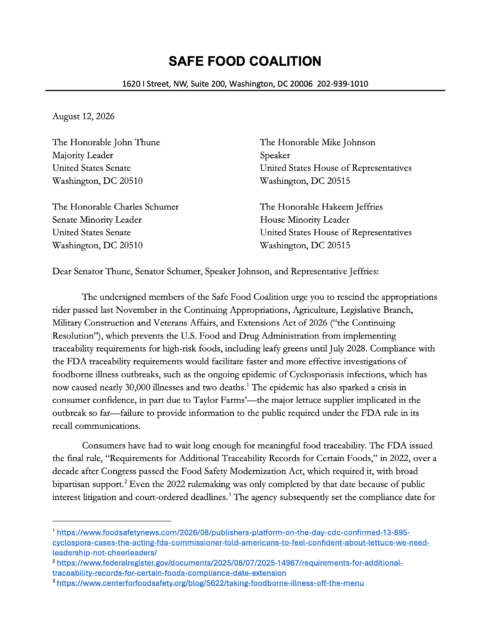
Yesterday the Safe Food Coalition sent a letter to Senate Majority Leader John Thune, Senate Minority Leader Charles Schumer, Speaker Mike Johnson and House Minority Leader Hakeem Jeffries. Eleven organizations signed it. They ask for one thing: rescind the appropriations rider Congress passed last November that bars the Food and Drug Administration from spending a dollar to administer or enforce its own food traceability rule before July 20, 2028. The Consumer Federation of America announced it the same afternoon. I am with them, and I want to say so with my name attached and every one of theirs spelled out.
Start with what the rider actually does, because the part that gets reported is the smaller part. FDA had already pushed the compliance date to July 2028 on its own, a year ago this month. A rider that only froze the money would have been redundant. Section 780 goes further. It directs the agency to identify and implement additional flexibilities for satisfying the rule’s lot-level tracking requirement, and to hand industry recommendations for those flexibilities. Lot-level tracking is not a feature of the traceability rule. It is the rule. A lot code is the only thing in the whole system that distinguishes one shipment of iceberg from the next one off the same line. Take it out and what remains tells an investigator that a company received lettuce, which is a fact nobody was ever in doubt about.
The history is worth saying out loud, because it is long and almost nobody outside this world knows it. Congress passed the Food Safety Modernization Act in 2010 with bipartisan majorities and told FDA to propose recordkeeping requirements for high-risk foods no later than January 2013. FDA did not. The Center for Food Safety sued and won a federal consent decree that set the deadlines the agency then met: propose by September 2020, finalize by November 2022. The final rule set compliance for January 20, 2026. FDA moved that thirty months. Congress wrote the delay into a spending bill and told the agency to reconsider the centerpiece while it waited. Sixteen years from a statute to a rule to a maybe, and the clock has not stopped running.
Here is why that matters this month rather than in some abstract future. Add up what the state health departments have published themselves and the Cyclospora floor stood above 28,000 as of yesterday. FDA’s own outbreak page still says 6,358 cases across fifteen states and still carries an August 5 stamp, and Maine, which declared itself into this outbreak on August 7, is still not on the federal list six days later.
The coalition puts the traceability point where it belongs, on the recall, writing that Taylor Farms failed to give the public information the rule requires in its recall communications. I can be more specific than that, because I went and got FDA’s own file. Event 99453 covers 236,192 cases and it names the buyers: Walmart’s Marketside, Cross Valley Farms, Markon, Peak, Sysco, Subway, Jack in the Box, YUM and Taylor Farms itself. Somebody can say where the product went and how much of it there was. I did.
Look at what it took, though. That record ran three weeks behind the recall, sits in a search form nothing indexes, and had to be totalled by hand out of a spreadsheet. Four weeks on, as far as I can tell two people have written any of it down: Phyllis Entis at eFoodAlert, who got there the same weekend I did, and me. Alabama’s health department had published the consignee list on July 20, three weeks before FDA’s own file gave it up, and nobody picked that up either. The coverage that has appeared since describes a new FDA report. It is not new. It has been sitting in the recall database since the day of the recall. A document that is public and unfindable at the same time is not disclosure.
And the file ends at the first buyer. Markon is a purchasing cooperative whose members resell to independent operators who never see the Markon name. Sysco and US Foods are distributors. The file says YUM, not Taco Bell. Nobody outside those companies can say which case reached which kitchen on which day, and that is the question an outbreak investigator is actually asking. A recall notice tells you who bought it, weeks later, if somebody thinks to go looking. A traceability rule puts lot-level records in FDA’s hands in twenty-four hours. The alternative is what the country got in 2018, when FDA told every American to throw away romaine grown in an entire region because the agency could not narrow it further. FDA said so itself, in its own rulemaking, and the coalition quotes the agency back to Congress.
Look at who is actually opposed. The letter names FMI, the food retailers’ association, and that is a narrow opposition to be carrying a provision this consequential. The International Fresh Produce Association, which speaks for the growers and which disagrees with me about nearly everything else this summer, put itself on the record against continued delays and has spent July and August asking for end-to-end traceability. Taylor Farms posts on its own outbreak hub that it fully supports and endorses food traceability legislation. Kroger, Albertsons and Walmart had already built programs to the rule and past it before FDA announced the delay, which means the rider does not spare industry a cost so much as it strands the part of industry that already paid.
That points at the argument in the letter I most want to underline, and it is not the one people expect from consumer groups. When an outbreak cannot be traced, the warning has to be broad, and a broad warning drives people away from fresh produce altogether. Growers in Salinas are plowing lettuce back into the groundrather than harvesting it, farmworkers are losing shifts, forty percent of consumers told a pollster they have changed what they buy, and carrots, cauliflower, spinach and Brussels sprouts had nothing whatever to do with this parasite and are selling worse anyway. The coalition says plainly that Americans are eating less real food as a result and calls that a public health disaster of its own. Traceability is the mechanism that lets a regulator name a lot number instead of a category. Anyone in Washington who genuinely wants this country eating more whole, fresh food ought to be the loudest voice in the building for lot codes. There is no version of a healthier American diet that runs through a system whose only available warning is to stop eating a vegetable.
Now the names, because they are the point of this post. The Center for Food Safety, without whose lawsuit there would be no traceability rule to delay in the first place. The Center for Science in the Public Interest. The Consumer Federation of America, which convenes this coalition and has been filing on this rule since 2024. Consumer Reports. Farm Forward. The Government Accountability Project. The George Washington University Institute for Food Safety and Nutrition Security. The National Consumers League, which has been doing this work since 1899. Stop Foodborne Illness, built by and for the families who end up inside these outbreaks, and the organization on this list whose people have the least to gain and have already paid the most. The United Food and Commercial Workers International Union, whose members cut, wash, pack and box the product. And U.S. PIRG.
Not one of those organizations has a client in this outbreak. Not one of them bills an hour for it. They wrote a page and a half and asked for the smallest thing anyone has asked Congress for all summer. Rescinding Section 780 requires no new appropriation, no new rulemaking, no new authority and nobody’s permission. It requires striking a paragraph that a narrow set of interests got written into a spending bill while the largest outbreak of this parasite ever recorded in the United States was already underway. People ask now and then why a plaintiffs’ lawyer spends his weekends on a recordkeeping rule. A lot code is a piece of paper that ends an outbreak in days instead of months, and the surest way to put me out of business is to make that paper exist. Eighteen days remain in the season this parasite has been riding. Two people are dead. Eleven organizations asked for it yesterday, and they are right.