

Today HHS Secretary Robert F. Kennedy, Jr., standing at a children’s center in Des Moines, announced the first major update to infant formula nutrient standards in nearly thirty years. The FDA issued the first of three planned proposed rules. It would update the requirements for iodine, manganese, vitamin A and vitamin D, reaffirm the requirements for chloride, potassium, selenium and sodium, and ask whether nutrients most manufacturers already add, such as DHA, ARA and L-carnitine, should be required. Comments are due February 26, 2027, in docket FDA-2026-56789. The agency also released another round of chemical contaminant testing, launched an Infant Formula Testing Webpage and a Chemical Contaminants Dashboard, and said it is working toward action levels for certain contaminants under its Closer to Zero initiative.
That is real work, and I want to say so plainly. The nutrient requirements have not had a comprehensive review since 1998. Putting contaminant results on a public dashboard is exactly the kind of transparency I have spent years asking agencies for. Operation Stork Speed and the Make America Healthy Again push forced the first serious federal look at infant formula in a generation. I said that to the Senate HELP Committee in June, and I will keep saying it.
Secretary Kennedy said today that “Parents deserve confidence in every bottle they feed their baby.” I agree. Which is why I read the release twice.
What the release does not say
The subheading says the new testing data “reaffirms safety of infant formula.” The testing it describes is for chemical contaminants. The words Clostridium botulinum do not appear in it. Neither do Cronobacter, Salmonella, nor the word pathogen. Nothing in today’s announcement touches the hazard that actually put American babies in intensive care this year and last.
Since November 2025, fifty-two infants have been hospitalized with botulism after being fed powdered infant formula: forty-eight in the ByHeart outbreak across seventeen states, and four in the Nara Organics outbreak in California, Pennsylvania and Washington. Many were on ventilators. Everyone was treated with BabyBIG, which the State of California prices at $69,300 a dose. Not one of them was hurt by a heavy metal or an outdated vitamin D requirement. They were paralyzed by spores of a soil organism that came in with the milk.
On August 27, CDC closed the Nara investigation and said, without a hedge, that the formula was contaminated with C. botulinum and made infants sick. Whole genome sequencing tied a Nara infant to a ByHeart infant, ByHeart base powder and four sealed cans of ByHeart formula. Both brands were made with milk supplied by Organic West Milk and spray dried by Dairy Farmers of America. One contamination, two brands, two outbreaks.
And the rule has not moved. Under 21 C.F.R. § 106.55, powdered infant formula makers must test finished product for two organisms, Cronobacter and Salmonella. C. botulinum is not on the list. It was not on the list when the FDA named the organism by genus and species in its March 8, 2023, Call-to-Action letter to the entire powdered formula industry. It was not on the list when the FDA wrote to industry again on July 13, 2026, after both outbreaks, telling manufacturers that their responsibility reaches every ingredient and every supplier. It is not on the list today.
The agency’s own record says testing is needed
The FDA added Cronobacter to the testing list in 2014 on a record of roughly one reported illness a year, because voluntary testing might not be enough for a food that is an infant’s sole source of nutrition. The botulism record is fifty-two hospitalized infants in two outbreaks.
The FDA’s own post-outbreak response page reports that when it sampled 48 powdered milk samples from four suppliers to infant formula makers in February 2026, two came back positive for a Clostridium carrying a gene associated with botulinum toxin. The Reagan-Udall Foundation’s September report, from a roundtable funded in part by ByHeart and the International Dairy Foods Association, found that there is no standardized method for detecting these spores in formula and that the indicator test the industry relies on can miss spores at levels high enough to make babies sick. The FAO/WHO expert group that met in Rome in June added botulinum neurotoxin-producing clostridia to the priority hazards for powdered formula and said dairy ingredients have been shown to carry them.
Letters, roundtables and referrals to international bodies are not a rule. Guidance has been tried twice now, and it has a body count.
No reply to the letters, no reply to the t-shirts
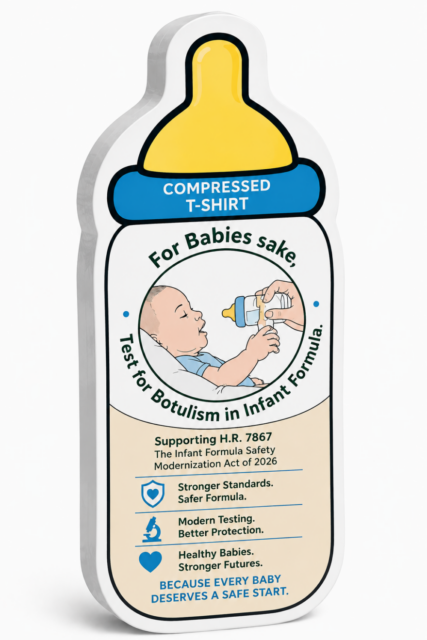
I wrote the House Energy and Commerce Committee in support of H.R. 7867, the Infant Formula Safety Modernization Act, on June 23, with fourteen families’ statements attached, and again on August 28 after CDC confirmed the genetic link. I wrote the Senate HELP Committee on June 29 and again on August 28. Four letters. No reply to any of them. In September, two “For Babies sake, Test for Botulism in Infant Formula” t-shirts, compressed into the shape of a baby bottle, were hand-delivered to every one of the 77 offices on those two committees, and one went to every other member of Congress. H.R. 7867 has sat in Energy and Commerce since its April 29 hearing without a markup.
So, I am going where the rule is actually written.
The petition
I posted a draft citizen petition earlier this month asking the FDA to add botulinum neurotoxin-producing clostridia to the finished-product testing table at § 106.55(e), and, because the organism arrived in a dairy ingredient, to require that each lot of whole milk powder, nonfat dry milk, whey and similar ingredients be tested before it is used. It also asks for one-business-day notice to the FDA of any confirmed positive, a validated test method within 180 days, lot-level records tracing ingredients back to the dryer and the farm, and environmental monitoring as a secondary control. Each request stands on its own so the Commissioner can grant in part what he will not grant in whole. Forty-six parents of twenty-four of the infants are Co-Petitioners.
The comments have made it better. A pediatrician and neonatologist wrote to endorse every request and to add that cans should tell parents the product was tested and found negative. A veteran food microbiologist answered the question I asked about testing raw milk at the dryer: test the fluid milk at the gate, where a low-level contaminant is more evenly mixed and has not yet been diluted across lots, and hold powder from any presumptive-positive tanker until the result is confirmed. Comments close tomorrow, October 30. I will file shortly after.
What I am asking
Of the FDA: you just showed you can open Part 106 and 107 and do the work in phases. Make botulism the next phase. If the agency can review thirty nutrients in three rounds, it can add one organism to a table that has two. And when you update the testing webpage and dashboard you launched today, put the pathogen results there too.
Of readers: the nutrient docket is open until February 26. If you comment, and you should, tell the FDA that a modern infant formula rule has to cover what is in the can as well as what is supposed to be in it. And when my petition is docketed, I will post the number so you can comment there too.
Nutrition matters. So does a baby who can still swallow, hold up his head and breathe on his own. Parents deserve confidence in every bottle, and confidence comes from testing for what has actually hurt babies.
Perhaps I need to order more t-shirts.