

The Honorable Brett Guthrie, Chairman
The Honorable Frank Pallone, Jr., Ranking Member
Committee on Energy and Commerce
U.S. House of Representatives
2125 Rayburn House Office Building
Washington, DC 20515
Re: Support for H.R. 7867, the Infant Formula Safety Modernization Act of 2026
Dear Chairman Guthrie, Ranking Member Pallone, and Members of the Committee:
I write in support of H.R. 7867, the Infant Formula Safety Modernization Act of 2026.
For more than thirty years — since the 1993 Jack in the Box E. coli outbreak — I have represented children and families sickened by food they trusted. I now represent babies who fell ill with botulism in the first few months of their lives because of tainted infant formula. The attachment to this letter contains their stories—of pain, survival, and preventable harm.
The hard arithmetic of my work is that reform rarely arrives until enough people are hurt to force it. The Jack in the Box tragedy[1] is what moved USDA to declare E. coli O157:H7 an adulterant in ground beef in 1994[2] — a single decision that has kept countless children out of hospital beds in the decades since.
This Committee has the same kind of window open right now to make infant formula safe, and this bill is the right response.
Two botulism outbreaks in seven months — and a longer pattern behind them
In November 2025, Clostridium botulinum in ByHeart Whole Nutrition Infant Formula — a whole-milk-powder product — was tied to an infant botulism[3] outbreak that ultimately sickened 48 infants across 17 states. Every infant was hospitalized. I represent more than twenty of those families. FDA’s whole-genome sequencing matched the organism across a clinical isolate, a closed can of finished formula, and the incoming ingredient — organic whole milk powder. It also matched it to a Blendhouse facility tied to that supply chain that had already been flagged “Official Action Indicated,” FDA’s most serious inspection classification, before these babies were ever hurt.[4]
Seven months later it happened again. In June 2026, three more infants — in California, Pennsylvania, and Washington, all between two and five months old — were hospitalized with botulism and treated with BabyBIG antitoxin after consuming Nara Organics Whole Milk Organic Infant Formula, a product manufactured abroad and sold here through national retail.[5]
And these two outbreaks were not merely alike — they shared a common source. The whole milk behind the contaminated ByHeart formula and the whole milk behind the Nara formula came from the same supplier; one upstream source furnished both the fluid milk and the powdered milk that went into these products.[6] The contamination did not strike two unrelated companies by chance; it traveled through one shared supply stream that the system missed the first time and missed again — the clearest proof that the gap this bill closes sits upstream, at the milk and the plant, exactly where H.R. 7867 directs the testing.
A second botulism outbreak in the same year, in the same category of product, was foreseeable. We had just lived through the first and the system did nothing in between. The pattern is older still: we knew about Cronobacter bacteria for two decades before contamination at Abbott’s Sturgis plant in 2022 took infant lives and triggered a national infant formula shortage.[7] The thread is not bad luck. It is a system that tests for too little, too late, and tells too few people when something goes wrong.
And these were not faraway statistics or someone else’s constituents. The ByHeart outbreak reached infants in seventeen states — among them Arizona, California, Idaho, Illinois, Kentucky, Massachusetts, Michigan, Minnesota, New Jersey, North Carolina, Oregon, Pennsylvania, Rhode Island, Texas, Virginia, Washington, and Wisconsin[8] — and the June 2026 Nara outbreak struck families in California, Pennsylvania, and Washington, each of them represented by a member of this Committee. The children paralyzed by contaminated infant formula are the children of the families you serve.
The hazard was on the government’s own record — in writing — years in advance
On March 8, 2023 — two years before the first ByHeart baby became ill — the FDA sent a Call-to-Action letter to every manufacturer, packer, distributor, importer, and retailer of powdered infant formula in the country, signed by the Commissioner of Food and Drugs and the Director of the agency’s food-safety center. It named the organism by genus and species, instructing the industry to account for the historical association between powdered infant formula and pathogens including Cronobacter, Salmonella, and Clostridium botulinum when designing safety controls[9].
In March 2025, under Operation Stork Speed,[10] FDA announced it would increase testing of formula and its ingredients for spore-forming contaminants — naming C. botulinum specifically — and by early 2026 it had opened a sampling assignment aimed at exactly the ingredients at issue: whole milk powder, nonfat dry milk, and whey.[11] The science is not obscure: C. botulinum is a spore-former whose spores survive ordinary pasteurization and spray-drying and live in soil and dust. That is precisely why the controls must start with the milk and the plant — upstream, where the spores enter — and cannot end with a reassuring number on a finished can.
Guidance has already been tried — and it failed twice.
The FDA named botulism in writing in 2023 and folded spore-forming pathogens into Operation Stork Speed in 2025, yet it never required anyone to test whole-milk-powder formula for botulinum before shipping it. Two outbreaks followed. The lesson is not that the agency needs another guidance letter or another voluntary initiative — either of which can be quietly shelved when budgets tighten or administrations change — but that the duty to test must be written into law, where it is durable and enforceable. Nor is the testing impractical: after these outbreaks, manufacturers began screening for spore-formers on their own. Nara itself quietly added “spore-forming organisms” to its published testing list after its recall. If industry can test for this hazard once babies are hurt, it can test for it before a single can ships. H.R. 7867 simply makes the timing mandatory rather than optional.
The economics favor this bill as strongly as the ethics do.
A single dose of BabyBIG — the antitoxin that is the only treatment for infant botulism — costs $69,300[12] per dose (some need at least two) and every one of the 48 ByHeart and three Nara infants needed it. Add to that the intensive-care stays, the air-ambulance transports — one family in the appendix was flown by medevac from Idaho to a children’s hospital in Utah — the months of feeding tubes and physical therapy, the nationwide recalls, the plant shutdowns, and the litigation that inevitably follows. Routine pathogen and environmental testing costs a small fraction of a single dose of the cure. This is the rare safety mandate that saves money — for families, for hospitals, for insurers, and for the public programs that ultimately absorb these costs.
What the bill does — Each fix mapped to a failure we have already seen
I have read every line of H.R. 7867.[13] It is sober, specific, and it closes the exact gaps that let these babies get hurt. It does six concrete things:
1. Expands required pathogen testing. Current rules effectively require finished-formula testing only for Cronobacter and Salmonella;[14] C. botulinum was not on the list — which is precisely how two botulism outbreaks slipped through. The bill directs FDA to build a real list and names C. botulinum on it.
2. Mandates environmental testing inside the plant. Standardized monitoring of Zones 2 and 3 catches contamination in the production environment before it ever reaches a can — standard practice elsewhere in food manufacturing but not required by law for the food we feed newborns.
3. Sets consistent standards. FDA, not each company, sets the testing frequency — so “we tested” means the same thing at every facility instead of each manufacturer grading its own work.
4. Requires early notification — within one business day of a positive test, even before product leaves the building. This is the provision that matters most in a botulism event. Today a company can get a positive result and sit on it while product lingers on shelves; mandatory early notice shrinks the gap between when the company knows and when parents do — a gap measured in hospitalized infants.
5. Holds foreign manufacturers to the same standards. ByHeart’s botulinum rode in on a home-grown ingredient. While the Nara formula behind the second outbreak was made abroad, for at least a period, it used a US-grown ingredient and same suppliers as ByHeart. Either way, if it is sold to an American baby, it should meet American testing requirements.
6. Strengthens Congressional oversight. The bill requires notice to Congress of any confirmed positive in finished formula and any “Official Action Indicated” inspection finding. That “Official Action Indicated” finding already existed in the ByHeart supply chain and went nowhere without Congressional oversight.
The bill also gives FDA 90 days to finalize the rules. We have waited long enough.
The bill will protect the formula supply, not threaten it.
Some will warn that more testing means more recalls and another 2022-style shortage. The opposite is true. Contaminated formula is the supply crisis: it was a contaminated plant in Sturgis that emptied the nation’s shelves in 2022, and it is undetected pathogens — not the tests that catch them — that force the largest recalls and the longest shutdowns. Catching contamination upstream, before a single can ships, is how this Committee keeps safe formula on the shelf. Safety and supply are not a trade-off; they are the same fight.
Bipartisan, broadly endorsed, and overdue.
Protecting infants from contaminated formula is not a left-or-right question. H.R. 7867 is led by Representative Rosa DeLauro and joined by Representative Jeff Van Drew, and it is endorsed by the American Academy of Pediatrics, Consumer Reports, the Consumer Federation of America, the Center for Science in the Public Interest, the Environmental Working Group, STOP Foodborne Illness, the Association of Public Health Laboratories, and Prolacta.[15] That the American Academy of Pediatrics — the physicians who actually stand at these infants’ bedsides — has put its name to this bill should carry particular weight: it is the considered judgment of the people who treat the disease. Every provision in this bill is something that, had it been law a year ago, might have meant fewer of the families in the appendix to this letter ever needing to suffer.
The Senate has already acted — now the House must finish the job.
On April 29, 2026, the Senate passed the Protect Infant Formula from Contamination Act, S. 272, by unanimous consent — bipartisan legislation introduced by Senators Gary Peters and John Hoeven and reported out of the Health, Education, Labor, and Pensions Committee by a vote of 22 to 0.[16] That a measure to close the infant-formula notification gap cleared the other chamber without a single dissenting voice is proof that this is neither a partisan question nor a close one. But S. 272 reaches only the contaminants already on the books — Cronobacter and Salmonella — and would not have caught the Clostridium botulinum that paralyzed the infants whose parents speak in the appendix to this letter. It is the narrower bill. H.R. 7867 is the one that names botulismon the testing list, mandates environmental monitoring inside the plant, and holds foreign manufacturers to American standards. The Senate has shown the consensus is there; this Committee can finish what the Senate started — and take the one further step these two outbreaks demand.
We have seen this turn out well before.
We turned the Jack in the Box tragedy into a rule that made hamburger safer for a generation of children. This Committee can do the same for the formula we feed newborns. The Subcommittee on Health has already held its hearing on this bill; the next step is to act on it. I respectfully urge the Committee to markup H.R. 7867 and report it favorably.
I note, with no small alarm, that the second botulism outbreak arrived while this very bill was already pending before you: Nara’s babies were hospitalized in the spring of 2026, after H.R. 7867 was introduced in March and after its April 29 hearing. The cost of waiting is no longer hypothetical.
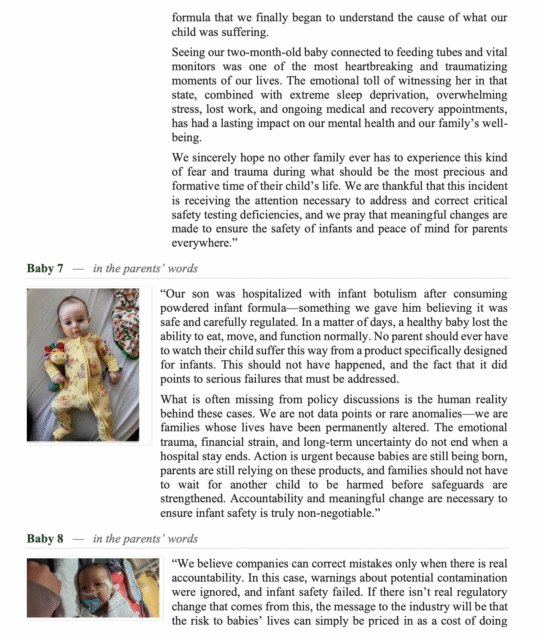
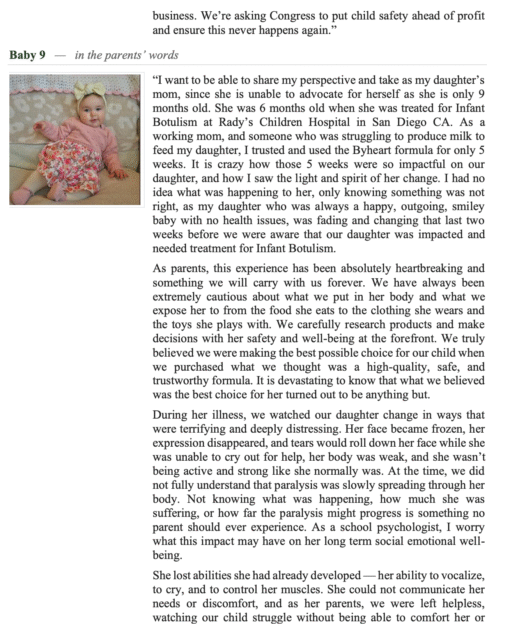
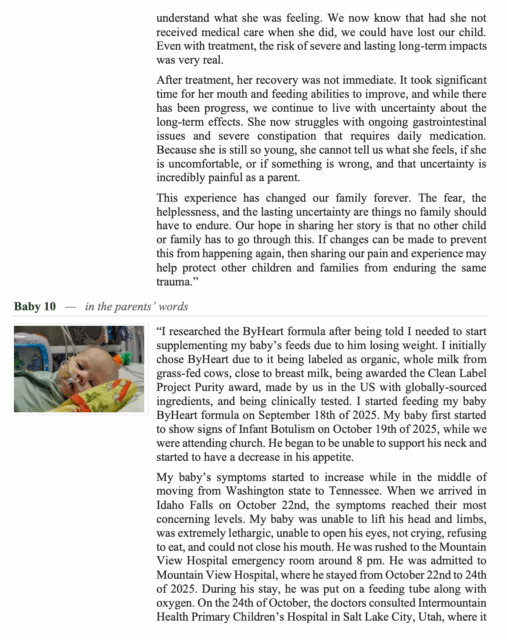
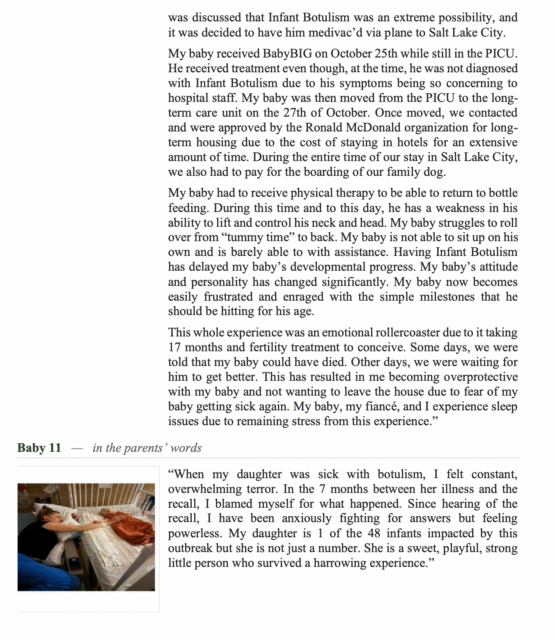
The appendix that follows is the real heart of this letter. These are the infants harmed in the ByHeart and Nara outbreaks, in their parents’ own words — statements many of these families wrote for Congress. I ask you to read them, and to keep these children in mind as you consider this bill.
Very truly yours,
William D. Marler
Enclosure: Appendix A — Statements and photographs of affected families
APPENDIX A
“From Botulism Babies and Parents”
Infants of the ByHeart and Nara outbreak — in their parents’ own words
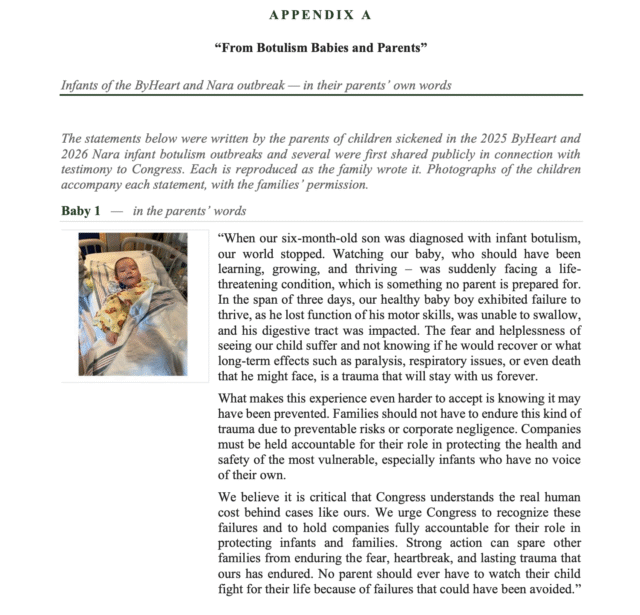
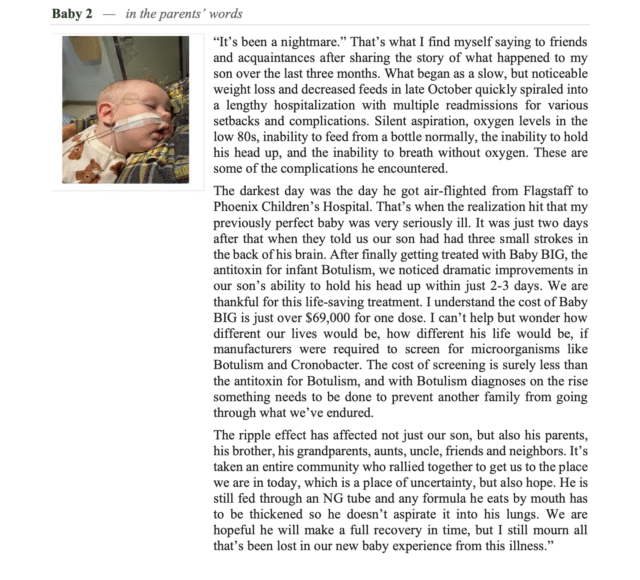
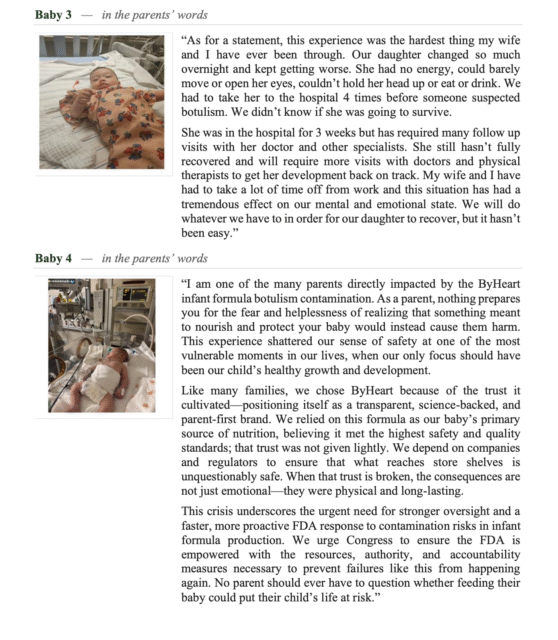
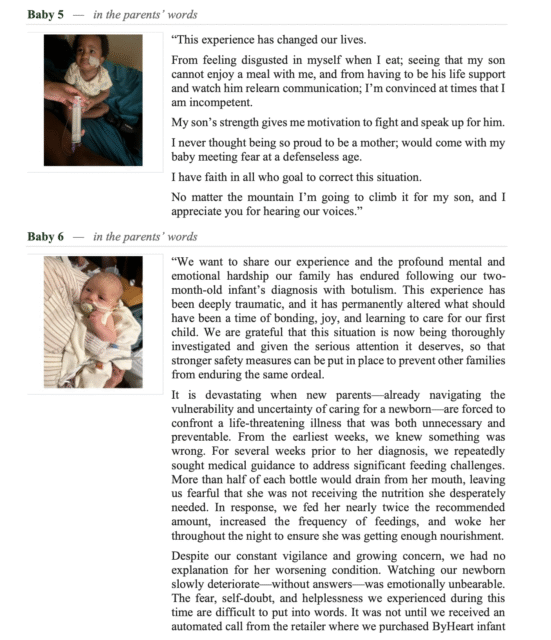
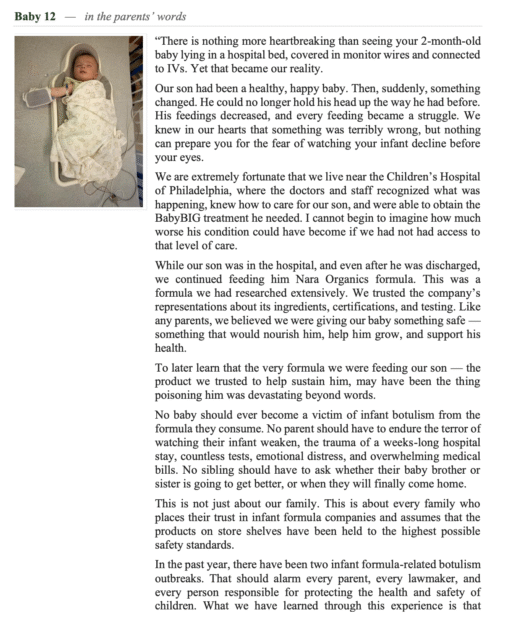
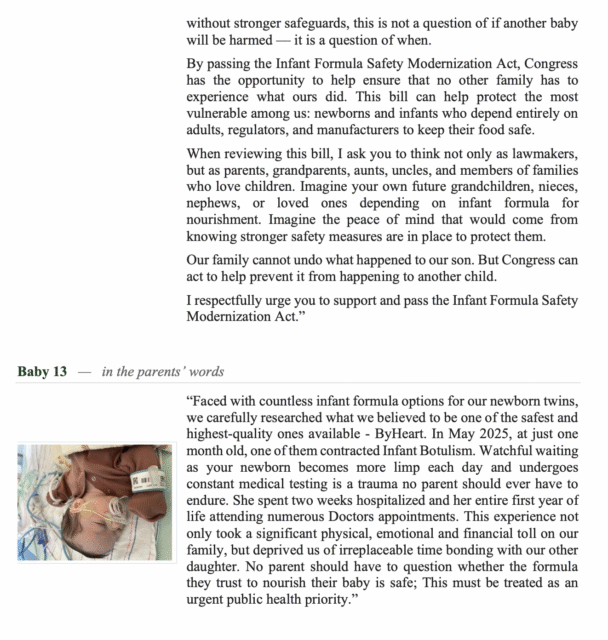
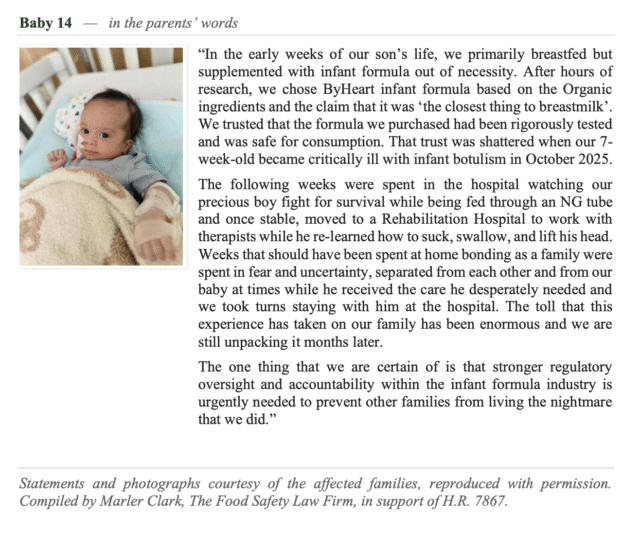
The statements below were written by the parents of children sickened in the 2025 ByHeart and 2026 Nara infant botulism outbreaks and several were first shared publicly in connection with testimony to Congress. Each is reproduced as the family wrote it. Photographs of the children accompany each statement, with the families’ permission.
[1] Over 600 sick, over 50 with acute kidney failure and four dead children.
[2] U.S. Dep’t of Agriculture, Food Safety & Inspection Service, Risk Assessment of E. coli O157:H7 in Ground Beef (“In August 1994, FSIS declared E. coli an adulterant.”), https://www.fsis.usda.gov/node/2003.
[3] Infant botulism is a rare but serious illness caused when spores of Clostridium botulinum grow in a baby’s intestine and produce toxin that weakens muscles, https://www.cdph.ca.gov/Programs/cls/idld/ibtpp/Pages/InfantBotulism.aspx.
[4] U.S. Food & Drug Admin., FDA’s Actions to Respond to Clostridium botulinum Illnesses Associated with Consumption of Powdered Infant Formula (2026) (whole-genome sequencing linked the strain across the clinical isolate, finished formula, and the incoming whole milk powder), https://www.fda.gov/food/outbreaks-foodborne-illness/fdas-actions-respond-clostridium-botulinum-illnesses-associated-consumption-powdered-infant-formula. The case totals (48 infants in 17 states; 28 confirmed, 20 probable) and the “Official Action Indicated” designation — the agency’s most serious inspection classification — are reflected in FDA’s Outbreak Advisory and in the bill sponsor’s summary, https://delauro.house.gov/media-center/press-releases/delauro-introduces-bipartisan-infant-formula-safety-modernization-act.
[5] U.S. Food & Drug Admin. & Centers for Disease Control & Prevention, investigation of infant botulism associated with Nara Organics Whole Milk Organic Infant Formula (June 2026); see also note 2, supra. Three infants in California, Pennsylvania, and Washington, ages two to five months, were hospitalized with type A botulism and treated with BabyBIG®.
[6] Helena Bottemiller Evich, Federal Court Halts SNAP Restriction Pilots in Five States, Food Fix (June 23, 2026) (reporting that the Nara Organics formula and the ByHeart formula shared the same whole milk supplier), https://foodfix.co/federal-court-halts-snap-restriction-pilots-in-five-states/.
[7] See Rep. Rosa DeLauro, DeLauro Introduces Bipartisan Infant Formula Safety Modernization Act (Mar. 2026) (Abbott Nutrition’s Sturgis, Michigan facility, then responsible for roughly 40% of domestic formula production, shut down in 2022 following Cronobacter contamination, triggering a national shortage), https://delauro.house.gov/media-center/press-releases/delauro-introduces-bipartisan-infant-formula-safety-modernization-act.
[8] The 48 infants in this outbreak were reported from 17 states: Arizona, California, Idaho, Illinois, Kentucky, Massachusetts, Michigan, Minnesota, New Jersey, North Carolina, Oregon, Pennsylvania, Rhode Island, Texas, Virginia, Washington, and Wisconsin. CDC, Investigation Update: Infant Botulism Outbreak (Feb. 26, 2026), https://www.cdc.gov/botulism/outbreaks-investigations/infant-formula-nov-2025/investigation.html.
[9] U.S. Food & Drug Admin., Letter to the Powdered Infant Formula Industry (Mar. 8, 2023) (signed by the Commissioner of Food and Drugs and the Director of the Center for Food Safety and Applied Nutrition; “Historical associations between powdered infant formula and pathogens such as Cronobacter spp., Salmonella, and Clostridium botulinum should be considered when designing and implementing controls”), https://www.fda.gov/media/166044/download; see also FDA, FDA Calls for Enhanced Safety Measures in Letter to Powdered Infant Formula Industry (Mar. 2023), https://www.fda.gov/food/hfp-constituent-updates/fda-calls-enhanced-safety-measures-letter-powdered-infant-formula-industry.
[10] U.S. Dep’t of Health & Human Servs. & FDA, HHS, FDA Announce Operation Stork Speed (Mar. 18, 2025), https://www.fda.gov/news-events/press-announcements/hhs-fda-announce-operation-stork-speed-expand-options-safe-reliable-and-nutritious-infant-formula; see FDA, Operation Stork Speed, https://www.fda.gov/food/infant-formula-homepage/operation-stork-speed.
[11] U.S. Food & Drug Admin., FDA’s Actions to Respond to Clostridium botulinum Illnesses… (note 2, supra) (FDA “initiated additional sampling of dairy-based ingredients, including whole milk powder, nonfat dry milk powder, and whey protein concentrate”).
[12] California Dep’t of Public Health, Infant Botulism Treatment & Prevention Program, BabyBIG® Fee Schedule, $69,300 per dose (eff. July 1, 2025), https://www.cdph.ca.gov/Programs/OLS/CDPH%20Document%20Library/DPH-25-005-BabyBIG_Fee_FP.pdf; see Infant Botulism Treatment & Prevention Program, https://www.infantbotulism.org.
[13] Infant Formula Safety Modernization Act of 2026, H.R. 7867, 119th Cong. (2026), https://www.congress.gov/bill/119th-congress/house-bill/7867; bill text at https://delauro.house.gov/sites/evo-subsites/delauro.house.gov/files/evo-media-document/infant-formula-safety-modernization-act-of-2026.pdf.
[14] The current testing requirement reaches only Cronobacter spp. and Salmonella. See 21 C.F.R. § 106.55; 21 C.F.R. pts. 106–107 (infant-formula quality-control and testing requirements). The regulations do not require testing for Clostridium botulinum.
[15] H.R. 7867 is sponsored by Rep. Rosa DeLauro (D-CT) and co-led by Rep. Jeff Van Drew (R-NJ); endorsing organizations are listed in the sponsor’s release, https://delauro.house.gov/media-center/press-releases/delauro-introduces-bipartisan-infant-formula-safety-modernization-act. The bill was referred to this Committee and received a legislative hearing before the Subcommittee on Health on April 29, 2026.
[16] Protect Infant Formula from Contamination Act, S. 272, 119th Cong. (2026), https://www.congress.gov/bill/119th-congress/senate-bill/272. The Senate passed S. 272 by unanimous consent on April 29, 2026; the Senate Committee on Health, Education, Labor, and Pensions had earlier reported the bill favorably by a vote of 22–0. See Press Release, Sen. Gary Peters, Senate Passes Peters’ Bipartisan Legislation to Prevent Infant Formula Shortages (Apr. 29, 2026), https://www.peters.senate.gov/newsroom/press-releases/senate-passes-peters-bipartisan-legislation-to-prevent-infant-formula-shortages. S. 272 amends 21 U.S.C. § 350a(e) to require one-business-day notification of confirmed positive finished-product tests for the microorganisms already covered by 21 C.F.R. § 106.55(e) — Cronobacter and Salmonella — and does not reach Clostridium botulinum.