

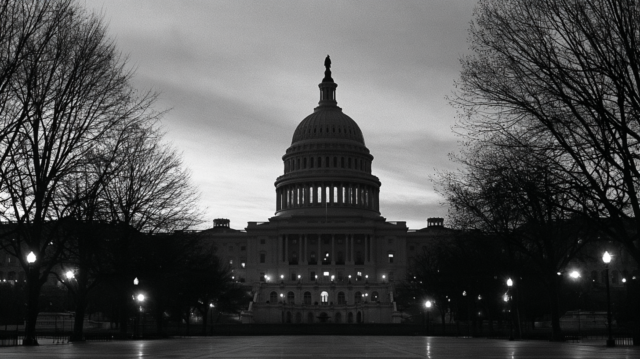
Democrats won the House and the Senate on Tuesday. NBC News projected both chambers before the night was over. Republicans held 53 Senate seats going in; Democrats flipped seven, in Iowa, Kansas, Maine, North Carolina, Ohio, South Carolina and Texas, and by Wednesday held at least 54, with a few races uncalled. In the House, Republicans went in at 218 to 214, and the Associated Press said early Wednesday that Democrats had crossed 218, with dozens of districts still counting. I wrote yesterday about the new Congress. This is about the eight weeks before it is sworn in.
What a lame duck session is
The Congress that lost does not go home. The 119th Congress returns on November 9 and sits until the 120th is seated at noon on January 3, with every member who lost or retired still voting. That is a lame duck session; the Twentieth Amendment, ratified in 1933, is why it lasts eight weeks and not four months.
It is not an empty eight weeks. The stopgap that kept the government open through the election expires December 11. None of the twelve fiscal 2027 spending bills has become law; the House has passed three, the Senate none, and a defense bill and a farm bill wait behind them. Whatever is not signed by January 3 dies. A lame duck is where must-pass bills get written in a hurry and riders nobody read get attached. Section 780, which bars FDA from spending a dollar to enforce its food traceability rule before July 20, 2028, became law on November 12, 2025, in exactly that kind of bill. The window can be used the other way.
Safer food is not a Republican or Democratic issue
Theodore Roosevelt signed the Meat Inspection Act in 1906. The 1994 declaration that E. coli O157:H7 is an adulterant in ground beef came under Bill Clinton, the 2002 law requiring food facilities to register with FDA under George W. Bush, the Food Safety Modernization Act, passed by the Senate 73 to 25, under Barack Obama, and the 2022 law putting an FDA inspector in every infant formula plant once a year under Joe Biden. This year the Making America’s Food Safer Act, introduced by two Republican senators and a Democrat, was reported 22 to 0 and passed the Senate without an objection. Salmonella does not check party registration, and the people who vote on it do not have to either.
What follows comes from Project 2027, the working paper I have circulated since September, and from thirty years of asking for the same handful of things. Each item fits eight weeks and one must-pass bill.
Fifteen things Congress can do before January 3
1. Take Section 780 out of the December package. The House-passed agriculture and FDA bill, H.R. 8646, passed 213 to 210 on June 4 and carries the same bar on enforcing the traceability rule before July 20, 2028. The Senate’s own report language last year said the opposite: full compliance and enforcement by that date. Eleven consumer, public health and labor organizations asked leadership on August 12 to rescind the rider. Whoever writes the December bill decides this.
2. Pass S. 4974 in the House. The Making America’s Food Safer Act passed the Senate by unanimous consent on September 28 and has sat at the House desk since October 5. It lets FDA share unredacted outbreak, inspection and recall information with state and local health departments and order a refused import destroyed instead of re-exported and tried at another port. The House passed the import-destruction half, H.R. 2715, by voice vote in July. One suspension vote finishes it.
3. Pass H.R. 7867, the infant formula bill. Fifty-two infants have been hospitalized with botulism in two outbreaks tied to powdered formula since 2025. Representative DeLauro’s six-page bill, with Republican Jeff Van Drew as lead cosponsor, expands required pathogen testing, requires notice of positive results, and requires FDA to tell Congress within one business day of a serious inspection finding at a formula plant. It is already on the incoming majority’s first-100-hours list; passing it now saves the hundred hours for something else.
4. Put the surveillance back. On July 1, 2025, FoodNet went from eight pathogens to two, and the reason given was money. Fund PulseNet and the state public health laboratories first, because every multistate outbreak count depends on their sequencing, then restore the eight pathogens. Consumer and academic groups asked a year ago for about $36 million more for CDC’s food safety program. This year the request comes with the largest parasitic foodborne outbreak in the country’s history attached.
5. Hold the inspectors harmless. The House bill runs 1.4 percent below the enacted 2026 level. FDA’s foods program should come out of December no worse than it went in, the produce safety cooperative agreements that pay for farm inspections intact, and FSIS’s roughly 8,000 frontline inspectors funded. An adulterant standard nobody can sample for is a press release.
6. Keep preemption out of every must-pass bill. The FRESH Act discussion draft would supersede any state requirement on the use, labeling, sale or marketing of food. Harvard’s Food Law and Policy Clinic read the clause line by line in August and found it reaches allergen disclosure, heavy metal limits, retail inspection and state licensure. The last version of that idea passed the House 283 to 139 in 2006 and died in the Senate. An omnibus or a farm bill is where such a clause hitches a ride.
7. Tell FDA to name the companies. On October 26, the Justice Department’s Office of Legal Counsel told HHS in writing that FDA’s own regulations keep the names of firms in outbreaks secret, and that FDA can amend them. Stop Foodborne Illness has had a petition on that question pending since February 4. Report language directing FDA to answer it by a date certain costs nothing. The 2024 romaine outbreak, 89 sick, seven in kidney failure and one dead, closed with the public never told whose lettuce it was.
8. Publish the testing we already pay for. FDA’s Laboratory Flexible Funding Model pays forty state laboratories to sample food and publishes the results only in aggregate. Direct the agency to publish them at the sample level, as USDA’s Microbiological Data Program did until it was defunded in 2012, and to put a dedicated produce sampling program, about $4.5 million a year when last funded, in the fiscal 2028 request.
9. Count imported food. FSMA told FDA to inspect 600 foreign facilities in its first year and double that every year after, 19,200 a year by now, and GAO found it missed those targets every year from 2018 through 2023. The lettuce this summer came from Mexico, the blueberries from Chile, and FDA’s response to the Chilean plant was a records review over the internet. Require FDA to publish each year the foreign facilities inspected, the supplier verification actions taken and the import alerts issued, and stop counting a remote review as an inspection.
10. Hold FSIS to its own Salmonella notice. On May 1, 2024, FSIS determined that not-ready-to-eat breaded stuffed chicken with Salmonella at one colony forming unit per gram or more is adulterated. Testing was to begin May 1, 2025, then November 3, 2025; on December 2, 2025 it was delayed indefinitely. The standard is law and nobody is checking for it. One paragraph in the agriculture bill: publish the method evaluation, say what an acceptable method must show, and set a date.
11. Make an outbreak trigger an inspection. FDA’s investigations table in September carried seventeen open outbreak investigations, most with no on-site inspection, because the statute sets inspection frequency by facility risk category and is silent on the one event that means something went wrong at a particular plant: people got sick. Drafted text exists for a for-cause inspection within a set period once an outbreak is linked to a firm, and for an annual inspection floor for commodities with a recurrent outbreak history. Both fit an appropriations bill; I will send them to any member who asks.
12. Protect the people on the line. FSMA’s whistleblower section, 21 U.S.C. 399d, protects a worker who reports a food safety violation at an FDA-regulated facility; the Labor Department’s own guidance says a meat or poultry plant is not covered unless it also handles FDA-regulated food. The 2022 Abbott formula complaint came from a former employee and sat at FDA for months. Extend the protection to meat and poultry plants. A cheap bill with a natural bipartisan frame.
13. Say who prosecutes food crimes. The Justice Department eliminated the Consumer Protection Branch on September 30, 2025, and moved the work into a unit inside the Fraud Section. The Commerce-Justice-Science bill is one of the twelve. Report language can require the Department to publish its charging guidelines for food cases and say whether the strict-liability misdemeanor under the Food, Drug, and Cosmetic Act is still charged. Deterrence nobody can locate is not deterrence.
14. Ask for the national strategy. Federal food safety oversight has been on GAO’s High-Risk List since 2007. In 2017 GAO recommended a national strategy for the fifteen agencies and thirty statutes that share the work; in January 2025 the Office of Management and Budget told GAO there were no plans to write one. A request letter to GAO costs one member’s signature and no gavel.
15. Hold the hearings while the gavels are still in hand. The outgoing chairs hold the gavels through December. The Cyclospora season, 18,445 confirmed cases, closed by FDA at 12,883 illnesses, 570 hospitalizations and two deaths tied to shredded iceberg lettuce from Taylor Farms de Mexico, has never had a hearing. Neither has the Expanded Food Safety Investigation Act, which would let FDA sample the feeding operation next to the lettuce field and has waited four Congresses for one. A December hearing is how a bill comes back in January with a cosponsor from the other party.
The single food safety agency I first asked for in 2002, after the ConAgra recall, is a fight for the 120th Congress. Nothing above waits for it. Fifteen items, eight weeks, one must-pass bill. The members who lost on Tuesday still have a vote until January 3. This is a good use of it. If you want the paper, email me at bmarler@marlerclark.com.