
A board that investigates outbreaks the way the NTSB investigates crashes needs a statute. I drafted one for each chamber of Congress, and here is what is in it.

In my last column on Food Safety News I tipped my pen to Jack Guzewich’s case for a National Food Safety Board, an independent body modeled on the National Transportation Safety Board that would investigate foodborne illness outbreaks and say publicly why they happened. I ended that column by writing that somebody has to write the bill. I took my own advice. There are now two discussion drafts of the National Food Safety Board Act of 2027, a Senate version and a House version, nearly identical. This column explains why the idea needs legislation and what the drafts say.

Why this takes an act of Congress

The agencies cannot build this board themselves, for three reasons.

Independence. The agencies that write the rules, inspect the plants and accept the corrective actions are the same agencies that investigate the outbreak. Their own conduct may be part of the story. An office inside one of them, or an agreement among them, still answers to the people being examined. Only a statute can create a body that answers to none of them.

Power. An outbreak leaves no wreckage. The food is eaten or thrown away, and the records sit in private hands, some of them abroad. A board built for cold trails needs subpoenas, sworn testimony, sampling and a way onto the land. No agency can hand those powers to a new body. Congress can.

Follow-through. In August 2013, after more than 600 people in 25 states were sickened with cyclosporiasis, FDA investigators spent eight days at a lettuce plant in Guanajuato and wrote the right recommendation about Cyclospora and the wash step. It went into a file. Nothing in current law requires anyone to answer a recommendation like that, and nothing tracks whether anyone did.

Frank Yiannas, FDA’s former deputy commissioner for food policy and response, called for an outbreak investigation board a year ago. De Ann Davis of Western Growers called it a strong idea if we follow through and listed the design questions nobody had answered: what triggers an investigation, whether the board leads or reviews, whether it can compel records and testimony, who pays, and how agencies must respond. A bill is where those questions get answered.

What the draft does

  • The Board. Five members, appointed by the President and confirmed by the Senate, no more than three from one party, removable only for cause. One seat is reserved for a state or local outbreak epidemiologist and one for an advocate for people injured by foodborne illness.
  • The triggers. The Board must investigate any outbreak with a death, ten or more hospitalizations, 50 or more illnesses across three or more states, a repeat of a food, company or growing region implicated in the prior five years, or any illness tied to infant formula. State and local health officers, victims and their families can petition for others.
  • Its place. The Board runs alongside the emergency response and never in front of it. It cannot write food regulations, order a recall, seize food or penalize anyone. FDA, USDA, CDC and the states keep every authority they have.
  • Its powers. Records, samples, subpoenas and testimony under oath. Importers must produce their foreign suppliers’ records, and a foreign supplier that refuses access risks having its food refused at the border.
  • The land next door. Investigators can enter and sample neighboring operations the Board has reason to believe may be the source, including animal feeding operations and water sources. If an operator refuses, the Board asks a federal court for an inspection warrant. I have argued that FDA already holds that power for the feedlot beside the lettuce field. A new board would not inherit it, so the draft grants its own.
  • The record. A preliminary report in 60 days, a final report with probable cause and contributing factors in 12 months, a public docket for every investigation and a permanent, free, searchable database.
  • The clock. Every recommendation names its addressee. Federal agencies and food companies get 90 days to answer in writing, 30 if it is urgent: adopt it, adopt part of it, or decline and say why. Each February the Board publishes the list of who has not answered and sends it to Congress.

No pass for candor

This is where I part ways with the aviation model. Federal law bars NTSB accident reports from being used as evidence in civil damage suits (49 U.S.C. 1154(b)). Copy that into food and the best root cause analysis ever done on an outbreak would be sealed away from the people it sickened.

The draft goes the other way. Cooperation buys no immunity. Board reports, findings and dockets are admissible and discoverable. No court may recognize a self-critical analysis privilege for what a company tells the Board. A pending investigation is no ground to delay a lawsuit or a prosecution.

There is one narrow exception, and the Fifth Amendment is the reason for it. An individual ordered to testify cannot refuse on self-incrimination grounds, and in exchange that testimony cannot be used against that individual in a criminal case. It covers people only. Companies, documents, samples and every form of civil liability stay fully exposed.

I have an obvious bias here, and the draft deals with people like me too. Nobody paid in the prior two years to represent or advise a party in a foodborne illness claim, plaintiff or defendant, may serve as a member, employee or expert. That keeps me away from any probable cause vote, which is where I belong.

Two versions, and what it costs

The Senate draft contains no dollar figures, pay provisions or monetary penalties. I wrote it that way out of caution about the House’s prerogatives over money. The House draft authorizes $30 million for fiscal year 2028, $45 million for 2029 and $60 million a year for 2030 through 2032, plus a $5 million emergency investigation fund.

The benchmark is the Chemical Safety Board, which received about $14 million for fiscal year 2026 and has completed roughly four in-depth investigations a year since 1998. The NTSB received about $145 million for fiscal year 2025. Food sits between them. For 2018, 1,053 foodborne disease outbreaks were reported to CDC, and in 2024 CDC and its partners investigated 203 possible multistate outbreaks of enteric illness and confirmed 62.

USDA puts the annual cost of foodborne illness at $74.7 billion. The largest year in the House draft is less than one-tenth of one percent of that. The money comes from the general fund. The bill imposes no tax, fee or assessment on anyone.

What is still open

These are discussion drafts, and I can name the weak points. The mandatory triggers may be too broad for the budget; romaine from one growing region could trip the repeat-source trigger most years. Twelve months may be too short for a hard case. Telling state courts what evidence to admit raises a federalism question, and for-cause removal protection for board members is the kind of provision courts are now reexamining. Legislative counsel will need to check every cross-reference.

Those are arguments worth having over statutory text and not over a concept.

I have said for more than twenty years that I would like someone to put me out of business. Here is the text. Mark it up.

https://www.marlerblog.com/files/2026/11/House-Bill-National-Food-Safety-Board-Act-of-2027.pdf

https://www.marlerblog.com/files/2026/11/Senate-Bill-National-Food-Safety-Board-Act-of-2027.pdf
Saturday, November 28, 2026

Last Saturday’s edition was about who knew what, and who got the blame. This week (week 21) was about what got put in writing the day before Thanksgiving, and what still did not. FDA posted closing reports on four Cyclospora investigations from the summer and named the processor and the restaurant chain in one of them; the other three black out sixteen firms, the foods, the states and, in one, a case count FDA publishes on its own table. The same update closed the chicken wrap E. coli file with no report at all. Four senators introduced a bill that would make an agency weigh public health before it withholds a record. A newspaper published FSIS’s own Salmonella test results for the country’s largest turkey company. And Virginia’s fifth round of oyster tests came back ten for ten positive.

The largest outbreak of this parasite on record finally has a closing report with names in it. On November 25 FDA posted Executive Incident Summary abstracts for four Cyclospora files. File #1390, the iceberg lettuce outbreak, names Taylor Farms de Mexico and Taco Bell and closes at 12,883 laboratory-confirmed illnesses in 21 states, 570 hospitalizations and two deaths as of September 11, with Michigan at 5,762, Ohio at 2,871 and Missouri at 1,071. FDA collected 59 samples and found the parasite in two: wastewater at the Taylor Farms de Mexico plant and sediment at a supplying ranch whose name is the one redaction in the document. No product sample was positive. The inspection produced a Form 483 with three observations, and Taylor Farms de Mexico went on Import Alert 99-35 on October 1. The dates are the part worth stopping on: Michigan’s link to Taco Bell reached FDA’s outbreak team on June 25, FDA’s call with Taylor Farms came July 15, and the recall came July 16. The three companion files read differently. File #1385, five restaurant clusters first reported May 5, file #1396, 66 people in one state at two locations of a Mediterranean-style chain, and file #1392, 174 people across seven restaurant clusters traced to one importer and one parsley farm with a June 6 harvest date, together account for 278 sick, ten hospitalized and sixteen firms put on increased import screening, none of them named. The suspect foods, the states and, in #1385, the case count are blacked out under the deliberative-process exemption, although FDA’s own table shows that count as 38. Coral Beach at Food Safety News had it first. My Thanksgiving post makes the legal point once: a head count is not a deliberation.

The chicken wrap file closed with no report at all. The same November 25 update moved #1421, the joint FDA and FSIS E. coli O157:H7 investigation, to the closed table at 51 sick. Nine weeks after it was posted, FDA’s page has never carried a brand, a maker, a state list or a hospitalization count, and no abstract is linked. The only brand name on the public record is still the one in the complaint my firm filed on October 15, Gottlieb and Bright v. Trader Joe’s Company in the Central District of California. The Food Poison Journal post has the nine-week timeline.

Nine files stay open on FDA’s table, and six of them still have no food. The Salmonella Javiana file #1424 grew again, 73 to 76, with traceback, inspection and sampling all underway and no CDC notice a month after it was posted. The two Salmonella Enteritidis files posted November 12 sit at 34 and 14 on traceback alone, the Listeria files at 52, 12 and 11. The six no-food rows add to 199 people. CDC’s dashboard counted 26 active multistate investigations on November 25, fifteen of them Salmonella, five E. coli, four Listeria and two Campylobacter, and none of the six no-food files has a notice. FSIS’s ground beef E. coli O157:H7 row, 2027-01, has now been public for more than a week with no case count, no states, no recall and no public health alert; the FSIS site would not load from here this week, so the row’s current status comes second-hand.

Virginia’s fifth round of oyster tests was positive, ten samples for ten. The Virginia Department of Health page, re-stamped November 25, reports that Little Wicomico Oyster Company cage oysters collected November 16 from five leases all carried Salmonella, the same result as the November 9 round. Five rounds since October 13, zero clean, nineteen of twenty-two lease results positive, no serotypes reported since October 21, and the November 4 water and public-ground samples still pending. Three consecutive clean rounds are required to reopen the river, which puts the earliest reopening in the second week of December, after the December 11 hearing in the company’s $9.1 million suit against the state. CDC’s count has not moved since October 30: 28 sick in 13 states, five hospitalized. Food Poison Journal has the five-round table.

Butterball’s ground turkey tested positive 43 percent of the time, and the plant that failed the federal standard faces no penalty for it. That number came out November 25 in the Guardian, from FSIS sampling data analyzed by SourceMaterial, not from FSIS. Across four Butterball plants over the past year just under 43 percent of ground or chopped turkey samples were positive; at Mount Olive, North Carolina, which processes about 285,000 birds a week, 16 of 45. The federal performance standard is seven positives in 52 samples, 13.5 percent, and a plant that exceeds it is not fined, not shut and not required to recall anything. Jennie-O tested at 7 percent. Butterball’s food safety chief told the paper FSIS should measure how much Salmonella is in a sample rather than whether it is there, and noted its cooked products tested negative. I asked FSIS in 2020 to declare outbreak serotypes adulterants; it said no in 2022, proposed a Salmonella framework in 2024 and withdrew it in April 2025. The Food Poison Journal post has the figures, and last week’s hamburger piece has the model that worked.

Ohio University holds at seventeen, Capitola’s final results did not arrive, and a cruise ship counted 268. The Athens City-County Health Department’s November 23 release keeps the Ohio University cluster at 17 confirmed, no new cases since November 18, onsets November 5 to 10, source not identified, now called an isolated exposure event with no further update scheduled unless something changes; serotyping was due that week and the comparison through PulseNet after it (Food Poison Journal, Marler Blog). Santa Cruz County’s November 19 release promised final results on the Capitola Beach E. coli O157:H7 outbreak, nine children, three hospitalized, one with kidney failure, the following week; the county’s advisories page, updated November 25, still says genomic testing is pending and still lists an advisory at the Capitola jetty. My position on the county’s birds theory has not changed. CDC’s Vessel Sanitation Program updated the Caribbean Princess outbreak November 24: norovirus, 233 of 2,936 passengers and 35 of 1,132 crew sick on the November 11 to 23 voyage, a field response, and the largest count of the ten cruise ship outbreaks CDC has posted this year. And in Doral, Florida, 18 people fell ill after a catered Thanksgiving luncheon at Leon Medical Centers’ headquarters on November 25 and 15 were hospitalized, a mass casualty call for Miami-Dade Fire Rescue (CBS Miami, WSVN); the caterer is unnamed, no pathogen has been reported, and the company says it is working with the caterer to find the cause, if possible.

ByHeart’s complaint file is bigger than one botulism report, and its founders are now named in a motion. The FDA inspection reports show 3,247 consumer complaints between April 26, 2024 and March 14, 2025, 2,167 of them about a baby’s health, of which 69 were sent to the Portland plant and ten were marked sensitive. The December 22, 2024 report of a hospitalized baby with suspected botulism, lost to follow-up, was not among the ten. Forty-eight babies in seventeen states were hospitalized before the recall, and the founders have moved on to buy Perrigo’s formula business under a new name. On November 25 my firm asked the court running the ByHeart multidistrict litigation in the Southern District of New York for leave to amend all six of its member cases to add the co-founders, Ron Belldegrun and Mia Funt, as defendants for negligence; two of the cases would add negligent misrepresentation, and four, where the governing law allows it, would seek punitive damages against ByHeart and the founders. The motion adds no claims against the dairy suppliers or the retailers, and the court has not ruled. It went in within a week of finding the December 2024 botulism complaint.

The recall ledger opens with a fish recall that took thirteen days to reach FDA’s page. With thanks as always to Phyllis Entis at eFoodAlert: FDA posted on November 23 Prime Food Processing’s recall of uneviscerated dried croaker and dried herring, 425 cases in all, sold at Asian grocery stores in 31 states, for Clostridium botulinum risk after routine testing by New York’s Department of Agriculture and Markets; the company dated its notice November 10, and the same herring item was recalled in June. FSIS added four Granna’s frozen meals, biscuit and gravy dinners delivered to homebound seniors through an Oklahoma distributor with best-by dates running to October 2027, to its public health alert over C.H. Guenther & Son’s biscuit Listeria recall, the fifth notice and fourth company in a chain the biscuit maker itself has still not posted a word about (Food Poison Journal). On November 27 FDA’s page added OC Raw freeze-dried chicken hearts, a pet treat sold in California, Maryland, New Mexico and Washington, for Salmonella, and an expansion of Laub’s hay cube recall to as much as 400 tons for botulinum risk to horses.

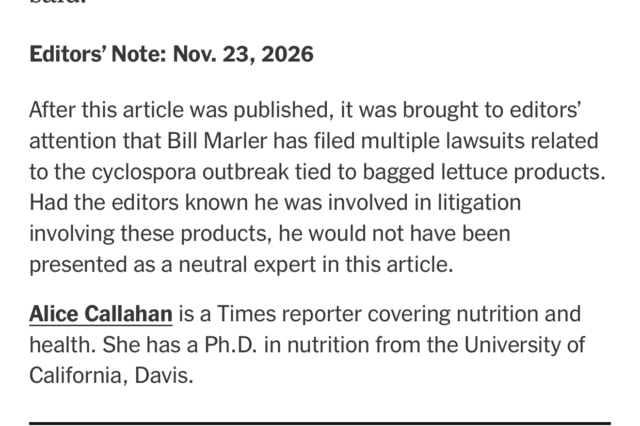
Four senators put the disclosure fight into a bill, and the rest of the week’s paper trail followed.On November 25 Chuck Grassley, John Cornyn, Dick Durbin and Peter Welch introduced the FOIA Clarification Act, which would let an agency withhold a record only where the harm from disclosure outweighs the public interest in it, names furthering public health or safety as such an interest, and says the Trade Secrets Act does not bar a disclosure that passes that test. I am adding it to both of my pending FDA petitions, on naming implicated firms and on recall consignee lists, which go in next month, and I asked the sponsors to pass it in the lame duck or refile it on January 3. Secretary Kennedy’s Radical Transparency commitment is the other hook, and FDA’s outbreak files are the place to prove it. Jesse Newman and Liz Essley Whyte of the Wall Street Journal reported that the long-delayed federal definition of ultraprocessed food is coming, covers about 60 percent of the food supply, exempts additives used for food safety and would not be usable in lawsuits; my notes are on those two clauses. The New York Times appended an editors’ note to Alice Callahan’s five foods piece saying I should not have been presented as a neutral expert; I agree I am a lawyer. Doug Stearn, who ran food compliance at FDA from 2018 to 2023, wrote in March that FDA already has authority to sample feedlots tied to outbreaks under section 361 of the Public Health Service Act and 21 CFR 1240.30; my CAFO petitionwill cite him. Margot Pollans’s The New Food Safety got a thank-you, and so did everyone who commented on Project 2027. The traceability docket closes December 6, the continuing resolution runs to December 11, and the new Congress is sworn in January 3.

That’s the week — the biggest Cyclospora outbreak on record got a closing report with two names and one redaction while its three companions got sixteen redactions and no names, the wrap file closed with none, four senators wrote the fix into a bill, my firm asked the ByHeart court to put the founders’ names on the complaints, Butterball’s numbers came from a newspaper instead of the agency that collected them, and the Little Wicomico River is zero for five. Check back next Saturday.

About Bill Marler

William “Bill” Marler has spent more than thirty years as a food safety lawyer and advocate, work that began with the 1993 Jack in the Box E. coli outbreak and has never really stopped since. In the years that followed, he has represented victims in nearly every major foodborne illness outbreak in the United States. That case, and the movement it launched, is the subject of the book “Poisoned” and the Emmy Award–winning Netflix documentary of the same name. Bill’s work has been profiled in The New Yorker (“A Bug in the System”), the Seattle Times (“30 years after the deadly E. coli outbreak, a Seattle attorney still fights for food safety”), the Washington Post (“He helped make burgers safer. Now he’s fighting food poisoning again”), and many others. Dozens of times a year, Bill speaks to industry, regulators, and universities across the United States, Canada, Europe, Africa, China, and Australia about a simple idea: outbreaks are preventable. He has testified before Congress on the Food Safety Modernization Act and teaches food safety at institutions including the Harvard T.H. Chan School of Public Health. He writes regularly about food litigation and food safety at Marler Blog, and in 2009 he founded Food Safety News, which he continues to publish.

Yesterday morning I sent out my Thanksgiving posts. One of them thanked Margot Pollans for “The New Food Safety.” In it I wrote that the Project 2027 working paper asks for “authority for FDA to sample the feeding operations next to growing fields.”

A few hours later an email arrived from Douglas Stearn. Doug spent years inside FDA. From 2018 to 2023 he was the deputy director for regulatory affairs in FDA’s food center, the senior official over food compliance and outbreak response, and he later served as principal deputy in FDA’s Office of Inspections and Investigations. He was polite. He said he finds the blog useful. Then he told me, in effect, that I had it backwards.

FDA does not need new authority to sample the feedlot next to the lettuce field. It already has it. It has simply chosen not to use it.

He pointed me to an article he published last March in the Food and Drug Law Institute’s Update magazine, “The Need to Integrate Animal Agriculture in our Approach to Food Safety.” I have now read it twice. Doug is right, and I want to thank him the same way I thanked Margot: by telling more people what he wrote.

The problem: we keep stopping at the fence

I have represented people sickened by leafy greens for close to thirty years. The pattern does not change. A child gets E. coli O157:H7. Public health officials link the illness to romaine. FDA traces the romaine to a growing region and then to farms. And then, at the edge of a cattle operation, the investigation stops.

Yuma, 2018, is the case everyone remembers. The outbreak sickened 210 people in 36 states. Ninety-six were hospitalized, 27 developed hemolytic uremic syndrome, and five died. FDA found the outbreak strain in an irrigation canal that ran beside a feedlot able to hold more than 100,000 head of cattle. Investigators took six samples of manure and water at that feedlot. They took them in June, for illnesses that began in March, at an operation that turns its animals over constantly. None of the six carried the outbreak strain. Six samples is not a negative result. It is the absence of a test.

Doug makes the same point in plainer language. The investigation report, he writes, “does not reflect that FDA conducted any sampling at the CAFO itself” beyond that limited effort. Salinas in 2019 and 2020 was no better. The best evidence came from a cattle grate on public land, a trough, a fence line, and cattle feces on a roadside. None of it came from inside the animal operations the evidence pointed toward.

In 2025, FDA and CDC scientists reviewed every farm investigation FDA led after a multistate STEC outbreak linked to leafy greens from 2009 through 2021. Where the investigation traced to a single farm and livestock information was available, there were livestock nearby every time. And the authors wrote the sentence that should embarrass everyone in this field: FDA and CDC “do not have direct authority to access private land used for livestock operations.”

That is the conventional wisdom. Doug’s article says the conventional wisdom is wrong.

The legal argument: a steer is food

Doug’s first argument is so simple it is almost funny. The Federal Food, Drug, and Cosmetic Act defines “food” as articles used for food or drink for people or animals, and their components. FDA has long taken the position that animals raised for human consumption are food, even while they are still walking around.

This is not a theory Doug invented. It is FDA’s own written position. The agency’s compliance program on illegal drug residues says that “food-producing animals and fish, even though not in their final, edible form, have been held to be food under the statute,” and puts it more bluntly: “live animals raised for food are ‘food’ under the [FDCA].” The few courts that have looked at the question agree. In United States v. Tuente Livestock, a federal court in Ohio held in 1995 that FDA may treat live animals raised for food as food. A New York court reached the same result in 1983 for veal calves.

If a steer in a feedlot is food held for sale, then FDA’s ordinary inspection power reaches the feedlot. FDA has actually used that power for decades, on ranches, to chase illegal drug residues in cattle. What it has never done, as far as Doug can find, is use it publicly to investigate an outbreak of foodborne illness.

Doug is honest about the weak spot. In an outbreak investigation, FDA would not be on the ranch because of the cattle. It would be there because of the lettuce growing on someone else’s land. A rancher’s lawyer will say the statute was never meant to work that way. Doug answers with the Supreme Court’s instruction that Congress meant the Act to be “as broad as its literal language indicates,” and that the Act is to be read liberally to protect public health. I think he has the better of that argument. I would also not want to bet a five-death outbreak on it alone.

The second key: the Public Health Service Act

That is why his second argument matters. Section 361 of the Public Health Service Act lets FDA write and enforce regulations to stop communicable disease from spreading from one state to another, including “inspection” and the destruction of “animals or articles” that are sources of dangerous infection. FDA’s own regulation, 21 CFR 1240.30, already says the Commissioner may order inspection of animals believed to be sources of infection when state efforts fall short.

FDA has used this law against live animals for fifty years. In 1975 it banned the sale of turtles smaller than four inches across the shell because they spread Salmonella to children. That rule is still on the books. If FDA can regulate a pet-store turtle because it carries Salmonella, it can walk onto a feedlot that genomic evidence has tied to a multistate E. coli outbreak and take a sample of manure.

So why hasn’t FDA done it?

Doug’s answer is uncomfortable, and I think it is true. FDA has “opted out” of a more robust assertion of its own jurisdiction. Part of the reason is capacity. The agency’s food program was already short of inspectors before the recent cuts. The Government Accountability Office has reported for years that FDA cannot meet its domestic inspection targets. Part of it is culture. FDA knows produce farms and food plants. It does not know ranches, and ranchers do not know FDA.

And part of it is that nobody else will do it either. USDA’s Food Safety and Inspection Service starts at the slaughterhouse door. APHIS acts when animal health is at stake, not when the cattle are healthy carriers of a human pathogen. EPA regulates manure discharges from the largest operations under the Clean Water Act. That is a permit regime, not an outbreak investigation. The result, as Doug puts it, is a gap where “neither agency has taken or accepted responsibility.”

Meanwhile FDA has made the produce grower responsible for the feedlot. The new agricultural water rule requires growers to assess hazards from adjacent and nearby land, including animal operations upslope of their water, and to mitigate quickly if they find one. The grower has no right to a sample from that feedlot. Neither, in practice, does the agency that wrote the rule.

Why it matters now

Produce is where the outbreaks are. Doug notes that in 2024 FDA investigated twenty-six outbreaks and identified the food in twenty, and fourteen of the twenty were produce. FDA’s leadership has called recurring leafy greens outbreaks one of the most urgent problems it faces and wrote a whole Leafy Greens STEC Action Plan around them. And still, as the GAO found early last year, foodborne illness in this country has not meaningfully declined.

We now have tools that did not exist when Jack in the Box happened. Whole genome sequencing can match a strain in a sick child to a strain in a canal, a cow pie, or a water trough. Doug’s point is that the matching only works if someone is allowed to collect the sample. You cannot sequence what you are not permitted to pick up.

Doug also makes a point about incentives that anyone who has litigated these cases will recognize. Ranchers and growers can share data voluntarily, and some do. But an operator whose cattle might be the source of a deadly outbreak has every reason not to find out. Voluntary programs are good for education. They are not built to find the cause of a specific outbreak while people are still getting sick.

Where poultry fits

Doug’s article goes beyond lettuce. He discusses new genomic work suggesting that Salmonella and Campylobacter in American chicken can often be traced back to a small number of primary breeding companies, and notes that Denmark and Sweden have controlled Salmonella Enteritidis by going after it in breeding stock. That is a bigger fight for another day. It rests on the same insight: the pathogen is in the animal before it reaches any plant, and our system starts looking only after it gets there.

What I am changing

Two things.

First, Project 2027. Where the working paper asks Congress to give FDA authority to sample feeding operations next to growing fields, it will now also ask FDA to use the authority it already has. Congress can confirm it. FDA should not wait.

Second, my citizen petition on sampling at animal feeding operations, which I plan to file. It already rests on section 361 and part 1240. It will now also cite Doug’s article and FDA’s own position that live animals raised for food are food, as an independent basis for the same rule. The petition asks for something narrow: when the Commissioner finds in writing that an operation is implicated in a multistate outbreak, investigators may enter and take samples, for a limited time. No seizure, no regulation of husbandry, no fishing through a rancher’s books.

I will say again what I said about the New York Times last week. I am a lawyer who represents people sickened in these outbreaks. Weigh what I say accordingly. But the rule I am asking for would operate during the outbreak, on FDA’s initiative, with results going to the operator and the state. It is a tool for finding the source while finding it can still prevent the next one.

Thank you, Doug

Doug wrote that FDA “should use this authority to investigate outbreaks without waiting for additional authority.” Seven words in his email did more to sharpen my thinking than a month of my own drafting.

The next time the outbreak strain turns up in a canal beside a feedlot, I hope investigators go through the gate. Read Doug’s article. It is short, careful, and right.

Sources

Douglas Stearn, “The Need to Integrate Animal Agriculture in our Approach to Food Safety,” Update Magazine, Food and Drug Law Institute (March 2026).

FDA, Environmental Assessment of Factors Potentially Contributing to the Contamination of Romaine Lettuce Implicated in a Multi-State Outbreak of E. coli O157:H7 (Nov. 1, 2018).

FDA, Compliance Program 7371.006, Illegal Residues in Meat, Poultry, Seafood, and Other Animal Derived Foods (Apr. 7, 2023).

FDA, Adjacent and Nearby Land Use and Its Impact on Produce Safety.

FDA, Investigations of Foodborne Illness Outbreaks.

FDA, Leafy Greens STEC Action Plan.

GAO, Food Safety: Status of Foodborne Illness in the United States, GAO-25-107606 (Feb. 2025).

GAO, Food Safety: FDA Should Strengthen Inspection Efforts to Protect the U.S. Food Supply, GAO-25-107571(Jan. 2025).

David J. Lipman, “Genomic Epidemiology of Salmonella and Campylobacter in Poultry Production: Quantifying the Contribution of Primary Breeders,” medRxiv (Nov. 13, 2025).

Stelio Viazis et al., “An Overview of Farm Investigation Findings Associated with Outbreaks of Shiga Toxin-Producing Escherichia coli Infections Linked to Leafy Greens: 2009–2021,” Journal of Food Protection 88(7) (2025).

United States v. Tuente Livestock, 888 F. Supp. 1416 (S.D. Ohio 1995); United States v. Tomahara Enterprises Ltd. (N.D.N.Y. 1983).

Public Health Service Act § 361, 42 U.S.C. 264; 21 CFR 1240.30; 21 CFR 1240.62.

Early on Thanksgiving morning, before most of the country had a turkey in the oven, an email arrived from a law professor I had never met. Margot Pollans, Associate Dean for Faculty Development and the Gilbert & Sarah Kerlin Distinguished Professor of Environmental Law at the Elisabeth Haub School of Law at Pace University, had read the Project 2027 working paper. She sent a careful set of comments, and she attached an article she wrote with Emily Broad Leib, who directs the Food Law and Policy Clinic at Harvard Law School: “The New Food Safety,” 107 California Law Review 1173 (2019).

Margot and I had never spoken before. Emily I do know, and if memory serves I have spoken to her class at Harvard.

Thank you, Margot, for sending it. I wish I had read it when it came out. It deserves a wider audience than law reviews usually get, so here is what it says, where the numbers stand today, and why I think the authors are right.

Three people, one question

The article opens with three people. A child gets Salmonella from a hamburger. A man is diagnosed with diabetes after decades of eating too much sugar. A person who lives near an animal feedlot has an asthma attack made worse by the air coming off it. Which of the three got sick because food is unsafe?

American law says only the first. The authors say all three, and they sort the risks into three kinds. Narrow food safety is the acute illness that follows eating a contaminated food, which is where I have spent my career. Intermediate food safety is the harm that builds over a lifetime of diet: diabetes, heart disease, some cancers. Broad food safety is the harm done in producing and disposing of food, to workers, to neighbors and to the environment. Together they call it Food System Safety.

What the narrow view costs

The article makes three arguments, and each one landed with me.

The first is about where the money and attention go. The authors cite a Government Accountability Office finding that of the nearly $1 billion FDA spent regulating food in 2016, 98 percent went to traditional food safety and 2 percent to nutrition, with about 4,200 full-time staff on one side and 97 on the other.

The second is collateral damage. Rules written with only pathogens in mind can work against other goals, as when safe food is thrown away or farms are pushed to sterilize the land around a field.

The third is the one a food safety lawyer should sit with: the narrow view defeats itself. Diabetes weakens the immune system, and the article cites a study finding people with diabetes three times as likely to contract Salmonella infection, four times as likely to contract Campylobacter infection and twenty-five times as likely to develop listeriosis. A food worker with no paid sick leave has every reason to hide an illness. And in the 2018 romaine lettuce E. coli outbreak from Yuma, Arizona, which put nearly 100 people in the hospital and killed five, FDA found the outbreak strain in an irrigation canal that ran beside a feeding operation holding as many as 100,000 cattle, an operation the produce rules do not reach.

The numbers, brought up to date

The article is seven years old. The numbers have moved, and not in a way that weakens the argument.

Foodborne illness. The authors used CDC’s older estimate of 48 million illnesses, 128,000 hospitalizations and 3,000 deaths a year. In 2025 CDC published new estimates for seven major pathogens alone: 9.9 million illnesses, 53,300 hospitalizations and 931 deaths a year. USDA’s Economic Research Service puts the cost of foodborne illness at $74.7 billion for 2023.

Heart disease and stroke. The article counted about 635,000 heart disease deaths in 2016. CDC’s count for 2024 is 683,491, with another 166,852 deaths from stroke.

(I learned about heart disease the hard way. In February of this year I was sitting at the Hay-Adams, across the street from the White House, preparing to speak to the Food Safety Caucus the next day, when I had a heart event of my own. The good people at Howard University Hospital fixed it, and I am thankful to them. It probably explains the feverish pace I have kept since: taking care of my own health, and pushing food safety on this blog, through the petitions and through Project 2027.)

Diabetes. The article put the cost at $327 billion in 2017. The American Diabetes Association’s figure for 2022is $412.9 billion, and CDC attributes 94,445 deaths to diabetes in 2024.

A national strategy. In 2019 the authors called for a national food strategy. In 2021 the Government Accountability Office counted 200 federal diet-related efforts spread across 21 agencies with no one in charge, and asked Congress to name a lead. By GAO’s own tally, as of February 2026 Congress has not acted.

The pathogen side has not been spared either. In 2025 the government cut its active foodborne illness surveillance network from eight pathogens to two. Nobody is winning this budget fight. Both sides of the food safety community are losing it separately.

What I have learned

For thirty-three years I have represented people sickened by bacteria and viruses in food, and I will keep doing that. A child on dialysis because of a hamburger is not a statistic to me.

But Project 2027 has put me in touch with people I would never otherwise have met, and they have taught me something I should have understood sooner. It is not only the bacteria and viruses that kill people in the short run. It is the insidious harm over the long run, the diet, the chemicals, the conditions of the people who grow and process our food, that has had an enormous impact on human health.

The working paper has started to reflect that. It asks for paid sick leave for food workers, protection for plant workers who report what they see, authority for FDA to sample the feeding operations next to growing fields, an end to routine antibiotics in animals that are not sick, and it gives diet-related chronic disease the same weight as the pathogen items.

Margot told me, kindly, that the paper does not go far enough, and that her own thinking has moved on since 2019, particularly on the article’s recommendations. I take both points. The diagnosis in “The New Food Safety” has held up for seven years, and that is the part I am asking everyone working on Project 2027 to read.

We are all asking the same agencies and the same committees for the same thing: a food system that does not make people sick, today or thirty years from now.

Read the article here. The current draft of Project 2027 is in yesterday’s post, and comments still go to bmarler@marlerclark.com. To Margot Pollans and Emily Broad Leib, thank you for writing it, and for sending it.

Somewhere in America this afternoon, someone is going to push a thermometer into the thickest part of a turkey thigh and wait for it to read 165 degrees. I am thankful for that person. Thirty-three years of representing people sickened by food have taught me that food safety is mostly small acts of care by people who will never know whose illness they prevented.

This Thanksgiving I am thankful for another set of small acts of care: the comments.

Thank you for the comments

Since September I have been circulating a working paper called Project 2027, a draft food safety agenda for the coming year. It has gone to well over a hundred people and organizations, and it is now on its twenty-second version. That number is not a sign of indecision. It is a count of how many times someone who knew more than I did took the time to say so.

I am thankful to the people who have spent their careers on Salmonella, E. coli, Listeria and Cyclospora, who corrected my facts and sharpened what the paper asks for.

I am thankful to the people who work on diet, chronic disease and the long-term complications of what we eat, who told me, fairly, that an early draft treated their work as a courtesy. It is now a commitment, carried at the same weight as everything else in the paper.

I am thankful to the people in industry who told me what would work in a plant or a field and what would not, and to the people in government, federal, state and local, current and former, who showed me where the authority to act already exists.

I am thankful to the academics, the lawyers and the scientists who checked the reasoning and the citations, and to everyone who simply asked a hard question. The questions were as useful as the answers. The disagreement was useful too. Where readers disagreed with each other, the paper says so instead of pretending otherwise.

The process has been more useful than I had any right to expect. What began as one lawyer’s list is becoming a document that a wide variety of people can get behind.

Why Project 2027 exists

The case is in the government’s own numbers. Foodborne illness costs this country $74.7 billion a year by USDA’s estimate. CDC reported this spring that not one of the pathogens it tracks has declined against its 2016 to 2018 baseline. This year the country had the largest cyclosporiasis season in its history, with 20,996 laboratory-confirmed cases by CDC’s count as of October 23.

The chronic disease numbers are larger still. Heart disease and stroke killed more than 850,000 Americans in 2024, and diagnosed diabetes cost $413 billion in 2022.

In all my years of doing this work, I have watched good organizations work their own contacts, inside their own silos, on their own piece of the problem. Project 2027 is an attempt to try the other way. Whether the subject is bacteria, antibiotic resistance, the chemicals in the food supply or the chronic disease that follows what we eat, we are asking the same agencies and the same committees for the same thing: a food system that does not make people sick. Our voices are stronger together than separate.

What Project 2027 is

It is thirty-six specific things that would make American food safer and that can be done within a year by people who already exist: Congress, the agencies, the states and industry itself. Known problems, known solutions. Bold and doable.

It is a draft. Nobody is asked to sign anything, and nobody is asked to give up an agenda of their own. The ask is only that, where this paper and yours say the same thing, we say it at the same time, to the same people. The paper has no owner. The measure of its success is how much of it ends up in other people’s documents.

Where this is going

The current version of Project 2027 is attached to this post as a PDF. Download it, read the part you know best, and tell me what is wrong, what is missing and what should be cut. Email your comments to me at bmarler@marlerclark.com.

It would be great to have your comments before November 30, but if they bleed into the first week of December, I will not turn away a good one.

In December the comments go into a shorter draft, with the detail moved to attachments, and that draft goes back out to everyone. Then, on Friday, January 15, 2027, once the new Congress is seated, I will host a working meeting in Washington D.C., at a neutral venue, with a way to join remotely for those who cannot travel. One day, the pathogen side and the chronic disease side in the same room, with the shorter draft on the table.

Until then, thank you. Enjoy the people at your table today, and take the turkey to 165.

Download here – https://www.marlerblog.com/files/2026/11/Project_2027_Working_Paper_v22_11_26_26_Clean_Dates_Aligned.pdf

I have spent more than thirty years asking the government to tell people what made them sick. This Thanksgiving I have some thanks to give.

A disclosure first. I am a lawyer who represents people sickened in foodborne illness outbreaks, and I use the Freedom of Information Act to get records FDA will not publish.

Thank you, Senators

On Wednesday, November 25, Senators Chuck Grassley of Iowa, John Cornyn of Texas, Dick Durbin of Illinois and Peter Welch of Vermont introduced the FOIA Clarification Act. Two Republicans and two Democrats, the day before Thanksgiving. I am grateful to all four, and I support the bill.

Here is what is great about it.

  • Today an agency may withhold a record if it reasonably foresees that disclosure would harm an interest a FOIA exemption protects. The bill adds a second test: that harm must outweigh the public interest in access to the information.
  • The bill names “furthering public health or safety” as one of the public interests to be weighed.
  • The bill says that, for purposes of that test, a disclosure is not deemed prohibited by the Trade Secrets Act.
  • Agencies would have to post more records on their own, and report each year on their most requested records and whether those can simply be published.
  • Federal employees would be protected from retaliation for making a FOIA request.

A lawyer friend in Washington sent me the bill on Thanksgiving morning with a note: if it passes, FOIA becomes a much stronger fallback when FDA will not disclose. She is right, and I am thankful for her too.

Thank you, Mr. Secretary

Secretary Kennedy has made radical transparency a commitment, and I wrote this week that he is right. In March 2025 his Department committed to “promoting radical transparency to make sure all Americans know what is in their food.” In July 2025 FDA told food industry leaders that “radical transparency in food safety and nutrition actions is key to reducing foodborne illness and chronic disease.”

Here is what is great about that idea. It starts from the right place: the information belongs to the public, and the burden is on the government to explain why it should be kept back. There has been movement, and I am thankful for it. In September 2025 FDA began publishing summaries of its closed outbreak investigations. On October 26 the Office of Legal Counsel at the Department of Justice concluded that FDA has the authority to write a regulation disclosing the firms behind an outbreak. On November 13 FDA said that a firm’s name is not confidential, agreed that “actively exploring rulemaking is an important next step,” and invited input.

Where the promise meets the outbreak file

Gratitude does not require pretending the work is done.

On November 18, FDA posted its closing summaries of three Salmonella outbreaks that sickened 261 people and hospitalized 47. I wrote about what was blacked out. In two of the three, the suspect food itself was withheld. In all three, the states where people got sick were withheld. In the romaine outbreak, romaine was the leading suspect inside the government on August 7. The public was told on November 4. The processor has still not been named.

The senators’ bill would help after the fact. An agency could no longer simply point to an exemption. It would have to find that the harm of naming a vegetable, or a processor, outweighs the public’s interest in health and safety.

But FOIA starts with a request and ends months or years later. It does not tell a parent which bag of lettuce to throw away this week.

What my two petitions add

I have been drafting two citizen petitions to FDA, and I plan to file them. I am adding the FOIA Clarification Act to both.

The first asks FDA to write the regulation the Office of Legal Counsel says it may write. FDA would name the food and the firms its investigation implicates within five business days, on defined evidence, with three business days’ notice to the firm and a duty to correct any error. Its public outbreak table would name the suspect food once traceback begins, and say at closure whether the traceback found a source.

The second asks FDA to publish the list of stores that received a recalled food in the most serious recalls, as USDA’s Food Safety and Inspection Service has done by rule since 2008, and to classify recalls within ten days.

Here is how they help what the senators and the Secretary are proposing.

For the senators: the bill asks every agency to look at its most requested records and consider publishing them without waiting to be asked. The petitions do that for outbreak records. What FDA publishes on its own, nobody has to request, appeal or litigate. The bill is the backstop for after the file is closed. The petitions are for the weeks when people are still getting sick.

For the Secretary: the petitions turn a principle into a rule. A regulation says which firms are named, on what evidence, when, and with what chance for correction. It gives companies fair notice, and it lasts longer than any one Secretary or Commissioner.

For FDA itself: the petitions protect the agency’s standing with the public. When a public agency withholds the name of a food or a firm and the name comes out anyway, through a lawsuit, a records request or a reporter, it looks as if the agency was doing the bidding of the industry and not protecting public health. I do not believe that is what the people at FDA intend. A rule that requires disclosure takes the suspicion away.

Why it matters for safety

A shopper who knows the brand and the store can check the refrigerator. A doctor who knows the food can ask the right question. A buyer who knows the supplier can decide whom to buy from next season.

Consumers benefit most. Everyone who buys food buys on trust: the family at the grocery store, the grocery chain, the restaurant. A supplier’s track record, including whether it has been tied to an outbreak, is what a buyer needs to know. When that record is withheld, the public cannot make an informed decision, and a firm with outbreaks behind it sells on the same terms as one that has never made anyone sick.

It matters to farmers too. During the 2026 Cyclospora outbreak, 6.5 million households stopped buying salad kits in a single month, and nearly all of the companies that lost those sales had nothing to do with it. Naming the firm responsible protects everyone who did the job right.

What I am asking

Senators, please pass the bill in the lame duck session, and reintroduce it on the first day of the new Congress if you cannot. Say in the record that the food, the states and the firms in an outbreak investigation are the public health information the bill means.

Mr. Secretary, please ask FDA to open the rulemaking it has already called an important next step.

Safe food is not a Republican or a Democratic position, and neither is open government. This week four senators from both parties and a Secretary of Health and Human Services were all saying the same word. For that I am thankful.

Happy Thanksgiving.

Here is the bill – https://www.marlerblog.com/files/2026/11/grassley_cornyn_et_al_-_foia.pdf

On November 19, Alice Callahan of the New York Times published “5 Foods That Food Safety Experts Avoid.” I liked it enough to write a tip of the pen the same morning. I still like it. Go read it, then come back.

On November 23, the Times added an Editors’ Note. It reports that, after publication, the editors learned I have filed multiple lawsuits over the Cyclospora outbreak tied to bagged lettuce, and that had they known, “he would not have been presented as a neutral expert in this article.”

I intend to cooperate fully. In that spirit, and to spare the editors a second note, here are some further disclosures.

Further disclosures, offered voluntarily

I am a lawyer. I have been one for more than 30 years. I have never been accused of neutrality before, and I would like the record to reflect that I did not start it.

My firm is Marler Clark. We call it “The Food Safety Law Firm.” It is on the website, the letterhead and the door. In hindsight, we could have made the font bigger.

I have represented people sickened by every food on Ms. Callahan’s list. Sprouts, deli meat, bagged salad, raw oysters and melon. That is not a coincidence. That is how I know what is on the list.

I published my own list nearly eleven years ago. In January 2016, I wrote about six foods I do not eat. Four of the Times’ five were on it: raw sprouts, prewashed and precut produce (which covers both the bagged salad and the precut melon) and raw shellfish. I have been on the record as not neutral about bagged salad for a decade.

There is a book. There is also a Netflix documentary. Both are called Poisoned. I appear in them. I am not presented as neutral in those either.

I disclosed it myself. My November 19 post said, in so many words, that I was the one who gave her the bagged salad answer, and that I have been suing lettuce and leafy greens companies for a very long time.

I am biased against food poisoning. Strongly. I have been for my entire career, and I do not expect to recover.

Which way does the conflict run?

A conflict of interest usually means the source makes money if you take his advice. Consider mine. If I am right about bagged salad, and you buy a whole head of lettuce and wash it yourself, fewer people get sick. Fewer sick people means fewer people calling a food poisoning lawyer. As a business plan, it is one of the worst in American law.

I have been pursuing that plan in public since 2002, when I wrote an op-ed after the ConAgra ground beef recall asking the industry to put me out of business. The beef industry largely did. The hamburger E. coli cases that built my firm are nearly gone, and that is the best thing to happen in food safety in my lifetime. I would be delighted if lettuce were next.

The editors have a point

Here is the part where I stop joking. Readers should know who is talking and what stake that person has in the subject. I have filed petitions asking FDA to tell the public more about outbreaks, not less. I can hardly object when the standard is applied to me.

The article now tells readers that I am a lawyer with lawsuits pending over this outbreak. That is accurate. Weigh what I said accordingly.

I would add only this. I am not sure a neutral expert on foodborne illness exists, and I am not sure you would want one. Barbara Kowalcyk, who opens the article, lost her 2-year-old son to an E. coli infection in 2001 and has spent the years since making food safer. Sandra Eskin runs Stop Foodborne Illness. The scientists quoted have built careers studying Salmonella, Listeria and norovirus. None of us is neutral about whether people should get sick from dinner. That is the qualification, not the defect.

What Alice Callahan got right

None of this takes anything away from the reporting. Ms. Callahan, who covers nutrition and health for the Times and holds a Ph.D. in nutrition from the University of California, Davis, did what most “foods to avoid” stories do not. She explained the why. Each of her five foods comes with the mechanism that makes it risky, and with something a reader can do about it. The advice is also nearly free: buy the whole head, buy the whole melon, wash it, and cook the sprouts.

It is short, it is accurate, and it is worth five minutes of your Thanksgiving weekend. Read it, note included.

I am thankful this year for reporters who cover food safety well, for editors who care about disclosure, and for having it confirmed in the paper of record that I am not neutral about food poisoning. I never have been.

Editors’ Note: After this post was published, it was brought to the author’s attention that he is still a lawyer. Had he known, he would have written it anyway.

On the day before Thanksgiving, FDA posted Executive Incident Summary abstracts for four Cyclosporainvestigations from last summer. Coral Beach at Food Safety News had the story within hours: only one of the four names a company. I have read all four. She is right, and the details are worth laying out, because together they show exactly where FDA draws its line between telling the public and not.

The one file with names

File #1390 is the iceberg lettuce outbreak, the largest Cyclospora outbreak on record in this country: 12,883 laboratory-confirmed illnesses in 21 states, 570 hospitalizations and two deaths. The abstract names Taylor Farms de Mexico and Taco Bell. It gives the count state by state, from 5,762 in Michigan, 2,871 in Ohio and 1,071 in Missouri down to three each in North Carolina and Georgia. It says 65 Taco Bell subclusters received shredded iceberg lettuce from the processor, and that at least 17 locations had no other lettuce supplier.

It reports that FDA collected 59 samples and that two were positive: wastewater at the processing plant and sediment from a ranch that supplied it. No product sample was positive. FDA issued a Form 483 with three observations and added Taylor Farms de Mexico to Import Alert 99-35 on October 1. The timeline is there too. Michigan’s link to Taco Bell reached FDA’s outbreak team on June 25. FDA’s call with Taylor Farms was July 15, twenty days later, and the recall came the next day.

The whole file carries one redaction: the name of the ranch, withheld as confidential commercial information. My firm represents people sickened in this outbreak, and I will get that name. Even so, this is close to what a closed outbreak file should look like.

The three files without

File #1385 covers five clusters tied to Mexican-style restaurants, first reported to FDA on May 5. FDA drafted 13 traceback assignments. Four of five points of service converged on a single importer, which bought from a shipper supplied by two growers. Seven firms were put on increased import screening. FDA took 13 import samples; ten were tested and were negative, and three could not be analyzed because of shipping delays and product degradation. One person was hospitalized. The suspect food is blacked out. The importer, shipper and growers are not named. The number of sick people and the number of states are blacked out.

File #1396 is 66 people, all in one state, tied to two locations of a Mediterranean-style restaurant chain. One was hospitalized. The state, the chain, the suspect food, the importer and the grower are all withheld. Four firms went on increased import screening. FDA took one import sample.

File #1392 is 174 people and eight hospitalizations across seven clusters at Mediterranean-style restaurants. Here FDA names the food, parsley, and says traceback from all 11 points of service converged on one importer and pointed to one farm with a harvest date of June 6. The importer, the shipper, the farm, the restaurants and the states are withheld. Five firms went on increased import screening.

Add the three together: 278 people sick, ten hospitalized, sixteen firms flagged at the border, and not one firm, restaurant or state named. By my count the three abstracts carry roughly 55 redaction marks. None of the three outbreaks produced a recall or a public advisory.

FDA redacted a number it had already published

In #1385, the case count and the state count are withheld under FOIA Exemption 5. FDA’s own outbreak investigation table lists #1385 at 38 cases. The agency blacked out, in its final report, a number it posts on its website every week.

I wrote last week about three Salmonella abstracts where FDA used the same exemption to hide a vegetable. Exemption 5 protects an agency’s internal deliberations. It does not protect facts, as the Supreme Court said in EPA v. Mink in 1973, and since 2016 an agency has to reasonably foresee harm before it withholds. A vegetable is not a deliberation. Neither is a head count, and neither is the name of a state.

Why the line falls where it does

The one file with names is the one with a recall. Taylor Farms was already public on July 16, so the abstract names it. Where there was no recall, there are no names. That is the same pattern as the romaine and Salmonella files earlier this month.

The parsley file is where that rule stops making sense. In #1392, FDA names the food and says traceback from all 11 points of service converged on one importer and one farm. That is the same kind of evidence it had against Taylor Farms, minus a positive environmental sample. The firms are still withheld. The only real difference is that nobody recalled anything, because by the time the traceback was done the parsley was long gone. A rule that names the company that recalls and protects the company that does not rewards exactly the wrong behavior.

The import side follows the same rule. An import alert is a public list, and anyone can look up Import Alert 99-35 and find Taylor Farms de Mexico on it. Increased import screening, as far as I can find, has no public list. Sixteen firms are being watched more closely at the border because of produce that FDA’s own tracebacks tied to sick people, and buyers of that produce have no way to know who they are.

Then there is the sentence that appears in two of the files: this was the third consecutive year that Mediterranean restaurants in the same redacted place were linked to Cyclospora and received implicated parsley from the same redacted growing region. States have been more forthcoming than that. Texas health officials, for example, described a 2023 outbreak of 181 cases at a Mediterranean restaurant in Harris County tied to Italian parsley in tabbouleh. I do not know whether that is the same place or the same supply chain, because FDA has blacked it out. I should not have to guess, and neither should the people who eat there.

Three questions for FDA

First, what deliberation is protected by withholding the number of sick people in #1385 when the agency’s own table says 38?

Second, who are the sixteen firms, and why is increased import screening confidential when an import alert is not?

Third, after year one and year two of the same restaurants and the same parsley, what was done, and were the customers of those restaurants ever told?

FDA deserves credit for posting these abstracts at all, and for the Taylor Farms file in particular. Two days ago I asked Secretary Kennedy to make FDA’s outbreak files the proof of his Radical Transparency commitment. Here are three more files to start with. I am still drafting the citizen petition that would make naming the food, the firms and the states the rule, and I will share the draft with anyone in industry or government who wants to comment on it.

Put me out of business. Please. Start by telling people what made them sick.

FDA documents

Cyclospora / Iceberg Lettuce / July 2026, file #1390 (Taylor Farms de Mexico)

Cyclospora / suspect food redacted / May 2026, file #1385

Cyclospora / suspect food redacted / July 2026, file #1396

Cyclospora / Parsley / July 2026, file #1392

FDA Foodborne Illness Outbreak Executive Incident Summary Abstracts page

FDA Investigations of Foodborne Illness Outbreaks table

A tip of the pen tonight to Jesse Newman and Liz Essley Whyte of the Wall Street Journal. Their story, “Coming Soon: RFK Jr.’s Long-Delayed Ultraprocessed Food Definition,” went up late Wednesday afternoon, the day before Thanksgiving, which is not when most people are reading food policy news. It deserves to be read.

Here is the headline news. The White House is now moving ahead with a proposed federal definition of ultraprocessed food, a centerpiece of Health Secretary Robert F. Kennedy Jr.’s “Make America Healthy Again” agenda. By the Journal’s account, the proposal would put “around 60% of the U.S. food supply” in the ultraprocessed category. It had been stuck since before the midterm elections. What changed, Newman and Whyte report, is that Stephen Miller, now President Trump’s chief of staff, picked it back up in recent weeks. Their sources expect it out soon, with a public comment period to follow.

The part that took real digging is further down. The reporters got a look at a document describing the introduction the administration has been debating, and it is full of caveats. The government would not be saying that foods meeting the definition are harmful. The definition would be for research purposes. It is not supposed to be used for state laws or regulations, or in lawsuits. And there is an exemption for additives used for food safety, along with carve-outs for infant formula and foods that meet FDA’s “healthy” standard. None of that was public before tonight.

The Journal had reported earlier this fall that Kennedy’s food proposals had run into resistance inside the White House. The administration first asked for public input on a definition in July 2025, and Kennedy at one point said it would be public as early as April 2026, according to Bloomberg Law. It is now late November. For most of that time the public has learned where the definition stands from reporters, not from the government.

My work has been on the acute side of food: E. coli, Salmonella, Listeria, the illnesses that put people in the hospital within days. Ultraprocessed food is the chronic side, the illnesses that take years. Two things in this reporting have my attention. The first is the food safety exemption. Some additives are in food because they keep pathogens from growing, and I want to see how widely that exemption is drawn. The second is the language about lawsuits. I will be reading that closely when the proposal is published, and I will say what I think of it then.

Until then, thank you to Jesse Newman and Liz Essley Whyte for telling the rest of us what is coming and what is in the fine print. Good food policy depends on good reporting, and this is good reporting. Go read the whole thing.

The email came in this morning, the day before Thanksgiving, from Cary Sun, Global Event Manager of the China International Food Safety & Quality Conference (CIFSQ). The 20th conference was held in Shanghai on October 28 and 29. I was not there. As I wrote before it opened, the day job and a docket of outbreaks kept me on Bainbridge Island. Cary wrote to say the conference gave me its Outstanding Contribution award anyway, in absentia, and that the plaque is on its way from the China office.

Thank you. I share the award with two people who earned it by showing up year after year: Wu Yongning, chief scientist at the China National Center for Food Safety Risk Assessment (CFSA), and Cindy Jiang, the former head of global food safety at McDonald’s. Cindy closed the ceremony with her song, “Food Safety Starts with You and Me,” performed, the organizers report, by a group of singers with a robot joining the dance. I am sorry I missed the robot.

Cary also sent the conference’s 65-page post-event report. I read it the way you read the box score of a game you could not get to. Here is what stood out to a lawyer who has spent more than 30 years on the back end of outbreaks.

The numbers

The report counts 591 delegates, more than 150 speakers, chairs and panelists, 15 countries and regions, five plenary sessions and 14 breakout sessions over two days. About half of the delegates came from food and beverage companies. The first conference, in Beijing in 2007, drew about 600. Twenty years on, people are still filling the room.

What China said about its own food

Fan Yongxiang, deputy director of CFSA, told the opening session that heavy metals in China’s food continue to decline and that the leading problem in foodborne disease surveillance is microbial. Salmonella is first, in meat, eggs and, notably, baked goods. Vibrio parahaemolyticus is second, with E. coli and norovirus also significant. China now has 1,775 national food safety standards. An American reader will recognize the bug at the top of that list.

What my own government said

Sarah McMullen, who directs FDA’s China Office, said the agency is developing a 10-point plan to reduce Cyclospora in produce for the 2027 growing season, is meeting with stakeholders quarterly on the Food Traceability Rule, and is continuing its work on Listeria prevention. I have been asking FDA, Congress and the produce industry to act on Cyclospora before the 2027 season. A plan is welcome. I look forward to reading all ten points.

On day two, FDA’s Melinda Hayman walked through the traceability rule. According to the report, she noted that the original compliance date was January 2026 and that Congress has since directed FDA not to enforce the rule before July 20, 2028. The rule that would let us trace a bag of lettuce in hours instead of weeks was finalized in 2022. Every outbreak between now and July 2028 that ends without a named source is a reminder of what that delay costs.

Todd Reed, Deputy Administrator for Science and Policy at USDA’s Food Safety and Inspection Service (FSIS), described an agency with inspectors in about 7,000 plants every day, collecting around 100,000 samples a year. He also made the point that not every Salmonella is alike, and that type and amount matter. I agree. It is the reason I petitioned FSIS in 2020 to treat the Salmonella serotypes that cause outbreaks as adulterants. The agency denied the petition. Reed’s point is still the best argument for granting it.

Four stories worth the airfare

The strain that waited ten years. In the environmental monitoring session, a speaker from Neogen described a case in which whole genome sequencing linked outbreaks in 2014 and 2024 to the same strain of Listeria monocytogenes, persisting in a well-run plant that had a monitoring program. Routine swabbing missed where it was hiding. A program that never finds anything is not proof that nothing is there.

The $300 million recall with no one sick. Melody Yu, founder of Women in Food Safety, described a nationwide 2024 recall of frozen waffles that began with a routine positive test for Listeria and, by her account, cost the company about $300 million with no confirmed illnesses. Every department had done its own job. Nobody had connected the monitoring, maintenance, sanitation and operations data. That is the expensive version of the good outcome. I have seen the other version, and the people in it are my clients.

The ingredient, not the formula. Zhao Rong of the Beijing Center for Disease Control and Prevention reviewed the wave of infant formula recalls in early 2026 over cereulide, the toxin produced by Bacillus cereus. One global recall reached more than 50 countries after the manufacturer’s own testing found the toxin in an oil used as an ingredient. The formula was the carrier. The contamination came in through the supply chain. Test the ingredients.

The reason any of this matters. Vanessa Coffman of the Alliance to Stop Foodborne Illness told a family’s story of a child seriously ill with E. coli shortly before her second birthday. The Alliance traces its roots to the 1993 Jack in the Box outbreak. My work does too. I am glad that story was told in Shanghai, in a session on food safety culture, to the people who run the plants.

Why I keep supporting it

Donald Prater, FDA’s Acting Deputy Commissioner for Food, sent a video greeting. The report quotes him: “Food safety is, at its core, a shared global responsibility.” I said something like that less eloquently in 2007, when I first spoke at CIFSQ: Chinese food safety officials were doing exactly the right thing by inviting people from around the world to share what they know. Food does not stay home. Blood clams from Ecuador, blueberries from Chile and formula ingredients from everywhere end up in American kitchens. The regulators, scientists and companies who have to trace those products ought to know each other before the outbreak, not after.

See you in Beijing

CIFSQ 2027 is set for November 3 and 4 at the JW Marriott Hotel Beijing Central. I would like to accept the next handshake in person.

My thanks to Cary Sun, Kenny Sun and the CIFSQ Secretariat, to Dr. Chen Junshi and Ge Zhirong, who were honored for two decades of leadership, and to the International Association for Food Protection, the conference’s global host. Congratulations to Wu Yongning and Cindy Jiang.

Happy Thanksgiving. Cook the turkey to 165 degrees.

Bill

Here is the Report – https://www.marlerblog.com/files/2026/11/CIFSQ_2026_Post_Event_Report_1124.pdf